From Nigeria With Love

Nigeria

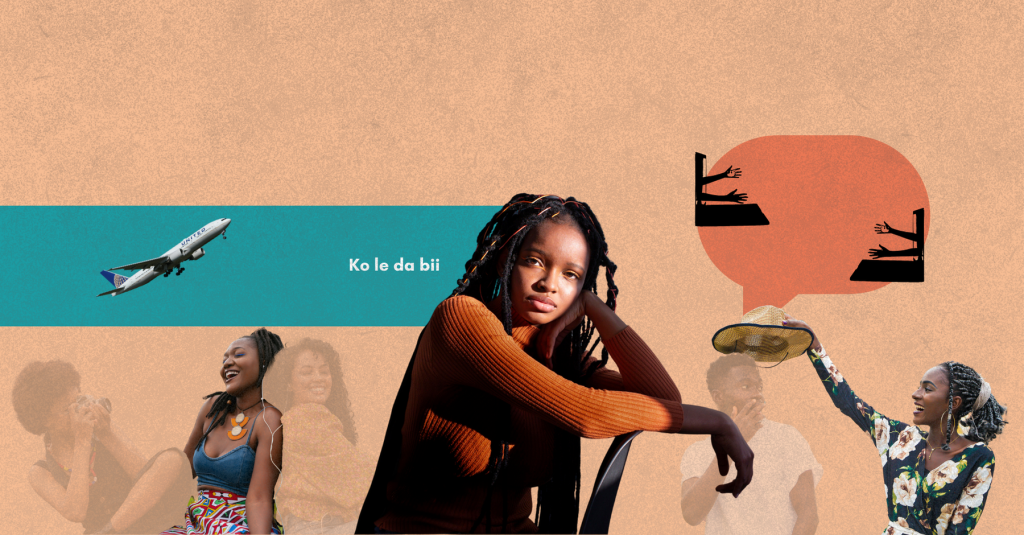
Photo illustration by Michael Emono / THE REPUBLIC. 

THE MINISTRY OF CULTURAL AFFAIRS

From Nigeria With Love

‘I don’t recall the exact moment it dawned on me that almost everyone I called a friend had left Nigeria, but the realization was shattering. Having a friend leave you is heartbreaking, having them troop out one after the other, like soldiers off to battle, is decimating.’
Nigeria

Photo illustration by Michael Emono / THE REPUBLIC. 

THE MINISTRY OF CULTURAL AFFAIRS

From Nigeria With Love

‘I don’t recall the exact moment it dawned on me that almost everyone I called a friend had left Nigeria, but the realization was shattering. Having a friend leave you is heartbreaking, having them troop out one after the other, like soldiers off to battle, is decimating.’

The screen is split into three. We are ladies in our twenties, chapping white teeth like children when our eyes meet each other’s digitized faces. Of the three of us, I’m the only one still in Nigeria. These sporadic calls are one of the many ways we ensure the cord of our friendship isn’t easily broken. Our relationship, like plants, will wither if we do not nurture it. 
 
On most days, we water the friendship with trending Instagram memes; we wrap little rays of sunlight into minute-long voice notes that we hope the other would wake up to in their time zone. We remember to share news in a timely fashion. Anything after two weeks suggests you have forgotten your friend.  
 
We interrogate whoever is in the dock for more answers. In between, we trade anecdotes from much younger daysDo you remember Mr X, our math teacher in Louisville? Then we slip into fleeting arguments about the last time we physically saw each other: Was it at the Adeniran Ogunsanya Mall in Lagos? Or at Iye’s wedding in Ibadan? Speaking of weddings, we’re all still unmarried. Are we serious like this? We tease ourselves. As ringlets of emotions feather across the call—excitement, nostalgia and sadness—I take a second to appreciate the beautiful, imminent passage of time. We are now grown women. 
 
I was nine when I met Chibabes and FT. Our parents had independently thought it a brilliant idea to drop off clueless, impressionable, young girls at a stringent Catholic secondary school in the middle of nowhere. As the days grew into weeks and the weeks into months, we navigated the new world of incessant assignments, despotic seniors, ‘Madam Koi-koi’ rumours and all the other problems of a typical Nigerian boarding school. Our friendship didn’t happen at once; we crept into our love story. It helped that schools are replete with opportunities for friendships—repeated run-ins at the dormitory, sports field or a pew at the chapel. 
 
15 years later, thousands of miles apart, we are on this call, taking turns rehashing life updates previously shared on our Forever Friends WhatsApp group chat. The group description, which is usually the celebration of a recent achievement or the anticipation of a goal, is captioned: ‘Anjola and FT get into an Ivy League School’. The display picture is from the last time we saw each other—at a dainty cake shop on Bode Thomas Street. We are holding treat bags with broad, bright smiles smeared on our faces. 
 
As an act of finality, we reel out future plans which are mostly uncertain: quit a job, take a course, change cities. Like laundry spread out on sun-kissed grass, we are met with warmth as we lay out our fears about our various career paths. It is a safe space. 
 
The tempo of our conversation wanes and we prepare to wrap up. I feel reinvigorated, happy to have taken yet another step toward protecting what we have. We try to determine when our next call should be, but it is to no avail. There are no see you soons but lots of I love yous peppered with let’s stay in touch. And we really do hope to stay in touch.  

RAPTURE

I met my best friend Victoria in university, during a Bible study. We were a group of about ten ladies clustered on a veranda with railings bespeckled with brown rust marks, singing praises and dancing. I noticed the healthy puffs of 4C hair that rested regally atop her head. Then her coy smile which suggested she was still finding it hard to settle in. I wanted to know her, so I walked up to her once we said the final ‘Amen’. 

That first year in university became the first year of an incredible friendship. Our love flourished as we shared our wildest victories and deepest losses. We ate together, laughed together, prayed together, and in the process, etched out indelible memories. Our friendship never suffered any fights, malice or pugnaciousness. It was as though without trying, we understood the language of each other’s souls. 

The year is 2023 when Victoria arrives at my house. We agreed to meet by fire, by force, before she leaves for Canada. When we see each other, our joy illuminates the dimness of the street. We fetch as many hugs as possible, hoping to preserve the warmth long after our separation. Then we record a video, whining about how much each person will miss the other, about how surreal the moment is. Once we hit the stop button, the clip saves automatically and the event time is sealed forever as 10:35 p.m., 28 September 2023. Victoria gives me a pair of earrings and I give her my favourite hair extensions. It’s a small, sentimental exchange, but for us, it means the world. Later, we can look at these souvenirs and remember the other person, even if for a short while.  

My eyes become teary. It’s unbearable, this rapture unfolding before my eyes. A friend here, a friend there—they continue to disappear, leaving nothing but their absence behind. My skin crawls. My heart aches. 

LOVE

I’m at a photo studio in Lekki, taking pictures for my birthday. I look extra-stunning, so I upload a behind-the-scenes picture of me in a pair of blue jeans and a black blouse on my Instagram story. Tee, an acquaintance living in the UK, responds to my story.  

‘Are you still single?’  

‘Yes, why?’ I already know why. 

‘Send me your number,’ he responds. 

I send it to him, and six months quickly slither away in routinous, nightly phone calls that I eagerly anticipate. We spend evenings sharing stories from our utterly different lines of work. We get to know each other deeply, our families, quirks, hopes and dreams. All of it is enchanting, yet when he asks me to be his girlfriend, I freeze. I can’t bring myself to say yes. Something about what we share feels incomplete, like a bird without wings; a love that will never fly into the fullness of its potential because of what the future holds.  

The initially exciting calls begin to feel like a weight I have not been trained to carry. It doesn’t help that my frustration is exacerbated by the terrible internet service in Nigeria. ‘Hello…hello…Can you hear me? Can you see me? Refresh your network, please.’  

Not long after, it became hard to not question what we were doing and how long we would do it for. Sure, we could navigate the cumbersome flight costs and visit each other but it would be a waste. I was neither planning to relocate to the UK, nor was he moving back to Nigeria. 

I contemplated what the future held for two people on perpetually separate continents and concluded that it had nothing. Weeks later, we handcuffed our potential love story and sentenced it to death.  

shop the republic

shop the republic

SEATS

I come from a large family—with lots of cousins and extended family members with whom I share a beautiful relationship. I grew up having them around during holidays and special occasions. My mum would cook food in large pots and serve multiple plates with portions as equal as possible. At night, because the rooms were separate and small, we hoisted large mattresses to the living room where we slept. 

Every day, I woke up with new excitement, ready to unbox all the love and happiness the day promised. I was never disappointed. Once, right in the middle of a beautiful chaos that was my brothers and cousins yapping, a neighbour knocked at the door. She expressed, very warmly, that our loud voices suggested we’d been fighting, so she came to check that all was well. All was indeed well. In fact, my parents were spectators, entertained by the spectacle. This is how my family is: large, free and fun. 

We usher in every new year with a party at the Olori Ebi’s house. It’s a great way to celebrate life and the gift of family. With an assortment of food options from jollof rice to pounded yam, old and young, we all gathered. The elderly would sit in the living room, and the children would gather around the dining table, bantering with zingers shooting around—music, soccer, relationships, we spoke about everything. Each voice would compete hard to be heard. I’d watch with admiration the chaotic clash of male baritones and feminine sopranos.

In the last three years, the event has slowly become a shadow of itself, with one young person relocating after another. All my cousins, apart from two, have left for Canada. My brothers now live far away with their new families. So now, even though I’m hesitant, I go because it’d be a great opportunity to introduce my new partner to uncles and aunties.

I wait till it is evening before we make our way there. I’m wearing a brown mesh dress while my partner is draped in a black kaftan set. Together, we walk through the gates and past a dingy passage to the living room. As expected, my uncles and aunties are seated on the black leather sofas, eyes fixed on a football match on the television. We exchange pleasantries, and they tease my partner about doing the ‘proper thing’ soon. Afterwards, when we search for space to sit, I notice the vacant dining table, where only food warmers and ceramic plates are stacked. Flashes of a table filled with cousins, cackling voices and echoing laughters flicker before my mind’s eyes. I look away and lead my partner to a compact, less comfortable sofette instead. The seats at the dining table belong to people who may never return but I know we can hold space for those we love, even when they’re no longer around. 

DESPAIR

I don’t recall the exact moment it dawned on me that almost everyone I called a friend had left Nigeria, but the realization was shattering. Having a friend leave you is heartbreaking, having them troop out one after the other, like soldiers off to battle, is decimating. 

The ruinous effect was that I began to lose myself—the parts of me these people took along with them. My happiness tapered off at the news or prospect of someone relocating. My wide-eyed glee became largely replaced with polarizing emotions that I still struggle to comprehend to date. I was, of course, elated to see people move from mediocrity to more fulfilling lives. But grief was no stranger to me as I mourned the death of experiences that would never breathe again. The friend who would accompany me to an audition was now completing his master’s degree abroad. The cousin’s flat I’d usually visit when life proved overwhelming, was rented out to a young couple. So I’d stay home and thug it out, because what I needed wasn’t a video call to Canada. 

Sometimes, the hardest juncture to be is the in-between—those periods of neutrality where life isn’t going well or poorly, just going. It’s in those pockets of time that my heart grows heavy with things it wants to say. It’s in those moments that I miss my friends terribly. It’s in those times that I swipe through my phone’s gallery, brooding on images and videos from the past. I force my mind on a trip, inhale the scent of an era, cuddle myself in the warmth of time and allow the sound of laughters past to reverberate inside me. In Notes on Grief, Chimamanda Adichie writes, ‘grief is a cruel type of education… in which you learn how much of it is about language, the failure of language and the grasping for language.’ As I navigate this despair, English fails to carry my pain. Yoruba, my mother tongue, as beautifully nuanced as it is, doesn’t save me.  

How do you even explain this half-done grief that yearns for expression? Can you mourn over someone who isn’t dead? Does it make sense? Shouldn’t I be grateful that they are alive and a call away?  

Whenever I send the words ‘I miss you’ to a friend, my brain warns me of the insensitivity before I send it out. ‘Whatever I’m feeling, it’s much worse for the person who’s left.’ I occasionally close the chat to protect them, even as a part of me continues to fall apart. Other times, I defy my brain and let my heart do the talking. It may tear them apart, but at least we’ll be sundered together.  

shop the republic

shop the republic

RELOCATION

I tried to relocate once. 

At first, I’d started to adjust to a new normal where I greeted people by saying, ‘Ah! You haven’t left?’ ‘So, when are you leaving now?’ or, my personal favourite, ‘I didn’t know you were still in this country o.’  

Then someone asked me, a writer living in Nigeria, ‘How many Nigerian writers living and writing in Nigeria do you know that are rich?’ The question sent me to Google first, then into an anxiety spiral, and finally into deep introspection: Why was I romanticizing the same place others are fleeing from? Why was I hoping that I’d be the one chosen writer making international waves from the comfort of my room in Lagos? Would I wake up ten years later, when all my friends had secured foreign citizenship and ask myself why I loved mediocrity? Would I find I’d settled for the life I was accustomed to out of fear, rather than the life I deserved? 

Frantic, I created a to-do list in my iPhone’s notepad, titled it ‘relocation’ and set a passcode, because in Nigeria, a relocation plan isn’t something your enemies should have easy access to. I contacted my alma mater requesting that my transcripts be sent to WES, while also searching for resource materials for IELTS. I resumed my weekly French classes because from research, I’d found that writing the TEF Canada exams would aid my application. 

All these went on for a little while before my enthusiasm dissipated. The accountability partners who would lovingly check in on my progress with applications were getting tired of my unseriousness. I just kept stalling despite being a go-getter. The truth is, it didn’t feel right; it didn’t feel like the time had come yet, and when I searched my soul, the unrest I found was all the confirmation I needed to stop.  

While recently flipping through my all-time favourite book, The Alchemist by Paulo Coelho, I stumbled on a scene where Santiago, a boy on a quest to find his life’s purpose, was consulting a medium to help him interpret a dream he’d had. This was her response: ‘Dreams are the language of God. When he speaks in our language, I can interpret what he has said. But if he speaks in the language of the soul, it is only you who can understand.’  

I’m a deeply spiritual person. I believe that our spirit knows, per time, where we should be. And should we ever find ourselves off course, we will recognize the displacement and our own disobedience to the instructions of our soul. It wasn’t time for me to leave. 

shop the republic

shop the republic

CONTEMPLATIONS

‘Kò lè dà bí’ is a phrase in Yoruba that means ‘it can never be like.’ No matter how many calls I have with my friends, it can never be like seeing their eyes light up at a joke, poking them to get their attention or simply drawing them into a warm embrace. There is a certain kind of presence the soul longs for, which can never be replaced with the best technologies. And perhaps this is why when we’re no longer physically present with people, we literally lose touch with them.

I still wonder about the possibility of rekindling friendships on the plains that once existed. I still get anxious at the thought of eking out a living as a writer in Lagos. Like many people, I fight feelings of uncertainty about so many things, but really, who is sure about anything? 

I decide that these cords of friendship will only break if I let them. I embrace these new approaches to nurturing old relationships. I open myself up to new experiences and new friendships, because in the end, the heart, no matter how full, will always find space for more

BUY THE MAGAZINE AND/OR THE COVER