

Our new print issue, Africa’s Hustle Republics, is here! Subscribe for less than ₦1K/$1 a week for full access.

To be a saint is the exception; to be upright is the rule. Err, falter, sin, but be upright.
Despite the current economic conditions, it remains that Nigeria was one of the poster nations of the ‘Africa Rising’ narrative. The Africa Rising paradigm was based on expectations that the continent would capitalize on its fast-growing population size, emerging consuming middle class and rapid urbanization fuelled by a large youthful market. The McKinsey Global Initiative 2012 report, Rise of the African Consumer, was notable as a distinct voice on Africa, which, until then, had been looked upon as an economic wilderness. The report hailed rapid mobile penetration, highlighted improved banking cultures and noted the sprouting of locally relevant retail products and services as indicators that the continent was indeed experiencing remarkable growth.
Reports such as McKinsey’s were in stark contrast to the damning assessments that had, just a decade earlier, dominated the discourse on Africa. The Economist’s 2000 cover story, “Hopeless Africa”, for example, cited a wide range of obstacles—war and brutality; poverty and disease; corruption and despotism—as everlasting impediments to Africa’s prosperity. Despite the subsequent publicity of ‘Africa Rising’, also an Economist cover story, the credibility of the drastic switch from pessimism to optimism about Africa remains questionable.
Notwithstanding the insightfulness of observations and forecasts typically detailed in reports on Nigeria such as McKinsey’s, when it comes to the economy, the majority of Nigeria’s population seems to live another truth. The reality is that this majority lives unaffected by narratives created in glass offices whether overlooking the lagoon, the Thames or Hudson rivers. And in an economy where the cost of living is continually on the rise, the cheapest product remains the consumer’s favourite option. The majority of Nigeria’s population has never cared for GDPs. Rather, the clearest economic indicators have always been the costs of goods in the market. As a result, many rate the government’s performance according to the prevailing prices of a bag of rice and a litre of fuel.
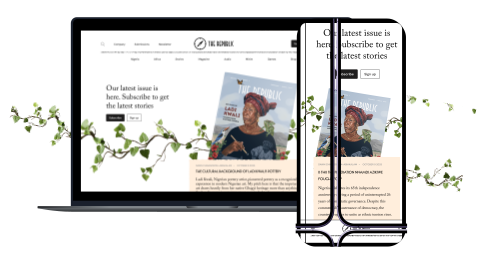
The Republic is a Nigerian media-tech company dedicated to explaining our time—through deeply reported journalism on power, culture and society.
Focused consumption without interruptions.
Years of reporting at your fingertips.
Long-form journalism that matters.
Create a free account to continue reading this month and access more of our work.
About the Author
is a fiction writer and essayist on social issues. He is the author of Prince of Monkeys and his writing has appeared in Afreada, Brittle Paper and The Kalahari Review.




Comments
Sign in to comment.