

Our new print issue, Africa’s Hustle Republics, is here! Subscribe for less than ₦1K/$1 a week for full access.
Jul 23, 2017
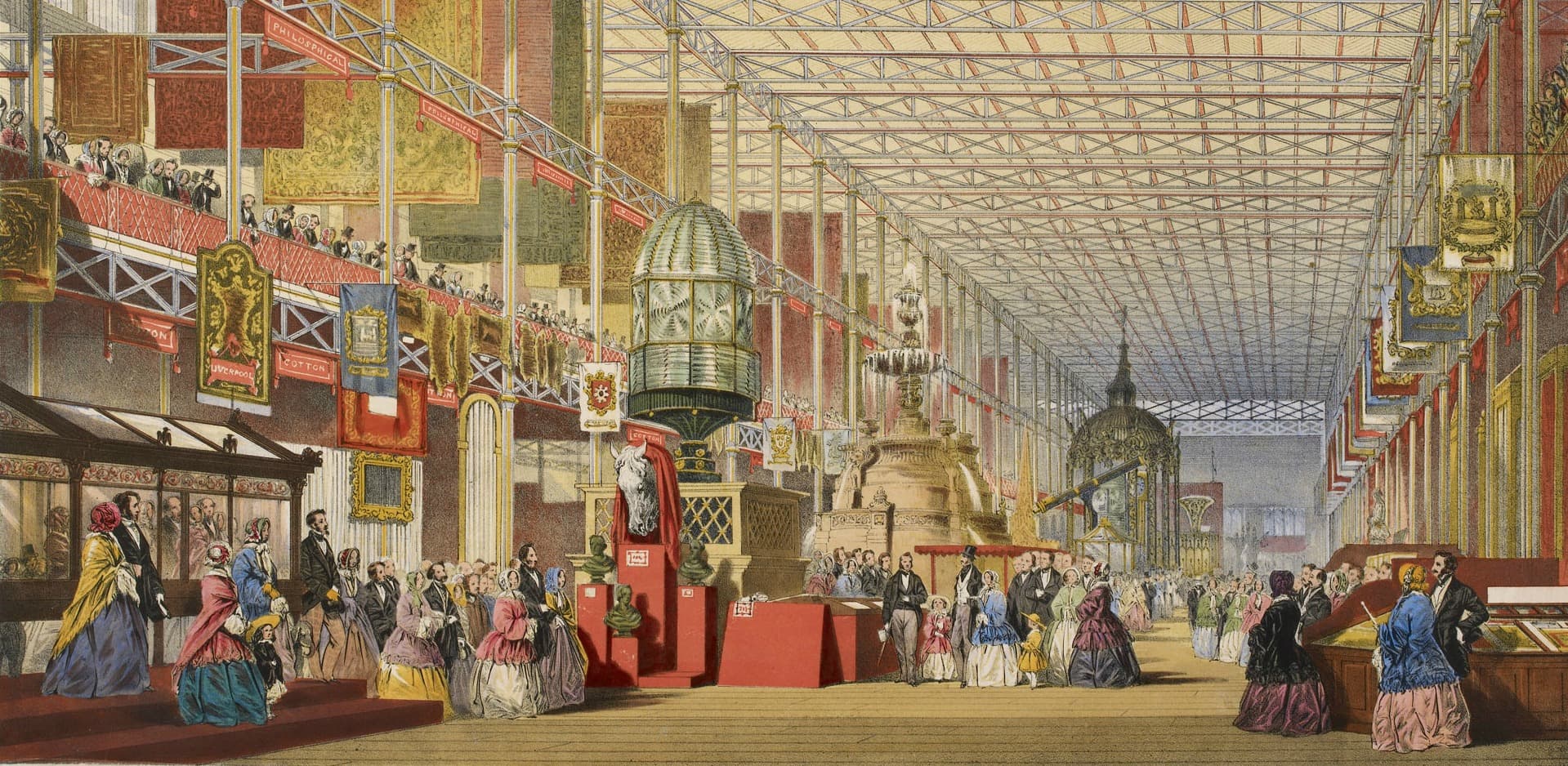
"The British Nave" from Dickinson's Comprehensive Pictures of the Great Exhibition of 1851, and among the Originals Painted for Prince Albert, by Messrs. Joseph Nash, Louis Haghe and David Roberts. Held by the British Library
In 1851, at the height of colonialism, London held what is now widely regarded as the first “Great Exhibition”. Within a giant iron and glass structure, known as the Crystal Palace, the ‘great men’ of the time—inventors, industrialists and entrepreneurs—presented “the wonders of industry from around the world”.
The exhibition was the first of its kind and was evidence of an increasingly globalized world linked by technology. In hosting, the British state showed its desire and commitment to control this new system. Symbolised in a glass dome, the wonders of this ‘world interior’, like the bordered West, were to be exclusive; accessible only to a minority. The exhibition introduced the tenet that ideas and wealth would move freely around the world, but people would not.
100 years later, following World War Two, Britain’s metaphorical Crystal Palace revealed cracks. In 1948, the Windrush ushered a wave of migration from the Caribbean, then, following independence in parts of Africa and Asia, thousands of former colonial subjects moved to Britain seeking a new life. These migrants were hardly embraced with open-arms, but were welcomed as a much-needed boost to a weakened labour force. Soon their food, music and culture permeated modern British life. In the 1970s, Britain joined the European Economic Community (soon to be the European Union), beginning a relationship that would see 40 years of increased closeness between the United Kingdom and mainland Europe.
Some have met the influx of foreigners into Britain with confusion and resistance. Cultural theorist, Stuart Hall’s response was the famous quip, “I am the sugar at the bottom of the English cup of tea”, referring to the British national drink and its Asian-Caribbean origins. Despite the diversity within Britain, significant parts of British society have long been ignorant of the world outside their shoreline. Many, for instance, failed to connect the dots when, in 2015, boats, and bodies, began to arrive on the shores of Greece and Italy.
While it was generally believed that ignorant Britain constituted only a minority, last June, this viewpoint was challenged. On the morning of the 24th, Britain woke to the news that a majority had voted to leave the European Union.

The Republic is a Nigerian media-tech company dedicated to explaining our time—through deeply reported journalism on power, culture and society.
Focused consumption without interruptions.
Years of reporting at your fingertips.
Long-form journalism that matters.
Create a free account to continue reading this month and access more of our work.
About the Author
studied at the University of Manchester and SOAS, University of London. He writes on Africa, social movements and music, and is based in London and Brazil.




Comments
Sign in to comment.