

Our new print issue, Africa’s Hustle Republics, is here! Subscribe for less than ₦1K/$1 a week for full access.
Barack Obama’s election as the first black President of the United States was greeted with tremendous fervour and hope across the globe, especially within sub-Saharan Africa.
Aug 2, 2017
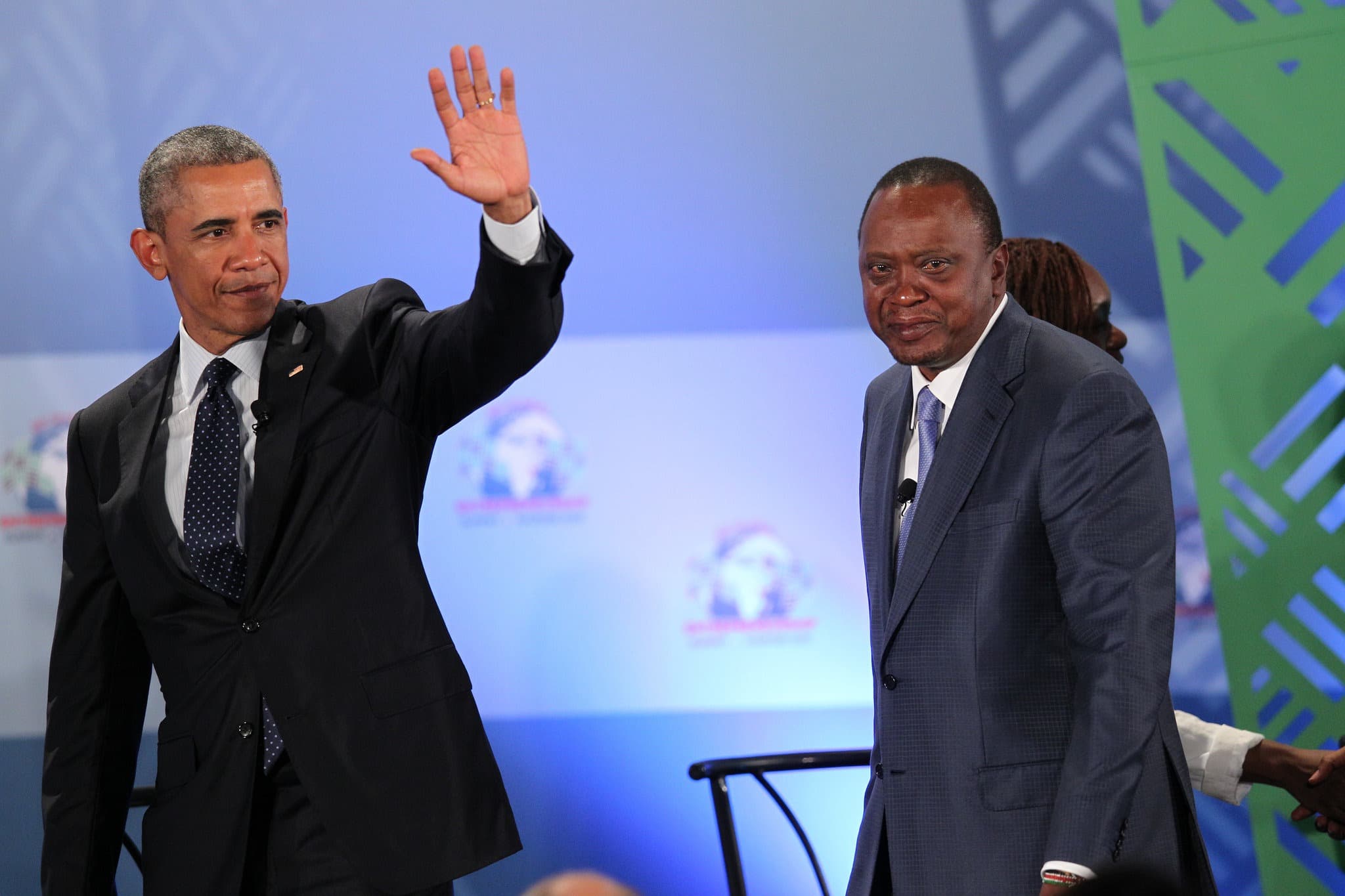
US President Obama and Kenyan President Kenyatta Wave as They Depart the Stage at the Global Entrepreneurship Summit in Nairobi, 2015.
Barack Obama’s election as the first black President of the United States was greeted with tremendous fervour and hope across the globe, especially within sub-Saharan Africa. Many Africans (and Africa observers) had believed that the biracial son of a Kenyan father, whose biography did not typify that of many of his predecessors, would approach US-Africa relations in much less paternalistic ways, and would regard the region as strategically important to US interests. Even before his November 2008 election, many Africans had bitten the Obama bug, with his famous “Hope” poster facsimiled on wall posters, T-shirts, decals and other decorations. Indeed, many Africans had invested a sentimental attachment in the outcome of the 2008 campaign and in unprecedented ways.
Early on in Barack Obama’s presidency, it looked as though this notion of an administration thoroughly engaged with African affairs might represent a dream fulfilled. Only 6 months into his first term, President Obama visited Ghana where, in a much-heralded speech to the Ghanaian parliament, he made a number of declarations that came to shape his dealings with sub-Saharan Africa; notably, he asserted that “the twenty first century will be shaped by what happens not just in Rome, or Moscow or Washington, but by what happens in Accra as well,” also adding that “Africa’s future is up to Africans”. Perhaps most famously, he declared that “Africa doesn’t need strongmen, it needs strong institutions.”
Yet during the course of the Obama presidency, a curious narrative emerged regarding Obama’s Africa legacy—one of false starts, disappointments and, in some quarters, outright failure. A writer at The New Republic, perhaps America’s most renowned centre-left publication, wrote that “… there is a palpable sense that Obama’s legacy in Africa is not what it could have been”. In 2015, Politico discussed lingering feelings of frustration and disappointment among African leaders, advocacy groups and regional experts, contrasting Obama unfavourably with George W. Bush. Nicolas van de Walle, an African Studies expert at Cornell University, argued in Foreign Affairs that, as President, Obama maintained the status quo in US-Africa relations, rather than reinvent the wheel as expected.

The Republic is a Nigerian media-tech company dedicated to explaining our time—through deeply reported journalism on power, culture and society.
Focused consumption without interruptions.
Years of reporting at your fingertips.
Long-form journalism that matters.
Create a free account to continue reading this month and access more of our work.
About the Author
is a foreign policy analyst, writer, editor and political risk consultant specializing in comparative authoritarianism, African regional & continental integration and transnationalism in African diasporic communities. He is also a sub-editor with The Republic.




Comments
Sign in to comment.