One hundred and thirty-six years after the Berlin Conference of 1884–85 fired up the first scramble for Africa, global players are repositioning themselves for a second round. The original European heavyweights (such as the United Kingdom, France, Portugal and Germany) and new partners (such as the United States and China) will move to consolidate their spheres as they face greater competition from new players at the table, including Russia. Western European countries, the United States and China dominate African markets, and newcomer Russia will need to work hard to break through the already saturated markets. Russia will also need to tread cautiously to ensure it does not seize market share at the expense of diplomatic relations with older players and its own economy.
Russia might just pull it off. As Olga Kulkova highlights in an article for Foreign Policy, in Russia’s return to the African continent, ‘there are still some elites across the continent that have ties to the Soviet era, but the next generation doesn’t have the same links to Russia as before. So, we need to take the opportunity to return now while there are still people with connections.’ This return is welcomed by African countries for different reasons. The Soviet Union fostered goodwill, national liberation movements and anti-colonial sentiment towards the ‘decolonization’ of African countries, including the supply of military equipment. There is also the salient appreciation of the fact that Soviet Union did not attempt to colonize African countries, thereby strengthening Russia’s credibility as a safe business partner. In addition, the Soviet Union invested heavily in the education and training of Africans before its collapse in 1991—many of whom have returned to strategic positions in their home countries.
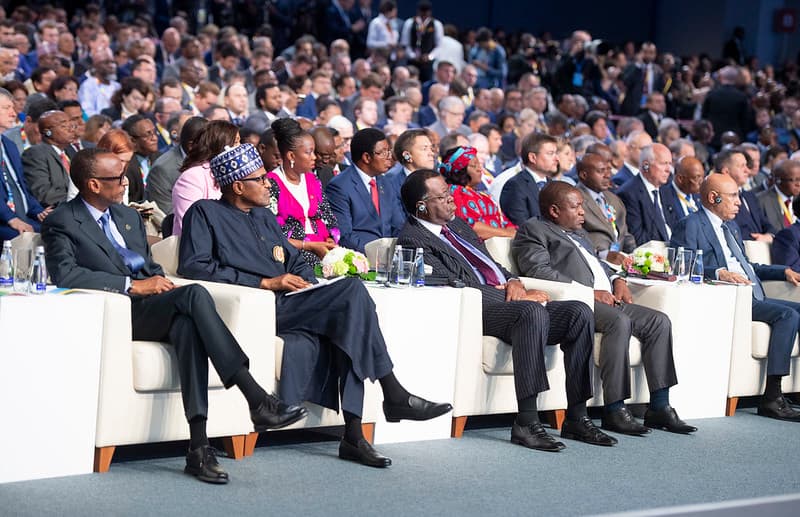
Leadership and timing have also been critical factors in Russia’s renewed interest in Africa. The collapse of the Soviet Union left Russia in economic turmoil, but Vladimir Putin’s presidency has turned the tide. Russian-African trade has increased substantially in the last decade, with Russia investing as much as US$20 billion across multiple projects in 2013. Putin’s leadership has also seen a substantial amount of African debt steadily written off in the last decade: Tanzania in the early 2000s, Madagascar in 2015, Mozambique in 2017 and Ethiopia in 2019. At the 2019 Russia-Africa Summit, President Putin announced over $20 billion African debt had been written off, stressing Russia’s commitment to development in Africa. The summit itself was an opportunity to strengthen ties with African leaders and delegate, broker bilateral deals and reinforce that cooperation between Russia and Africa was ‘strategic and longstanding’. These ties have been renewed at an opportune moment for Russia, as relations between Africa and other global superpowers, including the United States, have become strained. Despite announcing the New Africa Strategy in 2018 and even describing Chinese and Russian activity on the continent as ‘predatory’, implementation by the Trump administration has been lacklustre. A year later, the same administration expanded travel restrictions to four African countries, which will undoubtedly impact African economies, perceptions of the United States and affect nearly a quarter of Africa’s 1.2 billion population.
Russia has premised its interests on ‘a combination of geo-economic and geopolitical calculations’ and already gained some ground in the Democratic Republic of Congo (DRC), Central African Republic (CAR), South Africa and Sudan through natural resource extraction. In the DRC, partnerships with Russian companies have focused on geographical exploration, mineral extraction and processing, and infrastructure projects such as railway construction. Russian companies are also heavily involved in mineral extraction in South Africa, including Renova Group which focuses on the exploration and production of manganese ore and silicon manganese.
The supply of military equipment has been another way in for Russia, evident in its activities in the countries above. Increased terrorism, cybercrime and civil unrest have driven the need to strengthen African military forces and Russia, like the Soviet Union in the past, has stepped in to provide discounted arms and military training. Russia has offered 200 military experts and hundreds of weapons as a military aid to weaken militia groups in CAR, and has already signed military cooperation agreements with over 20 African countries. Sudan was the second largest buyer of Russian arms in 2017, and before being ousted in 2019, President al-Bashir granted a Russian mining company preferential access to the country’s gold reserves. Russian influence in Sudan remains strong—the succeeding regime reassured Russia of the security of its substantial investments and aims to boost defence technology cooperation with Russia. The activities of Russian mercenaries in CAR’s internal affairs do not go unnoticed either. According to an article in The Africa Report, private security company Wagner ‘provides more than a thousand instructors to the Central African Republic, ensures the security of various institutions, and plays a leading role in the training of the Presidential Guard and the army.’ Last year, Russia delivered warplanes to South Africa in an effort to strengthen military cooperation.
Over a hundred years ago, it was Europe monopolizing influence in Africa. Decades ago, it was the Soviet Union and China scrambling for spheres of influence. Now, Russia is set to make a comeback—will its motives be any different?







Comments
Sign in to comment.