

Our new print issue, Africa’s Hustle Republics, is here! Subscribe for less than ₦1K/$1 a week for full access.
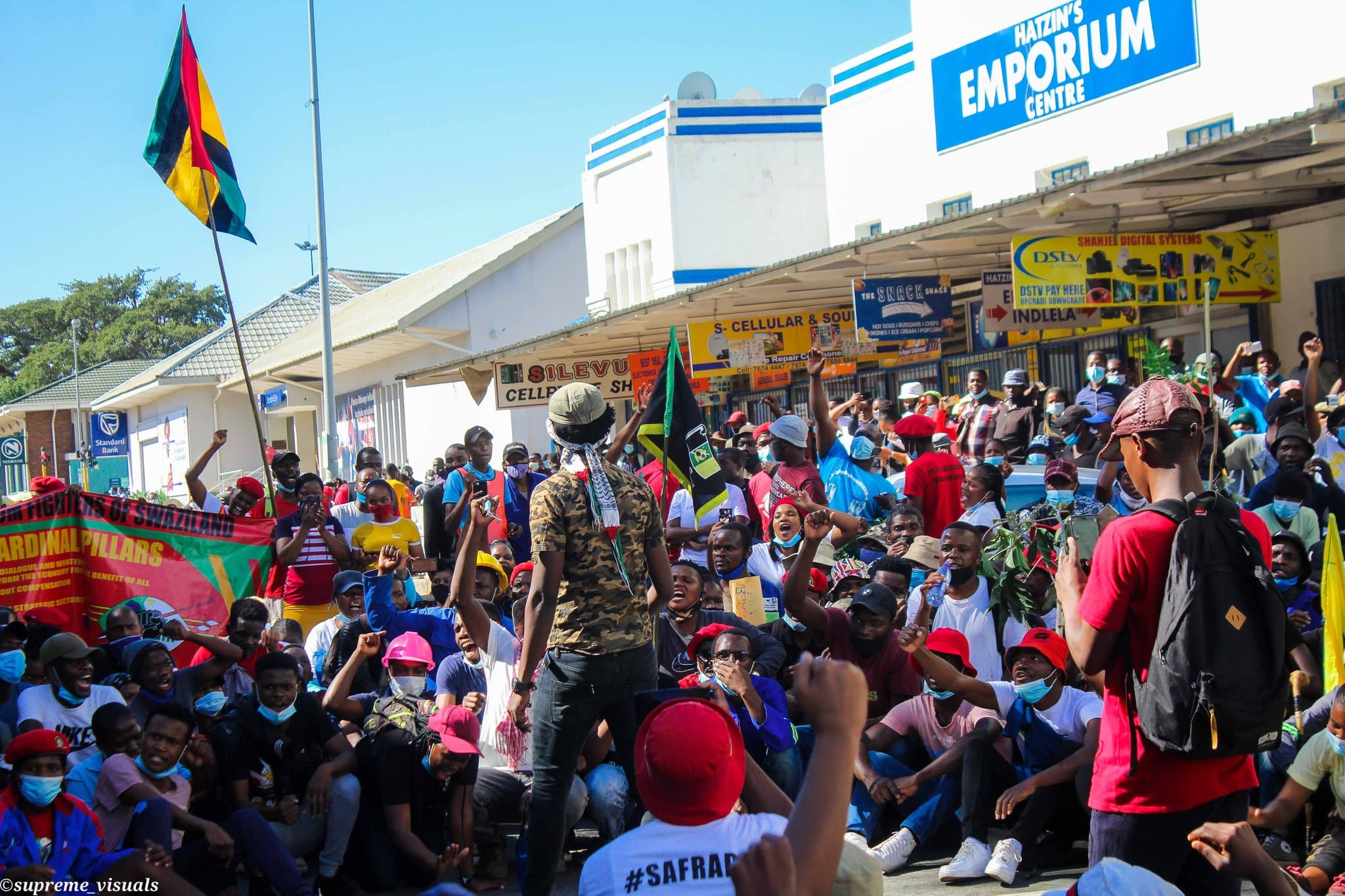
When a recent spate of pro-democracy protests spread across Eswatini, the untruth of the country’s peace and stability gained a global audience.
Eswatini’s contrived reputation as a ‘peaceful and stable’ country has come to define the kingdom. The notion of being peaceful was quickly internalized as intrinsic to being Swati. But what that only serves to perpetrate is to silence people confronting unforgiving realities and trick them into docility. When a recent spate of pro-democracy protests convulsed across the country, the untruth of the country’s peace and stability gained a global audience and pronounced a political re-awakening, driven by the youth against the structural violence of scarcity.
Eswatini’s political putrefaction actually began 48 years ago, in 1973. On the 12th of April 1973, the late King Sobhuza II made a proclamation that repealed the multi-party constitution of 1968 with a rule by decree where ‘all political parties and similar bodies that cultivate and bring about disturbances and ill-feelings within the Nations are hereby dissolved and prohibited.’ The decree further states that any person who even conspires to form a political party would be liable for imprisonment. The late ruler believed the 1968 multi–party constitution disrupted ‘Swazis peaceful, constructive and essentially democratic methods of political activity’. Under the guise of ensuring peace was maintained, specifically this Swazi peace, he bequeathed complete power to the throne. By disallowing the political agency of his people, a wound was marred into the nation’s body politic and somewhat frozen in that time. As years have passed, that wound has been thawing and there has been clear evidence in the years since of pro-democracy movements gaining pace, and its latest manifestation were the June 2021 protests.
But before these particular protests escalated, there was already mass protest action against police brutality in Eswatini, following the mysterious death of 25–year–old law student, Thabani Nkomonye. Nkomonye is believed to have died at the hands of police, after illogical explanations the police peddled to the family and nation. The student-led #JusticeForThabani protests quickly morphed, encompassing more than demanding accountability for a young life lost under what seems like police brutality but became a demand for all the injustices that plague the country and accountability from a government, which has systemically failed its people. With the support of three members of parliament (Bacede Mabuza and Mthandeni Dube are currently in jail under terrorism charges, while Gawuzela Simelane is in hiding), the protest burgeoned as the three MPs proposed a constitutional democracy, in which the election of the prime minister lies with the people instead of being elected by the King, as is the current method. Well within their right to freedom of association enshrined in the 2005 Constitution and galvanized by the MPs’ boldness, citizens across Eswatini started petitioning government through their constituencies, known as Tinkhundla, the supposed democratic and participatory wing of governance. Instead of creating an environment that fosters dialogue between the government and demonstrators, the government proceeded to ban protests citing COVID-19 regulation violations and potential ‘anarchy’ as their reasons. This was a critical moment for the government to respond in a manner that avoided violence and the loss of life. Instead, the government chose to wield the force of the military and the police to regulate protestors, to ‘maintain peace’. The notion of states deploying violent strategies to keep the peace has always been a political misnomer, because how does violence birth peace? But Eswatini prides itself on its peace-hood, and this peace-hood has even come to describe Swati identity. Yet, the ferocious response the government chose, ultimately, spurred the protests and looting that began on Monday, 28th of June, which is the anti-thesis of the peace they allegedly advocate for.

The Republic is a Nigerian media-tech company dedicated to explaining our time—through deeply reported journalism on power, culture and society.
Focused consumption without interruptions.
Years of reporting at your fingertips.
Long-form journalism that matters.
Create a free account to continue reading this month and access more of our work.
About the Author
is a writer, journalist, and ex-scientist.




Comments
Sign in to comment.