

Our new print issue, Africa’s Hustle Republics, is here! Subscribe for less than ₦1K/$1 a week for full access.
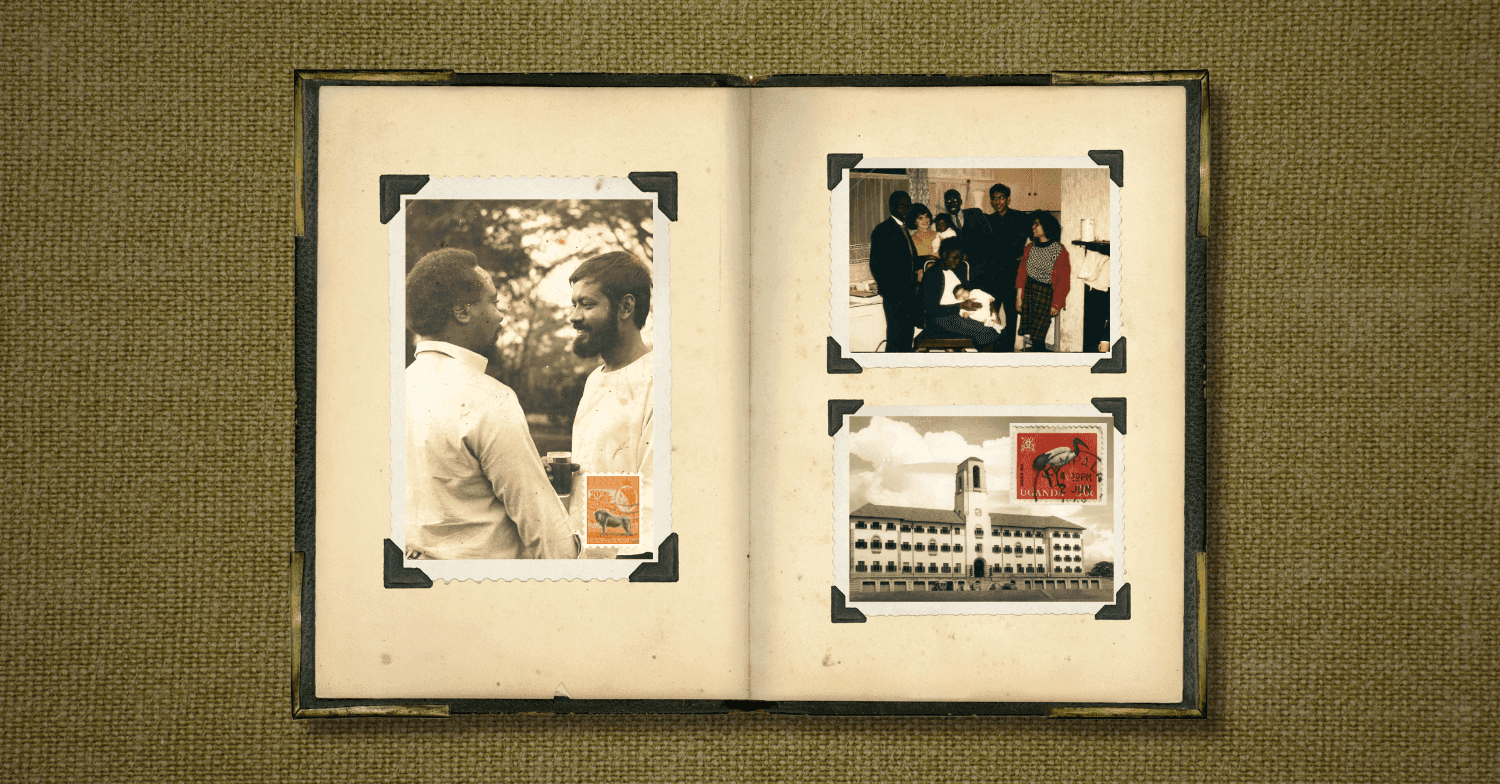
For much of the sixties, Kampala was at the centre of literature in Africa, its status propelled by Makerere University and Rajat Neogy’s Transition Magazine.
Apr 6, 2024
Photo 1: Rajat Neogy with Robert Serumaga in Kampala, Uganda, late 1960s. Transition Magazine / Facebook. Photo 2: Ngũgĩ wa thiong'o, Elvania Zirimu holding Kathleen Nazareth, unidentified person holding Julia Zirimu, Pio Zirimu, Peter and Mary Nazareth. Source: R Benedito Ferrão / SCROLL IN. Photo 3: Makerere College Kampala, 1960s. Collage by THE REPUBLIC.
‘There’s something ineffable about great cities,’ Marcus says. ‘Not that Kampala is one,’ he adds. ‘But yes, great cities have a personality they take on—a personality that’s disconnected from the collective personality of its inhabitants.’ —Derek Lubangakene, The Unfinished Manifesto
John Nagenda died in March 2023, and I got on a bus and went to Kampala. In Kampala, in the evening, I walked through the Makerere University campus where Nagenda and other members of his cohort had first emerged as writers. It was five in the evening, and the sun, getting lower in the sky with each moment, was blazing. There were very few students out on the campus that day, the university empty because of Easter. I walked past the McKinnell Knowledge Centre, and further on, the School of Dentistry. Makerere was very green, the trees old and leafy—the perfect colonial garden city.
Just before I’d left Nairobi for Kampala, a book I’d ordered had been delivered to me. Nagenda’sThe Seasons of Thomas Tebo, a novel which he had written as an allegory of the Uganda of Idi Amin and Milton Obote, was out of print, but I’d gotten a second-hand copy shipped to me in a roundabout way—from France across the channel into Britain, then to the United States, whereupon a friend acting as final courier brought it to me.
Nagenda intrigued me. When I’d spoken to Ngũgĩwa Thiong’o a few months prior for a profile I was writing about him, he’d talked about Nagenda, and mentioned how integral Nagenda’s writing had been to his own career. Ngũgĩtold me, ‘John Nagenda, oh my God. I don’t know if it’s as good as I thought it was, but you should read “And This, at Last”. Oh my God, that story.’
In the story, a two-pager which was published in the second issue of Rajat Neogy’sTransition, a young reporter goes to interview an old man who has gained a reputation as a bit of a recluse. The reporter is ‘bright and eager-looking, but dead scared inside.’ The old man lives in a ‘house full of old memories of voices now forever silent and faces gone, still and empty’. It is a tightly-woven piece of prose, rather like a Raymond Chandler short story. The old man’s memories are ‘so powerful that he carried the boy with him and together they winged their way into the past, the one realistically, the other by hearsay, with his imagination.’
And now Nagenda, the genius behind this story, was dead, passed away after spending the past three months in hospital. And here I was, walking through the university where his writing, as well as those of an entire wave of East African writers, had flowered.

The Republic is a Nigerian media-tech company dedicated to explaining our time—through deeply reported journalism on power, culture and society.
Focused consumption without interruptions.
Years of reporting at your fingertips.
Long-form journalism that matters.
Create a free account to continue reading this month and access more of our work.
About the Author
has written for The Guardian, The New York Review of Books and Financial Times.




Comments
Sign in to comment.