

Our new print issue, Africa’s Hustle Republics, is here! Subscribe for less than ₦1K/$1 a week for full access.
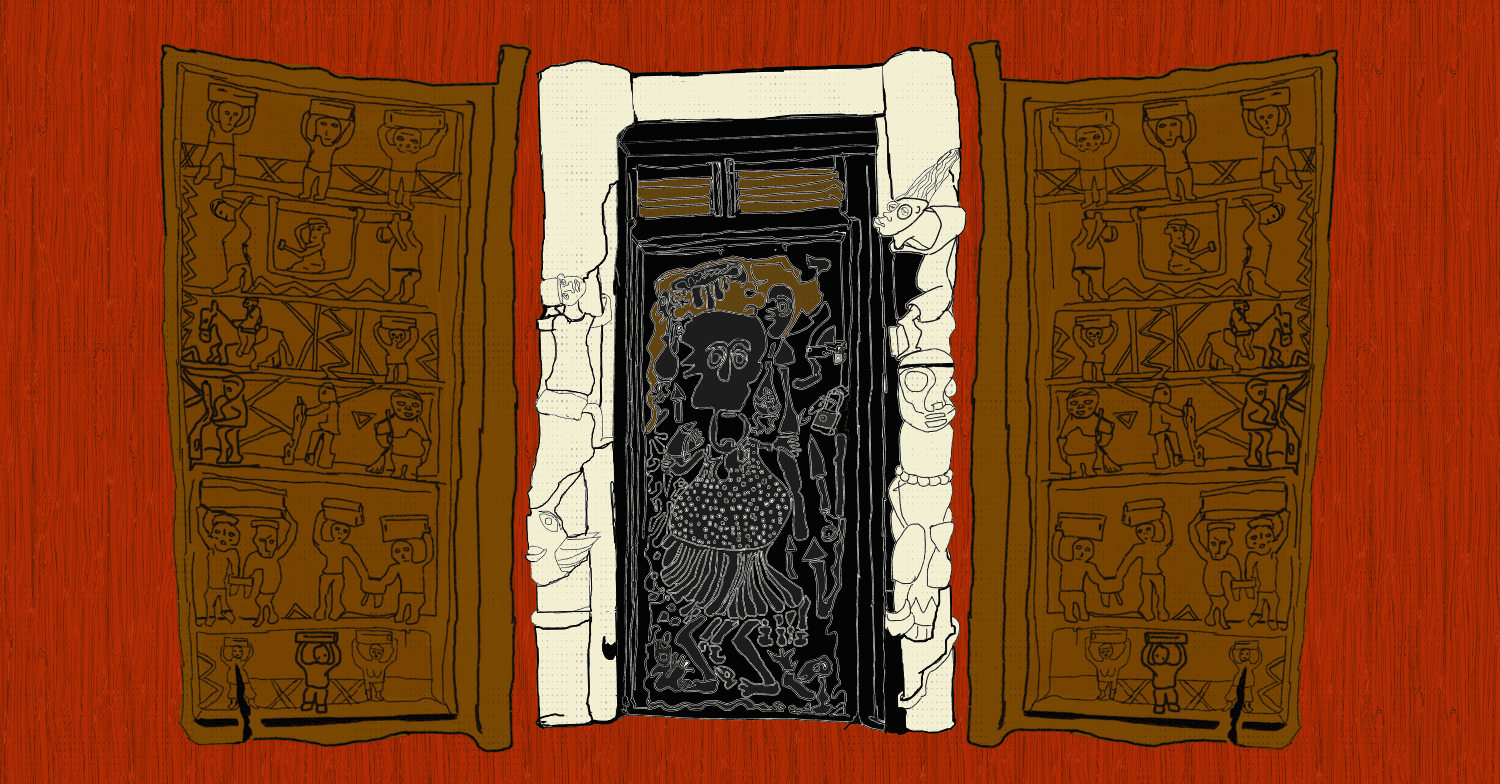
Yoruba carvers were once revered for their intricate spiritual and cultural door designs. The few carvers remaining today persevere against a world that increasingly overlooks the value of their art.
Kasali Akangbe is resting on his wooden, handcrafted chair. His hands are clutched on his stomach as he stares into the wide expanse of space before his house in Sasa, a bustling neighbourhood in the city of Osogbo, the capital of Osun State. Akangbe’s home—unlike the other large houses in the area—is appropriately flanked by trees.
Trees are his beloved. The renowned 83-year-old woodcarver has just returned from his workshop, which sits just beside his home. In the workspace, logs of wood lie scattered, some skinned, some rotten. At a side is an uncompleted carved pole next to a giant carved mural of an unidentified traditional god holding two ase—small, wand-like staffs. The head of the mural utilises Akangbe’s signature style: elongated, lean faces with distinctive eyes. A style that made him one of the most celebrated artists of his generation.
Akangbe’s portfolio includes handcrafting most of the sculptures and poles in the Osun-Osogbo Sacred Grove, the ancestral and spiritual forest through which the Osun River flows. In the Yoruba tradition, it is believed that the Osun River is home to Yemoja, the river goddess. In 2015, the United Nations Educational, Scientific and Cultural Organization declared the grove a World Heritage Site. One of Akangbe’s most cherished works is the very door that leads to Yemoja’s shrine, where worshipers go to seek whatever they desire—from health and wealth to children and security. As well as Yemoja, the design on the door contains a craft of Arugba—a virgin maiden who carries the calabash during the Osun Osogbo festival—and other smaller gods. It took Akangbe about three months to complete the door, which included the final process of invoking it with ‘spiritual powers’ through incantations. ‘When carving, the Ifa will be consulted to understand the process of how to wield the tree with power,’ Akangbe says. ‘We use “Ewe Igbo” to...invite the spirit into it. If anyone knocks, a headache will kill the person. That is the spiritual power.’
For Yorubas, Akangbe adds, these specially carved doors were not simply considered as ordinary household items because, ‘they were not made by ordinary people,’ but by carvers who possessed a special mastery of both the physical and spiritual requirements.
Growing up, Akangbe’s family worshipped Ogun, the Yoruba god of iron, commonly worshipped by warriors. One of the doors carved by his family is called ‘Abogunde’, which is specifically carved for warriors and features depictions of weapons etched on it. Abogunde doors are believed to be imbued with powers that shielded warriors by notifying them that danger was coming. A Yoruba saying succinctly captures this sentiment: ‘Ilé tí kò ní ìlẹ̀kùn ni asínwín ń wọ̀,’ which means: Buildings without doors are open to miscreants and mad people.

The Republic is a Nigerian media-tech company dedicated to explaining our time—through deeply reported journalism on power, culture and society.
Focused consumption without interruptions.
Years of reporting at your fingertips.
Long-form journalism that matters.
This story features in our print issue, 'Reimagining Nigerian Heritage'.
Create a free account to continue reading this month and access more of our work.
About the Author
is a creative writer and journalist based in Osogbo, Osun State, Nigeria.




Comments
Sign in to comment.