

Our new print issue, Africa’s Hustle Republics, is here! Subscribe for less than ₦1K/$1 a week for full access.
In the age of artificial intelligence, can Africa recode its global positioning?
Aug 10, 2025
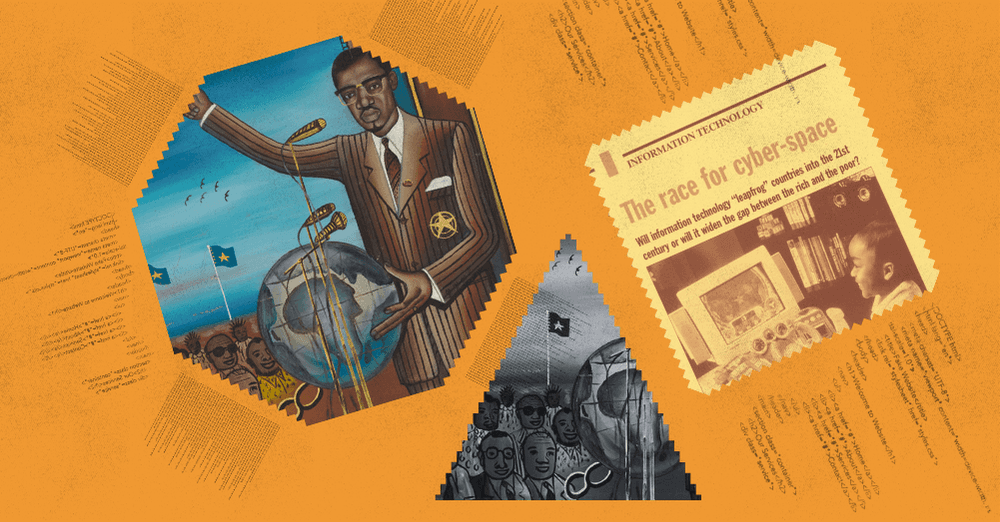
Photo illustration by Dami Mojid / THE REPUBLIC. Ref 1: Patrice Émery Lumumba’s Independence Day speech, DRC, 1960 / SMITHSONIAN LAB. Ref 2: African Review, 1997 / ARCHIVING.
On the morning of 11 February 1889, as Japan prepared for the unveiling of the Meiji government’s new imperial constitution, Mori Arinori, the minister of education, lay bleeding on his deathbed. He had just been stabbed by a bereaved nationalist who believed that Arinori was an enemy of the state for his openly Western ideologies and his proposed educational reforms. This was because at the time, Japan was going through one of the most rapid socio-cultural reforms in history, the Meiji Restoration, which usurped Japan’s traditional political structure, social strata and institutions in a bid to catch up to Western countries and avoid colonization. Arinori’s brutal assassination was the culmination of the angst that traditional Japanese people felt at the time, and more importantly, a signifier of how harsh the Meiji reforms were to Japan and its people, who had to give up their way of life, and their social and economic structures in a dire attempt for global relevance and protection from Western annexation.
While Japan is one of the few countries in the world that was never colonized, ironically, it still had to go through radical social, economic and institutional reforms to align with Western needs. This shows how heavy the hand of European hegemony was on the nations of the world. By 1914, 84 per cent of the world’s nations had been colonized by Europeans, and many of them had to also undergo political, economic and social reforms to align with the needs of their colonizers. This is even more interesting when you consider that Europe has a smaller population and less access to natural resources than a lot of these countries. Philip Hoffman, a professor of history and social science at the California Institute of Technology, attributes this to the power disparity created by differences in military-technological advancement (gunpowder and firearms) between Europe and other countries. A telling example of this can be seen in the United States’ first contact with Japan in 1853, which was through a squadron of armed gunships and an order to establish trade relations with the United States.

The Republic is a Nigerian media-tech company dedicated to explaining our time—through deeply reported journalism on power, culture and society.
Focused consumption without interruptions.
Years of reporting at your fingertips.
Long-form journalism that matters.
Create a free account to continue reading this month and access more of our work.
About the Author
is an idealist, designer and economist based in Abuja. Agboola is interested in African digital policies and technology for social good.


Comments
Sign in to comment.