

Our new print issue, Africa’s Hustle Republics, is here! Subscribe for less than ₦1K/$1 a week for full access.
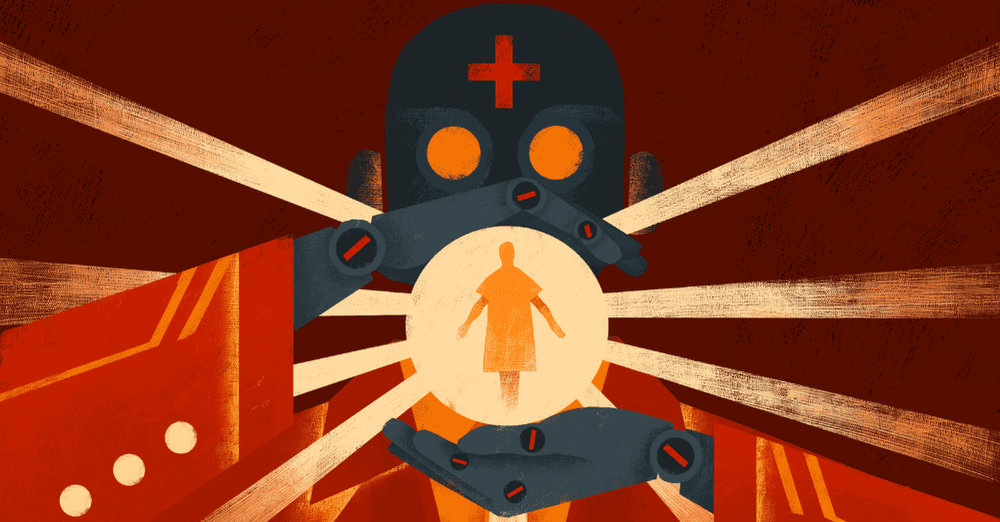
AI is opening the door to health systems that can learn, adapt and act. Can Africa harness it to leap ahead?
A robot, Osadebe, came out to greet me. Osadebe would be performing my procedure and had already been synced to all my records in The Database. Osadebe knew my favourite musicians, my favourite books, and even made jokes that matched my sense of humour. I couldn’t believe it. Osadebe would be something of a nurse and physical therapist to me after performing my procedure. Osadebe had already created customized versions of recommended lifestyle changes for me, accounting for my quirks—like what time I liked to go to sleep and how flavourful I liked my food. Osadebe would also be calling me to make sure I was fine before and after the procedure and providing me some counselling if needed.
—‘The Winged Woman’ by Ebele Mogo
In 2021, in response to a call for speculative fiction on alternative economic futures and technologies by Edgeryders, I wrote the short story ‘The Winged Woman’. It envisioned a future where an AI agent, Osadebe, trained on biomedical data, supported a woman preparing for surgery, offering personalized diagnostics and emotional support. At the time, it seemed like science fiction from a distant future. Yet, only a few years later, that future no longer seems so distant. By 2024, the United States Food and Drug Administration had authorized over 880 AI-powered medical devices, ranging from diagnostic tools and radiology image interpreters to systems that predict deterioration or guide treatment pathways. Algorithmic agents are already helping people plan surgeries, support diagnoses, and translate complex health information, and the promise of surgical robots is very real.

The Republic is a Nigerian media-tech company dedicated to explaining our time—through deeply reported journalism on power, culture and society.
Focused consumption without interruptions.
Years of reporting at your fingertips.
Long-form journalism that matters.
This story features in our print issue, 'An African Manual For Debugging Empire'.
Create a free account to continue reading this month and access more of our work.
About the Author
is a public health scientist, specializing in upstream approaches to disease prevention, with a focus on behavioral health, chronic disease, and population well-being.


Comments
Sign in to comment.