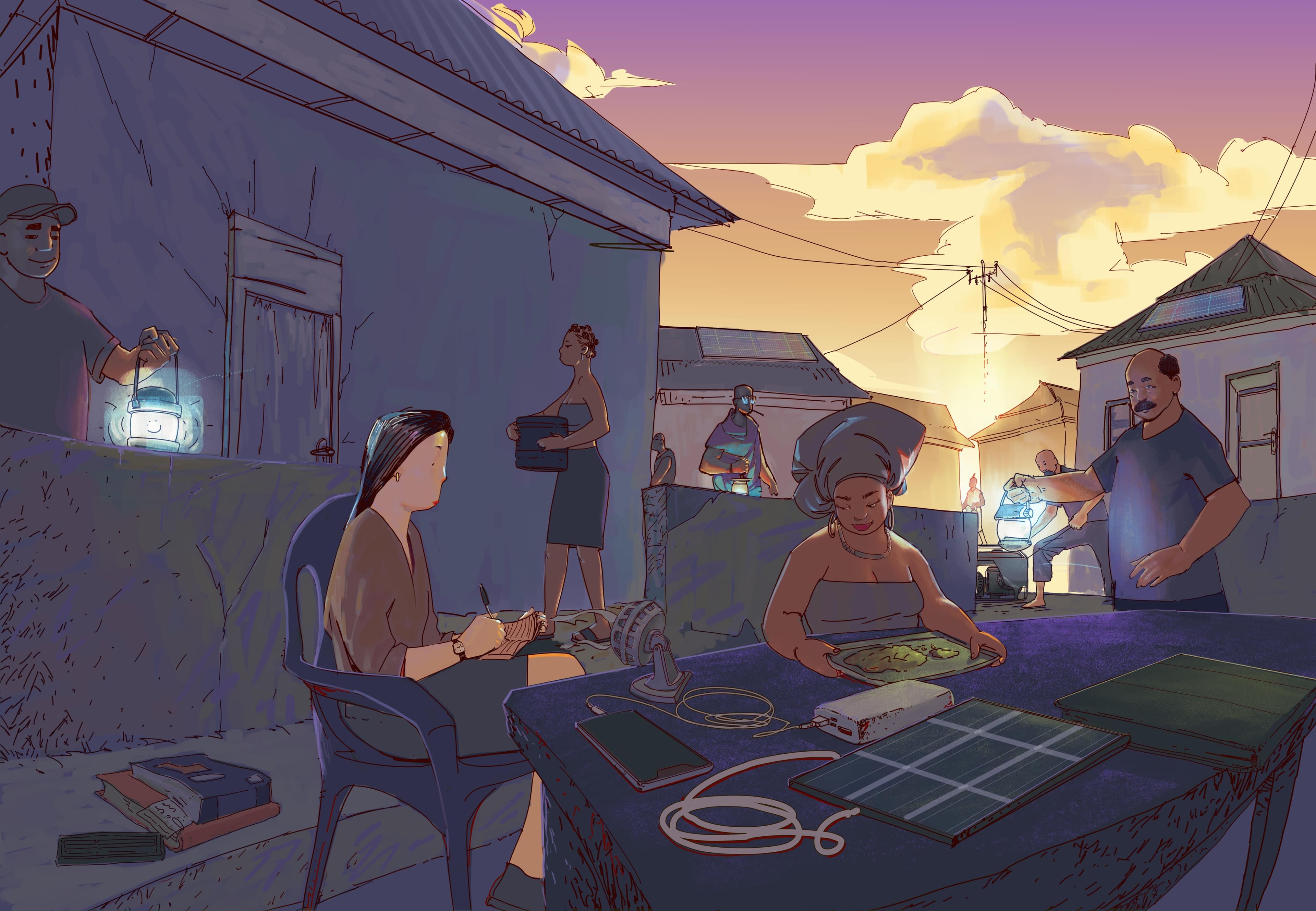

In N’Djamena, the lives of Chinese residents expose the cracks in Chad’s electricity system, revealing how unreliable power reshapes everyday life and survival.
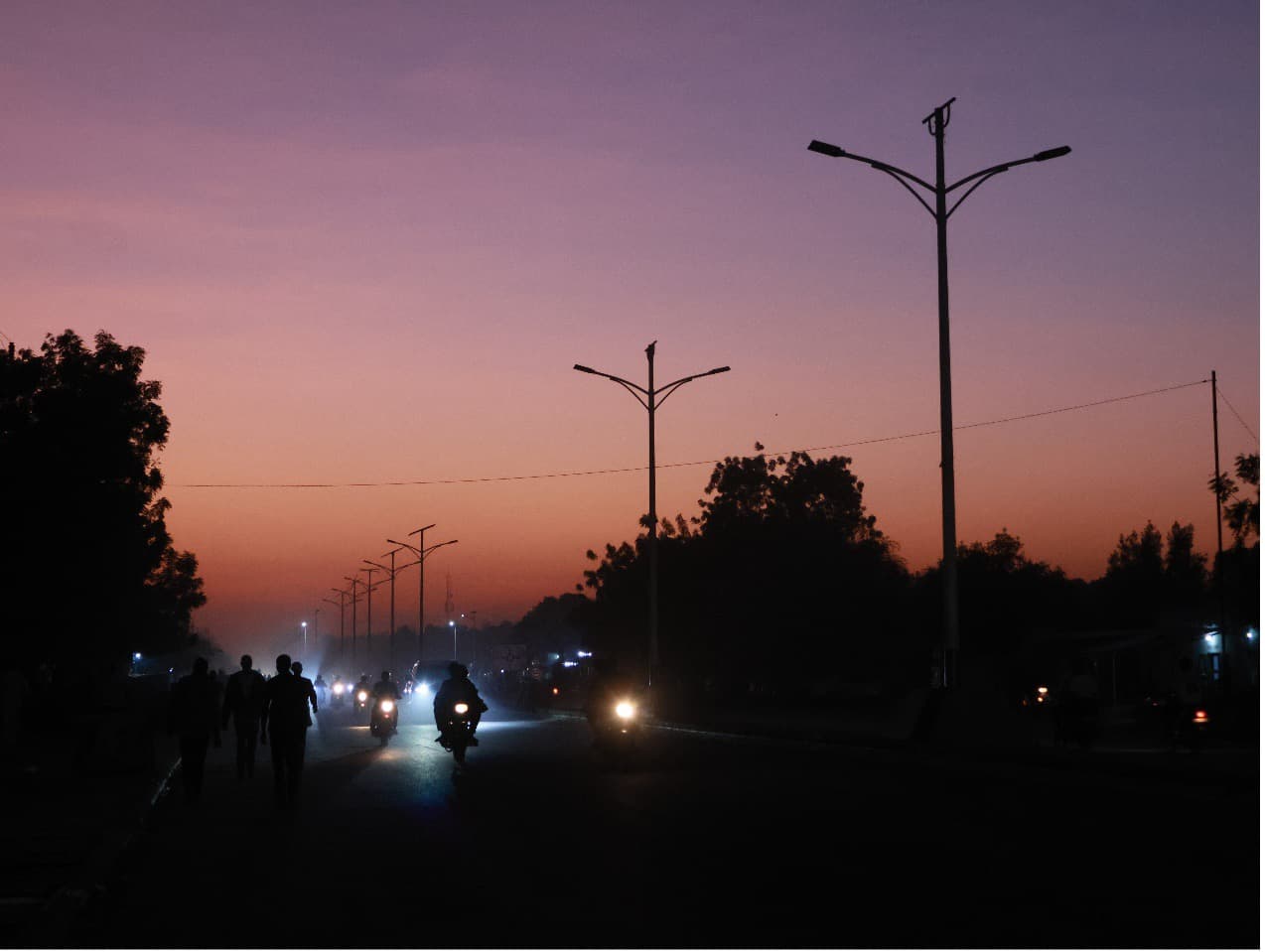
Illustration by Sheed Sorple Cecil / THE REPUBLIC.
N’Djamena was out of power again. I was sitting in the courtyard of the woman I call my Chadian mother, watching the light disappear while the evening heat held on. By then, I had already been living in Chad for seven months as a Chinese PhD researcher conducting long-term fieldwork in sociology, and I had learned that blackouts were part of the city’s rhythm. But that night was not just another interruption. My Chadian mother had cared for me with a steadiness that made kinship feel less metaphorical than real. Her husband was a professor, who occupied a relatively high social position. Yet, to save on rent, they still lived in an area where infrastructure was poor and cuts to electricity and water were frequent. On my side of the city, the power had only just gone out. On theirs, it had already been gone for four days.
Four days without electricity also meant four days without water. Water in my Chadian mother’s house was not something that arrived reliably through a municipal network; it had to be pumped up by electricity. A dull fatigue set in when the heat had nowhere to go, but one could not simply take a shower to relieve the discomfort. At the same time, with no electricity, the air conditioner and even the fans were useless. The house became almost uninhabitable, which was why everyone gathered outside despite the mosquitoes, the flies and the blowing dust. Phones and power banks were nearly drained. Electricity had to be mentally rationed before it ever physically returned. People used their phones less, conserving the last traces of charge. Nothing much could be done. When power finally does return after a long absence, the reaction can feel almost religious: people cheer as if something long prayed for has at last arrived.
A road in N’Djamena at dusk, with the nearest stretch still unlit. Photo courtesy of the author.

That was hardly an exceptional scene in Chad. Data from the International Energy Agency show that oil accounted for 98 per cent of the country’s total electricity generation in 2023. In 2024, oil accounted for around 51.8 per cent of government revenue and 65.3 per cent of exports. However, electricity has not become a widely accessible and affordable public service. World Bank data show that, only 13.4 per cent of the country’s population, estimated at 20.3 million, had access to electricity, placing Chad near the bottom globally. In the World Bank’s Doing Business 2020, Chad ranked 182 out of 190 economies, and 180 on getting electricity. More recent World Bank private-sector diagnostics in 2023 identify the lack of reliable and affordable energy as the country’s most serious bottleneck for doing business. In a place like this, power cuts do more than turn out the lights. They reorganize business costs, housing choices, social relations and the fragile routines through which everyday life is held together.
Then, that same evening, a friend of my Chadian mother sent over a large bag of goods. Alongside farm produce was a large solar power bank. It could run three lights at once and charge phones. As long as there was sun, it could keep working without waiting for the grid to return. On the outside were Arabic and French instructions, and even a small Chadian emblem. At first glance, it looked as though it naturally belonged here. Only on closer inspection did another line appear in much smaller print: Made in China. The relief it brought was immediate. The device did more than illuminate a room. It bought a little time, allowing phones to be charged again and making the night liveable. The object was modest, but the world it pointed to was much larger.
A COMPLICATED OPEN MARKET
Chinese goods had already entered the cracks of everyday life in Chad long before I began trying to make sense of them. And where goods moved, people had moved too. Traders, contractors, company staff, small manufacturers and business owners try not just to pass through, but to make a life and a living here. In a country where stable electricity is so rarely delivered as a public condition, those cracks do not remain empty for long. They become spaces of improvisation, profit, anxiety, negotiation and survival. Some are filled by a product that can keep three lights on through the night. Others draw in people who come searching for a market, only to find themselves confronting the same instability at a different scale.
One of them was Gong. He spoke French and spent about two months in Chad moving between market research and bid preparation for a Chinese meter manufacturer. He had not come from one of the best-connected firms in a major coastal centre, but from the far more common world of smaller manufacturers under intense pressure at home. In China’s meter industry, margins had already been squeezed so hard that even companies from such places were being pushed outward in search of markets. From a distance, the business logic had seemed clear enough. Compared with markets in other African countries already crowded with Chinese traders and contractors, Chad appeared less saturated. Poorer and harsher, yes, but perhaps still open. It was precisely that apparent space, that sense of an opening not yet fully occupied, that brought Gong there. ‘A small company like ours cannot compete in East or Southern Africa,’ he said, ‘so we mainly look for markets in Central and West Africa. Chad is extremely difficult—every time I come here, I lose more than five kilos. But there are also many business opportunities to explore.’
Once Gong arrived, however, the market looked very different from the one he thought he had come to enter. He recalled, ‘in China, a more advanced (meter) system would certainly be more welcome. But here, the difficulty in bidding is how to get people to accept the new system without resentment.’ The old system had already become part of how people managed everyday life. Many of the meters already in use were technically outdated and less precise than newer models, but that very imprecision left room for a looser arrangement between landlords, tenants and the electricity company. Among Chinese traders and small businesspeople, one heard the same thing repeated in fragments: in some places, if the relationship with the landlord was good, or if the right connections existed on the electricity side, bills might be handled more loosely and some costs softened. No one stated this openly. It circulated instead as practical knowledge, half-spoken, never fully acknowledged, but widely understood. What looked, from outside, like a purely technical problem turned out to be deeply social.
That was what made the formal meter market so hard to penetrate. A new meter did not simply mean a better device. It also meant a tighter system, less flexibility and the possible end of arrangements people had already learnt to live with. Technical superiority and lower prices were therefore not enough. As Gong put it, ‘meter technology is not particularly sophisticated to begin with, so profit margins can only be squeezed to the minimum.’ By the end of his time in Chad, Gong had reached a different conclusion: ‘Introducing the new meter system is unexpectedly too difficult, and I am afraid there will be no opportunity this year.’ Instead of continuing to bet on formal entry through meter replacement, he began looking more closely at solar products.
Even there, the picture was less straightforward than it first seemed. Chad has abundant sun, and Chinese-made solar lamps are everywhere in the streets. Yet sunlight has not automatically translated into larger-scale energy security. The country is not yet in solar transition. The commercial conditions facing Chinese photovoltaic exporters had also become more difficult. From 1 April 2026, China eliminated value-added tax export rebates for photovoltaic products, following an earlier reduction in the rebate rate from 13 to 9 per cent in December 2024. ‘There is no longer much room to drive prices down,’ Gong said. ‘It is very hard to make any profit.’ That, too, was part of what Gong learned: in Chad, the distance between visible need and a workable market is much greater than it first appears.
Sunset near N’Djamena embassy district. Photo courtesy of the author.
THE COST OF UNSTABLE ELECTRICITY
If Gong’s story shows how difficult it is to enter Chad’s electricity system from the outside, Lin’s shows how deeply unstable electricity can reorganize life and business from within. He was doing large-scale business, receiving clients, managing information and subletting spare rooms to other Chinese tenants. For Lin, electricity was essential not only to comfort, but to communication, presentation and the basic running of the house as a commercial and social space. ‘I often host guests at home to develop business opportunities, especially because restaurants are not convenient places to discuss business,’ he explained. ‘At times like these, I cannot be without electricity.’ A blackout threatened water, clients, tenants, sleep and the basic impression of order he needed to maintain. In this climate, the dependence on electricity became even more pronounced. During the hottest periods, temperatures could rise above 40°C. For people unaccustomed to living in such heat, neither air conditioners nor even electric fans felt optional. Without power, sleep became difficult, tempers shortened and the whole arrangement became harder to sustain.
Lin first rented a narrow building for his property rental and logistics business, where blackouts were frequent and living conditions were difficult. After about two or three months, he could no longer stand it. ‘The workers and I were crammed into small rooms. Whenever workers from the field came to the capital on business, or we had clients to host, there was not enough space. And as the power went out often, the heat became unbearable.’ Like many others, he became convinced that the only way to make life and business manageable was to move closer to the embassy district, where electricity cuts were known to be less frequent.
But a little more stability never came free. The house he eventually rented cost more than two million Central African francs ($3,470) a month—far beyond what most residents could pay, and already a heavy burden for someone trying to keep business costs under control. Yet, rent was only part of the price. He also had to spend heavily on a water pump capable of maintaining usable pressure across the entire house. The house had six or seven rooms, with a correspondingly larger demand for water. ‘Many households are not connected to the municipal water supply. I spent CFA 100,000 installing a water pump. When the power goes out, all we can do is wait for the water to come back,’ he said. Busy with his business, Lin had neither the time nor the rhythm of life needed to store water in advance whenever an outage seemed likely. So, when the power cut, it was not only his own discomfort at stake. With no electricity came no water, and his workers and tenants were left waiting as well. Their frustration fed back into his own.
Because so much depended on electricity, the relationship with the landlord quickly became more than a matter of rent. The landlord kept raising the price and adding conditions. Lin, for his part, remained wary of being overcharged precisely because he was Chinese. ‘When local people see that you are Chinese, they assume you have money and usually quote a higher price,’ he said. ‘Especially when you are unfamiliar with the place, you worry about being ripped off.’ What he wanted, at least at first, was not simply a roof and fewer blackouts, but a more workable arrangement around electricity. Since the rent was already so high, he also hoped that by staying on good terms with the landlord, some flexibility might still be possible on the electricity side. He knew, as many Chinese in Chad knew, that older meter arrangements sometimes left room for softer billing if the right relationship existed. So, when the landlord came by, Lin tried to show goodwill in the ways that made sense to him. He offered coffee. He gave the landlord vegetables from his small garden. But the landlord refused them. The respect Lin thought he was showing was not the respect the landlord felt he was owed.
Part of the tension lay in language. Part of it lay in generation and status. Lin was a busy businessman in his thirties; the landlord was retired in his sixties. What Lin sought was a workable relationship. What the landlord wanted was a sustained display of politeness, along with an acknowledgement of age and standing that Lin either did not grasp or could not convincingly perform. The mismatch ran deeper than a simple misunderstanding. It was built into the relationship itself.
Then the electricity issue sharpened everything. As a newcomer in Chad, Lin did not know how bills were supposed to be paid. For the first four months, he paid nothing, and the landlord responded by cutting off the meter. Tired of trying to negotiate through a relationship that seemed to go nowhere, Lin decided to bypass the landlord altogether. ‘I was already overwhelmed with running the business every day. It was very difficult to keep track of so many details of etiquette as well,’ Lin recalled. ‘I had done my best, but he (the landlord) was still unhappy, so I paid for things myself and tried, as far as possible, to arrange the electricity issue without involving him.’ He then replaced the meter himself and went to the national electricity company to have the account transferred into his own name. In doing so, he also gave up whatever possibility might have existed of benefiting from the landlord’s older, more flexible arrangement. What he gained instead was formal control.
For the landlord, however, this was a double affront. It was not just that he had not been consulted. It was that something tied both to his authority and his room for manoeuvre had been taken out of his hands. He cut off the meter again. In the end, I became involved as an intermediary. The two sides agreed to go together to the electricity company to confirm that the procedure was legal, and the account was formally transferred into Lin’s name, with Lin paying the bills directly from then on. On the day we reached that settlement, the landlord showed us the other meters on the property, each one attached to a different tenant, each one separately arranged. It was an unexpectedly revealing scene. What had seemed like a personal dispute was also a pattern. Stability existed, but not as something uniformly provided by the system itself. It had to be worked out tenant by tenant, meter by meter, arrangement by arrangement.
Once Lin’s living situation had become manageable, another Chinese trader, Tao, moved into one of the spare rooms in Lin’s house. Tao ran a small import-export business. Before moving, she had been renting on her own from a local landlord in a cheaper area, trying to keep costs down in this expensive city. But that arrangement exposed her to a more fragmented kind of difficulty. She needed electricity and internet constantly for her business, yet neither could be relied on. The infrastructure around her was weak from the beginning and the disruptions were hard to absorb. ‘For people like us whose business depends on constant communication, the internet is what we rely on most,’ she said. ‘When you rent a small place on your own, it becomes both your home and your workplace. I had wanted to save on rent, but the frequent power cuts made it difficult to do business.’
So daily life could only be held together through a whole set of small preparations. ‘I do not like the noise or smell of generators, so I do not use one often. They are expensive as well, and solar power is unreliable too. So, I have my own small strategies.’ Tao had to keep every power bank fully charged, save her work the moment the power cut and think constantly about how long her devices would last before the next outage. Here, the internet was tied to electricity: once the power went out, the connection often disappeared with it. She had therefore to buy extra mobile data to make sure she could at least keep working for a while after an outage. More devices, more power banks, one more layer of internet access—none of this was about comfort. It was simply about preventing work and life from being cut off all at once.
What was most frustrating was not hardship, but the fact that even after spending a great deal of money and making every possible preparation, one still could not build a truly stable, smooth, uninterrupted everyday life. ‘It is exhausting,’ Tao said. ‘Without the kind of stable electricity supply available, all you can do is choose among the roar of a generator, expensive rent and constant mental strain.’
Tao had already given up the cheaper option and moved into Lin’s house, where electricity was included in the rent and, for the time being, less of an immediate problem. But that relief came at a much higher price and with new frictions of its own, including the strains of sharing space and daily life with other Chinese tenants. What she bought was not comfort so much as a narrower range of uncertainty. At that point, lack of electricity was no longer just about having no power. It dragged down time, attention, bodily comfort and the ability to work all at once. In the end, the lesson was not how to defeat it, but how to keep lowering one’s expectations.
A CRACK IN THE SOCIAL ORDER
Large Chinese companies occupied yet another position in N’Djamena’s electricity landscape. If smaller traders like Lin and Tao had to negotiate, rent and absorb instability piece by piece, larger firms could internalize part of it. A Chinese employee, who had arrived when the company was first establishing its operations in Chad nearly 20 years earlier, recalled, ‘when I first came, this area was still barren land. Now, even when the power goes out and we have to wait a little for the generator to start, at least we know the electricity will come back soon.’ But they could not solve the problem once and for all simply by buying generators. What they built was a more expensive and more managed form of stability. Power had to be maintained, not merely installed. That meant fuel, repairs, replacement parts and electricians. It also meant labour costs that could not be ignored. Keeping Chinese electricians on staff for the long term was expensive, often far more expensive than relying on local workers whose wages might be only a third or a half as much. So Chinese electricians had to train Chadian ones, passing on enough knowledge to keep systems running day to day. A Chinese manager recalled, ‘at first, very few local workers spoke Chinese, so we tried to recruit those who could speak English and teach them as many technical skills as possible. Some of them have stayed with the company for more than ten years and now handle maintenance work, including electrical repairs.’ In that arrangement lay a certain kind of hope: local workers could acquire technical skills through it. But for the companies themselves, that hope was inseparable from cost. Stable electricity was not something they received. It was something they had to keep producing.
Even then, they did not fully escape the national grid. What was more common was a hybrid arrangement: state electricity when available, generators when it failed. I once went to play table tennis at one of these company compounds when the power suddenly went out in the middle of the game. The room dimmed, and everyone stopped for the ten or twenty minutes it took to switch over. What filled that pause was not impatience so much as memory. People began recalling the early years, when nothing had yet been assembled and everything had to be built piecemeal: the buildings first, then electricity, water and the ordinary conditions of life. What existed now, they made clear, was not comfort in any simple sense. It was the accumulated result of years of investment, maintenance and endurance—the slow construction of a space that could approximate, however imperfectly, the continuity they had once taken for granted in China.
A street in N’Djamena during the New Year holiday, as evening falls.Photo courtesy of the author.
On the surface, all of these may look like hope growing out of the cracks. People still find ways to reconnect the night, keep business moving and hold daily life together. But what gives these efforts their force is not that they have replaced stability. It is that they have had to stand in for it. In Chad, as in much of the continent’s more fragile infrastructural landscapes, electricity is not simply absent. It is unevenly reached, unevenly priced and unevenly secured. What should have been carried by the system is instead pushed downward, until it appears in the form of costs borne separately by households, traders, landlords, companies and tenants.
That is why the stories above are not only about Chinese goods or Chinese lives in Chad. They are also about the social life of infrastructure there: the way public failure does not produce pure paralysis, but a dense field of improvisation, negotiation and unequal survival. Hope remains real in these spaces, but it is never innocent. Each workaround, each arrangement, each small continuity won at a price, marks not the resolution of the problem but the shape it has taken. Stability has been privately assembled, piece by piece, by those who cannot afford to wait for it. And this distribution of costs is itself the deepest crack in the social order⎈
Note: The names in this article have been anonymized. Some identifying details have been omitted or altered to protect the individuals involved.
is a Chinese researcher and writer based in Chad. She writes about economic life through a sociological lens. Her work has appeared in Africa Is a Country.

Comments
Sign in to comment.