Our latest issue, Nigeria in the World, explores how Nigeria moves through the world and how the world, in turn, shapes and misreads Nigeria. Across Africa, Asia, Europe and the Americas, it traces the political, cultural and economic encounters that define this relationship and their consequences at home.
In October 2008, at an event held in Lagos to mark the 25th anniversary of the Guardian Newspaper, the novelist Chinua Achebe famously remarked in his keynote address, ‘Being a Nigerian is abysmally frustrating and unbelievably exciting.’ Made almost a decade into Nigeria’s return to democracy (our ‘Fourth Republic’), and at the onset of the ‘Africa Rising’ era (of which Nigeria would be a poster child), Achebe’s remark captured not just a national mood, but also a [still very familiar] Nigerian condition of being pulled, repeatedly and often violently, between what our country could be and what it often, instead, is. Today, almost two decades since Achebe’s speech, to speak of Nigeria in the world remains not simply an exercise in mapping our geography but, rather, the navigation of our convoluted historical, cultural, political and deeply personal entanglements with the world.
In putting together this issue, we’ve envisioned Nigeria not as a fixed place but as a condition, and one that travels just as much as it mutates, adapts, insists and disrupts. Across continents, Nigerian lives unfold within longer histories of empire, faith, migration and resistance, shaping and being shaped by the worlds we enter. What emerges is not a singular narrative of diaspora or diplomacy, but a series of encounters. Some of these encounters are generative; others are unsettling; all, however, are revealing.
In putting together this issue, we’ve envisioned Nigeria not as a fixed place but as a condition, and one that travels just as much as it mutates, adapts, insists and disrupts. Across continents, Nigerian lives unfold within longer histories of empire, faith, migration and resistance, shaping and being shaped by the worlds we enter. What emerges is not a singular narrative of diaspora or diplomacy, but a series of encounters. Some of these encounters are generative; others are unsettling; all, however, are revealing.
In Jerusalem, the life of Fatima Bernawi reminds us that Nigerian histories do not begin or end at our borders. Her story, situated within centuries of African movement across the Middle East, disrupts any easy understanding of national identity, revealing instead a more complex inheritance of race, empire and solidarity. In northern Nigeria, the legacy of Sheikh Abubakar Gumi charts another kind of movement: the transmission of ideas across borders and the unintended consequences of their return. What began as reform—an intellectual and spiritual project tied to global Islamic currents—has, over time, reshaped not only religious practice but also the very structure of authority and belonging in the region.
Elsewhere, these entanglements take on more intimate, and often more brutal, forms. The human trafficking pipeline from Nigeria to Italy exposes the mechanics of a global system that converts aspiration into exploitation, even as figures like Princess Inyang Okokon reclaim agency from within it. In Ireland, Nigerian presence emerges not as a recent anomaly but as part of a longer, layered relationship shaped by missionary histories, migration and cultural production. And in Brazil, a return to Yoruba spirituality reveals how what was suppressed at home has been preserved and reimagined elsewhere, inviting a reckoning with the narratives that have long defined our sense of self.
Taken together, these stories suggest that Nigeria’s place in the world is neither peripheral nor fully self-determined. It is dynamic, contested and, at times, disorienting. We export not only culture and talent, but also contradictions: systems that liberate and constrain, ideas that illuminate and unsettle, identities that are constantly being negotiated across borders.
And yet, there is something else that runs through these pages, something harder to name but impossible to ignore: a sense that Nigeria has always been more present in the world than we have allowed ourselves to recognize. Long before contemporary conversations about global influence, before Afrobeats, before tech unicorns, before the language of ‘soft power’, there was a generation of Nigerian thinkers, artists and cultural producers who defined how Africa would be read, heard and imagined globally. Their legacy lingers, may not always be fully acknowledged, but remains profound.
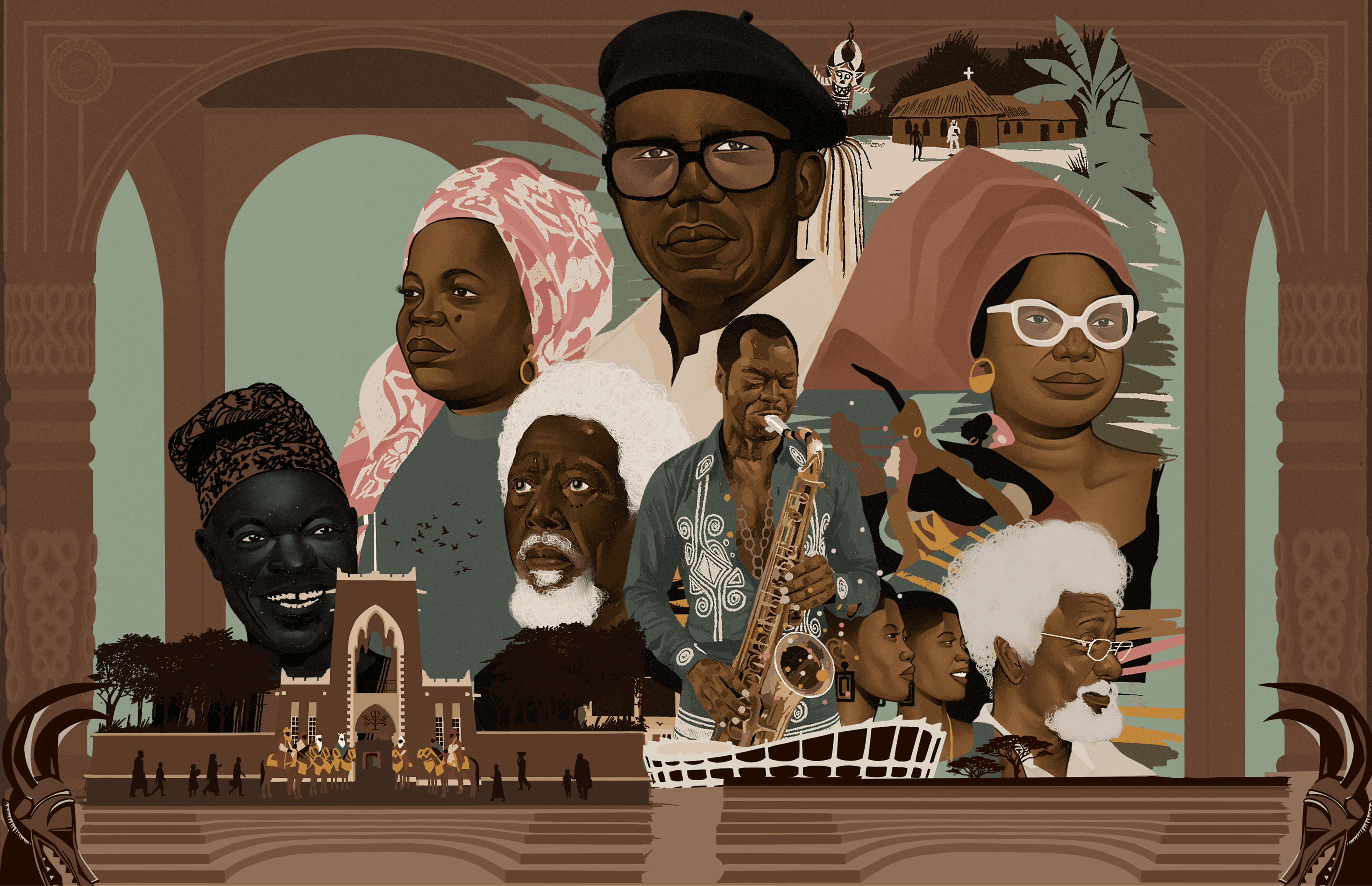
Continuing from our last issue dedicated to Ladi Kwali, the figures on our cover—Achebe, Buchi Emecheta, Ben Enwonwu (referenced via his paintings), Fela Kuti, the Lijadu Sisters, Flora Nwapa, Demas Nwoko, Wole Soyinka and Amos Tutuola—belong to that generation. Over the years, The Republic has published extensive longform on many of them—essays, profiles and reportage that trace their lives, work and influence. Readers can explore this archive by scanning the QR code (in print) or by visiting rpublc.com/collections/nigerias-golden-age.
Click this image to explore our archives on Chinua Achebe, Buchi Emecheta, Ben Enwonwu, Fela Kuti, Ladi Kwali, The Lijadu Sisters, Flora Nwapa, Demas Nwoko, Wole Soyinka and Amos Tutuola.
To reckon with Nigeria in the world, then, is also to reckon with this inheritance, and the questions such reckoning invites. Namely, what does it mean to come from a place that has shaped so much, yet struggles to fully value its own contributions?What does it mean to carry a legacy that is at once generative and unresolved?
This issue does not offer easy answers. Instead, it offers a set of reflections on ideas, movement, on memory, on power and possibility. Together, these stories insist on a simple but difficult truth: that Nigeria is not waiting to be discovered by the world. It is already in the world, complicated, consequential and, in ways both seen and unseen, continually remaking it.
And so, the stories.
This issue features stories from across five continents, from Africa to South America. We start in Asia and the Middle East, in Saudi Arabia, where Wardah Abbas explains how cleric and once-radio preacher, Sheikh Abubakar Gumi, transformed Nigeria’s Islamic landscape in ways that eventually spiralled beyond his vision and control. According to Abbas, ‘Gumi’s revolution didn’t stop in the North. It also began to travel south, quietly infiltrating the pluralistic Maliki traditions of the South West and bringing a new disruptive pulse to southern-Nigerian Islam. From Lagos to Abeokuta, Ibadan to Ede, young Medina-trained clerics also began to look at the gentle, inclusive Islam of their fathers with condescension.’
In Palestine, Kai Mora revisits the life and legacy of Fatima Bernawi, the Palestinian freedom fighter who was also Nigerian. In 1967, Bernawi became the first woman to be arrested by the Israeli Occupation Forces after planting explosives in a theatre frequented by Israeli soldiers. According to Mora, ‘Through free and forced migration, enslavement and betrayal, religious duty and knowledge seeking, Africans in the Middle East have been for centuries a cornerstone in upholding infrastructure, traditions, the nation and the ummah. In particular, Bernawi’s life and legacy exemplifies the critical yet disregarded role that both Africans and women played in the vitality and strength of Palestinian identity, history and future.’
In Europe, Maurizio Bongioanni reports on Princess Inyang Okokon, a survivor of human trafficking who now fights the very systems and people she survived. Originally from Uyo, Akwa Ibom State, in the 1990s, Okokon was trafficked to England and then Italy. According to Bongioanni, ‘The traffickers put Princess and other girls in a car, drove through the Channel Tunnel, crossed France and entered Italy through the Fréjus Road Tunnel. At the time, border controls were loose, and Princess arrived in Turin with no residence permit—an undocumented immigrant, in every sense.’
In Ireland, Ezra Olaoya tells the relatively unknown story of Nigerians in Ireland. ‘Further digging into my own family history revealed that the relationship between Ireland and Nigeria had deeper roots than I had initially understood,’ Olaoya explains. ‘In the 1980s, my mother attended St Louis Grammar School Mokola, Ibadan, which was established by the Catholic Mission in February 1961. There, she was taught by Irish sisters…My mother’s story does not exist in isolation, as Irish Catholic missionaries in the 20th century played an influential role in the country.’
We venture next to North America, arriving in Donald Trump’s United States. Could it be time for Nigeria and other African governments to explore transactional diplomacy, especially as the US is more aggressively pursuing its commercial Africa interests? According to Andréa Ngombet, ‘Trump’s renewed attention to Africa appears significantly motivated by geopolitical competition with China. This tired framing of Africa as a battleground in broader US–China rivalries nevertheless presents both opportunities and challenges for African nations.’
Also in theUS, Idowu Odeyemi reflects on life as a Nigerian doctoral student. ‘This is America. I am an African and I’m in the eyes of most Americans here to seek a greener pasture,’ Odeyemi writes. ‘Since Africa is the world capital of poverty, any African here is here because he lacks what Americans have. Indeed, that might be true, but the assumption is not just false but a bad doxastic attitude.’
In South America, Lanre Balogun recalls how witnessing a candomblé worship celebration in Salvador, Brazil, helped him reconnect with Yoruba indigenous religions. ‘I now understand that decolonial reclamation is not about rejecting Christianity or Islam outright,’ Balogun writes. ‘It is about undoing the idea that Yoruba indigenous beliefs are something to be ashamed of, feared or erased. It is refusing the colonial story that our ancestors were naïve and demonic. This story must be unravelled. This is where decolonization begins.’
Finally, we return home to Africa, where Faten Aggad considers how long-standing distinctions between ‘North’ and ‘Sub-Saharan’ Africa have shaped how the continent is understood. Such distinctions, she argues, are often presented as a natural geographic divide rather than a historical and ideological construction. ‘For much of our modern history, Africa’s internal borders, both physical and metaphorical, have been drawn for us,’ Aggad writes. ‘Whether intentional or as a result of inertia, these lines have been moved to serve the purposes of external actors and feed their imaginations of who is an “African”.’
While not specifically about Nigeria, Aggad’s essay articulates the conditions that inevitably shape how Nigerian ideas, histories, politics, products and cultures are interpreted within the world. We leave knowing that to understand Nigerians in the world, then, is also to confront the frameworks that shape how that world reads Africa itself; and how these frameworks both reveal and limit the terms on which Nigeria’s global presence is recognized.
This issue also features original short stories edited by Republic fiction editor, Chigozie Obioma. In ‘A Bird in Flight’ by Novuyo Tshuma, a brilliant schoolgirl risks everything on a forbidden path to escape her world, only to discover that the future she imagines may demand more than she is willing to lose. In ‘Good News’ by Chika Unigwe, when a grieving widow discovers her late husband’s secret life didn’t die with him, she must confront a love story that refuses to end—and the truth that threatens to remake her.
Additionally, this issue features quizzes, puzzles and other interactives. It also features a First Draftinterview with Nigerian novelist, Chris Abani. When we asked Abani what book gives him hope today, he replied: ‘All Nigerians have hope. Books do not give us hope, they confirm what we have always known: that we are a people that cannot be erased, cannot be held back, and who will endure in excellence and dignity.’ Read the interview for our full discussion.
Our World Issue, this edition is our second of 2026 and was developed with funding from the Open Society Foundations (OSF) and the Mellon Foundation.
As usual, we encourage our readers to engage with our essays and articles, and to provide insightful comments. Readers may send their views directly to the editor by addressing emails (of no more than 700 words) to wale@rpublc.com, with the subject, ‘Comment on Xyz Essay’, or ‘Letter to the Editor’ as applies. Comments and letters will be archived and, depending on the quality of the arguments presented, we may reach out to assist in developing your letters and comments further for publishing in the magazine.
At The Republic, we will always prioritize the meaningful exchange of ideas. We commit to pressing forward: on the most critical of social, political and economic issues; by innovating through knowledge gaps; and by providing guidance through thickets of opinion, ignorance and misinformation—three key features of our time—in search of glades of insight⎈








Comments
Sign in to comment.