Two centuries ago, Nana Asma’u built a network of female scholars at the heart of Nigerian Islam. Their authority faded from public view, yet among Muslim women in Nigeria today, their tradition survives.
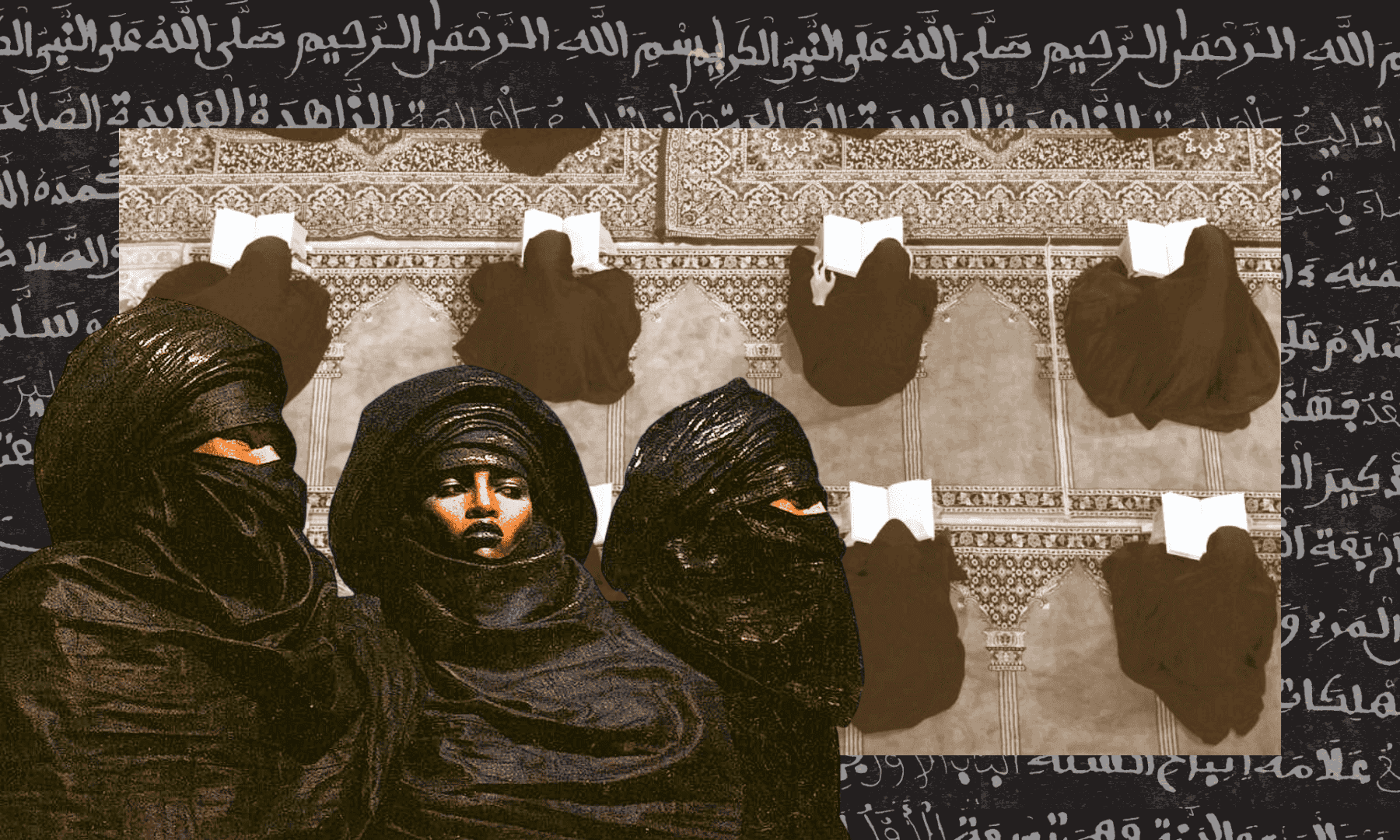
Photo-illustration by Toluwalase Onilede / THE REPUBLIC.
My Madrasah was crammed, heavy with the presence of mallams who had red flames in their eyes. Men in white kaftans and skull caps held a book in their left hand and the koboko, the long, meaty whip, in their right. That’s how I remember it. I was about six years old when I started attending ilé kéwú in Lagos. We sat on long wooden benches, screaming our lessons at the highest pitch to prove we were paying attention. Unlike regular school, there were no women teachers here. When I once asked why, the answer was that a woman’s place was to tend the home, while men went out to lead. Iyawo Alfa, the mallam’s wife, existed only in the background, sending food down to the madrasah. That was her domain. I never once heard a woman called Alfa.
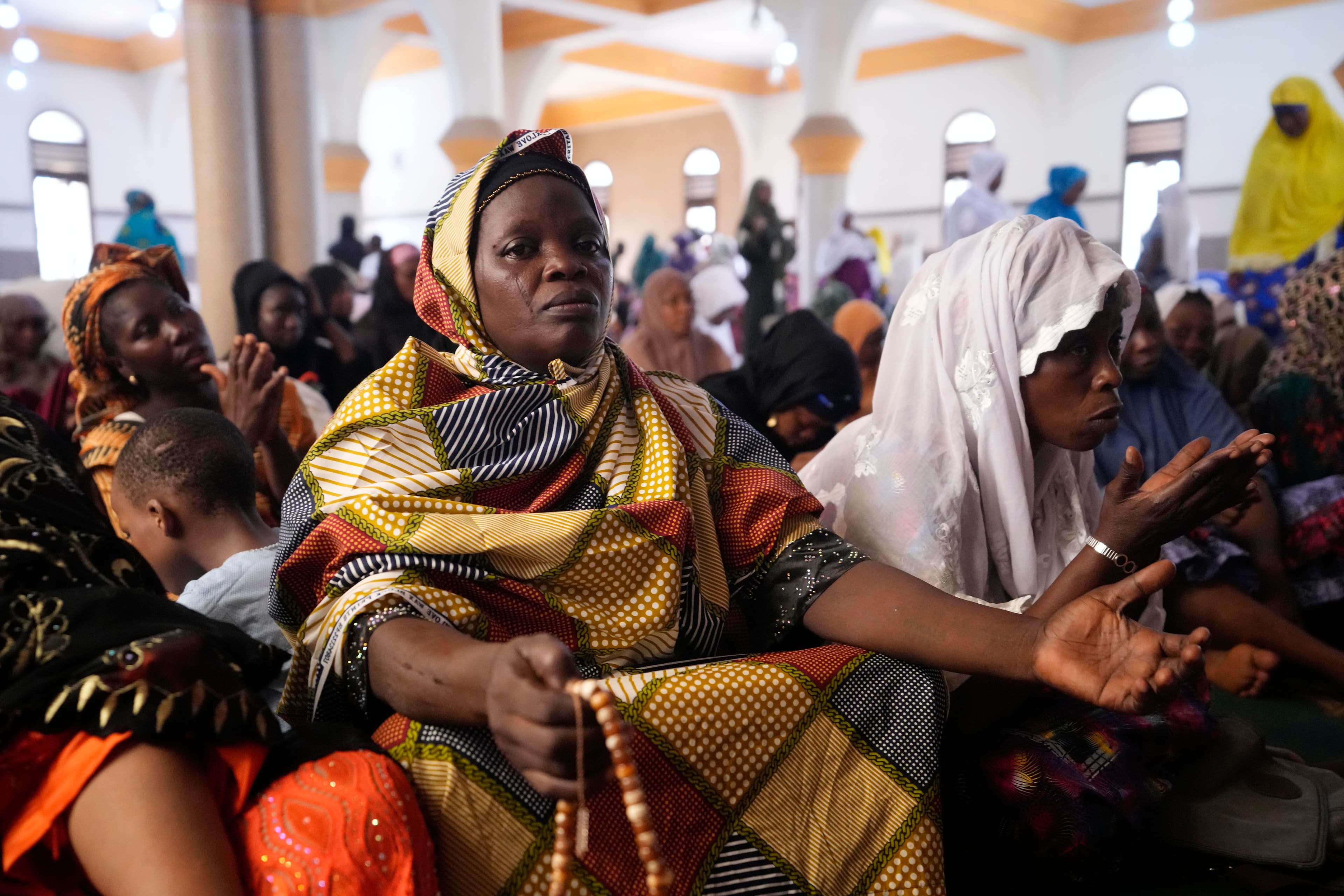
Muslim women offer prayers at the central Mosque in Lagos, on the first Friday of Ramadan in Lagos Nigeria, Friday, March 15, 2024. Muslims throughout the world are marking the holy month of Ramadan, when the faithful fast from dawn to dusk. (AP Photo/Sunday Alamba)
In the community, the role of women was largely passive. They sat tucked away in the female-designated spaces in the masjid, catching fragments of the Friday sermon. Whatever the Imam said was law; there was no room for questioning, and no tools for cross-referencing scripture. Many of the women couldn’t read the Arabic text themselves, so they had to rely entirely on the Imam’s recitation and interpretation. But what was more disturbing was the belief that faith was secondary for women. I grew up hearing the phrase ‘Óbìnrín ò lẹ́sìn’, which implies that a woman has no independent faith of her own, only that of her husband. She was like a spiritual chameleon. If she married a Muslim, she practised Islam. If she married a Christian, she adopted Christianity. Men answered to God, and women answered to men.
This is a memory that never sat right in my heart. I was just a child absorbing the world around me, deeply curious and hungry for answers. Then Fauziyyah, my primary five classmate, was taken to Kano to become a child bride at just ten years old. No matter how much the adults tried to explain it, my confusion only grew. It wasn’t until years later, through my own private study of Islamic history, that I discovered the truth: none of this belongs to Islam.
For years, I carried this memory as absolute truth; that in West Africa, spiritual authority was inherently male, and women were merely silent observers. It was a narrative that reduced centuries of complex female intellectual history to the domestic margins. But history tells a radically different story. Long before the modern ilé kéwú stripped women of their authority, there existed across the nineteenth-century Sahel an intricate, mobile and powerfully organized network of female scholars known as the Yan Taru movement. At the centre of this revolution was its founder and the daughter of Shehu Usman dan Fodio, Nana Asma’u.
THE YAN TARU MOVEMENT AND THE LEADERSHIP BLUEPRINT OF NANA ASMA’U
Finding Asma’u in the ruins of that history did more than heal a childhood wound; it gave me back my voice. Asma’u understood what the mallams of my childhood feared: that an educated woman is difficult to subjugate. Her weapon was not force, but the deliberate democratization of knowledge. Through the Yan Taru, she composed poetry in Hausa, Arabic and Fulfulde, translating complex legal and theological concepts into languages the everyday woman could understand...
You’ve Reached Your Limit of Free Reading.
The Republic is a Nigerian media-tech company dedicated to explaining our time—through deeply reported journalism on power, culture and society.
Ad-Free Reading Experience
Focused consumption without interruptions.
Unlimited Access to Exclusive Archives
Years of reporting at your fingertips.
In-Depth Deep-dive Reporting
Long-form journalism that matters.
Create a free account to continue reading this month and access more of our work.
You’ve Reached Your Limit of Free Reading.
The Republic is a Nigerian media-tech company dedicated to explaining our time—through deeply reported journalism on power, culture and society.
Ad-Free Reading Experience
Focused consumption without interruptions.
Unlimited Access to Exclusive Archives
Years of reporting at your fingertips.
In-Depth Deep-dive Reporting
Long-form journalism that matters.
Create a free account to continue reading this month and access more of our work.






Comments
Sign in to comment.