
Our new print issue, Nigeria in the World, is here. Subscribe for full access or order your copy today!

The colonial history of Fernando Po in Spanish Guinea and south-eastern Nigeria makes it clear that the new techniques of ‘modern slavery’ varied from deception and entrapment of unsuspecting migrants to harshly enforced debt bondage and penal sanctions for non-fulfilment of contracts. Read more.
Jun 7, 2021
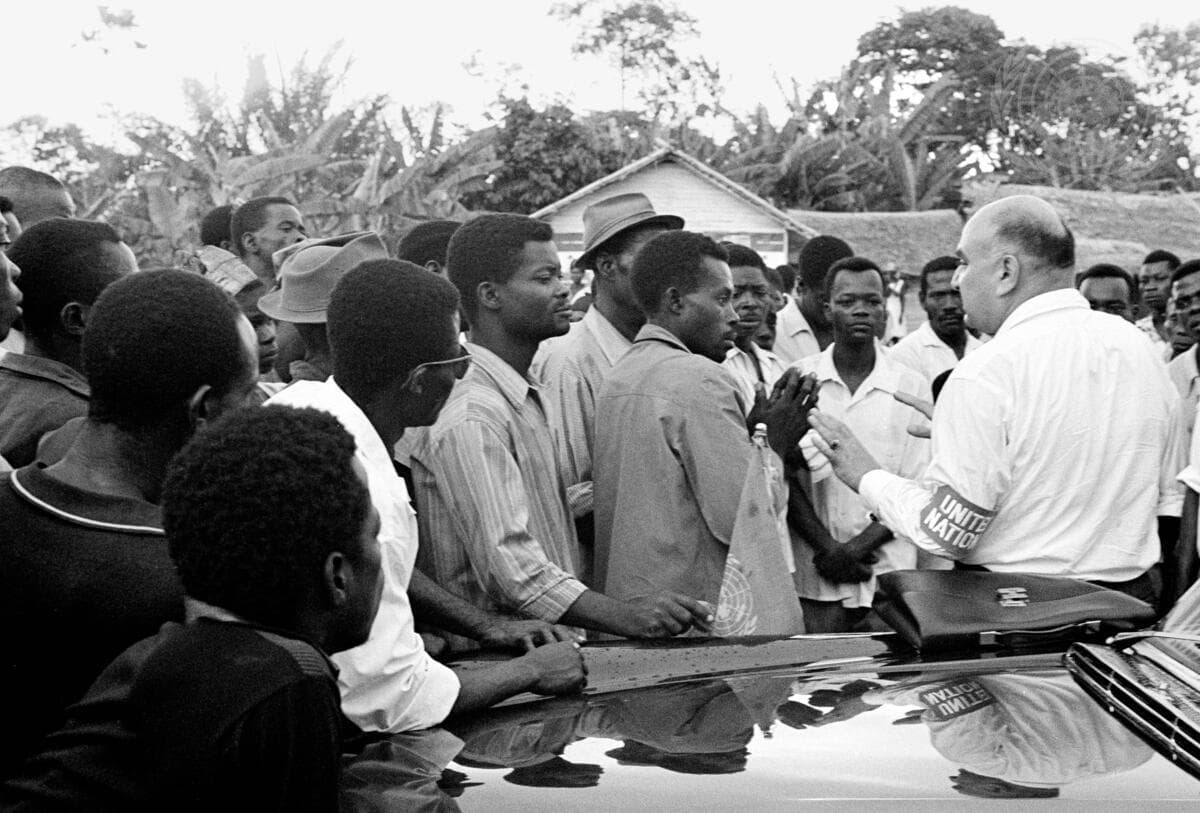
A member of the UN Supervising Mission talks to voters outside a polling station in Rio Muni Province, Equatorial Guinea, on Election Day, 22 September 1968. UN PHOTO
In early independent Nigeria, ‘modern slavery’ was principally associated with the ongoing existence of colonial labour regimes. Especially in the neighbouring Spanish colonial island of Fernando Po in the Bight of Biafra and in the Apartheid and Portuguese empires in Southern Africa. In 1962, Ghana even brought forward an international legal complaint against the Government of Portugal for failing to enforce the 1957 Abolition of Forced Labour Convention. The continued existence of forced labour and modern slavery in the last remaining African colonies were seen as a negation of everything that had been arduously deliberated upon and fought for in the anti-colonial twentieth century. Yet the paradox quickly presented itself that even with the end of colonial rule, ‘modern slavery’ was not overcome or abolished but seemed to reappear in different moments with the same characteristics. Arguably, this paradox arose because what was labelled or misrecognized as ‘modern slavery’ was usually the simple creation or operation of new but quite ordinary semi-regulated labour markets, whether first appearing under colonial or post-colonial rule.
Referring to these labour markets as ‘modern slavery’ creates a confused historical timeline that obscures the direct predecessor of what is today called human trafficking and people smuggling—the turbulent and transformative colonial period. Looking at the colonial history of Fernando Po in Spanish Guinea and south-eastern Nigeria, it becomes clear that the new techniques of ‘modern slavery’, varied from deception and entrapment of unsuspecting migrants in a new territory to harshly enforced debt bondage and penal sanctions for non-fulfilment of contracts and other local legislation such as vagrancy laws. It is equally clear that such techniques were intricately created by the legal and economic conditions of colonialism and were not in any way a persistence of slavery and the slave trade.
The Republic is a Nigerian media-tech company dedicated to explaining our time—through deeply reported journalism on power, culture and society.
Focused consumption without interruptions.
Years of reporting at your fingertips.
Long-form journalism that matters.
Create a free account to continue reading this month and access more of our work.
About the Author
is a professor at the Complutense University of Madrid with a PhD from the Humboldt University of Berlin. He is currently a junior fellow at the Freiburg Institute for Advanced Studies (FRIAS), University of Freiburg, Germany.



Comments
Sign in to comment.