

Our new print issue, Africa’s Hustle Republics, is here! Subscribe for less than ₦1K/$1 a week for full access.
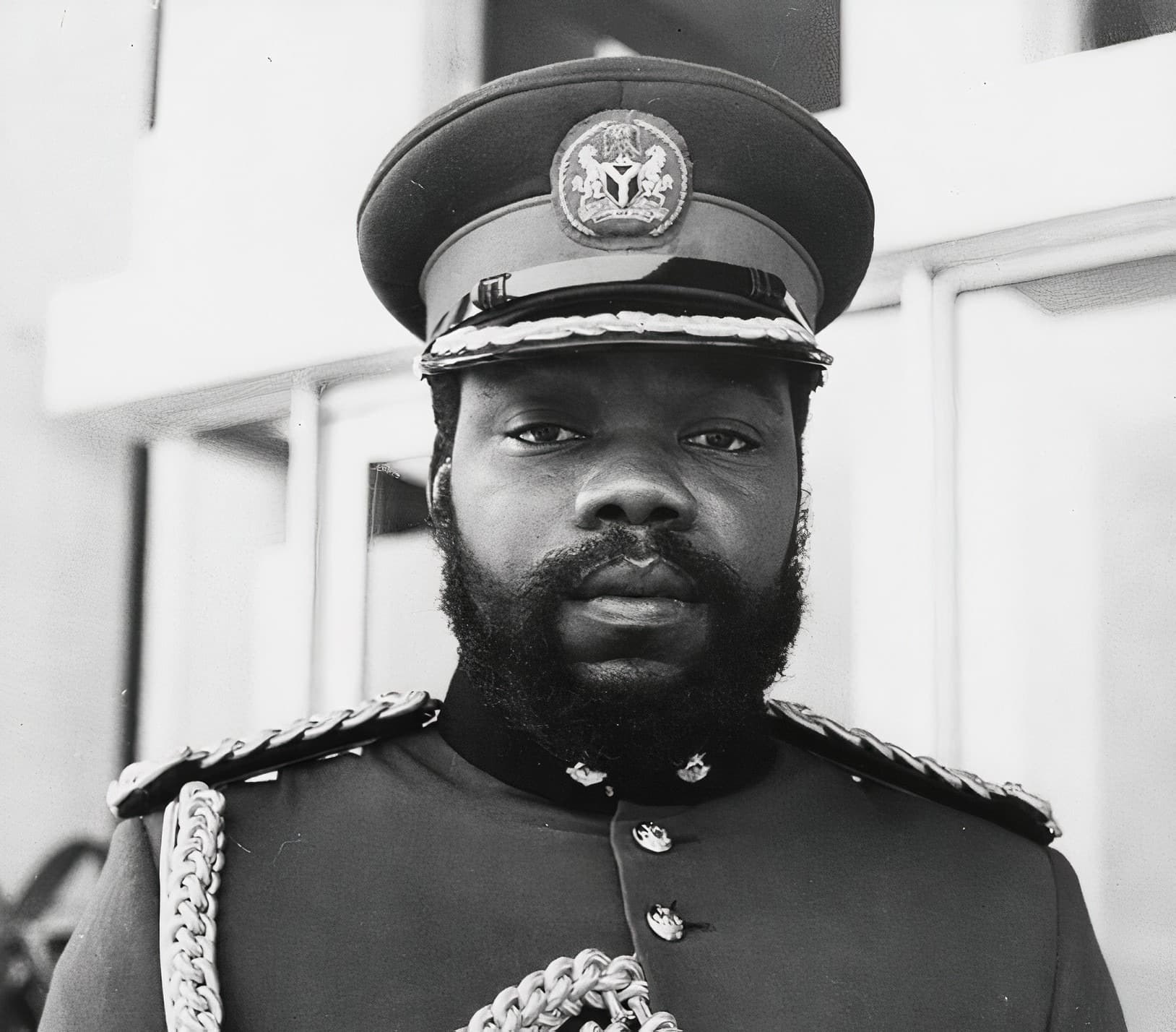
Before he died in 2011, leader of the Biafran secessionist movement, Chukwuemeka Odumegwu Ojukwu, had assumed four personalities: he was a hero, a villain, a rebel, and even a ‘one-Nigerianist’.
Sep 8, 2021
Colonel Odumegwu Ojukwu, Governor of East Nigeria, wearing military uniform, circa 1966. WIKIMEDIA COMMONS.
When Lt. Col. Chukwuemeka Odumegwu Ojukwu declared Biafra’s independence from Nigeria in May 1967, he became a well-known but contentious figure and the subject of numerous debates. To some, Ojukwu’s decision was inevitable as the aftermaths of two coups in 1966 posed an existential threat to the people of Nigeria’s Eastern Region. To others, by challenging Nigeria, the largest and most promising of Britain’s colonial legacy in Africa, Ojukwu attempted the unthinkable. But a blend of Ojukwu’s past and his choices after declaring Biafra a republic, succeeded in making him one of the most controversial figures in contemporary Nigerian history.
Before he died in 2011, Ojukwu had assumed four personalities, some distinct, some overlapping. He was a hero, a villain, a rebel, and even a ‘one-Nigerianist’. While his rebel personality seems to have stuck, the fact that he flipped sides to become one of the major promoters of ‘one-Nigeria’ is interesting though clouded by his much earlier reputation. His ‘wrongs’ reverberated so much that it ridiculed his attempts to right them. Yet, at his prime, he was cherished by some, just as he was despised by others. The most interesting aspects of his personality lie, however, not in his reportedly brash persona but in his courage to apparently mend fences. The latter, however, remains a neglected theme in the discourse on Ojukwu’s legacy. Who, therefore, was Ojukwu?

The Republic is a Nigerian media-tech company dedicated to explaining our time—through deeply reported journalism on power, culture and society.
Focused consumption without interruptions.
Years of reporting at your fingertips.
Long-form journalism that matters.
Create a free account to continue reading this month and access more of our work.
About the Author
is a lecturer/coordinator of the Peace and Conflict Resolution programme, Department of Political Science, Arthur Jarvis University, Akpabuyo, Nigeria. He is also a junior research fellow of the African Research Institute, Budapest.


Comments
Sign in to comment.