The elections have come and gone and the question persists—what happens now? Did Nigeria’s youth get to decide this time?
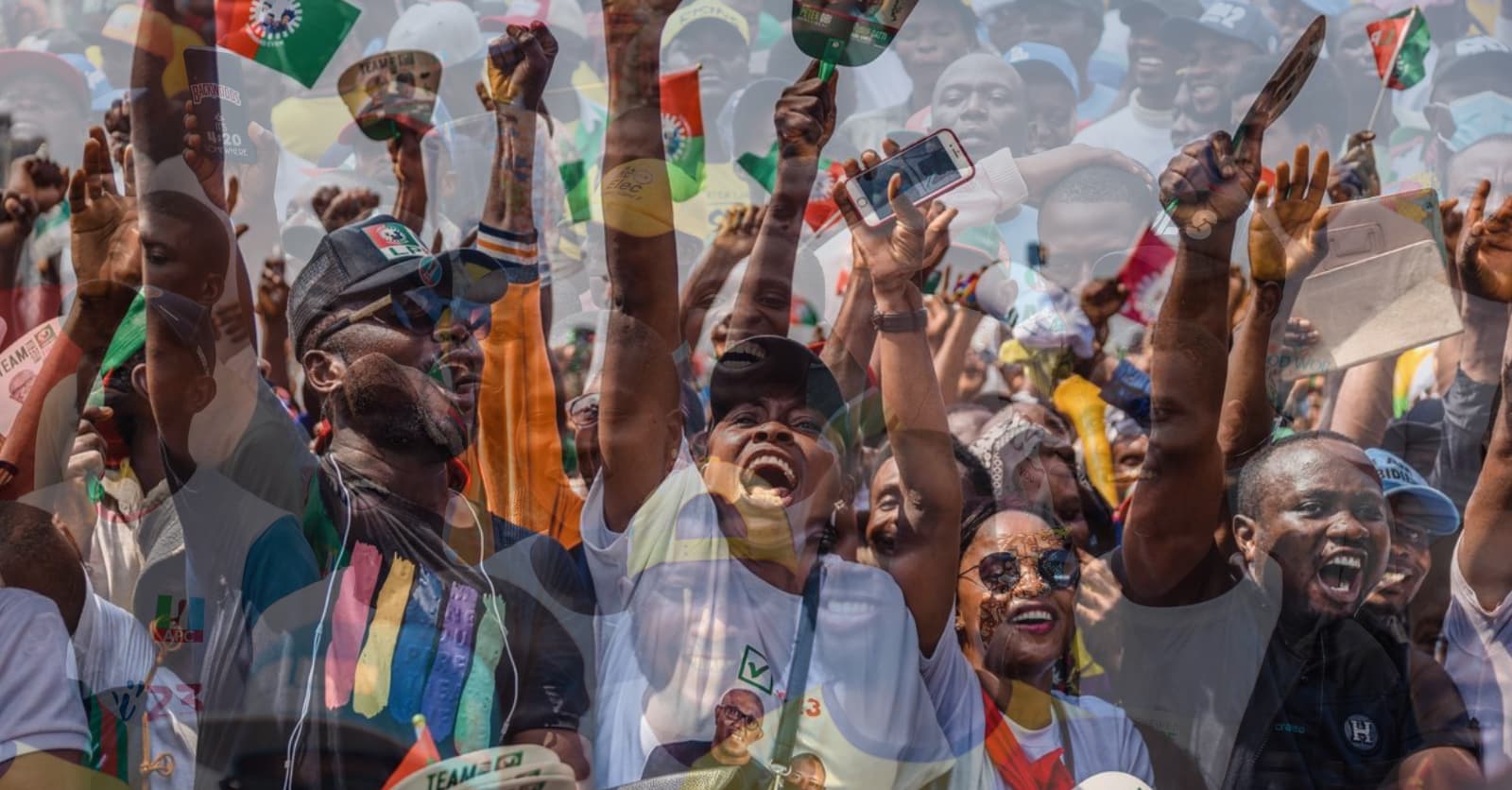
According to voter registration data from the Independent National Electoral Commission (INEC), more than half of new voters are young people aged 18-34 years
. Of the 9.4 million newly registered voters, 7.28 million or 76 per cent of them are young people. In terms of occupation, the data showed that
40 per cent of new voters identified as students, who at
27.8 per cent, made up almost twice the number of the next class of voters—farmers at 15.8 per cent of all voters.
Ahead of the polls, important questions were raised about what the elections could look like. Under democracy, the majority chooses and this year, the majority includes a demographic full of first time voters. It was expected that these numbers could spell a change in the political landscape in Nigeria. But a change in what way? In what direction?
At the moment, it is difficult to see the power of the electorate given the widespread disenfranchisement and violence that marred the recently concluded elections. Still, it remains worthwhile to understand the reason not only why Nigerian youths were active in the political cycle, but also why they trooped out en masse to make their voices heard. What are the nuances of the youth’s politics and ideologies? Why did the new generation of voters register in unprecedented numbers?
Insights, applicable not only to Nigeria’s political terrain, can be drawn from the elections. The 2023 general elections, and the build-up to them, can provide a window into understanding the nuances of political participation within Nigeria, and African democracies as it relates to the youth. Can insight be drawn from other African countries previously in a condition similar to Nigeria’s current political landscape? One where young people had the opportunity to swing the elections in their favour due to their strength in numbers, but yet, were unable to.
Drawing these parallels would be valuable in understanding how to protect, sustain, strengthen and perhaps overhaul weaker practices within African democracies as younger voting generations exercise their civic duty. Within Nigeria, the immediate benefit of participating in the elections is all too obvious—young people are the ones most likely to deal with the long-term outcomes of choices made today. The elections, both 25 February and 11 March, could be a turning point in what the future looks like for Nigeria’s youth.
GROWING PAINS
Youth participation in the elections stemmed largely from dissatisfaction with the status quo, especially in the recent past. The generation that makes up Nigeria’s youth has had to deal with unique frustrations, ranging from dire economic conditions to frustrations about extra-judicial killing by security agents and the administration’s general handling of the #EndSARS protests in 2020. In addition, the
eight month long strike in 2022 by the Academic Staff Union of Universities (ASUU) was a particular pain point among young would-be voters.
Many students across the country’s public tertiary institutions had to deal with the frustration of watching a protracted back and forth negotiation between the union and the federal government over unpaid lecturers’ salaries. Strikes are common in Nigeria but the strike action in 2022 was the second longest in the nation’s history.
The effect on the academic progress of students was particularly pronounced, considering the many other recent disruptions to the academic calendar such as the Covid-19 pandemic. Timilehin, a newly admitted student of the Federal University of Akure will only resume academic work in March this year, despite being admitted for the 2021/2022 session.
My experience with the strike…involved me staying at home and waiting for the strike (to be called off) while others (in private institutions) were in school, it was at some point unbearable. Knowing that the strike was an indefinite one, there was no sense in reading every day when no one knows when it will be over.
When the strike was eventually suspended, it was done so based on promises made by the federal government to pay the owed funds—a situation that is still awaiting rectification
Against the stressful process of gaining a university education, the outlook of life after higher education does not appear any better. Nigeria’s unemployment rate has steadily grown in the past few years, and the Nigerian Economic Summit Group
predicts that unemployment in 2023 could reach 37 per cent. This indicates that over a third of Nigerians would be unemployed, a situation that is particularly grim considering Nigeria is a country
with a large share of the world’s extremely poor.
The current administration has been responsible for
two economic recessions in the eight years it has been in power. The outlook for youth in tertiary institutions, and after graduation appears difficult.
Perhaps one of the most grievous actions of the current administration is the handling of
2020’s #EndSARS protest, where the government employed propaganda to deny the deaths of unarmed protesters in October. Young people across Nigeria watched an Instagram live-stream of officers of Nigeria’s army shooting down unarmed protesters. The country wanted answers for the atrocities, and the response from the government was a televised address by the presidency advising
youth to stop further protests. Perhaps, this is where the youth realized the true attitude of the current administration to their existence—one that was not designed to protect the fundamental human rights of Nigerian citizens.
Although the protests ended tragically, they signalled the first time that Nigeria’s new generation of youth felt collectively empowered to speak out, to take action against the failures of the government. The outcome of the protests might have been discouraging, but it taught us one thing—political participation is not only done with protests. If the government would not listen to the voices in the streets, perhaps they would listen to the noise at the polls.
There was a certain hope that could have motivated the new turnout of youth to register to vote, one that is a lot quieter than the hope in the #EndSARS protests, but it remains to be seen if this would be effective in achieving the youth’s ultimate goal: a Nigeria that works for them.
THE ROAD LESS TRAVELLED
While the motivators for youth participation in the 2023 elections are obvious, the threats to voter turn-out need to be considered as well. It is one thing to get a large number of people to register to vote for elections, but one could argue that the harder thing to overcome is getting people to show up to vote on election day.
The 2019 elections showed record-low turnout among voters, with only
35 per cent of registered voters participating in the elections, according to INEC data. This used to be the lowest recorded voter turnout since Nigeria’s return to democratic rule in 1999. This is glaring as neighbouring West African countries like Ghana and Liberia had voter turnouts of
68.6 per cent and
56 per cent during presidential elections in a similar period.
If voter apathy is a reason for voters staying away from the polls, what are the factors that create that apathy among Nigerians in the first place? The answer is simple, Nigeria’s elections are unlikely to be violence-free—and the recent elections made that all too clear.
As voters queued up at their polling units to cast their votes, they were met with numerous acts of violence by
unknown gunmen and attackers. These instances of violence, in many cases, disrupted the voting process by dispersing the voters, as was the case in Lagos. Apart from the violence, there were also numerous incidents across the country of INEC officials arriving late to polling units, and in some areas, not arriving at all.
In the 2019 general elections, there were numerous accounts of election day violence created by state security forces and political thugs alike. These acts of violence resulted in the recorded deaths of at least 629 people
during the 2019 election cycle. Following the #EndSARS protests, the threat to life is not only real but also quite fresh in the collective consciousness. The price to pay for political participation could be as steep as one’s life.
Before the elections, there were already incidents occurring across the nation with INEC local government offices being attacked, such as the INEC office in the
Izzi local government area, Ebonyi State that was set ablaze. Other states such as
Imo, experienced attacks in four different INEC offices in less than a month.







Comments
Sign in to comment.