Audience Lead at The Republic, Tomi Olugbemi, talks with Nigerian mixed-media artist and sculptor, Dennis Osadebe, about his new public installation, This is Lagos.
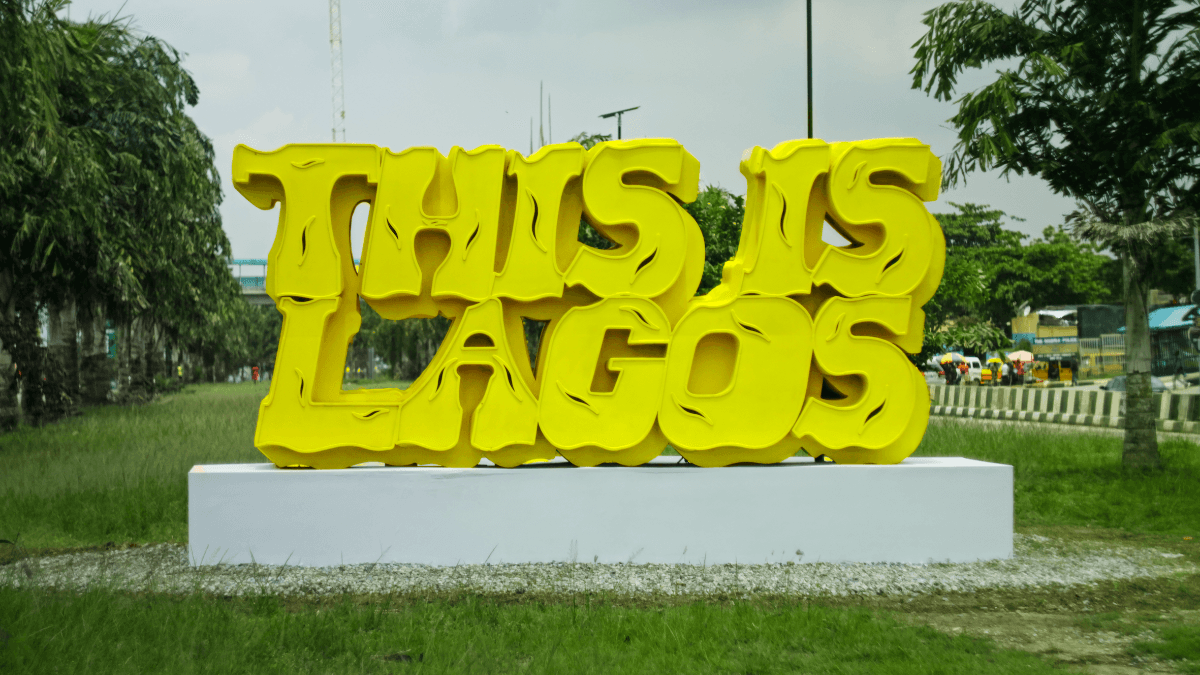
This Is Lagos: Ikeja. Photo by Kadara Enyeasi. Courtesy of Dennis Osadebe Studio.
The phrase ‘this is Lagos’ is a shorthand that explains Lagos without having to fully explain it. The traffic, the hustle, humour, the implausibility of it all working, somehow, always and every day. It is also the title of Dennis Osadebe’s ambitious new project: a series of five giant steel sculptures, commissioned by Lagos State and installed across the city’s administrative divisions. The first are already standing in Ikeja, Owode and Berger, with the remaining pieces underway. Rendered in bold, fluid typography that is itself a thesis on the hand-painted lettering that moves through Lagos on the sides of its buses, the sculptures translate the city’s voice into public form.
It has been seven years since we last spoke with Osadebe in 2019, and as part of the sculptures’ unveiling, we talked to him about the project, the city that shaped it, and what it means to make art for an audience outside the studio walls.
Photo by Kadara Enyeasi. Courtesy of Dennis Osadebe Studio.
TOMI OLUGBEMI
Thank you for agreeing to this interview. It has been seven years since your last conversation with The Republic, where we discussed your series, Work. Life. Balance. One of the themes we explored was the use of masks and anonymity in your work. Looking back, how would you describe the distance, difference and/or convergence between the artist/work we spoke to then and the one behind this new work, This Is Lagos?
DENNIS OSADEBE
I have grown a lot in my practice over the past couple of years. For me, this means that I am a lot more articulate and sharper with my expressions. My work is still the same in its approach to objects and symbolism. I have been able to lean into that while simultaneously moving between other objects that are important to the thinking behind my work. I would say there is a convergence that feels more resolved when I think about my visual language and practice as ‘worldbuilding’.
I have also been thinking a lot about my practice, its relationship to where I live and how to engage the audience around me. This Is Lagos was born out of this line of thinking, just really thinking about these interventions and programmes. A lot of my new work is moving towards this direction.
TOMI OLUGBEMI
How did growing up in Lagos shape your artistry, and how directly do you feel that showing up in This Is Lagos?
DENNIS OSADEBE
The first two exhibitions I experienced in my early years were on the streets of Festac, Lagos and, being catholic, in the church. I have always been inspired by our visual language, from the Queen Idia Mask to the patterns you see on the security bars we have on our windows. There is so much material to pull from and look at! This Is Lagos emerged from that line of thinking where I saw prevalent aesthetics that are a big part of our iconography: from the stylisation of the typeface, the use of colour and the quotes—there’s a strong visual design language, and I was keen on preserving and celebrating it.
Growing up in Festac, street art was everywhere, but so was basketball culture. If you grew up in the era of Kobe Bryant, Allen Iverson and Tracy McGrady, you knew you had to come correct with the basketball fits. So, expressing myself through style was something ever-present for me. By 14, I was designing T-shirts with graphic designers who were a few years ahead of me in school. We were cool because of my older brother, so we could jam and just create together. I made some music; this was around the time Nigerian music started to become globally relevant. The architecture of Festac was also interesting in that there were brutalist buildings, coupled with self-built homes. Not too far was the National Theatre (now Wole Soyinka Centre for Culture and Creative Arts), which was a statement building. I have always been stimulated by Lagos; the city has shaped my way of seeing and thinking.
TOMI OLUGBEMI
How did you choose the sites for installation? Was the city’s geography itself part of the concept?
DENNIS OSADEBE
For the sites, the approach was thinking about the five jurisdictions of Lagos, as well as the main entry points into the city. We wanted visitors coming to Lagos to engage with it as a welcome into the city, but in the Lagos fashion, where our welcome is a reminder of where you are—similar to the spirit of the writings on some Lagos buses: Shine Ya Eye!
TOMI OLUGBEMI
Can you talk about the typography of the installation? What is it about that visual language/style that felt worth translating into steel and public space?
DENNIS OSADEBE
Stylistically, it’s bold. Lots of colourful, blocky silhouettes with pronounced shadows—something very old western/cowboy about it. But it also feels distinctly local and adapted. It’s familiar. We know it but only from one interpretation—which is on vinyls and graphic design stickers. I wanted to monumentalize this and transform it into a different medium, but maintain the spirit of the typeface. This is my first public artwork, and it is in Lagos, so I wanted it to pull from the everyday experience of Lagosians, to feel familiar.
Courtesy of Dennis Osadebe Studio.
TOMI OLUGBEMI
Many Lagosians will encounter the pieces without necessarily seeking them out. How do you think about making work for an audience that didn’t directly choose to be an audience?
DENNIS OSADEBE
That is an interesting question. I wanted to make work that engaged the audience in a familiar way. The choice of finish was important: I wanted there to be a deviation from the standard yellow, so I made a shade called ‘Future Yellow’. It’s a block piece, as opposed to simply segmenting it into the different colours, similar to the reference.
TOMI OLUGBEMI
Your work up to this point has mostly lived in galleries and exhibitions. This is a state commission, permanently installed across the city. Did you have any anxieties or reluctance going into this?
DENNIS OSADEBE
Not at all. Interestingly enough, this is something we have discussed in the studio. It is important for us to see outside of the standard structure of how work is viewed and presented. Lagos needs to see and engage with the work of its most contemporary thinkers and makers. I believe that exchange is necessary, so coming into this new milestone has given me a huge conviction that this is important work.
This Is Lagos: Berger. Photo by Kadara Enyeasi. Courtesy of Dennis Osadebe Studio.
TOMI OLUGBEMI
Was there any part of the process that proved challenging, and how did you solve for it?
DENNIS OSADEBE
This project has been in progress since 2023. We encountered challenges from all fronts. For one, working with the government is quite a bureaucratic process, which requires patience and experience. Fabricating in steel for the first time also had its setbacks. The size of the sculptures meant that it had to be fabricated outdoors in the scorching sun for months. That wasn’t easy.
TOMI OLUGBEMI
In our last conversation, you talked about how globalization flattens local cultures, (the Brooklyn-ized Indonesian coffee-shop example you mentioned comes to mind). Is this project in some way, a bid to keep something recognizably and distinctly Lagos?
DENNIS OSADEBE
Yes!
TOMI OLUGBEMI
What emotion, if you could pick one, do you want people to feel when they see the installations?
DENNIS OSADEBE
Pride. This is for us, by us, inspired by us.
TOMI OLUGBEMI
What’s next after this? Are you looking to explore more public installations?
This Is Lagos: Berger. Photo by Kadara Enyeasi. Courtesy of Dennis Osadebe Studio.
DENNIS OSADEBE
Yes! I have another public installation that I am currently completing, which will be installed later this year. There’s also some public programming that opens the studio and the dialogue we are exploring with this wider audience⎈







Comments
Sign in to comment.