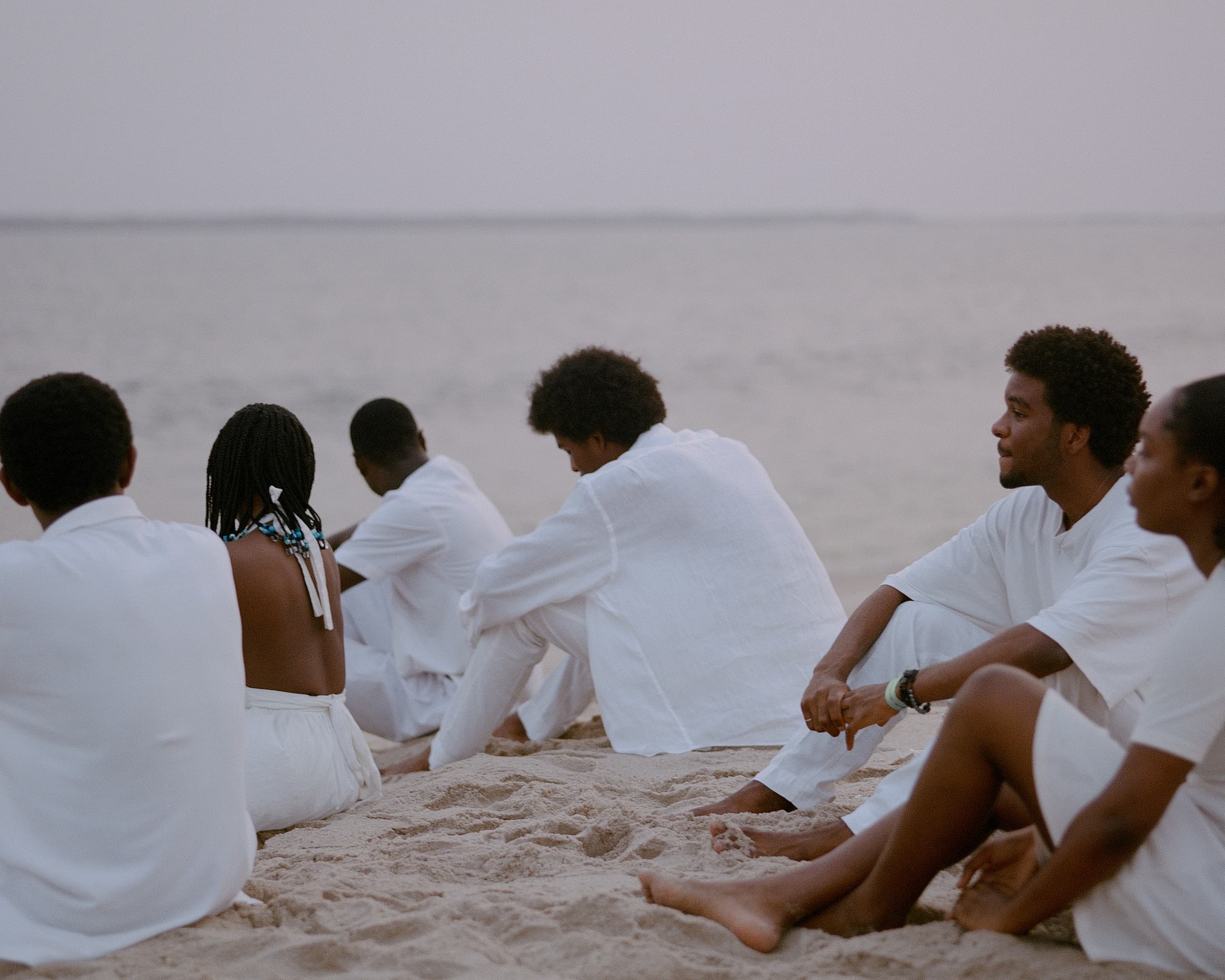
In response to the violence Black people around the world routinely face, Nigerian photographer, Isabel Okoro has been situating her work in what she terms ‘normatopia’. A normatopia is normal, not perfect; a middle ground between the harshness of reality and the dreaminess of utopias.
A ‘Soft and Spiritual Way’.Image courtesy of Isabel Okoro
The first time I meet Isabel Okoro is in the lobby of her apartment building in Toronto, Canada. It is mid-April 2022 and I have commuted 40 minutes on the Toronto Transit Commission’s subway line to pick up her then-newly released book, Friends In Eternity. The exchange is brief, and she tells me thanks for the purchase, as I cradle the text in my hands. I respond that I am looking forward to thinking with it. The purchase and interaction buoy me home with enough excitement that it almost makes up for the wintry chill and the long ride back.
I had only just begun to follow Okoro’s career. While we had briefly attended the same high school in Hamilton in Ontario, we had never spoken. I barely knew of her and likely would not have noticed her work till years later were it not for a recommendation from my cousin on a trip to Halifax, a few months prior. I had been bemoaning my lack of awareness of any interesting Nigerian artists in the diaspora. A literary lover all my life, I was somewhat well acquainted with what books to read and which authors were doing interesting work, but with visual art, I was a neophyte.
I could not have picked a better entrance into this world. Okoro’s work manages to pull off that magic trick few creatives can accomplish: be warmly welcoming to a lay audience, and simultaneously layered and complex for the more critical eye.
Friends of Eternity. Image courtesy of Isabel Okoro.
FIRST MEETING
Our interview for this profile happens over Zoom in late Fall, 2022. We have both turned off our cameras to accommodate for connectivity issues—she is visiting Lagos, while I am in Toronto. Her voice is slow and unhurried, and the absence of any visual cues forces me to listen intently so as not to interrupt before she is done speaking. (Quotes have been edited for clarity and conciseness.)
Okoro tells me she is a self-taught photographer who was introduced to pictures as a child growing up in Lagos by her mother. She narrates to me:
My mom is someone who is really big on photography. Not necessarily taking photos, but modelling and documenting photos of the house, of the family and the people around us. She always had cameras. I would take note of what was going on there.
I ask if it was love at first sight. She says it was not, but instead, a gradual process that began in exploration and culminated in a realization that this could be a way to tell intentional stories and to document the moments she was living through.
A key hindrance to this realization was of course the narrative of the ideal career path—that is, Nigerians should be lawyers, doctors, and engineers—which renders artmaking into a hobby. Moving to Canada, however, and seeing the work of other young Black artists like herself helped displace this limiting view and revealed a horizon she could make her own. She reflects to me that:
I didn’t have my own personal camera until I moved to Canada a few years later, but just being in certain environments allowed things to seem more possible, in a way, and I could share it on Tumblr. It basically gave me access. That access was definitely a privilege.
When I asked her what she studied at the University of Toronto Scarborough, I am tickled by her response—Neuroscience and Psychology, two very practical majors that reveal the pressures of societal expectations, but also the desire to live up to the dreams of your family. Like many other young Nigerian immigrants, Okoro confides that her parents sacrificed a lot so she could move here to study medicine and become a doctor. While she has carved her own path, it is clear that her success was made possible by the love of her family, and that the lessons along the way have indelibly shaped her practice.
Friends of Eternity. Image courtesy of Isabel Okoro.
SECOND MEETING
In August 2022, I encounter Okoro again. This time it is via her work in an exhibit curated by Roya Del Sol, a Toronto-based media artist. BLACK_BOX is an immersive experience that was housed at Trinity Square Video during its run. The artists behind it include instructions on how to interact with it and I take my time wandering from piece to piece. I am struck by BLACK_BOX’s ambition—it positions itself as an archive of Black knowledge, and simultaneously a speculative space that suggests future paths.
I sit in front of Okoro’s contribution, a short film titled the other side of Dreaming. In it, two Black boys laze on the shores of Dreaming, a small coastal town in Okoro’s imagined world ‘Eternity’. Responding to an invitation culled from British artist, John Akomfrah’s film, ‘The Last Angel of History’, the two boys race to discover another world on the other side of Dreaming and find a black box nestled among rocks.
Okoro’s title sits with me as I leave the exhibition. What might it mean to attempt to reach the other side of our dreams? I take it out every once in a while, and chew on it. I had never been arrested as much by a phrase and the intellectual labour it demands.
Isabel Okoro. Image courtesy of Isabel Okoro.
You’ve Reached Your Limit of Free Reading.
The Republic is a Nigerian media-tech company dedicated to explaining our time—through deeply reported journalism on power, culture and society.
Ad-Free Reading Experience
Focused consumption without interruptions.
Unlimited Access to Exclusive Archives
Years of reporting at your fingertips.
In-Depth Deep-Dive Reporting
Long-form journalism that matters.
Create a free account to continue reading this month and access more of our work.
You’ve Reached Your Limit of Free Reading.
The Republic is a Nigerian media-tech company dedicated to explaining our time—through deeply reported journalism on power, culture and society.
Ad-Free Reading Experience
Focused consumption without interruptions.
Unlimited Access to Exclusive Archives
Years of reporting at your fingertips.
In-Depth Deep-Dive Reporting
Long-form journalism that matters.
Create a free account to continue reading this month and access more of our work.
is a Nigerian living in the diaspora whose work and activism circles the axis of borders and bodies, the diaspora and the postcolonial, sexuality and gender, race and religion.








Comments
Sign in to comment.