‘It’s Essential That We Tell Our Own Stories’
Nigerian editor and author of Nigerian Gods, Kome Otobo, wants Nigerians to take pride in their traditional belief systems: ‘Our traditional religions were long-established before Christianity, Islam, and Judaism came to our shores and largely displaced them. Other countries have embraced and promoted their pantheons to the world—Greek, Roman, Hindu, Norse, etc.—so I think Nigerians should be just as proud of our myriad traditional belief systems instead of hiding them away.’
By Kome Otobo
July 7, 2023
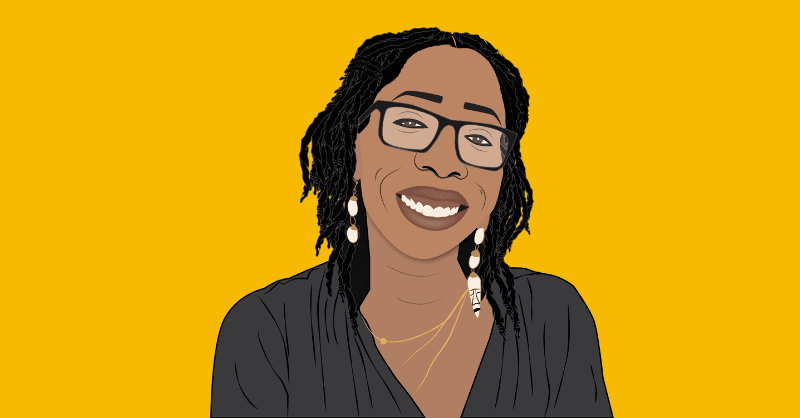
Photo Illustration by Onyinye Dike / THE REPUBLIC.
First Draft is our interview column, featuring authors and other prominent figures on books, reading, and writing.
Our questions are italicized.
What books or kinds of books did you read growing up?
I was introduced to books by my mother who began reading to me from when I was a few months old. My parents love to tell the story of how I could recognize that a book was upside down at the tender age of six months, and I would turn it the right way up. I like to think that this was the foundation of my lifelong love affair with books. I’ve always been a reader of a wide variety of subject matters—historical, autobiographical, romance, science fiction, fantasy. I didn’t limit myself because there were no limits imposed upon me by my parents who themselves read authors like Wole Soyinka, C.S. Lewis and Tanure Ojaide. I started out reading teen classics such as
Sweet Valley High,
The Famous Five and
Nancy Drew. I subsequently discovered Nigerian authors such as Buchi Emecheta, Chinua Achebe and Cyprian Ekwensi, then I expanded my horizons to engage with international writers like Arundhati Roy, Gabriel Garc
ía M
árquez and Octavia Butler.
If your life so far was a series of texts, which text (fiction or non-fiction) represents you at this moment?
If I had to choose one text that is an accurate screenshot of my life at this point, it would be
Everything Good Will Come by Sefi Atta. Firstly, the title itself represents the cautious optimism with which I’m greeting each new day. Secondly, the novel’s themes of feminism, political unrest, religion and tribalism are issues that I navigate on a daily basis as a Nigerian who’s deeply invested in what’s happening in Nigeria.
What’s the last thing you read that changed your mind about something?
I recently read
The Second Sex by Simone de Beauvoir, translated by Constance Borde and Sheila Malovany-Chevallier, and it completely transformed the way I saw many of the hallmarks of womanhood by saying the unsayable. The book also approached a number of romanticized concepts with unnerving clinical precision using extremely clear language, which in turn has helped me to sharpen my own writing. There’s a joy that comes with encountering a writer who has been fully liberated from their social conditioning.
“My parents love to tell the story of how I could recognize that a book was upside down at the tender age of six months, and I would turn it the right way up.
What makes a text powerful: the subject or how it’s written?
In my opinion, I would have to say both are equally important. You can have a vital subject but with poor execution, the message is lost. Similarly, you can have an excellent writer but if the topic is weak or uninteresting, their skills may count for nothing. Therefore, in order to have maximum impact, both elements need to be honed to perfection or as close to it as one can get.
What is your writing process: edit as you write or draft first, then edit?
I edit as I write, that has always been my writing process. I’m constantly refining as I go because my personal mantra is that the first draft should be able to survive close scrutiny from a potential reviewer. I’ve also found that this makes the editing stage easier to navigate further down the line because a significant amount of the heavy lifting has already been done.
I made considerable use of my day job’s project management skills before I started writing Nigerian Gods. Certain factors were identified and decided upon before I wrote a single word: the number of ethnic groups that would be discussed; the primary, secondary and tertiary sources of research that would be used; and the estimated number of pages per chapter. I also set aside a number of days per week as ‘writing days’ and on those days, I made sure that I wrote a minimum number of pages; this was the only way to ensure that I made consistent progress with the book.
How long did it take you to write this book?
I started writing Nigerian Gods in April 2021 and I completed the first draft in October of the same year. I took a short break to reset my mind and then began editing the second draft in November 2021, which took me around a month to work through. I took another much-needed break for Christmas and New Year, which allowed me to return with fresh eyes in January 2022 and focus on editing the third draft. After another month of final edits and proofreading, I submitted my manuscript to the publisher in February 2022. The hard work I’d done in the editing stage paid off, as the publisher requested minimal changes to my work, which was a huge relief.
Why was it important that you wrote on the impact of the introduction of the three main Abrahamic religions on Nigeria’s traditional religions, culture and way of life?
I think it’s essential that we tell our own stories. Our traditional religions were long-established before Christianity, Islam and Judaism came to our shores and largely displaced them. Other countries have embraced and promoted their pantheons to the world—Greek, Roman, Hindu, Norse, etc.—so I think Nigerians should be just as proud of our myriad traditional belief systems instead of hiding them away. I realized that there was a knowledge gap and I had the ability to attempt to fill it. My main goal in writing Nigerian Gods was to answer the questions that I was asking—What did we believe in before the Western religions came to Nigeria? Why don’t we know more about our traditional religions? What happened to all the traditional practitioners? How can we spark conversations about the damage that was done to our national psyches as a result of being forced to eliminate key elements of our culture?
“You can have a vital subject but with poor execution, the message is lost. Similarly, you can have an excellent writer but if the topic is weak or uninteresting, their skills may count for nothing.
What was the most interesting/fascinating discovery during the research process of your book?
I was staggered at the similarities between the traditional religions of the various ethnic groups and the problems that the religions addressed such as community policing, the continuation of legacies and a way of understanding and negotiating with the supernatural. These ethnic groups historically had more in common than they ever imagined and yet, the prevailing atmosphere was and continues to be one of simmering hostility and outright competition. My research shed further light on centuries of tribal tensions in Nigeria and it has provided me, and hopefully readers of the book, with clarity regarding some of the root causes.





Comments
Sign in to comment.