

Our new print issue, Africa’s Hustle Republics, is here! Subscribe for less than ₦1K/$1 a week for full access.
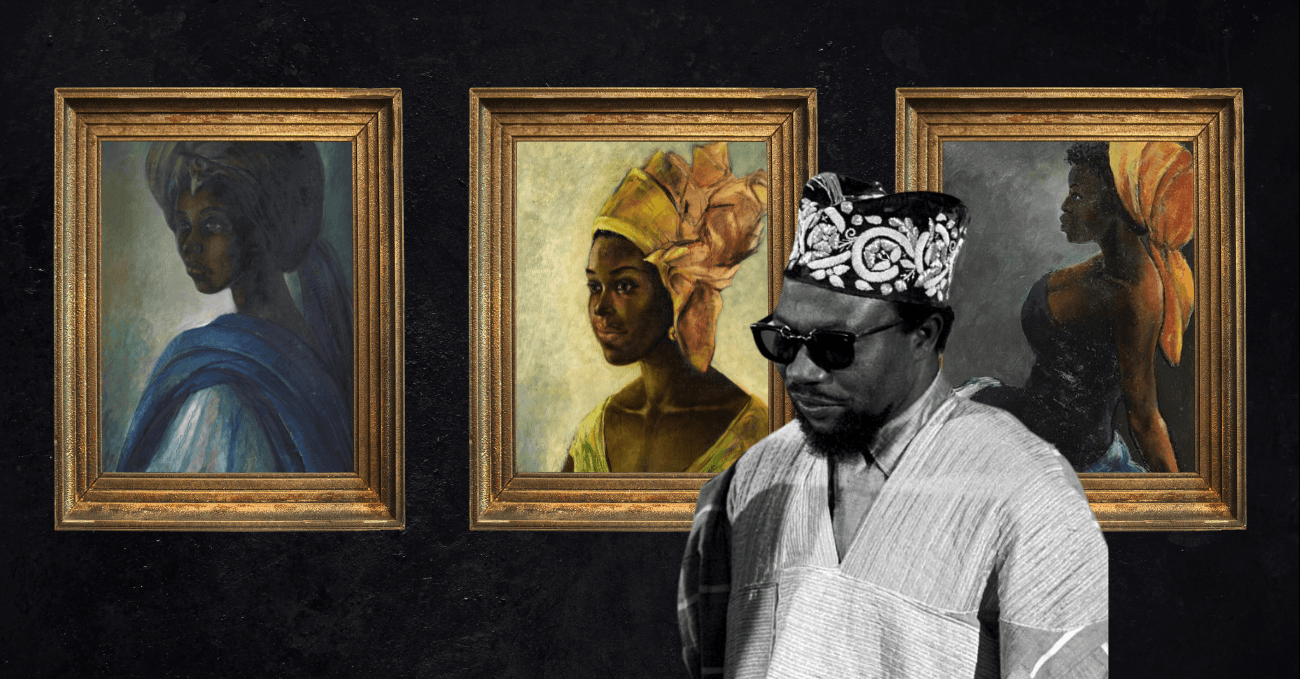
Ben Enwonwu’s impact on post-colonial African Art was nothing short of revolutionary. His life and work were a bridge between traditional conceptions of African art, and contemporary interpretations of what it means to be an African artist within a global community.
Jul 17, 2023
Photo Composition by The Republic. Photography Yutaka Nagata / UN PHOTO.
It was an exclusive exhibition of the Royal Society of British Artists in London in November of 1957 and a bushy-haired man from the Colony of Nigeria was showing Queen Elizabeth II around a larger-than-life bronze statue of her. This was an unusual sight in the 1950s: the young English queen and an African talking closely about a large piece of art—the queen herself cast in immutable bronze. What could have brought them together?
The journey to the event of the unveiling of that bronze sculpture began in 1956 when the queen visited Nigeria, then a British colony. On the request of the Nigerian government, she commissioned a sculpture from the leading African artist of the time, Ben Enwonwu. Before then, no African artist had ever received such a commission; it was seen as the final act of goodwill and solidarity between the queen and the people of Nigeria. Enwonwu, whose reputation had risen astronomically through the 1940s and 1950s, built on a novel fusion of European and African artistic techniques, took to the task with seriousness. Here was a chance to express the thoughts and feelings of the Nigerian people on the most recognizable figure of British imperialism.
From March 1957, the queen sat for Enwonwu at a studio inside Buckingham Palace. He spent an hour everyday sketching and modeling with clay in the studio. As the work matured, he moved to a studio in Maida Vale, West London, owned by William Reid Dick, the ‘sculptor in ordinary’ for Scotland. In this new studio, the queen sat on four more occasions before the work was completed. The completed sculpture captured the queen in a regal posture; the sculptor moved away from the standard European academicism; he left the folds of the figure’s flared garments vague, for instance, but infused the face with a beatific expression marked by subtle African features. In the view of Enwonwu’s biographer, Sylvester Ogbechie, ‘[Enwonwu] reworked the queen’s physical features using forms derived from his experiments in sculpture.’
The sculpture was unveiled in Nigeria on the 5th of November 1959 at the fifth session of the parliament. For the then governor-general, James Robertson, and the colonial authorities in Nigeria, it was a mark of British dominance and civilizing power. For both Ben Enwonwu and Africa, it was the culmination of a moment in which power was being returned to those from whom it had been taken—power of representation, of self-expression, of independence.

The Republic is a Nigerian media-tech company dedicated to explaining our time—through deeply reported journalism on power, culture and society.
Focused consumption without interruptions.
Years of reporting at your fingertips.
Long-form journalism that matters.
Create a free account to continue reading this month and access more of our work.
About the Author
is a writer of fiction and nonfiction. A runner-up for the J. F. Powers Prize for Fiction (2024), Chika was a 2021 Fellow of the Ebedi International Writers’ residency in Iseyin, Nigeria. He currently resides in Nigeria.


Comments
Sign in to comment.