
Editor’s note: This essay is available in our print issue,
Pan-African Dreams. Buy the issue
here.
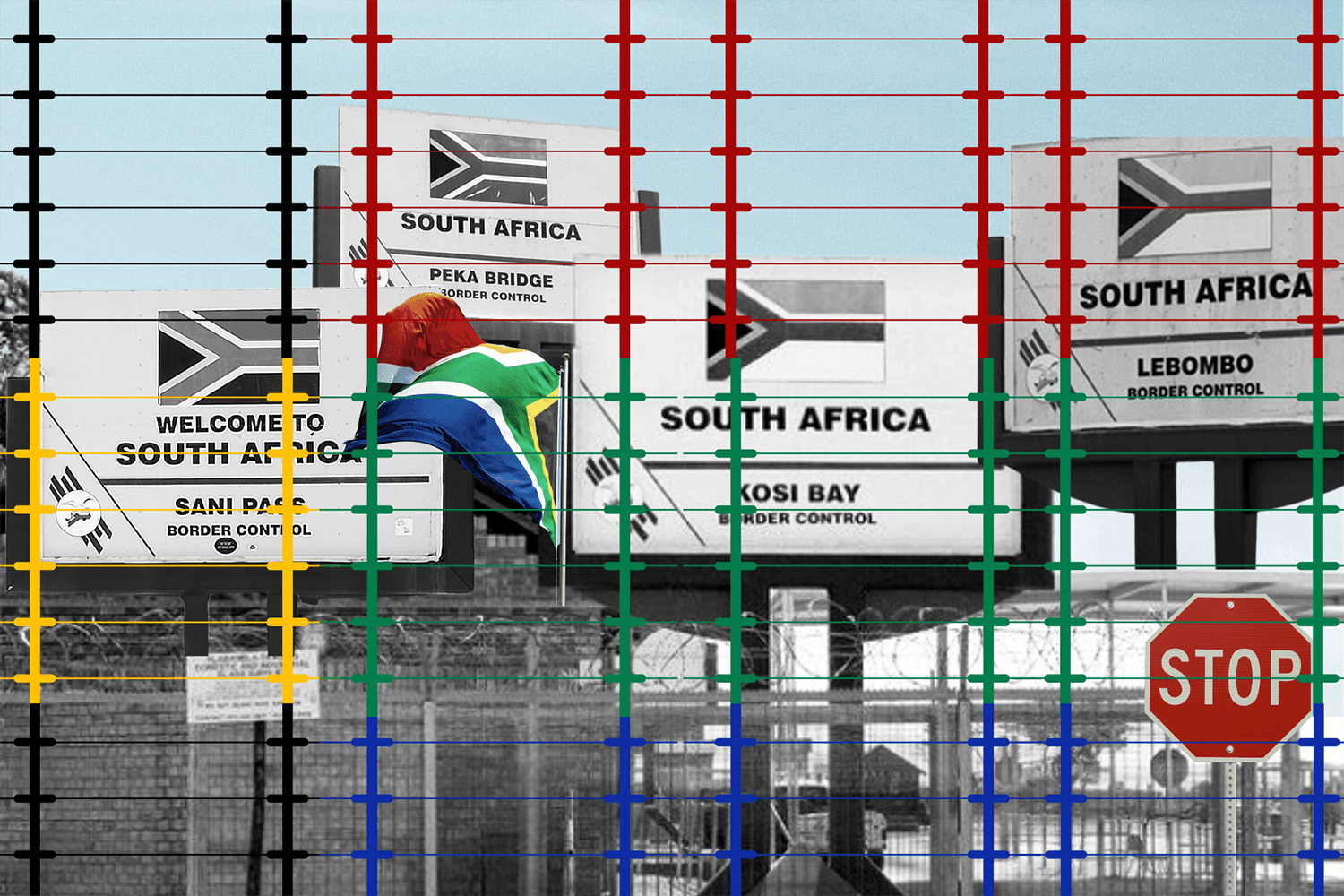
The word ‘containment’ is fitting when describing South Africa’s immigration policy. From the legislation that seeks to control and limit the movement of unskilled people, to the
alarming raids that seek to identify and incarcerate people who are undocumented in
harrowing detention facilities where there is little regard for their human rights. South Africa has an alarmingly high
deportation rate—it deported over 350,000 people in 2016 (the United Kingdom deported
40,377 people in the same year)—and chooses to haphazardly close refugee reception offices in places where refugees need them most. It is evident that South Africa’s migration policy functions to control and prevent immigration.
It is indeed perplexing that this policy was in place during the time when President Cyril Ramaphosa held the position of the African Union’s (AU) head. This is particularly noteworthy because it was during Ramaphosa’s tenure that the AU undertook its most comprehensive regional integration initiative since the establishment of the African Union. For this reason, it is important to understand what seems like policy uncertainty—the gap between South Africa’s regional obligations and its law. It is necessary to explore South Africa’s migration policy in light of the concept of free movement and the political and economic underpinnings of it on the African continent.
INTERROGATING SOUTH AFRICA’S MIGRATION POLICY
The official position of the South African government is that it stands firmly behind the idea of free movement. In a 2017 parliamentary briefing on the AU Agenda 2063, the Department of Home Affairs presented a report to parliament stating:
South Africa supports the development objectives and aims of Agenda 2063 in the context of strengthening the African cooperation, integration and for promoting inclusive development, peace and security. The support for the Agenda 2063 is informed by the understanding that South Africa’s destiny is intricately linked to that of the continent. Regional and continental integration are the foundation for Africa’s socio-economic development and political unity and essential for South Africa’s prosperity and security. South Africa fully supports the principle of free movement on the Continent, including the need for the AU to conclude a protocol to facilitate such free movement.
In this report, the Department of Home Affairs listed factors that it considered when choosing to forego signing the Free Movement of People Protocol (FMoPP). The FMoPP aims to facilitate the movement of Africans within Africa and enhance the right to entry, residence and establishment. The Department of Home Affairs’s factors for forgoing the FMoPP included the lack of preconditions to the implementation of the abolition of visa requirements, the failure to develop a civil registration system that would result in integrated border management and concerns regarding failure to establish bilateral agreements that would precede abolition of visas and an unqualified right of entry.
The FMoPP stands as the primary legal framework establishing the fundamental basis for continental free movement in Africa. It Is noteworthy to mention that no country in the Southern African Development Community (SADC) regional bloc has signed, ratified or acceded to the FMoPP. South Africa seems to have opted to follow the policy outlined In the SADC Protocol on the Facilitation of Movement of Persons which was ratified In 2008 which focuses on mitigating and controlling free movement rather than opening borders.
However, there is a general sense that policy relating to migration seems to say one thing while doing another. On one hand, migration treaties and
international statements commit to regional integration. On the other hand, South Africa seems to be leaning into robust border control and immigration legislation, which creates a proliferation of red tape around the movement of people, especially unskilled people, from other African countries. One of the South African Immigration Act’s main intentions is to permit an easy flow of highly skilled foreigners and investors into South Africa. Furthermore, the South African government has implemented increasingly restrictive measures on migration in the last decade. These have included the Immigration Amendment Act, which was aimed at providing adequate sanction for immigrants who had overstayed the stipulated dates on their visa, even if they timeously applied for an extension that had not been processed by the Department of Home Affairs.
This policy uncertainty muddies the waters of South Africa’s contribution to free movement. By signing and ratifying the Abuja protocol and the African Continental Free Trade Area treaty (AfCTA), South Africa has committed to free movement and continental integration. But failure to sign the FMoPP, the 2017 White Paper on Immigration and the lack of consistency in immigration legislation do not signify that this commitment is at all pressing, at least in the short term. This incoherency exists notwithstanding tight schedules for the implementation of economic integration.
Nonetheless, it is still meaningful to analyse the concept of ‘free movement’ and hope to understand its meaning, implications and how it can be actualized. Not only because South Africa has, in many uncertain terms, committed to it broadly but also because it is useful in imagining the future of immigration policy.
OUTLINING SOUTH AFRICA’S INTERNATIONAL LAW COMMITMENTS
In 1991, AU member states signed the Abuja Treaty, which established the African Economic Community. South Africa signed it in 1997. Article 5 of the treaty, which is especially noteworthy, envisages 34 years to consolidate and strengthen the structures of the African common market and includes a commitment to the free movement of all citizens on the African continent.
The Abuja Treaty is an expansive commitment to free movement because it situates the conversation on free movement in a broader conversation on African integration. Therefore, the commitment was not only to open borders in the continent but also concerned the social, political and economic integration of the continent. It is difficult to imagine that such a vast commitment could be made without an implicit acknowledgement of the future and present right of citizens to freely cross borders.
In hopes of realizing the commitments made in the Abuja Treaty, the AU has created a milieu of policies, treaties and programmes aimed at achieving regional integration and the free movement of Africans in Africa under the broad banner of the Africa 2063 policy framework. Agenda 2063 hopes to allow Africans to travel, live and work within the continent. It does so by hoping to streamline the process through which Africans can realize the right of entry, the right of residence and the right of establishment within all AU member states.
Most countries, including South Africa, have signed and ratified the AfCFTA, which largely regulates the movement of free goods while loosely alluding to the free movement of people. However, South Africa has neither signed nor ratified the FMoPP even though South Africa was largely at the helm of FMoPP negotiations.
FREE MOVEMENT: PHILOSOPHICAL, POLITICAL AND ECONOMIC UNDERPINNINGS
The Abuja Treaty for free movement of persons is defined as the right of residence and the right of establishment. However, the FMoPP refines this definition and includes the right to remain. This could be interpreted as the AU taking a policy stance on the use of visas and measures to regulate movement and in support of absolute free borders.
Free movement is the right of a person to freely enter, engage in economic activities, reside and seek employment in a state other than their state of origin in accordance with the laws of the state. In this context, it is the right of Africans to enjoy almost full benefits of citizenship in any African state.
FMoPP sets out three phases in its rollout plan. The first is the abolition of all visa requirements while the second is through the implementation of the right of residence and the third is the implementation of the right of establishment. The protocol also has descriptive requirements that set out the way free movement should be established. These include a non-discrimination clause that can function to prohibit protectionist labour policies that exclude non-citizens from certain careers, the establishment of an African passport, mutual recognition of qualifications of all member states, free movement of students and researchers and the portability of social security benefits. After the adoption of Agenda 63, Seychelles, the Gambia, Rwanda, Zimbabwe and Benin all took steps to ensure
visa-free travel to all Africans. South Africa’s stance has been to reduce visa requirements for some countries through
bilateral agreements.FREE MOVEMENT: PHILOSOPHICAL, POLITICAL AND ECONOMIC UNDERPINNINGS
Although South Africa is the largest African source of Foreign Direct Investment (FDI) for the continent (
accounting for 39 per cent of intra-African FDI), at
five percent of total FDI in Africa, this is
substantially below that of non-African sources and mostly concentrated in Southern Africa. South Africa also has a long way to go in extending its continental influence and structural power. Thus, despite its
strengths and positive impacts, the AU remains financially weak, dependent on external donors and fraught with limited implementation capabilities and supranational power.
THE POLITICAL ORIGINS OF FREE MOVEMENT
‘Aspiration 2’ of the AU’s Agenda 2063 envisages an integrated African continent which is united based on the ideals of pan-Africanism and the vision of the African Renaissance. In 2063, it reads, ‘Africa will be a united continent that has realised full economic and political integration.’ The political consensus surrounding the political free movement is solidly routed in and evolves from a post-colonial, pan-African tradition that sees Africa as the source of an identity that expands beyond its borders and into the diaspora. Pan-Africanism envisions a strong united and self-reliant continent as well as its diaspora as one nation triumphant against imperialism and colonialism. These ideas are embodied by leaders-cum-presidents like Leopold Senghor who wrote in the poem, ‘To Negro-American Soldiers’:
Under your closed face, I did not recognize you. I only touched the warmth of your brown hand,
Comments
Sign in to comment.