The Republic: Season 1, Episode 1 Transcript | The Republic
The Republic: Season 1, Episode 1 Transcript
Our central question in this episode is: What is the history of democracy in Nigeria? Why was IBB so pivotal in the entire process? Why did IBB choose 1993 as the right time for the democratic transition? And why did he decide that a two-party state would be the best format for this
‘It is true that the presidential election was generally seen to be free and fair and peaceful. However, there was in fact an array of election malpractices in virtually all the state of the Federation…’
― Ibrahim Babangida
What you’ve just heard is part of a speech General Ibrahim Babangida made shortly after the June 12 1993 democratic election. At the time, Babangida or IBB, as he was more commonly known, had been military president of Nigeria for about eight years. And he had spent a good part of his regime under pressure to transition Nigeria from years of military rule to a democracy. Until the June 12 election, IBB had repeatedly promised to yield power to a civilian president. But by the time of his speech, it was already clear he had broken his promises to witnesses like Baba Aye, who was a student activist during the IBB Era.
Baba Aye: I think what was clear was Babangida didn’t want to go. But it increasingly became impossible for him to avoid not going.
IBB became the president of Nigeria in 1984, after overthrowing General Muhammadu Buhari in a military coup. The country IBB took over was in a disastrous state. As president, IBB faced the dual pressures of a domestic climate that agitated against military rule and an international community that increasingly made the loans Nigeria’s declining economy needed, contingent on Nigeria becoming a democracy. On becoming president, IBB had sold himself as the military leader who would usher in Nigeria’s democracy; but what continues to puzzle historians is why he repeatedly delayed the democratic transition.
Nearly two years into his presidency, on January 13, 1986, IBB announced that Nigeria would hold democratic elections by October first, 1990. In July, the next year, he changed his mind and pushed the date to October first 1992. In January 1992, IBB postponed the date again to December fifth, 1992. That same year, in November, he moved the election date to June 12 1993; and just when it seemed settled, after the election actually held in June and had produced a winner, the wealthy businessman Moshood Kashimawo Olawale Abiola, IBB made that speech annulling the results.
IBB blamed the annulment on widespread electoral malpractices. Years later, in an interview with Mo Abudu, he would expand on his reasons for annulling the election.
Babangida: When the process was going on, we did swear that ours was going to be the last military coup that we were going to have. So we wanted to make sure that we handed power to a democratically elected government. To be honest, the situation was not right to hand over at that time.
But throughout IBB’s regime, he seemed to have a convenient reason every time he postponed the democratic transition. Over the years, he has been called misunderstood, a manipulative dictator, a political Maradona and even an evil genius, titles he was very much aware of, disapproved of and even, in some cases, encouraged. But what he didn’t know while giving that speech is that the annulment, that single decision, was a time bomb.
Hello and welcome to The Republic, a podcast about pivotal African figures and historical events. I’m your host, Wale Lawal. Over the next six episodes, I’m going to walk you through one of the most significant events in Nigeria’s political history. The June 12 1993 presidential election shaped the modern Nigerian state. But, why was it so controversial? Who were the main actors and what roles did they play? Most importantly, can we draw any parallels between then and now?
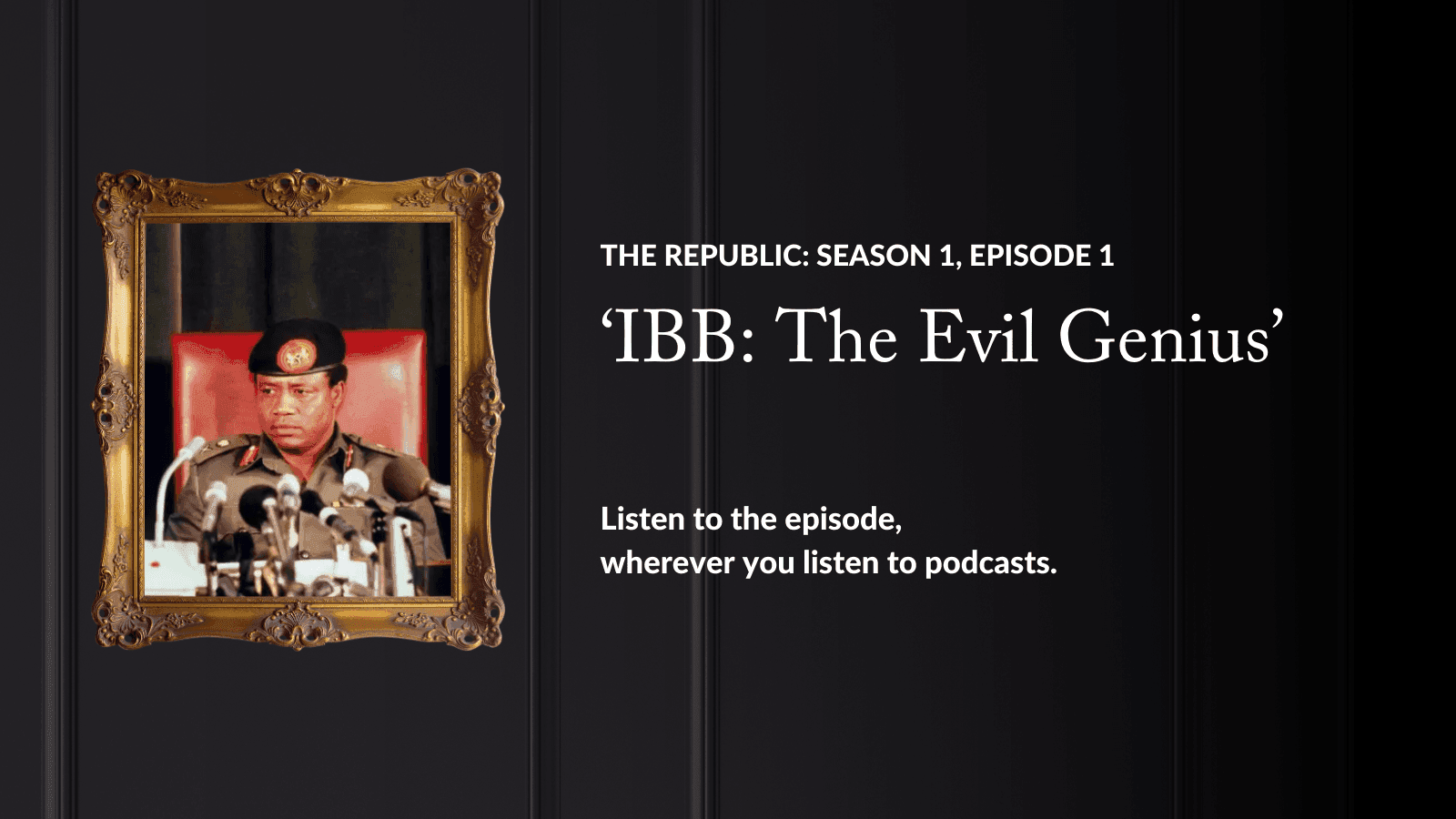
EPISODE 1: IBB, THE EVIL GENIUS
Baba Aye: ‘…..he was a smart person, he himself said he’s an evil genius.
….you know, he actually described himself as an evil genius, which also is kind of narcissistic. And how did he get about this, I think it partly has to do with being through several coup d’etat.’
How do you stage a coup? Well, for one, you need manpower. Then, you need meticulous planning. And if you were IBB in the 80s, you needed to be entrenched in quote-on-quote the system; you needed to build trust among the already powerful and you needed to have proximity to power. But they didn’t call IBB Maradona for nothing.
In Nigeria, we cannot talk about democracy without first talking about and understanding Nigeria’s legacy of coups. We cannot talk about MKO Abiola or the June 12 election without talking about Muhammadu Buhari and IBB and the coups they led. The story of Nigeria’s sixth coup, the coup that brought IBB into power, can be traced all the way back to 1966
That may sound a like a reach, but let me land. In Nigeria, like much of West Africa, the early days of post-colonial nation-building saw coups lead to more coups.
Reporter: There has been a wave of this in West Africa in particular, Central Africa Republic, Dahomey, the Congo, all kinds of places. Why is this?
Some political historians have argued that the common thread across these coup-prone countries was colonization and the legacy of weak state institutions that European colonizers left behind. During the colonial era, Europeans haphazardly created African colonies through artificial borders. The very purpose of these colonies was to allow Europeans extract resources and then following years of liberation struggles the colonizers were forced out. But they left behind ‘elite’ Africans with aspirations of nationhood and power. Nigeria for one was in a very fragile position: we had a federation that was really a mesh of over 200 ethnic groups that would potentially jostle for resources and political representation. Population size became the key determinant of access to resources and this fell to the three most populous ethnic groups, Hausas in the Northern Region, and the Southern Region split between Igbos to the East and Yorubas to the West. But with very little investment made into creating unified nationhood across all our ethnic groups, even this resource split between the most populous ethnic groups was unsustainable.
So, in 1966 when a young Lieutenant Babangida, witnessed the events of the bloody 1966 coup while he was stationed in Kaduna, his perception of Nigerian politics and the role of the military would be forever altered.
General Odumegwu Ojukwu: This coup seems to be at the centre of subsequent problems in Nigeria.
And Ojukwu had a point, because seven months later, when Lt. Colonel Murtala Muhammed, led a counter-coup young military officers , Lieutenant Ibrahim Babangida, Lieutenant Muhammadu Buhari, Lieutenant Mamman Vatsa and Second Lieutenant Sani Abacha, were all active participants. A not-so-fun fact: during the counter-coup, Buhari served as the motor transport officer at Ikeja barracks.
To anyone with the slightest knowledge of Nigerian history, these names are familiar and you will recognize that in almost every coup that came after the July counter-coup, these men would be critical actors. It was like a roster, after each officer helped the other get into power, they would check that name off the list and in the next coup, some other deeply involved military actor from Nigeria’s early military set would follow suit.
In 1985, 19 years after the 1966 coup, IBB’s name had now come up on this roster, making him a critical force in what would become Nigeria’s most important and most controversial election till date.
NIGERIA IN CONTEXT
In 1983, Major General Muhammadu Buhari emerged as the Head of State after Nigeria’s first elected civilian president Shehu Shagari was deposed in a coup. On New Year’s Eve 1983, Brigadier Sani Abacha, a crucial member of the 1983 coup plot, announced the dissolution of Shagari’s government.
In his speech, Abacha used words like ‘sqaundermania’ to describe the excesses of the Shagari government. He ended his speech by famously saying ‘I will like to assure you that the Armed Forces of Nigeria is ready to lay its life for our dear nation but not for the present irresponsible leadership of the past civilian administration.’
The military justified its takeover blaming the civilian government for ineptitude, corruption and economic mismanagement. Shagari had just won a second term, but, for the military, the harsh economic realities were proof enough. Somewhere in the background of the 1983 coup plotting and planning was Major General Ibrahim Babangida. At the time, Babangida served as the director of Army Staff duties and plans.
Moshood Kashimawo Olawale Abiola, also known as MKO Abiola allegedly supported the coup both financially and ideologically. MKO had built a strong relationship with the military largely because of his business enterprise but also his growing interest in politics. We will talk about this a bit more in the next episode.
You know how in international history, people always ask: ‘Was World War 2 inevitable due to the failures of World War 1?’ Well, the Nigerian spin on this would be, ‘Was the 1985 coup inevitable because of the structures created by the 1983 coup?’ One could argue, it was. And this argument is largely due to the character of coups in Nigeria but on closer inspection we can see how the December 1983 coup kickstarted the August 1985 coup.
When Buhari inherited Nigeria it was in economic disarray. Here’s a reporter from the UK’s Independent Television News describing Nigeria at the time:
Reporter: New years eve twenty months ago when the military deposed civilian democratically elected civilian Shagari with the aim to remove the scourge of years of corruption where Nigeria’s oil rich economy was kept afloat by billions of pounds of kick backs and slush money while much of the population live in poverty.
The story of Nigeria’s economic glory days in the 70s is a common feature of parlour politics talk.
Rufai Oseni: Let me just take you through a picturesque of that 70s era. 72, 73, Yom Kippur happened, crude oil prices rose from 3 dollars per barrel to 12 dollars per barrel. There was a boom in Nigeria’s economy, We had just come out of a war, Nigeria had money. That same Yakubu Gowon said, the problem was not money but how to spend it.
But in the early 80’s, Nigeria had come out of the oil-induced economic boom of the 70s and now it was time to pay the piper.
Reporter: Crippled by the oil slump, a 15 million dollar debt, spiralling prices and immense economic problems, his regime rashly promised a massive restructuring programme especially in agriculture.
In this era, oil revenues tanked due to an oil price crash in the international market and Nigeria faced an acute economic crisis. Unable to shift gears in the face of changing economic fortunes the country resorted to external borrowing. Instead of devaluing the naira, the government adopted a policy of deficit financing.
Reporter: Well Buhari has not delivered the goods, he has not been able to decide what to do with detainees from Shehu Shagari’s previous regime, he has not come up with a comprehensive economic policy, he has built himself into a corner by refusing any thought of devaluation of the local currency, the naira, which in turn has meant it quite impossible for negotiations with the IMF to proceed and that in its turn has really made Nigeria’s international trading relations almost impossible.
The economic cards were stacked against President Buhari. But beyond that, his regime was deeply unpopular for many reasons. First, he announced a government that largely excluded the military officers that helped put him in power and in some ways, weakened the military and isolated himself. According to a 1984 LA Times article, senior-ranking military officials accused President Buhari of having ‘betrayed and discarded’ the original aims of the 1983 coup.
IBB was a senior officer at the time, and President Buhari had him serving as the Chief of Army Staff. This made IBB the third ranking member of the junta. At the same time, President Buhari made Tunde Idiagbon, IBB’s junior, the Chief of Staff, and Idiagbon effectively became the junta’s second in command. This set up put control of the entire army at IBB’s disposal and IBB spent his time amassing allies across army bases. The story goes that a well-placed Defence Attache in Lagos was overheard in a conversation about President Buhari saying, ‘Apart from Idiagbon, who is on his side?’
The Buhari government reduced the Shagari budget by 30 per cent, and shortly before the 1985 coup, IBB had been heard saying that those who favour reduced spending cannot win. The coup de grasse was a-foot.
On the 26th of August 1985, it was Eid El Kabir and Nigerians across the country were celebrating. The head of state Muhammadu Buhari had just come back to Lagos from his hometown Daura and was marking the festivities in Lagos, the country’s capital. The second in command, his Chief of Staff, Tunde Idiagbon was in Mecca with an army delegation that included General Mamman Vatsa and MKO Abiola. There had been rumours about a planned coup, but there was very little the Buhari regime could do to quell it since IBB had drawn significant support from within the army.
At 6:00 am on 27 August 1985, after the military had taken control of the Federal Radio Corporation of Nigeria, Major Joshua Dogonyaro announced that General Muhamadu Buhari’s, military party, the Supreme Military Council (SMC) had been dissolved and that a new military party, Armed Forces Ruling Council (AFRC) had been formed with IBB as the new leader and Head of State.
Major Joshua Dongoyaro: The government has started to drift, the economy does not seem to be getting any better as we witness daily increases in inflation.
The Concord group, a newspaper company founded by MKO Abiola was reportedly in on the coup against General Buhari. It was common knowledge at the time that the Buhari regime seized a consignment of MKO’s newsprint and that had been the final straw triggering MKO’s support of IBB’s planned coup. Karl Maier, the author of This House Has Fallen, a book on Nigeria’s history, managed to track down IBB for an interview.
In the interview, IBB confirmed the popular belief that MKO had supported coups against Shagari in 1983 and later against Buhari in 1985, with money and publishing from his Concord newspapers. Shortly after the coup, Concord Newspapers ran with the headline ‘Buhari’s Government, Most Inhumane’.
But Nigeria under the IBB regime would prove to be more of the same. IBB didn’t improve much on Buhari’s economic approach and the debt stock grew rapidly from 17 billion dollars when he took over in 1985 to around 33 billion dollars in 1990–just three years before the 1993 elections.
THE IBB YEARS
Babangida: I am pleased to take this opportunity to declare once again that this administration attaches the greatest importance to constructive and helpful criticisms as well as the freedom of press. And to declare further that the administration also attaches the greatest importance of fundamental human rights.
When IBB came into power in 1985, he used all the right buzzwords. He talked about press freedoms and human rights and the path to democratic transition–things that sounded like a sweet deal for Nigerians in the aftermath of Buhari’s regime. Here’s lawyer and political commentator, Ayisha Osori, with some more context:
Ayisha Osori: Buhari had had a string of woeful economic policies, including changing the naira, including, you know, expelling foreigners, closing borders, a lot of the tactics that he’s used over the last eight years he had used in the short time that he was in power between 1983 and 1984, when he was on the throne. So I think IBB came in with a bit of promise.
Buhari had authoritarian tendencies which meant that Nigeria had a poor human rights record. His regime was known for detaining political prisoners excessively and for heavily restricting the press.
Reporter: General Muhammadu Buhari who led the successful coup in Nigeria on Saturday has now said that in the future corrupt civil servants will be put in jail without what he calls the nonsense of legal proceedings.
Buhari’s regime was also responsible for launching the War Against Indiscipline. Led by Major General Tunde Idiagbon, the campaign was supposed to correct degenerate social behaviour like criminal activity but of course, things sometimes got out of hand.
At this time, Nigeria’s relationship with the UK was shaky due to a fallout induced by an incident we all now remember as the Dikko Affair. Umaru Dikko was President Shagari’s brother-in-law and a former minister of transportation. In 1984, under the Buhari regime, Dikko was kidnapped from his home in London by a team of Nigerian and Israeli operatives.
Reporter: The millionaire Nigerian was snatched from the doorsteps of his luxury home just off the face of the road. Earlier this year, he told ITN he felt safe in London. Umaru Dikko: I do feel safe…everyday…because I believe that the British government and the British people will not support illegality.
Following the Dikko Affair, diplomatic relations between Nigeria and the UK were broken off. Now, put yourself in IBBs shoes. It is 1985, you are inheriting a country with a struggling economy and unimpressed foreign allies. What do you do in that situation? Well, one option is you famz. IBB had to go above and beyond to make up for the mess the General Buhari administration had created. Nigerians generally believe that IBB adopted a more accommodative governance style than General Buhari.
Ayisha Osori: He was more he was military was more liberal in terms of his inclusiveness to government as opposed to a closed Buhari. So that made him popular.
Baba Aye: When he came in, he extended his honeymoon period. People were angry with Buhari’s high-handedness. And then along with the structural adjustment program, which made things hard, he also introduced the settlement culture. And that’s why some people say it is we are good under him. He helped generalize corruption as part of the political economy of the country.
In IBB’s inauguration speech in 1985, he repealed Decree no 4. Before I explain why this was a big deal, here’s Iniye Spiff, one of the writers of this episode, with a quick Decree No 4 explainer.
Iniye Spiff: Okay, so before there was Donald Trump, there was General Muhammadu Buhari and, he didn’t like fake news either. So on the 29 of March during his administration in 1984 he introduced the controversial law, Decree No. It meant that the government could stop what it saw as false accusations and fake news in the media. They could arrest and imprison journalists, publishers, and editors without a fair legal process if they were found guilty of spreading false or damaging information about government officials or policies. Decree No. 4 faced a lot of criticism because it could limit freedom of the press and freedom of speech. Many thought it was a way to silence criticism and opposition to the government, and it made the media afraid to speak out. As a result, numerous journalists and media outlets were harassed, arrested, and put in jail because of Decree No. 4. This decree was just one of several controversial laws during General Buhari’s time in power.
By repealing Decree No 4, IBB was trying to prove that his regime would be different. He wanted to show that as Nigeria’s ruler, he was not only a man of the people but also a president that welcomed public criticism. He included some of Buhari’s toughest critics into his government. For instance, he made Olikoye Ransome-Kuti–Fela Kuti’s brother the minister of Health. Staying true to his human rights defender persona IBB launched investigations into human rights abuses that happened under the General Buhari regime. And many of the people General Buhari’s government had imprisoned had their jail terms reduced or terminated.
For many Nigerians, the IBB era felt different because it didn’t seem like IBB was overly committed to the rigidity of military leadership. People often referred to him as military president instead of the usual head of state.
Almost as soon as IBB came into power, it seemed like he was building a path towards democracy. In 1986, for instance, he established the Nigerian Political Bureau. This was a 17-person group led by Dr Samuel Joseph Cookey and it included notable Nigerians from different sectors. There were two women on the team and one of them was Hilda Adefarasin. Sound familiar? Here’s a hint.
Paul Adefarasin: The elections may not go exactly the way you want them to, if there are elections. Amen? They may not go exactly how you want them to go.
Hilda Adefarasin was a significant figure in Nigeria’s political history. But like many women in Nigeria’s history, she is under-discussed and not adequately recognized. She was also the mother of House on the Rock’s Pastor Paul Adefarasin. Hilda was the president of the National Council Of Women’s Societies Nigeria in the 80s and was one of the reasons, IBB created the Ministry of Women’s Affairs and Social Development in 1989.
Yemi Ogunbiyi: She was the one that got Babaginda to start the Ministry of Womens’ Affairs because of what she was doing as president of NCWS. Babaginda was so impressed when he met Mommy and then said to her, ‘I would start a ministry of womens’ affairs.’
The Nigerian Political Bureau created a platform to bridge the gap between governance and the issues. It helped to facilitate a national discussion on Nigeria’s political past and future, and to offer solutions. Following a suggestion from the Bureau, in 1987, IBB established the Mass Mobilization for Self-Reliance, Social Justice, and Economic Recovery or MAMSER. MAMSER eventually became a defining institution of the IBB regime and was led by the likes of Jerry Gana and Ken Saro-Wiwa. It attracted members like Nigerian feminist, activist and scholar, Omolara Ogundipe.
MAMSER was created to reorient Nigerians and change the way citizens thought about governance, power and wealth.
So two years in and we have IBB doing all these seemingly pro-republic things but the elephant in the room is still all the men in uniform.
A democratic transition was one of IBB’s core mandates and in 1986 he had promised to end military rule by 1990. In 1987, IBB formed the National Electoral Commission or NEC. Here’s Iniye again, explaining what the NEC was.
Iniye Spiff: The NEC was a brainchild of the Constitution Review Committee (CRC) which was formed to examine and review the 1979 constitution. And the committee aligned on new ideas on party formation, new revenue allocation, state establishment, and a new constitution.
It wasn’t until two years later in 1989 that IBB lifted the ban on political activity, which had existed since the coup of 1983. But the 1989 constitutiononly allowed Nigeria to have two political parties. Why? I like how Baba Aye explained this.
Baba Aye: He pushed several pieces on the chessboard, and for different reasons at different times. But zeroing in on your question, why the two-party thing? You see, the most effective means of maintaining the hegemony of the ruling class is a two-party system.
THE TWO PARTIES
I’m going to simplify the story of how the two political parties that eventually ran in the June 12 1993 election actually came to be. So, when IBB lifted the ban on party politics, many political organizations showed up to register as parties. About 88 of them. IBB’s government was deeply involved in the political process at the time and came up with so many ways to reduce this number.
Professor Toyin Falola: His deception now came into play. He made a series of moves that showed clearly he was leaving. Everybody thought he was leaving. You know what we now call INEC, it used to be called NEC, they just added independent to become an INEC. He set it up. Everybody was happy. And the job of that INEC was now to superintend the electoral process. So he now said, Okay, go and submit party formation. And they established many political parties. You know what they did? They now said these political parties fell into ethnic configurations. That they were ethnic parties and that of all of them NEC said, Only six, five or six, I think it was six met its own requirements and by 1989 his government rejected all of them.
IBB rolled out steep eligibility criteria for becoming a party. Parties had to have functional offices in two-thirds of all Local Government Areas or LGAs in Nigeria. At the time, Nigeria had about 450 LGAs. Parties were also required to send documents upon documents to the NEC to confirm their members. Think an NYSC office during clearance times hundred. And many Nigerians felt this complicated process was the intentional design of IBB’s political cunning.
Baba Aye: So that shows that a hidden agenda was baked into the program from the word go. And that was before 1990. I will say the point was in 1989, when the thirteen parties were scrapped, and a little to the left and a little to the right were constituted. Because even then, I remember one of the things that was circulating in the grapevine was that the aim of NRC or SDP, was of setting them up, was for them to reach a consensus of calling Babangida to take power using the Egyptian system as precedence, then a prime minister would emerge. So the whole idea was, and which was the game plan that Abacha wanted to play with the five leprous fingers that he was working to get in there, because that was about the only way that he could emerge. That’s Babangida in this case. He couldn’t run on the platform of one. So it was easier to manipulate getting two, apart from the primary reason of this been the most effective way of maintaining the hegemony of the ruling class, it would have also been easier to manage two coming together as a consensus, like asking Ceaser to come an wear the crown of Emperor.
So from 88 at first, we had 30 political organizations collect registration forms. These 30 eventually became the 13 that actually submitted applications. And of the 13, the NEC recommended six: the People’s Solidarity Party (PSP), the People’s Front of Nigeria (PFN), the Liberal Convention (LC), the Nigerian Labour Party, the Republican Party of Nigeria (RPN), and the Nigerian National Congress (NNC).
And of that six only four of those parties were considered as possible choices: the People’s Solidarity Party (PSP), the People’s Front of Nigeria (PFN), the Liberal Convention Party (LCP) and the Nigerian National Congress (NNC).
So now we have four parties, but these parties were mostly made up of the same groups of people. They just kept moving around as the funnel got narrower. This roundabout process eventually gave rise to two runners-up, The People’s Solidarity Party (PSP) and the Nigerian National Congress (NNC).
But here’s where it gets really interesting: IBB later decided to discard these two parties. He argued that all the parties that had submitted applications were ethnically and regionally biased. He claimed this made them unfit to be national parties and instead, he declared two new parties using military force. With that, the Social Democratic Party or SDP and the National Republican Convention or NRC were born. I asked the historian, Professor Toyin Falola, how to make sense of IBB’s decision.
Prof Falola: How can we sanitize that political space, so that ethnicity… Remember 2023 calculations was about ethnicity, North-West, North-East. How do we do the permutations? He now said, I’m going to form two parties for you. And in forming those parties, I’ll make it ideological, and they created an illusion of a center and all shift some of you to the left or shift some of you to the right, you know what they did? They created a socialist document, a capitalist document. You know, the outcome. Abiola was a capitalist joined the left leaning fascist party, but the SDP they call it social democratic party, and his opponent joined the National Republican Party.
The NEC Chairman, Professor Humphrey Nwosu, claimed that the manifestos of all the political organizations that had initially submitted applications to become registered parties clustered around the centre of the ideological spectrum. The NEC was tasked with producing two unique manifestos—one for the SDP and one for the NRC—using the manifestos the 13 parties had submitted previously.
The members of the six parties that were initially considered as possible choices then began to shuffle between NRC and SDP. The Nigerian National Convention, the Liberal Convention and the Republican Party of Nigeria went to NRC. The Peoples Solidarity Party, the Peoples Front of Nigeria and the Nigerian Labour Party went to SDP–all by choice.
Baba Aye: So he needed to set up a party system that allowed for the hegemony of the ruling class to be best projected with the safety valve of okay…because a little to the left, a little to the right is tweedledee tweedledum, it’s like the difference between six and a half a dozed while giving the illusion of difference. So that was the whole aim of his dream of his coming up with that gambit.
Historians believe this was when the lawyer and politician, Bola Ige pulled out of the electoral process, saying ‘Parties form governments and governments don’t form parties. SDP and NRC are two sides of the same coin’. I asked Mr. Gbenro Adegbola, a publisher and Bola Ige’s son in-law, what it felt like as a Nigerian at the time, watching the creation of SDP and NRC.
Gbenro Adegbola: Some of us had by then, you know, given up on the military, and for some of us, it was problematic, especially because prior to that, there had been a number of political parties that had sprung up with his announcement of, of the transition, the commencement of the transition. And the June 12 election was not the first election that was annulled. Earlier elections were cancelled. Yeah. So at some point, he kind of swept all the parties that had come up, swept them into the dustbin. And it was from then that people started feeling this man is playing games. Then he started the SDP and the NRC. A number of people didn’t see any sense in it. In this part of Nigeria, in the southwest, a lot of people took the cue from the position of one of the leading politicians of the era, Bola Ige, who put out a statement that he was not going to be part of the transition that he was stepping aside.
Bola Ige wasn’t wrong; political organizations were all made up of the same people just moving around and shifting allegiances as they saw fit. And all of this was largely done along cultural and religious party lines. It’s like the NEC chair said, there was no strong ideological backing for the parties, both parties, SDP and NRC, both leaned ‘a little to the left’ and ‘a little to the right,’ But what prevailed in typical Nigerian fashion were ethnic and religious loyalties.
SDP was MKO’s party and was supposedly left-leaning. SDP’s main mission was to create a self-sufficient economy that relied on national resources and the collective efforts of individuals. It placed a huge emphasis on narrowing wealth disparity by offering meaningful job opportunities to all Nigerians, ultimately ensuring a fairer distribution of resources.
In contrast, NRC’s initial objectives were to to promote a free-market economy that provided every Nigerian the chance to own a business of their preference. They believed this would create opportunities for a thriving political economy characterized by a fiercely competitive market.
Despite IBB being heavily involved in forming SDP and NRC, Tom Ikimi, the pioneering National Chairman of NRC, said the government gave each party the freedom to choose its own leaders.
Tom Ikimi: The formation of those parties and the leadership of those parties were not imposed. It was democratically done. I was elected first national chairman of the NRC in 1990 in a major convention here in Abuja. Many people did not give me that chance of winning but I came through. The other party, the SDP one a little to the left and the head of that party chairman was Babanagana Kingibe. So there were 30 states at the time and we went into elections in 1991 for the governorship and that was the beginning of creating the third republic.
With NRC and SDP now formed, the transition ball was rolling.
It was December 1989, and now the question was when are the elections?
THE TIMING OF THE TRANSITION/ELECTION
Baba Aye’s point is important; because it helps us contextualize IBB’s decision-making a bit more; with regards to the legacy of the June 12 1993 election. In a way, IBB saw himself as Nigeria’s saviour and because of that, his government firmly held the pen that was drafting the narrative of the transition programme.
IBB had initially promised to transition Nigeria into a democracy in 1990.
Baba Aye: By 1989, you also had the Committee for the Defense of Human Rights and then by 1991 you had the Campaign for Democracy. So there were several pressures in which, both from below and with the from above push of those they listen to in Washington, London and Paris, he had no choice but to try organize some form of transition. But he wanted to be in control of it.
The initial 1990 date eventually proved untenable; the government then began to move the date of the civilian handover. At one time, it was set for January 1993, and then August 1993.
IBB blamed the delay on internal instability. To his point, between 1987 and 1990 the IBB government foiled two coup attempts. One led by Major General Mamman Vatsa in 1986, and another in 1990 led by Major Gideon Orkar.
Gbenro Adegbola: Well, the whole idea of the democratic transition came because you know, as far as people were concerned, military rule was basically an aberration. And people yearn for a return to civilian rule. But he had a lot of pressure. Basically, from his immediate constituency, the military. Then there was the coup of 1990 or 91. I can’t really remember. That’s a famous Gideon Okar coup. That really shook him up. We don’t know for sure if the coup was pushing one for one way or the other in terms of military or civilian, but it really shook him up and put him in a kind of state of siege with some kind of persecution complex. That was the beginning of the rushed movement to Abuja. It was immediately after the Oka coup that the first movement to Abuja started. Prior to then Abuja was just like a retreat. Under Shagari, for example, Abuja was a retreat where he went once or twice a year. Under Buhari, Buhari hardy went to Abuja. But after Gideon Okar, Babangida rushed the movement to Abuja.
The Vatsa conspiracy is interesting because of how connected Babangida and Vatsa were. Vatsa and Babangida were friends from their days at the Nigerian Defence Academy. When Vatsa got married in the 60s, IBB was even his best man. Following the coup, Vatsa was executed along with seven other accused military officers. Later, in a documentary interview, Vatsa’s widow Hajia Safiya, who maintained that Vatsa was innocent, shared her experience of the Vatsa conspiracy.
Safiya Vatsa: Ha, Nobody can trust that man o, because he is not a man to be trusted.
IBB wanted his entire political identity to be viewed through the binary lens of economic recovery and political transition but he had to hold on to power in order to achieve that. He positioned himself as a post-colonial Hercules but in reality, he was more like Icarus, and flew too close to the sun.
By 1993, things got even more complicated. Nigerians were getting restless. A manifestation of this restlessness were protests in December 1992, especially in Kano, northern Nigeria which then spilled into the new year. People were not happy about all these delays and started calling for Babangida’s resignation.
The government even arrested and charged prominent figures like former Kano state deputy governor Wada Abubakar with subversion. It was a ‘devil and deep blue sea’ situation: IBB was backed against a corner and almost had no choice but to finally hold the elections that year. The military is known for having many rules and rule number 1 of a coup d’état is that you never get too comfortable leading a junta.
IBB understood the precarity of his position. After Colonel Bukar Suwa Dimka’s failed coup of 1976, a senior officer introduced him to Ken Connor’s book, How to Stage a Military Coup, from Planning to Execution. Here’s IBB recalling the experience in 2022:
Babangida: So you find those of you involved are going to be killed. Those of you who connived will also be killed. Everybody will be killed once it fails. So those are things that I keep on remembering.
Since he took over in 1985, IBB had also spent seven years consolidating power and influence within the military ranks and some civilian business circles. All of this was arguably an attempt to insure himself from either fading into obscurity after a democratic government came into power or establishing allies to protect him from the constant threat of being deposed. So if IBB, the self-proclaimed evil genius feared obscurity and overthrow, did he really just want to stay in power?
Baba Aye: Initially, it was clear that he wanted to self-transit. But I think he got lost in the labyrinth of realizing how almost impossible that was and with several interests impinging on it, lost control of things.
CONCLUSION
No one can deny that IBB was politically savvy. He rose up military ranks, took over Nigeria and prioritized his own interests despite the domestic and international pressures he faced. But he did not leave Nigeria in a better state as he promised on becoming president. During his regime, Nigeria declined both in economic and social terms. Among his lasting legacies, for instance, is that Nigerians believe IBB’s regime normalized the bribery and corruption that we now see everywhere in Nigeria today.
Prof Falola: Babangida was part of that international framework. You want democracy, but he didn’t mean it. Because when he came to power, when he came to power, you see two elements. Institutional corruption his government was the very first, it is now institutionalized in which a government against you will now bribe another government against you know, it used to be contractor, politician, contractor, politician, ten percent, under Babangida, and now under Buhari, it’s it’s become a culture.
IBB ultimately brought the public and private spheres closer in order to fulfil his own interests. He drew on the public sector just as much as he did the private sector. Next week on The Republic, we’ll be exploring the political rise of MKO Abiola. During the June 12 election, MKO Abiola was SDP’s presidential candidate. Until then, he had been perhaps the most popular of IBB’s private-sector associates.
We’ll take a closer look at MKO Abiola’s transition from businessman to politician. You’ll hear about the controversies surrounding the International Telephone and Telegraph Corporation, the company where he worked; you’ll also hear about Concord Newspapers his media empire and how he used this empire to further his political ambitions. You’ll meet his daughter, Saratu, who grew up in the shadow of the June 12 election and gives a rare, personal glimpse into the man underneath the myths and legends we grew up learning about.
Thanks to Peace Onafuye, Iniye Spiff and Victoria Audu for the archival audio you heard on this episode and our overall research.
You’ll find a full list of the books, articles, and documentaries that we relied on in researching this episode at our website, republic.com.ng/podcasts.
The Republic is produced by the Voix Collective. Our script writers are Iniye Spiff and, myself, Wale Lawal. I am also the editorial director⎈
The views, thoughts, and opinions published in The Republic belong solely to the author and are not necessarily the views of The Republic or its editors. We want to hear what you think about this article. Submit a letter to the editors by writing to editors@republic.com.ng.








Comments
Sign in to comment.