The clip is from a video interview MKO gave the Nigerian television channel, TVC, in 1993. In the video, he is sitting in a leather chair, wearing a blue lace agbada. He looks so confident. He has the demeanor of a man who is sure of his ability to bring democracy to Nigeria after over ten years of military dictatorships.
Despite MKO’s ties to the military, interviews like this (and he did several) suggest that he wanted a democratic Nigeria. MKO had a very humble background but aspired to greatness from early on. He would first try to run for president in 1983, only to fail early on in the race. In this way, running for president in June 12 1993 was a kind of return of the Mack for MKO. Given the scale of his achievements, it’s tempting to venerate MKO to legend status. But at the core of his mythic personality, he was a regular man. His daughter, Saratu, who was a child during much of his campaigning in the 90s, shared what it was like to grow up with him as her dad.
Saratu Abiola: And he’s this lionized figure and you get that sense even as a very young child that he’s almost not human. He’s just this giant of a person. But he’s also the person that you sit on his knee whenever he comes by and talk about your day. He is your dad. And when you’re someone who is seen, to give and give and give you take on the very shape of people’s needs.
I believe that the circumstances of our births influence our lives in one way or another. Because of that, I’ve always valued Yoruba naming customs. In Yoruba societies, twins are called Taiwo and Kehinde; but while the name Taiwo given to the first-born twin means the ‘first to taste the world’, according to Yoruba belief, Kehinde, the second-born twin is actually, the elder.
Yoruba people believe that Kehinde sent Taiwo into the world first to taste it, to see whether it is fitting for Kehinde—the more tactile and cautious twin.
MKO’s full name was Moshood Kashimawo Olawale Abiola. In Yoruba, Ka-shi-ma-wo means, ‘Let us wait and see’ and MKO bore that name as a totem during his adolescence. His name was a reminder of the circumstances surrounding his birth. MKO was the 23rd child of his parents but the first child to actually make it past infancy. It wasn’t until he was 15 and the anxiety of childhood death had drifted away that his parents gave him the name, ‘Moshood’. They waited and it seemed this child would stay. He would live. From MKO’s childhood, the die had already been cast: he was an outlier and so he had to make something of his life. In a 2019 interview with Arise News, his daughter, Tundun, explained this further.
Tundun Abiola: He was determined, he felt quite clearly that this was what he was born to do. He reminded us that his parents lost 23 children and that he was the one who survived. And he was called Kashimawo, and he really thought that he was a man of destiny and this is why God gave him all the wealth that he had and it was for this purpose and he was going to do it. And there was the whole Aare-ona-kan-kan-fo, the whole generalissimo for the Yoruba tribe; he took it very seriously and was not going to listen to anyone who tried to prevail over him with common sense.
MKO’s story reminds me of the Alexander Hamilton musical by Lin Manuel Miranda. In MKO’s case, though, we’d substitute the infidelity in Miranda’s musical with polygamy and allegations of corruption. Ultimately, both stories are very identical stories; stories about men who started life down on their luck, pulled themselves up and altered the histories of their countries. Here’s a line from the musical that I often think about:
Alexander Hamilton: What if this bullet is my legacy. Legacy. What is a legacy? It’s planting seeds in a garden you never get to see.
Hello and welcome to The Republic, a podcast about pivotal African figures and historical events. I’m your host, Wale Lawal. Over the next six episodes, I’m going to walk you through one of the most significant events in Nigeria’s political history. The June 12 1993 presidential election shaped the modern Nigerian state. But, why was it so controversial? Who were the main actors and what roles did they play? Most importantly, can we draw any parallels between then and now?
MKO’s legacy in Nigeria is a complex one: it is a tapestry of luck, hope, discipline, betrayal and destiny but underneath that tapestry lies a number of questions. The biggest one is why did such a wealthy man decide to run for president?
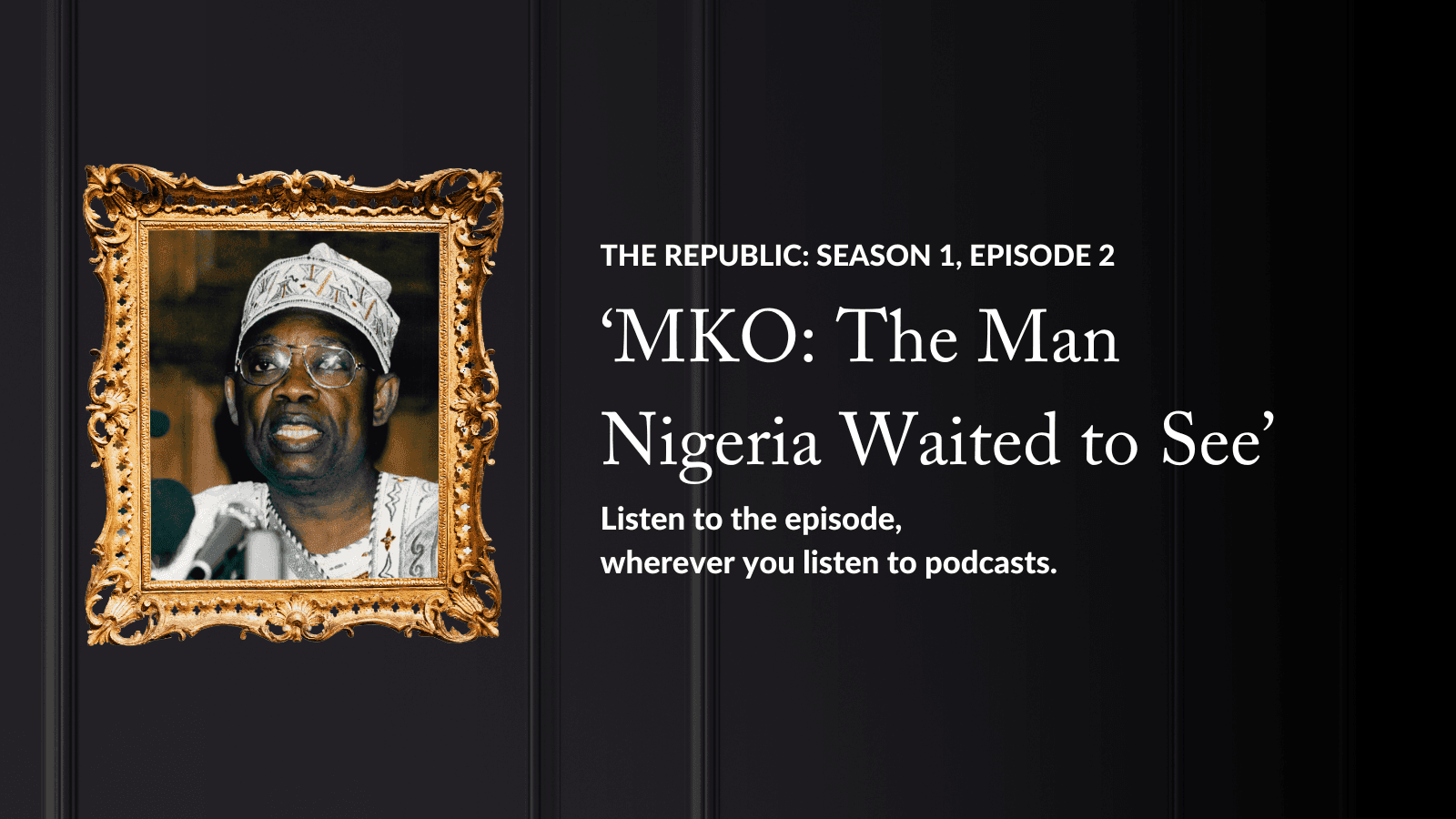
EPISODE 2: MKO, THE MAN NIGERIA WAITED TO SEE
How does a poor, quote—unquote nameless son of a cocoa trader born in the old Yoruba city of Abeokuta go on to become the almost president of Nigeria? Some may say grit.
Kola Abiola: MKO, started off very humble, very humble beginnings. I can remember us going to Lagos State staff school. My mother was teaching textile design at Yaba tech. We would always walk from school to join her at Yaba tech before we go home. Contrary to the stereotype, we did a lot of crawling before we started walking.
That was MKO’s son, Kola. MKO was born into a poor family in 1937; both his parents were traders. His dad sold cocoa and his mum sold kola nuts. As the first child in a poor family in the 40s, MKO began helping his father with his cocoa sales from as young as nine. And when his father’s business hit a tough time little MKO had to step up again and start his own business selling firewood alongside going to school. Still, according to numerous sources, MKO was a good student. He started off primary school at African Central School, Abeokuta and then went to Baptist Boys High School Abeokuta. Many boys that went to Baptist Boys High School eventually became notable figures in Nigeria’s history. The school’s alumni include Obafemi Awolowo, who became the premier of Nigeria’s Western Region; Thomas Adeoye Lambo, who is credited as the first western-trained psychiatrist in Nigeria; Onaolapo Soleye who was Minister of Finance under General Muhammadu Buhari’s military regime; and Olusegun Obasanjo, our two-time head of state.
Lieutenant General Olusegun Obasanjo in 1977: This military government is convinced that we must produce what we need, we must curtail our appetites for what we do not produce.
The clip you’ve just heard is of Obasanjo during his military regime in 1977. Obasanjo’s and MKO’s paths were inextricably linked, especially because of their similarities: both young men had ties to Abeokuta and big dreams that would take them beyond the ancient city.
As young boys, they both served on the editorial team of their secondary school’s magazine, The Trumpeter. MKO was the editor and Obasanjo was his deputy. As men, they moved within the same socio-political circles. Over the years, there has been great speculation about their relationship with some going as far as calling them ‘enemies’.
Mohammed Fawehinmi: Obasanjo hates Abiola, not just from secondary school even into the grave.
Those were pretty strong words from Mohammed Fawehinmi, a lawyer and the son of the publisher Gani Fawehinmi, in an interview in 2018, after President Buhari announced June 12 as democracy day. Until he died in 2021, Mohammed had been a champion of affirming MKO’s political legacy in Nigeria. He was also a staunch critic of Obasanjo for not properly commemorating June 12 during his eight-year tenure as democratic president. Rotimi Fasakin, a former chieftain of the ruling All Progressives Congress, confirmed the friction between MKO and Obasanjo in a 2018 interview with Channels Television.
Rotimi Fasakin: I remember what Chief, General, Dr, ex president Olusegun Obasanjo said then, in far away Zimbabwe that Abiola is not the Messiah that you all think, because he was my classmate. And I remember then that later on as part of mediatory work the then Archbishop Desmond Tutu came in from South Africa and the government arranged for him to see Abiola in incarceration and Obasanjo went with him. The newspaper reported that it was a very riotous time. Because the president elect confronted him. That you went ahead telling everybody that you were my classmate but you were actually my junior.
MKO’s political inclinations did not just suddenly appear when he ran for president in 1992. His desires for political participation and civic involvement can be traced all the way back to his teenage years. As a 19-year-old, MKO had strong nationalist zeal and joined the National Council of Nigeria and the Cameroons or ‘NCNC’, the party formed by Herbert Macaulay in 1944.
MKO joining NCNC is a vital piece of information because the other viable party at the time was Obafemi Awolowo’s Action Group. Action Group was essentially the formalization of the Yoruba political society, ‘Egbe Omo Oduduwa’. The party was ideologically socialist and was founded to serve as the platform for realizing Awolowo’s preliminary objective of mobilizing Western Nigerians to forestall NCNC’s control of the Western Region.
Before 1951, NCNC was the only national party in Nigeria. It won the Eastern regional seats in 1951 and also won the 5 Lagos seats in the Western Regional House of Assembly. Here’s Dr. Nnamdi Azikiwe, then the Premier of Nigeria’s Eastern Region, at an NCNC rally around 1959.
Nndamdi Azikiwe: In the words of one of the greatest men produced by the world, ‘we have been waging this struggle for charity for all and malice towards none.’ It makes no difference to me really whether I win this election or not. I want you to believe me and I am not talking politics. For 25 years of my life, I fought for the freedom of Nigeria. Nigeria will attain independence on 1 October 1960, so it makes no difference to me whether I or the Sardauna, or Tafawa Balewa of Chief Awolowo or myself will become the first Prime Minister. As long as Nigeria is free. I will be satisfied.
NCNC was an interesting party made up of several radical organizations that had emerged during the Second World War. The party began as a movement rather than a political party; between 1944 and 1951 it was pretty much a loose federation of diverse organizations including nationalist parties like the Northern Elements Progressive Union (NEPU), cultural associations, and labour movements.
When MKO joined NCNC, the party’s leadership was very diverse—at least ethnically. Nigeria’s first president Nnamdi Azikiwe was the party president, J. O. Fadahunsi who was Yoruba, was the first National Vice-President, Eyo Ita who was Ibibio-Efik was the First National Deputy President. NCNC also had a Sierra Leonean National Secretary in F.S McEwen and a Ghanaian National Auditor in A. K. Blankson. Despite this diversity, NCNC was tagged ‘the Igbo party’.
MKO’s first big break came in 1958 when he got a scholarship to the University of Glasgow to study Accounting. At the time, MKO had been working at Barclays Bank in Ibadan and would often shuttle weekly between Ibadan and Abeokuta to see his family. By now, MKO was around 21, his father was in his late sixties and his mother had died. As the eldest child, he was now the primary breadwinner.
MKO spent five eventful years abroad. He graduated from the University of Glasgow and then from the Institute of Chartered Accountants of Scotland. In 1960, MKO married Simbiat, his first wife and had his first child Kola in 1962. MKO would later go on to have several more wives and even more children. As of 1982, he had six wives and claimed to have 25 children in an
interview with Punch Newspapers.
When we think about MKO, we often only look through political and economic lenses; but who was he beyond campaign speeches, rhetoric and statistical variables? During my research for this podcast, Saratu told me that with a father like MKO, she inevitably felt like she was sharing him with Nigeria.
Narrator Wale Lawal: What was he like? Obviously, I mean, I wasn’t born. I was maybe like one at the time. But I will still say like to the rest of us Nigerians, he was this big, powering well-known figure. Saratu Abiola: I remember him as this person that would come by, we didn’t live in the main house, we lived outside of the main house, and he’ll come to visit. And he would carry me and we have just the most everyday conversations that I would assume people always have with parents. Tell me about school, tell me about your friends. And we would kind of just hang out. I think part of the reason why even as a child I hated the way that it would be…is because I wanted to hold on to that. Even then I wanted to hold on to that slice of normalcy, because it was the only thing that felt normal, and everything else felt overwhelming and crazy. So I was trying to hold on to that everydayness because I have to say, the reality of it is very normal for you know, your average… I guess in a lot of polygamous home, your main relationships are with the mothers and then your dad is this tiring figure out who’s, just he’s there but he’s not your primary relationship.
ABIOLA THE BUSINESSMAN
I spoke earlier about an interview MKO had with Punch Newspapers in 1982. In the interview, Tunde Obadina and Olusoji Akinrinade asked MKO what he attributed his new source of wealth to and MKO responded that it was the grace of God, some hard work, but mostly God’s blessing. The reporters probed further asking ‘Could it also be that you had powerful friends?’. To which MKO responded in the most Nigerian way, ‘Am I the only one who has powerful friends?’
By the mid 60s, MKO had moved back to Nigeria from the UK and now he had one goal: to blow. MKO landed a couple of accounting gigs at organizations ranging from the University of Lagos Teaching Hospital to the pharmaceutical firm, Pfizer. In 1968, during the Nigerian Civil War, MKO joined the Nigerian subsidiary of US telecoms company, International Telephone and Telegraph Corporation or ‘ITT’ as controller. Here’s Iniye Spiff, one of the writers of this episode, with a quick ITT explainer.
Iniye Spiff: So you are probably going to hear a bit about ITT in this episode and it’s only fair we explain a bit more about what ITT, the company, actually did. First of all, ITT has a really interesting history. So the company has been around for over 100 years, it’s one of those great legacy American companies. Essentially the company started off developing phones. So in 1920, two brothers named Sosthenes and Hernand Behn set out to build the first worldwide system of interconnected telephone lines. Today that doesn’t sound so revolutionary but in 1920, it would have been like the Apple of its time. And the company grew. It grew by acquiring and purchasing telephone patents. From 1960 to 1977, ITT acquired more than 350 companies its Nigerian subsidiary included and it had a portfolio that included well-known businesses such as Sheraton hotels, Avis Rent-a-Car, Hartford Insurance and Continental Baking, the maker of Wonder Bread in America. Just throwing this in there, I love to finding interesting connections but ITT had links to the third Reich in Germany during World War II. So let me explain real quick before I hand over to Wale. So as we know, war often results in improved technology. Also, ITT was doing lots of things beyond communication. There’s this book, Wall Street and the Rise of Hitler by Antony C. Sutton and it claims that ITT subsidiaries made cash payments to an SS-leader Heinrich Himmler. Essentially through its German subsidiary it owned 25 per cent of Focke-Wulf, the German aircraft-manufacturer, which built some of the most successful Luftwaffe fighter-aircraft. Long story short, ITT – Focke-Wulf planes were bombing Allied ships and ITT lines were passing information to German submarines, ITT direction-finders were saving other ships from torpedoes.In a 1983 journal by Prof Alaba Ogunsanwo he described ITT as ‘notorious but efficient’ and I think that’s such an apt description because of how many, shady contracts the company was a part of not in Nigeria but globally. I mean ITT was linked to the CIA in Latin America. There’s a 1980 Washington press article written by John Kerry with the opening line, ‘International Telephone and Telegraph Corporation has made questionable payments of millions of dollars beginning in 1975 and continuing into this year to gain huge telecommunications sales contracts in Nigeria.’
MKO’s work at ITT exposed him to several powerful people, including Colonel Murtala Mohammed who at the time was one of the most influential military officers. MKO’s wealth also grew significantly: according to historian Max Siollun, for instance, by 1972, MKO bought his first plane and took his dad on a casual rich flex trip from Lagos to Ibadan. Unsurprisingly, over time, MKO’s connection to ITT and his growing wealth became subjects of a lot of speculation. For some people, MKO’s wealth was the result of corruption and his entry into ITT marked the beginning of his allyship with the military and political elites.
For other people, those who view MKO as a commercial mastermind and strategist, MKO’s connection to the military was a smart investment. But what did MKO himself think? I asked a friend of mine, Dami Ade-Odiachi, to chip in here by reading MKO’s thoughts from the 1993 book, A Legend of Our Time: The Thoughts of MKO Abiola.
Before I hand over to Dami, here’s some useful context. In 1968, during the civil war, the Nigerian military needed communications equipment to give them the upper hand against the Biafran army. At the time, ITT seemed like the firm for the job. Initially, American firms were ambivalent about the war. But as the war went on, it impacted their profits and it became in their commercial interest to support the Nigerian government. The Nigerian military purchased equipment from ITT, but over time the military got preoccupied with the war and owed ITT a lot of money.
Dami Ade-Odiachi: The book reads: a long-standing debt of GBP 3.5 million owed by the Army for three and half years had been the subject of more than six volumes of inter-company memoranda between the [ITT] headquarters in London and New York. A delegation from London consisting of twelve top brass of ITT Africa and Middle East had been scheduled to meet the Army signals inspector, Lt.-Col. Murtala Muhammed on April 4, 1969. Naturally, I joined the delegation. Eleven of us waited in the Inspector of Signals waiting room from 7:30 in the morning till 3:30 in the afternoon when he left the office. The Inspector of Signals did not even say hello. We repeated the second and the third day with the same result. The United Kingdom delegation went back in disarray and frustration. The issue of the debt with the Army became urgent because on April 9, 1969, the first cheque I signed as controller of ITT Nigeria Limited was returned unpaid with the inscription ‘refer to drawer’. It was for GBP 500. Up till that stage in my life, I had never had to meet a bank manager to ask for overdraft.
In 1969, ITT’s Nigeria subsidiary was broke. But the story continues.
Dami Ade-Odiachi: Now, the International Telephone and Telegraph (ITT) system has dual leadership: that is, the general manager and managing director on one hand and the controller on the other, both of whom have direct reporting channels to headquarters. We had in Nigeria at the time a general manager who did not quite understand what was going on and if he understood he did not do much about it. The general manager spent more time in Lagos Boat Club than in the office. He had no marketing leadership or any form of managerial leadership to give to his team and people.
Enter MKO. MKO was not going to take no for an answer, so, after the UK delegation returned to London, he embarked on his own delegation. First he hit the books.
Dami Ade-Odiachi: I took all the files on the army transaction home and stayed up all night to get a proper handle on the situation.
When MKO felt he had a proper grasp of the transaction, he initiated step 2– he went back to see the army.
Dami Ade-Odiachi: At 5:30 in the morning, I proceeded to the office of the Inspector of Signals. I arrive at seven o’clock on the dot. Lt. Col Muhammed met me standing at his office at 7:29 am. He did not respond to my greeting but instead attempted to brush me aside. I refused to be brushed aside. The exchange of hot words ensued and continued for about half an hour during which time the Chief of Army Staff, then titled Chief of Staff, Army Brigadier Hassan Usman Katsina, arrived at the scene. He called the two of us into his office to question whether I knew who Lt. Col Muhammed was and I answered by asking whether Lt. Col Muhammed knew who I was.
Both Colonel Muhammed and Brigadier Katsina were stunned and impressed by MKO’s bravado. After further deliberations, they decided that the 3.5 million pounds would be signed off and paid. MKO collected the cheque and went back to the ITT office a hero.
But it wasn’t until he got to the office that stage 2 of his plan went into motion. His slow Tom Wambsgans ITT takeover gets very interesting. In Max Siollun’s book, Oil, Politics and Violence: Nigeria’s Military Coup Culture, he highlights that MKO and I’m going to quote this ‘got a photographer to take embarrassing photos of his boss cavorting about drunk’. According to MKO’s account in A Legend of Our Time:
Dami Ade-Odiachi: I proceeded immediately to London with the cheque and to report the affairs in the office and I insisted I could only carry on in the company if I became the managing director and at the same time was given no less than 50 per cent of the shareholding of the business. The managing director aspect of the request was granted immediately, but the shareholding part of it, I was told, required top policy consideration which would be resolved within six months on……The bottom line, in fact, was that I was requesting that at the determination of the profit for any year, half of that profit should be left behind in recognition of my contributions for making the whole profit. No more no less.
Initially, ITT wasn’t completely onboard with MKO’s requests and shut him down. But after MKO started his own company called Radio Communications Nigeria Limited and promised them a cut of a fictional 30 million pound deal, they took the bait and MKO was in! According to Max Siollun’s book, Nigeria’s Soldiers of Fortune, MKO admitted that and I’m going to quote this ‘They sold the shares to me, but the truth was that we [Radio Communications] had not landed any £30,000,000 contract. But it was too late for ITT to do anything about it.’
The shares became a goldmine. And just like that, MKO became the chairman of ITT Nigeria owning about 40 per cent of the subsidiary through Radio Communications.
MKO entered the 70s a rich and well-connected man and for him, this was only the beginning. MKO’s initial hostile connection with Murtala Muhammed morphed into a friendship. In fact, later in 1982, when MKO was asked about Murtala’s role in his success, he talked about how their relationship had grown from hostility. MKO claimed that Murtala was not just a friend but ‘a brother’.
The brotherly love was real: in 1974, Murtala almost single-handedly bankrolled MKO’s future business prospects. The Ministry of Communications had sent out a call for bids for a contract to provide telephone exchanges throughout Nigeria. Theophilus Oluwole Akindele, who was the director-general of communications at the time and Murtala, who was federal commissioner for communications, disagreed over the contract bidding process.
Murtala’s approach prevailed and he awarded ITT a contract worth 138.5 million dollars to provide telephone exchanges in 38 locations throughout Nigeria. These exchanges would handle 150,000 telephone lines (with the potential for more contracts worth over $1 billion dollars—around 6 billion dollars in today’s money).
Prof Toyin Falola: Abiola made his money from business he started as a technocrat with a multinational company, the ITT. He was getting contract for them from the military. And now he said look I’m no longer going to be collecting contract for you unless I’m your number one man. You know your cell phone that you now use did not exist before, it was a period of landline, he was the one who got the contract, the landline contract. They damaged so many roads. In the final analysis, it was a failed project. So the basis of his money was federal government contract which he now diverted to other businesses.
Not long after that, MKO and ITT became a tag team and their partnership earned them both millions of dollars and significant entry into the telecommunications market in Nigeria. ITT made millions from huge telecommunications sales contracts in Nigeria and MKO facilitated all those contracts. By the mid 70s to early 80s MKO was the man about town whose meteoric rise to fame had given him proximity to power.
Frank Underwood: Power is a lot like real estate, it’s all about location, location, location. The closer you are to the source, the higher your property value.
And, MKO’s property value was high. Between 1975 and 1983 MKO had built a strong relationship and rapport with Nigeria’s military leaders. Remember last week I spoke about a group of officers who constantly show up in Nigeria’s military history? Murtala Mohammed, Sani Abacha, Muhammadu Buhari, Ibrahim Babangida and Shehu Musa Yar’Adua—all had developed relationships with MKO. But on the political side, MKO wasn’t as well regarded. At least, not yet.
ABIOLA’S POLITICAL BEGINNINGS
Mr Gbenro Adegbola: Yeah. In the 70s, I knew very little of him. I think he got interested in the transition in 1979.
Mr. Gbenro Adegbola is a publisher and one of the people I spoke to for this podcast. He helped me understand that despite MKO’s commercial success and proximity to the military, in the political sphere, MKO had a visibility problem. He wasn’t really known there.
At least initially, MKO thought his lack of political visibility was a problem that money and proximity to power could fix. By 1979, MKO had peaked in the world of business. His numerous ventures included Abiola Farms, Abiola Bookshops, Radio Communications Nigeria, Wonder Bakeries, Concord Press, Concord Airlines, Summit Oil International Ltd, Africa Ocean Lines, Habib Bank, and even the now defunct football club, Abiola Babes F.C. Now, in politics, MKO nursed a new dream.
Julius Malema: I am going to be president of this country.
MKO wanted to be president.
In 1980, MKO joined the National Party of Nigeria or ‘NPN’ and that same year he was elected state chairman of the party. MKO pumped a lot of money into the party. In the 80s, John F Berry, a New York Times columnist, claimed that NPN sourced millions of dollars in funding from ITT, which was shared with officials in the party to bolster MKO’s chances of becoming the party’s 1983 frontrunner.
Mr Gbenro Adegbola: And then in 1982, leading up to the elections of 83, I think he tried to contest for the presidency, which was what led to that famous statement that ‘the presidency of Nigeria is not available to the highest bidder.’ And that says something about the reputation he had. He had that reputation of just a money bag, who had made tons of money out of the military. And he was fairly resented. And his attempt at running for presidency at that time was rebuffed with that statement.
MKO’s NPN run also reinvigorated an Abiola vs Awolowo narrative that dominated Yoruba political circles. Awolowo (the Yoruba political leader) was contesting for president for the second time under the Unity Party of Nigeria and was the favourite candidate for the Yoruba people. Previously, in 1956, MKO had bet against Awolowo by joining NCNC. In 1980, by trying to contest against Awolowo, MKO seemed to be doing the same thing again. But this time, MKO was older, richer and more powerful than he was in the 50s; so he thought he had a better shot.
In the American journalist, Karl Maier’s book This House Has Fallen, he talks about how MKO repeatedly used his Concord newspaper group to attack Awolowo. There were even rumours that MKO started Concord Newspapers in the 80s to counter the Nigerian Tribune, the newspaper Awolowo founded, which was at the time considered a mouthpiece for Awolowo’s political ideas.
Baba Aye: Abiola’s going to the National Party of Nigeria in 1978-79 was because he had always wanted to be president. It was clear to him that it was impossible for anybody to contest with Obafemi Awolowo for the presidential ticket of the UPN. The way he made money, a number of questions on that. But with time I know that let’s focus on his politics. He played the role of spoiler as much as he could to the UPN in the southwest working closely with the likes of Adeniran Ogunsanya. In fact, younger generation might not realize that he established the National Concord to fight the UPN in the southwest. So it was the counter to both the Nigerian Tribune and the Daily Sketch. And Obafemi Awolowo had a name for the National Concord. He called it the National Discord.
By 1983, the incumbent president and NPN frontrunner, Shehu Shagari was supposed to step down. MKO thought Shagari should step aside for a Yoruba man, and that this Yoruba man should be him. But MKO miscalculated because Shagari decided to run again. With his funds wasted, MKO left NPN. I asked the historian, Professor Toyin Falola how MKO’s departure from NPN happened.
Prof Falola: He did not run; he wanted to run to replace Shagari. And he lost and he became angry. He became very angry. And he used a memorable anecdote. He said,’The Fulanis, they love their cows and they milk the cow for food. But they don’t want to yield the cow. So he said the NPN wanted him to be taking in the milk, but they didn’t want him to yield the cow.’ It was a big fight. And he said, Okay, he will not accept the proposal that will not make him a presidential candidate. Very good. You know, you can be angry. But what are your options? His options were very limited. In fact, I think his enemies also calculated wisely that the man had no option. Why did I say that? He could not join the UPN under the influence of Awolowo. Indeed, there was no way the UPN would even have made him a prominent member. Remember, similar to the rise of Tinubu and in the first election, second election of Obasanjo, they were rejected by their own people. The Afenifere and some Yoruba people. There was no way Abiola would have run under the UPN.
MKO left NPN with a renewed sense of purpose and a mini vendetta. Already, Shagari’s poorly performing administration provided MKO and his friends the ammunition they needed. Shagari’s government oversaw the dramatic global oil price crash as well as the scapegoating and expulsion of West Africans in the Ghana must go saga of 1983. Through Concord newspapers, MKO played a crucial role in the coup-baiting that plagued Shagari’s administration, before Shagari was finally deposed by Buhari, in 1983.
MKO’s newspaper would publish headlines like ‘Nigeria set to combat recession?’harshly criticizing the government’s handling of the economy. In Shagari’s memoir, Beckoned to Serve, Shagari implicitly blamed a ‘well-known business tycoon’ for financing and supporting the coup. He didn’t provide a specific name but it was kind of obvious who he meant. It was common knowledge at the time that MKO had supported both the 1983 coup that brought in Buhari and the 1985 coup that brought in General Ibrahim Babangida or ‘IBB’.
IBB himself once publicly confirmed that the military couldn’t have taken over without collaborators across civil society, media, or without the wealthy who were convinced it was the right thing to do. In Karl Maier’s book, IBB claimed that MKO was ‘also very good at trying to mould the thinking of the media.’ IBB said the military relied on MKO a lot for both media and financial support.
But there might have been more to the story. If MKO truly supported these coups, did he do so while waiting for his own shot at the presidency? By many accounts, MKO believed IBB had promised him a clear path to the presidency. IBB’s eight-year regime was meant to usher in a democratic president and the regime was wrapping up. MKO was ready.
At first, after IBB promised Nigerians that he would restore Nigeria’s democracy, MKO was coy about his political ambition. You can hear this in an interview MKO gave at the time.
MKO: If the time is right, it all depends on a lot of things….we wish you luck sir.
MKO’s eventual motivation to run was just as unclear. He of course had his political ambitions but he wasn’t a 100 per cent sure about running. In fact, like many people in MKO’s family, Saratu believed one of the main reasons MKO ran for president was because IBB encouraged him to.
Saratu Abiola: But we were sure because IBB told him to run. I’ve never seen anybody actually mention that in any of the recordings on the history of the time. But IBB and Abacha told him to run. But Abacha was not unfriendly to him, Abacha was a benefactor at that time. IBB told him to run. Even though there were a lot of reservations about it. I mean, people are like, this presidency thing is that not too much wahala you are inviting on yourself. And he was like wavering. Okay, maybe I shouldn’t. And then IBB was like ‘no, no, no you should totally run.’ And that’s what convinced them to run. But he visited him personally, to tell him to run. He came to the house and told him he should run. There were some political machinations happening at the time. And it was very clear that I mean, yeah, I mean, he was well loved. So we were confident. It wasn’t a lack of confidence from the people that had questions. He was very well loved around the country, we were very confident that he would win. He was loved everywhere, north, south west, wherever. But it was more like, are you not inviting plenty wahala on yourself?
Because MKO had attempted to run for office in 1982, he was affected when IBB introduced the 1987 ban restricting former politicians and public officeholders from participating in presidential elections. MKO even challenged the ban at the tribunal but he was unsuccessful. That didn’t matter eventually because in 1989, IBB lifted the ban, and then MKO joined the Social Democratic Party or ‘SDP’. When MKO joined SDP there was a lot of internal politics.
If you remember from last week’s episode, SDP was one of two political parties IBB made eligible to participate in the elections. The other party was the National Republican Convention or NRC. Both SDP and NRC were collapsed versions of several smaller parties and as you can imagine, those small factions were very alive within SDP and NRC, which made them full of political wrangling and internal rivalries–we will get more into those in the next episode.
The factions within SDP were the People’s Front of Nigeria, the Governors and the People’s Solidarity Party. Ahead of the SDP primaries in 1992, MKO was a frontrunner for the presidential candidacy and had rivals in prominent SDP member Atiku Abubakar and SDP’s national chair, Babagana Kingibe. At the SDP convention, MKO took a slim lead with Kingibe following closely behind and Atiku placing third. But here’s where it gets interesting: MKO and General Shehu Yar’Adua (an SDP leader) struck a deal.
Yar’Adua basically told Atiku to step aside for MKO (with the understanding that Atiku would be MKO’s running mate if MKO won the primaries). To back MKO, they activated the political machinery of the People’s Front and in January 1993, MKO came out on top. In March that year, NPN held its convention in Jos and MKO was elected NPN’s presidential flag bearer. But contrary to Yar’Adua’s plans, MKO chose Kingibe over Atiku as his running mate. In a recording he shared with NTA in 2019, Kingibe recalled that:
Babagana Kingibe: As you can imagine under these circumstances of a presidential candidate emerging that there would be many pressures on him and also you’ll recall that he earlier entered into an agreement with General Shehu Yar’Adua and the Atiku Abubakar group. That in return for their support for him in the runoff primaries between me and him, he would pick Atiku as his running mate. Clearly the incumbent president at the time was not totally disinterested in the ticket. And one understood that he had his own ideas as to who he would have wished MKO Abiola to pick as his running mate. So I am sure all these pressures must have had a bearing on him.
Now, MKO had a party and a mandate. His next task was to convince Nigerians, many of whom knew him for his vast wealth, but not really for his political beliefs. MKO would also need to galvanize supporters for his party after the belief that he had once again betrayed the South West by choosing Shagari’s party over Awolowo’s. Awolowo was a known socialist, while MKO was a staunch capitalist. Even then, MKO had emerged as the front-runner of SDP. The Social. Democratic. Party.
Prof Falola: And those manifestos, whether you like it or not, when you join a political party, you began to say, ‘you know, I’m SDP. I am a socialist.’ ‘I am NRC, I am a capitalist.’
Already, you can see some inconsistencies within SDP and MKO’s political leanings. We’ll go into this a bit more in the next episode when we zero in on the June 12 parties.
MKO embodied the essence and contradictions of what you could call then, the Nigerian dream. He rose from the depths of poverty to aspire to the highest office in Nigeria. It’s tempting to cast him as a martyr, a champion of democracy battling against the corrupt political system. But it’s also important to remember that he was also very much a part of that system. His controversial takeover of ITT in Nigeria and his connections to the military elite solidified his wealth and influence.
In a society like Nigeria, where wealth and power hold great sway, it is possible that we don’t scrutinize MKO’s rise as thoroughly as we should. People, especially when they are public figures, are complicated, messy, but they are still people. MKO was an outlier from the get go. But it’s that personality he had; how he presented himself as someone any Nigerian could claim, or that any Nigerian could become, if they had enough grit; these were the things that clearly endeared him to Nigerians even years after the June 12 election.
OUTRO
The lawyer and politician, Bola Ige, once remarked that NRC and SDP were two sides of the same coin. Next week on The Republic, our big question is: to what extent is this statement true?
We’ll take a closer look at both parties, evaluating what they stood for especially in the context of that long debate on whether Nigerian political parties have clear ideological leanings. Other questions we’ll be asking include, what political vision did MKO share as SDP’s frontrunner that made him such an alluring presidential candidate? What was it like to campaign and experience political campaigns during the MKO era?
At the end of the episode, we want you to know what it was like at the onset of what would go down in history as the most controversial election that has ever happened in Nigeria.
Thanks to Peace Onafuye, Iniye Spiff and Victoria Audu for the archival audio you heard on this episode and our overall research.
You’ll find a full list of the books, articles, and documentaries that we relied on in researching this episode at our website, republic.com.ng/podcasts.
The Republic is produced by the Voix Collective. Our script writers are Iniye Spiff and, myself, Wale Lawal. I am also the editorial director⎈
The views, thoughts, and opinions published in
The Republic belong solely to the author and are not necessarily the views of
The Republic or its editors. We want to hear what you think about this article. Submit a letter to the editors by writing to
editors@republic.com.ng.








Comments
Sign in to comment.