Before the June 12 election, Nigeria had local, legislative and gubernatorial elections. These happened between 1990 and 1992. And people looked to these elections for a sense of how the presidential election might play out. But from the results, it wasn’t immediately clear where the party strongholds were.
During the 1991 gubernatorial elections, NRC, the so-called right-wing party, won 16 of the 30 state governorships and gained control of 13 state assemblies. SDP won control of 16 assemblies, including those in Lagos, Katsina and Cross River, three states where NRC had won the gubernatorial poll.
The results seemed to herald the end of regionalization in Nigeria.
During the 1992 legislative elections, regional party lines were a bit clearer. SDP won 52 seats and NRC won 37 seats in the Senate elections. And for the House of Representative elections, SDP won 314 seats, while NRC won 275 seats.
SDP’s support came from Lagos and the middle-belt states including Taraba, Plateau and Kwara. NRC support came mainly from Muslim Hausa and Fulani-speaking states in the North. Fighting was reported at polling stations in several states, mainly in the South East, and a number of elections were postponed in other areas because of logistical issues from the electoral Commission.
This is The Republic, a podcast about pivotal African figures and historical events. Our first season looks at Nigeria’s controversial June 12, 1993 elections. I’m your host, Wale Lawal.
So, by now we kind of know SDP. We know that it was the party MKO ran under. We also know that it was the party that was a little to the left. But what about SDP’s rival NRC? Well, I’m going to borrow from Beyoncé and tell you that Nigeria has a party problem. In today’s politics, we hear it a lot that Nigerian political parties have no clear political ideology. Even if you disagree with this argument, you agree that it’s very difficult for the average Nigerian to say, ‘Hey, these sets of beliefs are what this party stands for.’ This problem is an old problem.
Let’s go back to IBB’s regime. On paper at least, he tried to impose the typical Western split of left and right with how he went about forming SDP and NRC. But in the end, both parties were still largely the same. Both parties were offshoots of other smaller parties with active membership from the so-called elder statesmen.
In episode one, we touched on the two-party system IBB created. In today’s episode, we’re going to focus a bit more on the two parties. Who were the actors in NRC and SDP? How did MKO become the SDP candidate? Brace up: we’re going to hit you with many names and many dates. So, open your notes app or your notebooks, and hold to your seats because here we go.
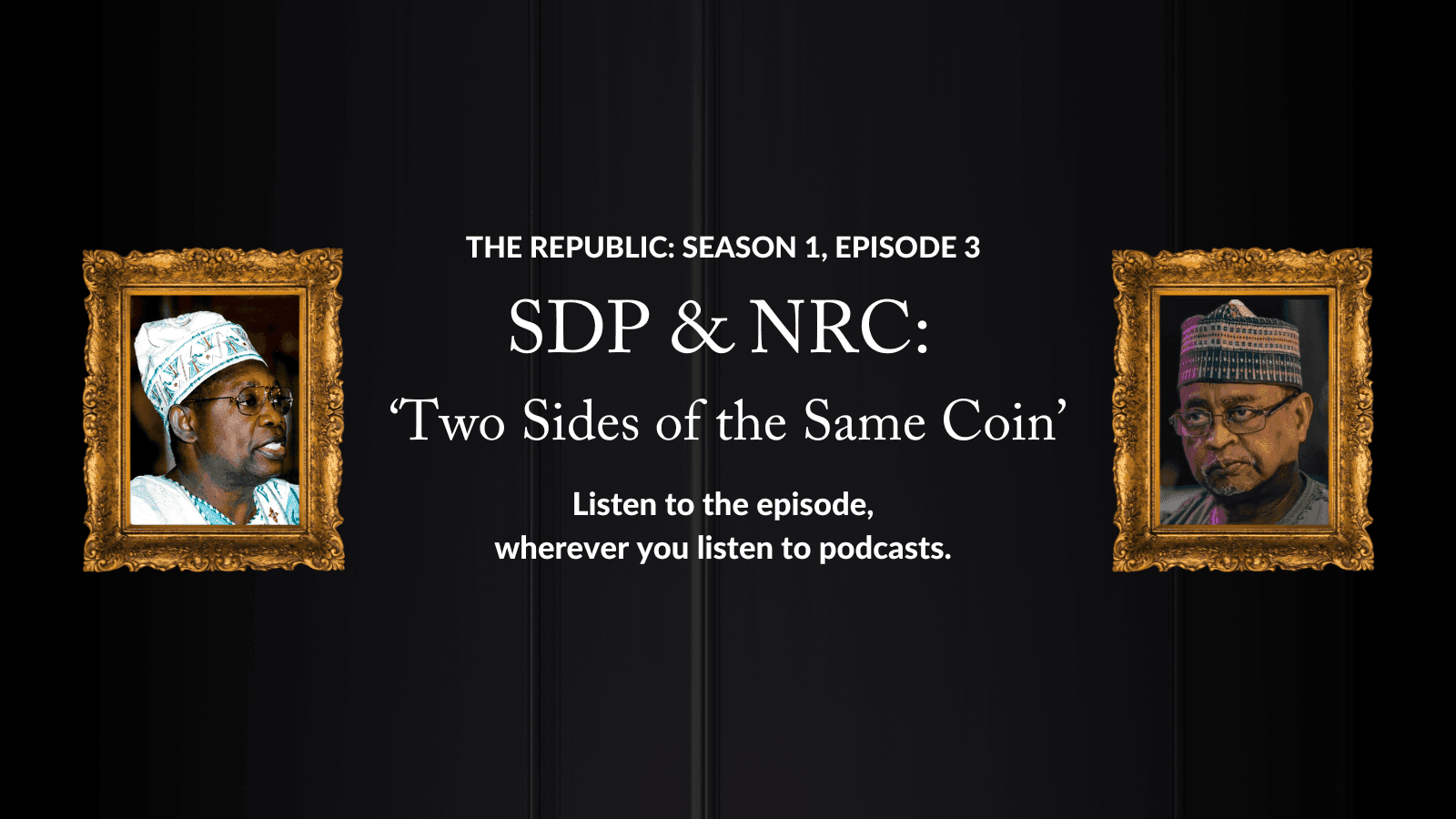
EPISODE 3: SDP AND NRC, TWO SIDES OF THE SAME COIN
SDP AND NRC BIG WIGS
At first, many Nigerians believed that IBB was delaying the democratic transition because he wanted to transfer power to himself. Baba Aye seemed to share this idea.
Baba Aye: But he wanted to be in control of it. Initially, it was clear that he wanted to self transit. But I think he got lost in the labyrinth of realizing how almost impossible that was and with several interests impinging on it, lost control of things.
Views changed by 1989, after he had announced the formation of SDP and
NRC.In 1990, elections were in view. Now, both parties had to choose their National Chairmen at their party conventions. It wouldn’t be Nigeria if there weren’t ethnic rules to play by. The plan was, if the party chairman came from the South, then the presidential ticket would go North.

In NRC, Emmanuel Iwuanyanwu was a party big wig. He first emerged in the political scene as the National Chairman of the unregistered Nigeria National Congress. The NNC was later absorbed by NRC. Iwuanyanwu wanted a Northern Chairman because he had his eyes on the presidency. But there were other games at play. Adamu Ciroma and Umaru Shinkafi were also NRC heavyweights who were formerly in NNC. Being from the North, they wanted a party chairman from the South because they also wanted the presidency for themselves. Ibrahim Mantu and Tom Ikimi–both politicians–slugged it out for party chairmanship at the NRC convention in 1990. With most of the presidential aspirants being from the North, Tom Ikimi won. And Mantu would later steer an unsuccessful presidential campaign for Alhaji Bashir Tofa, NRC’s candidate for the annulled 1993 election.
Ciroma had been circling and dipping his toe into the presidential race. After IBB lifted the ban on old politicians of the first and second republics, Ciroma firmly entered the contest in 1991. At the NRC party convention in 1993, he won the presidential primaries and Iwuanyanwu became his running mate.
So a quick recap: by 1992, NRC had Ikimi as its national chairman. NRC also had Ciroma and Iwuanyanwu as its presidential candidates.
Now let’s go a little to the left, to SDP. Remember those party factions I spoke about earlier and the so-called elder statesmen? Well, Shehu Musa Yar’adua was an SDP elder statesman.
Shehu Musa Yar’adua is Nigerian political royalty. I’m going to let Peace Onafuye and Iniye Spiff, who helped with research and writing for this episode, tell you a bit about who he was:
Peace Onafuye: Shehu Musa Yar’adua was an army general–the youngest major general in Africa Iniye Spiff: He was the son of Musa Yar’Adua–the Minister of Lagos Affairs during Nigeria’s First Republic and Matawalle of Katsina.
Peace Onafuye: He was the older brother of former president Umaru Musa Yar’adua, who took over from Obasanjo as democratic president in 2007. Iniye Spiff: He was an active participant in the military coup that deposed General Yakubu Gowon.
Peace Onafuye: After the success of the coup, he served as Transport Minister in General Murtala Muhammed’s regime. Iniye Spiff: He was Obasanjo’s second in command after the 1976 coup and then became deeply involved in Nigeria’s political structure.
Thanks guys! The recommendations from the 1987 Political Bureau and the Constituent Assembly initially prohibited Shehu Musa Yar’adua from being directly involved in politics but he had…shall we call them henchmen? Maybe allies. Allies sounds better. He had allies who represented his political interests at the forum.
Yar’adua would eventually become an SDP kingmaker, but before he planted his feet into SDP, he was shooting his shot at becoming the frontrunner of the political group, People’s Front Nigeria or PFN. The People’s Front included the likes of Ambassador Babagana Kingibe, MKO’s eventual running mate; SDP chairman, Atiku Abubakar (who would later become vice President of Nigeria from 1999 to 2007; Bola Ahmed Tinubu, the current president of Nigeria; two-time Kano state governor Rabiu Musa Kwankwaso; so-called father of the People’s Democratic Party, Lamidi Adedibu; and Chuba Okadigbo a man who once called Nnamdi Azikiwe an ant.
Here’s Obasanjo in 2017 discussing Shehu Musa Yar’adua’s entry into politics.
Olusegun Obasanjo: I remember when Shehu Yar’adua came to see me in my farm saying that he was going to form a party. He of course left me in no doubt that the purpose of forming the political party was not for him to use it to attain highest political office but to use it to achieve making Nigeria a great nation.
Yar’adua’s party and the big names associated with it merged with other smaller parties to become SDP. Another major faction with SDP was the People’s Solidarity Party, PSP. But unlike the other factions within the party, the People’s Front faction was considered more organized and this feature made them hold significant political weight.
In 1990, there was a general belief that the SDP party chair would be from the North. The factions within the party went to their posts. Led by Shehu Musa Yar’Adua, the PFN faction supported Babagana Kingibe, a Northern politician who had previously been their chairman while the PSP faction supported Mohammed Arzika. Kingibe held a lot of political goodwill and won. In 1990, he was elected party chairman.
Alright, so now the SDP party chairman is from the North. By the zoning rules I explained earlier, we should automatically expect a presidential aspirant from the South. Right? Well…
IBB’S BAN
Let’s zoom out a bit. It’s important to understand first that Yar’adua played a very key role in SDP. During IBB’s ban on political activities, Yar’adua kept on politicking. The military government caught up to this and in January 1992 he had a short stint in jail. But get this: shortly after IBB repealed the ban, Yar’adua announced his presidential bid.
Shehu Musa Yar’Adua: I hereby solemnly declare my intention to seek the nomination of my party the Social Democratic Party to the office of the president of our great country.
At this time, MKO was barely in the picture. In contrast, Yar’adua had a nationwide campaign structure for the SDP presidential primaries. He had a national campaign directorate. He also had campaign coordinators and ward mobilizers in every state. His campaign group included people like former PDP chairman Anthony Anenih, Atiku and Tinubu. Before MKO was a real contender, Yar’Adua was leading the SDP presidential primaries. In fact, he won in the SDP’s presidential primaries of 1992, with about 480,000 votes, dominating his primary opponent, Olu Falae, in the first round.
But on October 16, 1992, IBB annulled the results of both SDP and NRC primaries. IBB’s government accused both parties of electoral malpractices. The Armed Forces Ruling Council or AFRC nullified the results and then dissolved NRC and SDP’s party executives. The government then barred their candidates from contesting again. This ban would affect Shehu Yar’Adua along with figures like NRC’s Ciroma and Iwuanyanwu.
The ban sent shockwaves through SDP and NRC. Both parties had to go back to the drawing board. The publisher, Mr Gbenro Adegbola, helped me understand how the fall out of the ban created an opportunity for MKO.
Mr Gbenro Adegbola: But to my mind, his entry into politics was sudden, and it really came, if I recall, well, at the point when the old breed politicians were banned, and new breeds were being projected and promoted. His emergence to my mind, to my recollection, was sudden.
IBB was deeply involved in the political process. And the nature of his involvement has puzzled historians for years. On one hand, IBB seemed like this puppet master who was dictating the pace of the game. This made a lot of people believe that IBB never really intended to let go of power.
But on the other hand, IBB also seemed to be making all the right democratic moves. After he suspended the results in October 1992, he restructured the military government and replaced the AFRC with the National Defence and Security Council. The council was led by Chief Ernest Shonekan, a prominent corporate executive from the South West. More importantly, Chief Shonekan was a civilian. IBB created a clean slate and now the National Electoral Commission, had a new assignment. The NEC had to ask itself: How do we conduct primary elections that are as credible as possible? Enter Option A4.
I have my friend Jola Ayeye from the I Said What I Said Podcast in the studio with me today. Here’s Jola explaining what Option A4 was. Jola Ayeye: Okay, so as we know the initial 1992 primaries were sha just very corrupt. The presidential primaries were supposed to hold in six rounds of 5 states per round and you had heavyweights in the contest. In both NRC and SDP there were rumours of proper rigging and trust Nigerians, people went to court tire to prove that rigging happened. So, after IBB cancelled the primaries, the NEC came up with a new nomination process, Option A4, which was an open ballot system. If that sounds awkward that’s because it is. Think of it like this IBB was tired of a corrupt system so he said wo, everybody will see who you voted for. So if you were voting Obi, everybody will see because you would be standing on the Labour party ballot queue and if you were BATified then everybody would see too.. You get? It was also a knockout contest. So the top 3 candidates from each round would move to the next stage from the wards to local level to the state level and then finally at the national party level. It essentially was like World Cup knockout stage.
SDP now had 155 aspirants. NRC had 133. But between both parties, only a few people mattered. In SDP, these were Babagana Kingibe, Atiku Abubakar and MKO Abiola. NRC’s key members were Dalhatu Tafida and Bashir Tofa. In SDP, the factions emerged again.
It was like that tweet where the dad says, ‘Ayomide rise, don’t waste my money’. PFN, the Governors and PSP, aligned with their respective candidates. PFN, chose Atiku because of his relationship with General Shehu Musa Yar’adua. Governors chose Kingibe and the PSP faction chose MKO likely because of its historical southwestern ties to figures like Bola Ige, Pa Michael Ajasin, Lateef Jakande and Ebenezer Babatope.
The process for the primaries was long. To become a contender, you had to succeed at the ward, local government and state levels. All roads were now leading to the SDP convention in Jos. In Lagos MKO’s campaign machine was revving up. You could already hear it in Opebi, the neighborhood in Ikeja, where MKO had set up his ‘Hope 93’ secretariat.
THE CONVENTIONS
MKO had lost one presidential ticket in 1983. He wasn’t about to lose another. Going into the national convention, MKO had won 375 votes unopposed at the wards, 383 out of 386 votes at the local government level and at the state convention, he won 1,112 out of 1,146 votes.
On the 25th of March 1993, the night before the national convention in Jos, MKO was in Kaduna meeting with high-level members of his party.
MKO Abiola: Everybody has got a role to play in history. One either fulfils one either fulfills one’s role or betrays it. We’ve been told by our leader that our role tomorrow is to cement the bridge and to unite this country in future prosperity and concord harmony. Those in support of this call should raise their two hands… SDP, progress!
You can hear MKO rousing up the crowd. Picture it: the crowds are cheering and raising their hands in support. MKO is working the room and the people love it. Several political insiders have claimed that MKO’s trip to Kaduna was also to secure a deal between PSP and PFN, the two factions of SDP. And MKO somehow was able to achieve that. Ahead of the national convention at a party meeting in Hamdala Hotel in Kaduna, there is a video, where you can see Shehu Musa Yar’adua lifting MKO and Atiku’s hands in front of a large crowd… The deal was that PSP and PFN would put their aspirants in the first and second slots. So that MKO would be number one and Atiku number two.
Kingibe recounts this deal in a 2019 interview with NTA:
Babagana Kingibe: Also, you would recall that he had earlier entered into an agreement with General Shehu Yar’adua and the Atiku Abubakar group that in return for their support in the runoff primaries between me and him, that he would pick Atiku as his running mate.
On the 27th of March 1993, the SDP candidates were in Jos. Over 5218 SDP delegates from all the wards showed up. There were over 30 presidential aspirants but our men of the hour, MKO, Kingibe and Atiku, were heart in hand at the Convention.
The election played out over two rounds. In round one, the aspirants gave a three-minute speech to the delegates.
MKO was electric. He played on the popularity his wealth and political affiliations had given him.
MKO Abiola: SDP! Everyone in every home knows MKO! Yes or No? .. Good. You know me because of my involvement all my life in the government of every society not only in Nigeria but throughout Africa, yes or no?
But he didn’t stop there. He talked about how he pulled himself up from poverty. Nigerians, as you know, love a grass-to-grace story.
MKO Abiola: I was born very poor, I’ve seen poverty and fought it and by the grace of God I have won the battle against poverty. I am appealing to our great party to let me do the same for this country as a whole. MKO Abiola: For God sake, give me your mandate and I will continue to serve with dedication and with total commitment.
Another thing that stood out from MKO’s initial speech was his reference to party unity and the need for NRC votes. It’s an election and you need votes, sure. But MKO promised that he could even secure votes from NRC governors.
MKO Abiola: Our party is at least 1.5 million votes behind the NRC, I have the approval of at least 7 NRC governors that they would vote for me. We need NRC votes…
Now, it was Kingibe’s turn. Kingibe had a slight upper hand. Unlike MKO, he was deeply entrenched in party politics. People didn’t see him as just this rich guy they might have seen before on TV or in newspapers. Kingibe was known across all the party wards and local government areas nationwide. And don’t forget, he was elected as the party chairman in 1990. So even before facing NRC, MKO had some tough competition within SDP.
Kingibe’s speech was heavy on ideology. He wanted the delegates to know that he was a party man through and through. It was very intentional. MKO came across as ideologically inconsistent. He was a staunch capitalist in the Social Democratic party. To Kingibe, Ideology was MKO’s Achilles heel. In his speech, Kingibe kept referring to himself as a progressive. He emphasized that SDP was a progressive party. He even stressed that the kind of leadership Nigeria needed was progressive leadership.
Babagana Kingibe: By the grace of God, I offer you leadership; proven one, tested one.
MKO, Kingibe and Atiku came out as the top three candidates after a long voting process that went into the next day. While our top 3 still remain our focus, the candidate who came fourth might surprise you. At the SDP convention in 1993, Sarah Jubril, a politician from Kwara State, was the only woman in the race. She won the presidential nomination for her state. She had run for president on four different occasions and was Nigeria’s first female presidential candidate both at the primaries and main elections. Years later, at the 2011 presidential election primaries, Sarah was the only female PDP candidate. She eventually lost to President Goodluck Jonathan with only a single vote.
Prof Tony Adeniran: There are three candidates, the third place is taken by Dr Mrs Sarah Jubril who scored one vote. His excellency the Vice President of the Federal Republic of Nigeria Atiku Abubakar scored 805 votes, Dr Goodluck Ebele Jonathan scored 2,736 votes.
At the SDP primaries in 1992, Sarah won 950 votes. By the second round of the SDP primaries, it had become a two-horse race. During his speech, Atiku officially withdrew from the race.
Atiku Abubakar: In order to ensure a violence-free elections tonight, I beg and I plead to discontinue.
MKO and Kingibe continued the race. MKO’s round two speech further revealed his idea of governance. Anyone listening could easily tell that he hadn’t fully bought into being on the ideological left. At one point during his speech, he even said ‘Governance is business’.
MKO argued that being a businessman made him the best candidate to govern Nigeria. When Kingibe took the stage, things took a dramatic turn. Kingibe went straight for MKO and outrightly rejected MKO idea’s that governance is business.
Babagana Kingibe: I want to tell each and every one of you that government is not business.
But after his speech, Kingibe got off the podium, walked up to MKO and gave him a hug. Both SDP men saw each other as fair and equal competitors and there didn’t seem to be any bad blood. Later, rumours would emerge that Atiku had stepped down on instruction from General Yar’Adua. The rumour was that Yar’Adua and MKO had agreed that PFN would rally behind MKO, who would then choose Atiku as his running mate.
PFN rallied behind MKO and he won the SDP primaries that night with 51.4% of the total votes. Kingibe accepted the results, congratulated MKO and prayed for SDP’s success. In a parallel universe, that might have been the end of the story. History would have MKO winning his presidential ticket, choosing Atiku as his running mate and Kingibe leaving the picture. But in our universe, that wasn’t the case.
MKO chose Kingibe as his running mate. According to Kingibe, MKO believed that Kingibe could ‘add value’ to the ticket. MKO and Kingibe ran on a Muslim-Muslim ticket. It’s interesting because nowadays, same-faith presidential tickets are frowned upon. We saw this during the 2023 election. In the backlash that followed when Tinubu and Kashim Shettima, two Muslims, emerged as APC’s presidential and vice-presidential candidates. Nigerians argued that it’s not democratic if our presidency doesn’t represent our religious diversity. It’s a tempting argument but we never seem to extend that argument to Nigerians who have indigenous beliefs.
In 1993, MKO and Kingibe’s Muslim-Muslim ticket wasn’t the most crucial point on the agenda. For some people at least.
Babagana Kingibe: Babangida was not pleased at all and he told him, according to MKO Abiola, that why should he pick a Muslim as a running mate and that a Muslim-Muslim ticket would undo all that he had done to create a Muslim-Christian balance.
At NRC, Bashir Tofa won the presidential ticket at the party’s convention. They held their convention in Port Harcourt in March 1993. Tofa chose Sylvester Ugoh, a former governor of the defunct Central Bank of Biafra, as his running mate.
MKO and Tofa were not that different. There was a perception that both candidates had close ties to the military, and therefore their election would be in the military’s interest. The two men were close associates of IBB. Where they differed was that IBB tried to discourage Tofa from contesting the election because he thought that Tofa was not a winning candidate. Well, he wasn’t wrong.
AHEAD OF THE RACE / THE DEBATE
Debate host: Thanks very much Bashorun Abiola and Alhaji Bashir. The first issue is SAP and Bashorun Abiola, I will be coming to you.
That was the host of the 1993 presidential debate. Weeks before the June 12 1993 election, millions of Nigerians sat glued to their TVs watching Nigeria’s first ever televised presidential debate. MKO and Kingibe were representing SDP. Tofa and Ugoh were representing NRC. The host was asking MKO and Tofa about SAPs. These were known officially as Structural Adjustment Programme policies. And they were policies the International Monetary Fund was recommending to several struggling economies, especially in Latin America and Africa.
SAPs were pretty controversial: they typically involved downsizing the government, privatizing state-owned companies, liberalizing markets and opening them up to free trade. They were often criticized as being ‘one size fits all’ policies. Because they didn’t always take into account that countries faced different contexts and had different needs.
Here’s Lawrence King, an Economics professor at the University of Massachusetts Amherst, discussing SAPs further with the Real News Network in 2018.
Lawrence King: These are policies that could cover literally any facet of an economy and they almost always,not always, but almost always seek to privatize assets and to liberalize markets and to reduce inflation. Often, they don’t work, but so some examples would be in Georgia in 1996 the IMF asked Georgia to ‘reduce the number of ministries and committees.’ In Bulgaria, they were asked to submit amendments to the labor code to make hiring, firing and working hours more flexible. In Moldova, they were asked to cut 4,000 jobs from the state budget that were paid for by the state budget, etcetera, etcetera, eliminate tariffs, privatize particular industries. These are all examples of structural adjustment programs.
During the 1993 election, everyone wanted to know what MKO and Tofa were going to do about Nigeria’s SAPs. At the debate, MKO responded first. He thought Nigeria needed something other than SAPs.
MKO Abiola: SAP is not an SDP policy, it is a policy of the federal Military government… It’s not going to be our policy, we have an SDP economic policy that will really deal with excessive money supply.
Under IBB, Nigeria’s economy had been declining rapidly. We were heading to an inflation rate of over 70 per cent, and a foreign debt situation of over $30 billion. Months later, a report from the New York Times would have as its headline: ‘in Nigeria’s Mess, A Frustration For All of Africa’. In response to Nigeria’s economic situation, SDP took a pro-poor stance. Their core economic plan included tackling inflation, increasing standards of living and addressing Nigeria’s budget deficit. For MKO, the solution to Nigeria’s economic problems was simple.
MKO Abiola: You must cut your coat according to the cloth you have available, not your size.
And for a long time Nigeria’s poor had borne the brunt of poor economic planning. MKO admitted that things might be difficult at first. Adding that however, Nigerians would begin to see improvements within six months of his government. For Tofa, SAPs weren’t the problem. He believed the problem was that SAPs had been implemented badly.
Bashir Tofa: So SAP came, and SAP came with intentions that were made to serve the purpose of the economy. I don’t think there will be any government who will bring bad policies to make things difficult for the citizens. It was a policy that was very well conceived but unfortunately went sour because it was very poorly implemented.
To say that SAP is a bad policy per se would not be very accurate. But to say that the implementation was bad and that there is a need to review SAP… I think that would be a very reasonable approach.
CONCLUSION
In mainstream readings of Nigeria’s history, IBB’s rationale for instituting the two-party system was to inject ideology into Nigeria’s political machine and avoid party ethnocentrism. But a closer assessment of both objectives shows that he wasn’t successful. On paper, NRC and SDP were meant to be ideologically different but in practice and at the top levels of the party, this difference was not clear.
Tofa and MKO were deeply acquainted with IBB. Their two parties had elder statesmen pulling invisible strings. And both parties still prioritized ethnic splits and allegiances within their structures. For all the challenges with party structure, the silver lining was the Option A4 voting process at the primaries and, the willingness of contestants to actively engage with the issues of the day. For MKO Abiola at least, the primaries transformed his image from that of a political newbie to that of a political maverick. MKO had an infectious campaign, and was very strategic at how he engaged with his party officials and Nigerians. These factors, along with his presidential debate, positioned him more favourably than his opponent Tofa.
OUTRO
After 8 years of anticipation, and 8 years of promises from IBB’s junta – Nigerians were finally about to have their say at the ballot box. In next week’s episode, we’ll dissect the candidates’ election performances. What tilted the scales in favour of MKO over Tofa? We’ll delve into how the June 12 election was perceived both locally and internationally. The burning question is how did this highly anticipated event turn into such a controversy?
Thanks to Peace Onafuye, Iniye Spiff and Victoria Audu for the archival audio you heard on this episode and our overall research.
You’ll find a full list of the books, articles, and documentaries that we relied on in researching this episode at our website, republic.com.ng/podcasts.
The Republic is produced by the Voix Collective. Our script writers are Iniye Spiff and, myself, Wale Lawal. I am also the editorial director⎈
The views, thoughts, and opinions published in
The Republic belong solely to the author and are not necessarily the views of
The Republic or its editors. We want to hear what you think about this article. Submit a letter to the editors by writing to
editors@republic.com.ng.






Comments
Sign in to comment.