The Republic: Season 1, Episode 4 Transcript | The Republic
The Republic: Season 1, Episode 4 Transcript
After eight years of anticipation, and eight years of promises from General Ibrahim Babangida’s junta, Nigerians were finally about to have their say at the ballot box. In this week’s episode, we head to the polls!
LAGOS, NIGERIA. The year was 1993 and it was the 12th of June, election day. Months of presidential campaigning had gone by. Campaign posters and billboards lined the streets. Televisions had aired debates between SDP’s MKO Abiola and NRC’s Bashir Tofa. And to many Nigerians the outcomes of today’s voting, whether an MKO victory or a Tofa victory was a welcomed improvement.
In a documentary by Channels Television about MKO’s campaign, you can almost feel how electric Lagos was ahead of the election.
One thing was clear, for the first time in a very long time, Nigerians felt like they were gaining control over their destiny. For centuries, that promise of agency is what has always drawn societies to the democratic system of government. And in 1993, that appeal was evident. To the lay observer, the vibes were, as the kids say, immaculate. Everything was going to be perfect. There’s an iconic photograph of MKO voting by news agency AFP’s Francois Rojon. In the photo, MKO has a big smile. He’s wearing a green Agbada with white embroidery, reminiscent of the Nigerian flag. He has a white stallion stitched to the chest of his agbada, galloping through the letters M, K, and presumably O, as if referencing our coat of arms.
Nigerian politicians have historically been expressive with their dressing. Think of the first Nigerian finance minister, Chief Festus Okotie-Eboh whose flamboyant dresses often had an entourage so long it was tied to the neck of a young boy; or the Western Region’s premier Obafemi Awolowo with his glasses or even present-day politicians like Bola Ahmed Tinubu with his infinity monogram.
In the Southwestern Yoruba states particularly, politicians like to express themselves through their headgear, their fila. In Francois’ photo MKO is wearing a green fila, with his initials M K O stitched in white. In the image though what we see is the fila and a giant K in the middle of it, referencing his name Kashimawo. It is a striking photograph. You see MKO’s palpable optimism but the crowd around him shows a mix of joy and anxiety. The New York Times would later report and I quote, ‘The exhilaration many Nigerians felt in 1986, when Gen. Ibrahim Babangida promised a swift return to elective civilian rule, has been supplanted by rising anger and anxiety over the sluggish pace of change.’ But who can resist the allure of change? On election day, Lagos, already by then the chaotic city we know and love, ground to a halt. In fact, Channels described June 12, 1993, as and I quote, ‘The Day Lagos Stood Still for Abiola’.
This is entirely retrospective so—spoiler alert—we know that Nigeria didn’t get a fairy tale ending. The June 12 election had gone through so many false starts since 1990. So, the controversy around the eventual election makes some morbid sense. For people who now have lost hope in Nigeria, we can draw a straight line from Nigeria’s present disappointments to everything that materialized in the June 12 electoral cycle.
This is the The Republic, a podcast about pivotal African figures and historical events. Our first season looks at Nigeria’s controversial June 12 1993 election. I’m your host, Wale Lawal.
We’ve spent the last couple of weeks trying to make sense of June 12, Nigeria’s controversial 1993 presidential election. We know that June 12 emerged in the context of IBB struggling to hold on to power amidst Nigerians desperate for political and economic change. We know that NRC and SDP, the parties IBB strategically permitted to contest during the election were borderline identical. On today’s episode we are going to look at what all of this meant for voting on election day.
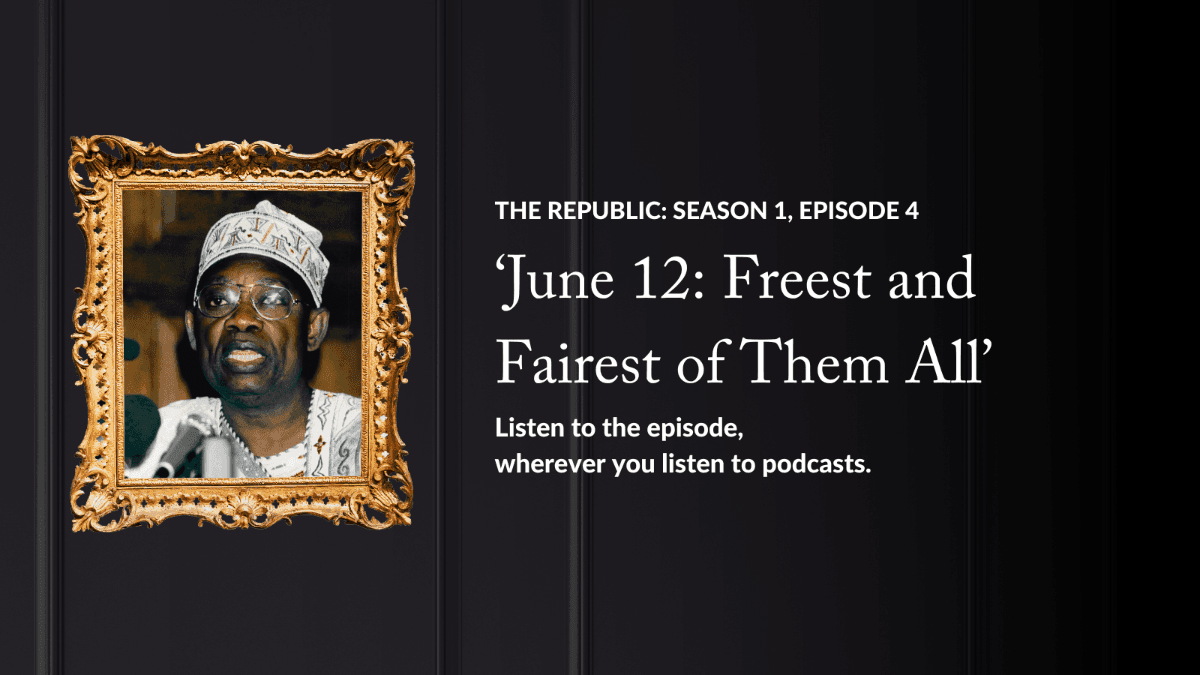
EPISODE 4: ‘FREEST AND FAIREST OF THEM ALL’
ELECTORAL MANAGEMENT
Arthur Nzeribe was a known IBB stan and the leader of the Association for a Better Nigeria. The ABN was for lack of better words a funny group. They failed to see the irony in their own name by being some of IBB’s staunchest supporters. But that’s not even the issue: Nothing about them adds up. There’s some debate about whether the group was formed in 1991 or 1993. No one knows exactly how many members the group had. Given how badly Nigerians wanted democracy, the ABN was so unpopular that anyone who associated with them kept it a secret. And yet at one point they claimed to have as many as 25 million members who were supposed to be from the private sector.
What we do know though is that the ABN was active in the 90s after IBB’s government set up NRC and SDP. The ABN was like the ancestral version of Big Brother Naija’s fan love. A 1994 report by Canada’s Immigration and Refugee Board described the group saying and I quote:
The primary objective of the ABN was to keep Ibrahim Babangida in power and maintain the military administration that has governed Nigeria for so long. The ABN demonstrated its determination to achieve its objective by putting up billboards in the Nigerian capital Abuja that carried the message “Four More Years”, which means the military government should stay in power for another four years. The intensity of the ABN’s pro-government campaigns led many observers to conclude that the federal military government was behind the activities of the association.
The quote ends.
Just two days before the June 12 election, Nzeribe got an injunction against the election from the High Court, citing corruption and irregularities. The injunction was dismissed by Henry Nwosu, the National Electoral Commission chairman, on the grounds that the high court had no authority on electoral matters. And so the show went on.
Years later, in 1999, Nzeribe was elected senator for the Imo Orlu constituency. In November 2002, he was suspended by Senate President Anyim Pius Anyim following accusations of being involved in a 22 million naira fraud case. Nzeribe’s suspension lasted until 2003, when he was re-elected. There have also been reports that Nzeribe was trying to push for Anyim’s impeachment but we won’t get into all that. Nzeribe died in 2022 and was a controversial figure in the June 12 election cycle. An ARISE News tribute described him saying:
ARISE News Reporters: Some remember him as the man used by the military to truncate Nigeria’s transition to democracy through the annulment of the June 12, 1993, presidential elections.
The ABN wanted IBB to remain in power for another four years and some Nigerians believe this was because they underestimated just how important the June 12 election was. It wasn’t just your random election where you could erect a few propaganda billboards, pat yourself on your back and say your watch has ended. This was the largest Black democratic exercise of its time. It wasn’t just locally significant; it had a global audience. Anyone who was anyone was watching.
Mr Gbenro Adegbola: But the 93 elections were quite very exciting. For the exact reasons that I outlined earlier. People were just desperate for the military to go. And in that sense, it brought a lot of hope, it was exciting. Quite a bit of money, I imagined, must have been spent. So, it was quite a carnival.
The election intrigued observers worldwide: journalists, delegates from the Commonwealth and other international bodies; observers from the Election Monitoring Group specifically trained by the Centre for Democratic Studies. Remember, this was Nigeria’s first election in over 10 years. The electoral commission really had something to prove.
Humphrey Nwosu: Remember, we were promised that if that election was conducted to be free and fair, accepted by international and local observers that we would be given international honours. So, my colleagues were also working hard as Nigerians.
That was Humphrey Nwosu, the Chairman of the National Electoral Commission, the body that organized the June 12, 1993, election.
In that recording from the BBC which you’ve just heard, the reporters estimate that about 40 million people were eligible to vote in the June 12 election. Some reports put this figure at 39 million. And while the BBC reporter noted heavy turnout in the polling stations she visited, other newsrooms like the Washington Post reported turnouts of less than 40 per cent at several polling stations, even in Lagos. This is not surprising though. Just as people were excited about the prospect of Nigeria returning to democracy, attempts like Nzeribe’s and the ABN to stop the election caused a lot of confusion. A large number of people had begun to suspect that the IBB government was playing games and decided to stay at home. Some didn’t even register in the first place, considering that IBB had been promising and delaying the election for several years.
Mr Adegbola: As I said, I started out being an IBB supporter in all my foolishness. And I actually did not register for the elections of 1993. So, I didn’t vote. If I were going to vote, I would have voted for Abiola, because he was a better known quantity. His opponent, the NRC candidate, was a totally unknown quantity. And there was no point experimenting with the presidency of Nigeria.
Some Nigerians couldn’t vote because of the kind of admin issue only possible in Nigeria. During my research for this podcast, a footnote I found funny about the June 12 cycle, was this report from the Washington Post, which claimed, and I quote, ‘The other candidate, Bashir Tofa of the National Republican Convention, was not allowed to vote because his registration card had expired. The report continues with Tofa quoted as saying, “All I know is that I had a voter card. I don’t know whether it was old or new”.’
It sounds crazy that Tofa was going about campaigning with an expired voter’s card but, like the musician Falz said, This is Nigeria. An anecdote might explain this better.
Nigeria was one of several countries that bought encryption machines from the Swiss firm, Crypto AG between 1950 and the early 2000s. Crypto sold machines that helped governments around the world communicate discreetly with their spies, security agents and diplomatic agents. You can imagine that encryption machines would have been valuable to countries at war or facing domestic political instability like say a penchant for military coups. We don’t know exactly when Nigeria became one of Crypto’s clients but a 2020 Washington Post article suggests it may have been during the 80s. At that time, Crypto’s biggest clients were Saudi Arabia, Iran, Italy, Indonesia, Iraq, Libya, Jordan and South Korea.
But this is where it gets interesting. The same Washington Post report revealed that Crypto was secretly owned by the CIA, meaning that the CIA (and thus the US government) was able to listen in on its so-called encrypted messages. According to the report, the US knew the most controversial plans of its allies and its adversaries. But my favourite part of the Washington Post report goes, and I quote:
Nigeria bought a large shipment of Crypto machines, but two years later, when there was still no corresponding payoff in intelligence, a company representative was sent to investigate. He found the equipment in a warehouse still in its original packaging.
Nigerians have a term for this: Anyhowness. It describes a uniquely Nigerian preference for getting the job done only halfway. A disregard (and sometimes even hatred) for process, rigour and completeness. Anyhowness protected Nigeria from the CIA; but in 1993, anyhowness meant Tofa, a presidential candidate, whose supporters would have spent months encouraging Nigerians to register to vote, did not bother to check if he could vote. It explains why there’s no known image of Tofa voting—at least not one that can rival Rojon’s photo of MKO. If as we say in Nigeria, a ‘whole candidate’ did not realize his voter’s card had expired, what more regular voters?
Another factor that explained the low voter turnout was the Ogoni boycott. Ken Saro-Wiwa, a prominent Ogoni writer and activist and other environmental activists had called for a boycott of the polls to press their demand for compensation for the environmental damage caused by oil exploration in southern Nigeria. They were not going to vote for a government that ignored minority ethnic rights.
This is important to note in the context of the June 12 struggle. Because when we talk about voting despite ethnic allegiances in Nigeria, we typically refer to the Hausa, Igbo and Yoruba ethnic groups. In fact, while MKO drew widespread support, he was very much branded as a Yoruba politician who saw himself as finishing what Awolowo started. He was often called the Aare Ona Kakanfo, a traditional Yoruba title historically given to the war general during the old Oyo Empire of the 16th to 19 centuries. This war general could represent the Alaafin, the traditional ruler of the empire, in times of war. In recent times the Aare Ona Kakanfo is expected to ‘fight’ for the development and growth of Yorubaland.
According to a 2018 article in The Nation, whoever bears the Aare Ona Kakanfo title must be at the vanguard of advocating Yoruba interests within the larger Nigerian framework. In Senior Advocate, Chief Afe Babalola’s words, the Aare Ona Kakanfo is ‘the generalissimo of Yorubaland.’
Tundun Abiola: The whole Aare Ona Kakanfo, the whole generalissimo of the Yoruba tribe, he took it all very seriously.
Like Mr Adegbola implied, going into the election, MKO was the clear favourite. But it was not going to be an easy win. In the political sphere, MKO’s wealth had its limits. He had alliances with the military and gatekeepers like Shehu Musa Yar’adua but even these alliances were shaky. The lawyer and political commentator, Ayisha Osori, who I spoke to during my research for this podcast, made this very clear.
Ayisha Osori: And I understand that this is nowhere in the history books, but speaking to people who were part of that PDM (People’s Democratic Movement) Shehu Musa Yar’Adua Movement, that after the convention, there was some interaction between Abiola and Shehu Musa Yar Adua, that was after the convention before the elections, but Abiola had gotten the ticket, and apparently, Yar’Adua’s driving off in a car and said, ‘That man can never be president.’ So, the forces against Abiola had started building even before the elections. People keep saying that IBB has never been open about why he annulled the elections considering their relationship. There are some other snippets, I’m not sure if it’s a direct quote from IBB, but if you read enough about it, I stumbled upon this where according to people reporting on IBB, the military were going to take over anyway if it was Abiola and so that’s why he didn’t bother putting us, the country, through that. Because the forces against Abiola had already, you know, made it clear that this was a man who would not be president. And now, what is interesting is he was not going to be president because why? Was it because of his reputation as a businessman? Was it because of his ethics or his values? Was it because the North felt uncomfortable with what he would do if he came into power? How they would feel? How he would treat them?
Nevertheless, voting, for those who registered and actually showed up was largely hitch-free. Electoral monitors generally reported that voting on June 12 went fairly and smoothly. Here’s NEC Chairman Nwosu on how the NEC conducted the elections.
Humphrey Nwosu: So, when according to our efforts, you knew all the problems, all the restrictions, in spite of all that, June 12 came, the election was conducted, it was peaceful, materials were distributed all over Nigeria, promptly, in all difficult terrain because of arrangement and logistics preparation put in place.
And this wasn’t just the NEC patting its own back. A day after the election, the Nigerian Election Monitoring Group issued a release commending Nigerians for the ‘visible, high degree of political maturity and patience in the conduct of the presidential election.’ The group’s president, Okon Asuquo Osung, said the commendation was particularly relevant in light of comparison with previous elections.
According to Max Siollun’s book Soldiers of Fortune, the election management introduced a Modified Open Ballot System (MOBS) as a modification to the open ballot system of voting. The MOBS method was supposed to maintain the secrecy of each voter’s choice while still requiring them to cast their vote openly, ensuring transparency. On the day of the election, voter registration officially took place between 8 am and 10 a.m. Voters formed a single line, disregarding their party affiliations. Each voter proceeded from the line to separate tables, where they received a voting card displaying the logos of the two political parties. In private, voters could mark or thumbprint their preferred candidate on the voting card. Then, they were required to walk to the ballot box in full view of others present and drop their card into it. This process aimed to strike a balance between confidentiality and transparency in the voting process. In polling units with high turnouts like the BBC reporter mentioned earlier, this process led to very long queues. But voters did not mind this, since it meant that IBB would finally leave.
Baba Aye: But the process that led to June 12 made them think that ‘at last, this thing is going to lead to an end. Let us confirm it without our votes.’ So, there was more of a voting against Babangida and the junta than a voting for either MKO or Tofa.
HOW EACH CANDIDATE PERFORMED
According to NEC rules back then, to win the election, a candidate needed to secure one-third of the vote in at least twenty of Nigeria’s then-30 states. June 12, 1993, was a Saturday, and the results of the election were not expected before Tuesday 15th of June. On the 14th of June, the NEC posted results from 15 states on a billboard outside their Abuja headquarters, and MKO was leading in all regions, including Tofa’s home state of Kano. It seemed like regionalism did not matter much in Nigerian politics at the time.
As of June 17, partial results suggested that MKO had won 19 out of 30 states. He had won all the states of the south-west; three of the seven states in the south-east; five of the nine northern states including Kano, Tofa’s state; and four out of the seven states in the central middle belt. Of the 6.6 million votes that had been announced, MKO had received 4.3 million and Tofa 2.3 million. If MKO had been declared the winner, he would have been at that time the first southerner to be elected president of Nigeria, breaking through ethno-religious divides having received support from all regions of the country.
But the full results never emerged. By June 18, the NEC was being criticized for withholding the results; threatening Nigeria’s planned return to civilian rule, which IBB had promised would happen on August 27 of that year. At the same time, when it appeared that MKO, the SDP candidate, would win, Tofa’s NRC supporters began claiming that the election had been rigged. Tijjani Ramallan, the Republican chairman in Kaduna state, called the June 12 election ‘the sale of the century’ and ‘the mother of all rigging.’ The NRC’s national spokesman, Okey Uzohoh, said the election was ‘massively rigged and voters intimidated, thus leading to total falsification of results.’
Baba Aye: Tofa was a largely unknown quantity. Abiola was known and he had a story of grace to grace to tell, self-made millionaire and all that and here he was telling the whole world, he was telling Nigerians that he will ensure a farewell to poverty. His campaign organization was Hope 93. So, this resonated in the hearts of people who had particularly become pauperized under Babangida and could see in Abiola a personification of what he said he would do. So, this reverberated and then the fact also, which I said earlier, of his generosity. There were several forces that were like, this man is not just talking, he supports people, he supports causes.
One of these causes is Nigeria’s favourite past time: football. As part of his campaign, MKO had pledged to ensure that the national football team, the Super Eagles, would make it to the 1994 World Cup finals in the United States. And this might be a little-known fact, but MKO was a trailblazer in Nigeria’s sports sector.
Reporter: He was a patron of the Nigerian Olympic movement and the Confederation of African Football (CAF).
It is no coincidence that the National Stadium in Abuja is currently named after him.
The engine behind MKO’s path to victory was multifaceted but his Hope 93 campaign, which we talked about last week, was really the jet fuel. MKO’s son, Kola, oversaw the campaign.
Kola Abiola: We had the campaign for the pre-election delegation in Jos, which was just an advert highlighting the qualities of the candidate on the one hand and then once we scaled Jos we had the other jingle before this, you played going out and then once Baba Kingibe was picked as VP then we had the one that you played now so that was the sequence.
One of our writers wasn’t even born by the time of this election but after playing the jingle a couple of times during our research, she’s been humming it. So, imagine turning on your radio on your drive to work in 1993, or watching your favourite programme and hearing the SDP jingle again and again and again.
Kola Abiola: It was based on a lot of data; we did a lot of data crunching and sampling and surveys and things like that. It’s one of the biggest things I’ve heard about that election.
How do you win an election? Well, you run an aggressive campaign backed by data… and a LOT of money.
Baba Aye: This was the alignment of several forces that made the SDP to have an edge over the NRC. Then there was money. Whilst Babangida tried to use it in a poisonous manner, it is true that there was so much money because Abiola threw everything he had into it, he threw money into that. Money not necessarily to buy people but in elections generally, money counts. People look at… only even in places where people don’t collect… money counts. You need money to push out materials to get people out there and he had more than enough of it. So, these were several factors that played into SDP emerging within the context of the primary votes being against the junta, than for, that is being for either SDP or NRC.
ELECTION PERCEPTION
Two days before the announcement that the NEC would ignore the ABN’s demands and proceed with the June 12 election, the U.S. Information Service issued a statement saying ‘any postponement of the elections is unacceptable to the United States government.’ The service later replaced that statement with one saying a delay ‘would cause grave concern.’
In response, Nigeria’s Foreign Ministry accused the United States of interfering in Nigeria’s internal affairs and withdrew the accreditation of eight American election observers. The ministry also expelled Michael O’Brien who had issued the statement. IBB’s government gave O’Brien 72 hours to leave Nigeria.
Even before the court’s ruling, widespread power cuts and fuel shortages had overshadowed the last days of presidential campaigning. The African Guardian, a Nigerian weekly newspaper, described the campaigns at some point as ‘all blah blah and no bite.’ They had a point. During the entire campaign season ahead of June 12, neither Tofa, nor MKO, squarely addressed the problems of rampant corruption, restoring investor confidence or reducing the `29 billion dollar foreign debt. Issues widely considered to be Nigeria’s most important challenges at the time. And locally, there was still the issue of MKO’s inconsistent relationship with left-leaning Nigerians. According to Baba Aye, who was part of left-leaning student movements at the time,
Baba Aye: But, and this is the important bit and which maybe when we then talk on how the radical left and civil society movements responded. Abiola made it clear that he would not support the Sovereign National Conference call. I remember after the annulment, and we were having debates in the Campaign for Democracy, I pointed out that we cannot just throw our weight behind the fight for his reinstatement without going back to the issue of where there are differences in our demands because he categorically said it. He categorically said it on…there was this debate that the NTA at the time organized, I’m sure that if anyone checked online it’s there. I remember very vividly, I watched it, he categorically said it. So, he tried to give the impression that neoliberalism could work. And that is why I addressed several rallies as a student leader during the elections and I kept arguing that if Abiola won, Hope 93 would by 94 turn to disillusionment 94.
You know how in 2016 UK prime minister David Cameron shot himself in the foot by calling for the Brexit vote? How he set off a chain of disastrous events that are still unfolding today? How he then just quietly dipped, washed his hands and said, abeg not my problem. Well, as MKO’s victory seemed imminent to Nigerians IBB had his own gun pointing at his foot. It’s like those Nintendo video games we grew up playing, you can choose to press A to do one thing or B to do the complete opposite thing. And I imagine that was the position IBB was in. Press A to keep your promise and lead your country towards democracy or Press B and unlock 30 years of democratic confusion.
CONCLUSION
By 1993, MKO had gone from the man who couldn’t get on the ballot in 1983 to the man who swept votes away from his opponent. In the 1991 state elections, Tofa’s NRC had won more governorships than MKO’s SDP. So MKO’s victory during the presidential election was really an upset. NEC chairman, Nwosu said that as the results were coming in, Tofa had even called MKO to congratulate him on his win. With a combination of charm, determination, strategy and influence MKO was on the cusp of everything he had ever wanted.
OUTRO: So, how did such a highly anticipated election become such a controversial incident? It was a confluence of factors – a passionate populace that grappled with rising disillusion; regional tensions; political manoeuvring; and allegations of foul play. The June 12, 1993, election in Nigeria serves as a reminder of the challenges that young democracies often face on their paths to maturity. By June 18, it was already clear that something was up and when IBB’s government nullified the results on June 23, people were disappointed but not surprised. ‘How can the government abandon its own transition program? They were the ones who said they would return the country to civilian rule,’ people like Femi Oredeyin, the SDP spokesman, said. To many Nigerians, it was simply proof of an agenda IBB had hidden from the entire country. And in plain sight.
In next week’s episode we are going to look more closely at the annulment, and at the court cases and the riots that followed the annulment. Did IBB make the wrong decision? That answer, you’ll find, depends on who you ask.
Thanks to Peace Onafuye, Iniye Spiff and Victoria Audu for the archival audio you heard on this episode and our overall research.
You’ll find a full list of the books, articles, and documentaries that we relied on in researching this episode at our website, republic.com.ng/podcasts.
The Republic is produced by the Voix Collective. Our script writers are Iniye Spiff and, myself, Wale Lawal. I am also the editorial director⎈
The views, thoughts, and opinions published in The Republic belong solely to the author and are not necessarily the views of The Republic or its editors. We want to hear what you think about this article. Submit a letter to the editors by writing to editors@republic.com.ng.







Comments
Sign in to comment.