But on June 16, the Abuja High Court called for the suspension of the remaining results. Shock rippled through Nigeria. To many Nigerians, the election had been fair and unproblematic, so the suspension immediately raised some red flags. Protests took over the streets. Lawyers got busy preparing to contest the suspension. Then on the 23rd of June, just eleven days after the election that had inspired so much hope, Nigerians had their fears materialize when IBB announced he was annulling the election.
Reporter: Here is a special statement Ibrahim Babangida: It is true that the presidential election was generally seen to be free, fair and peaceful. However, there was in fact a huge array of election malpractice in virtually all states of the federation.
Reporter: What the military government of president Babangida has done is annul the elections and scrap all the decrees that would have taken Nigeria to civilian rule on August the 27th.
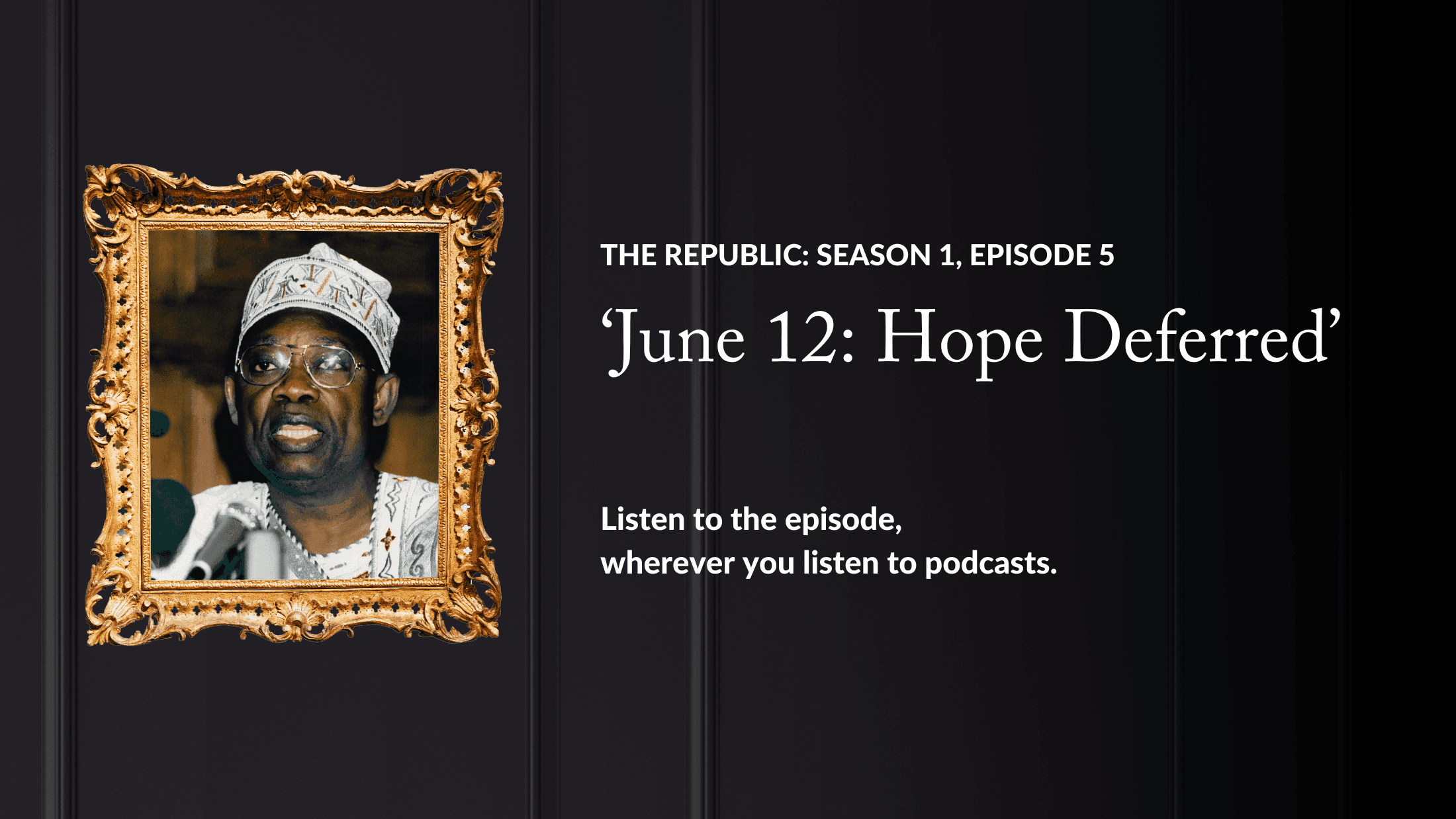
People didn’t take IBB’s announcement very well. Especially, the presidential candidate and depending who you ask, the second democratically elected president of Nigeria, MKO.
MKO Abiola: The people of this country went to the polls on Saturday June 12 1993 and without hindrance chose me as their president, didn’t they?
INTRODUCTION
This is The Republic, a podcast about pivotal African figures and historical events. Our first season looks at Nigeria’s controversial June 12, 1993 elections. I’m your host, Wale Lawal.
So let’s set the stage: IBB had annulled the election, Nigerians felt betrayed, MKO felt robbed and the people who believed IBB never truly wanted to concede power had their suspicions confirmed. Years later, IBB still claimed the annulment was a necessary evil for the greater good, but we are getting ahead of ourselves. What was this supposed good IBB was aiming for and did the annulment actually achieve it? The protests that followed the annulment suggested otherwise.
In this week’s episode, we are finally facing IBB’s most controversial act as military president: his decision to annul the June 12 election, despite it being, in his words, free, fair and peaceful.
EPISODE 5: HOPE DEFERRED
Where were you when you found out that the elections had been annulled?
Mr Gbenro Adegbola: Where was I? I really can’t remember, I just remember that my friend, Nduka Irabor, was the press secretary, who was given the assignment to make the announcement. And I just thought this was such a casual announcement. You know, just put a press release in the hands of a press aide and say, go and talk to them. You know, I thought this can’t be true, this can’t be true. And I think that was the attitude of many people, especially in my generation.
THE ANNULMENT
It would be easy to look out of a window at the state of Nigeria today and say IBB’s big plans didn’t work. But to do that we need to know what those ‘Big Plans’ were and the rationale that led him to annul the June 12 results, a decision that changed the course of Nigeria’s history. So, let’s go back to when the news of the annulment first broke; when IBB explicitly claimed he was cancelling the results due to election irregularities.
IBB brought up reasons like vote buying and the need to ‘protect the judiciary’. Except, nobody bought this. Even back then, the June 12 election was considered THE standard; people had gone on record noting that everything had run smoothly. Plus, several people believed IBB never wanted to give up his power. Simply put, he sold many reasons for annulling June 12 but no one was buying. Like we mentioned in the last episode, it wasn’t the first time these so-called ‘electoral irregularities’ had come up. From the last episode, remember Arthur Nzeribe, the leader of the Association for a Better Nigeria, ABN or IBB’s fan club.
ARISE News Reporter: Some remember him as the man used by the military to truncate Nigeria’s transition to democracy through the annulment of the June 12 1993 presidential elections.
And yet, according to publisher, Mr Gbenro Adegbola…
Mr Gbenro Adegbola: But the 93 elections were very exciting. For the exact reasons that I outlined earlier. People were just desperate for the military to go. And in that sense, it brought a lot of hope, it was exciting. Quite a bit of money must have been, I imagined, must have been spent. So it was quite a carnival. So you know, the annulment of it was really a daring move.
Did the election have issues? Of course. For one, voter turnout was low at only 35 per cent. Still, the election was considered peaceful and well organized. There was no violence, no ballot snatching; certainly none of the thuggery we saw in our last election. Some felt it was also a time Nigerians put the good of the public first, instead of being hung up on issues like ethnicity and religion.
Reporter: Nigerians irrespective of their religious or ethnic leanings went to the polls in what remains the freest and most peaceful elections in the nations’ history.
But let’s go back to June 15. That day, the ABN came back with a new court injunction and this time, the National Electoral Commission accepted it. On June 16, the NEC then announced that the election results had been suspended. To the public, this decision made no sense. As such, High Courts all over Nigeria sent in their own contradicting suits to Abuja, demanding the release of the results. And on the 18th of June, after threatening the government, the civil society group, Campaign for Democracy, took matters into their own hands.

The Campaign for Democracy leaked the election results, which presented MKO Abiola as the presidential winner with a 58 per cent majority. Since the Campaign for Democracy was considered reputable and the results were in line with general expectations, people began demanding official recognition of these results. Everyone from regular civilians to unions to politicians wanted the government to do the right thing and recognize the results. Many, however, felt this heat did not matter to IBB.
Protesters: We don’t want Babangida again, we want MKO. Reporter: Who is MKO? Protesters: Abiola!
The only people on board with the annulment were IBB, IBB supporters like Nzeribe and members of the losing NRC and NRC supporters who believed there had been election fraud from the jump. Everyone else was incensed. To Nigerians, the issue was cut and dry. They voted for MKO, he won the election, but the military government had pulled the rug from under them, end of. No one was taking this lying down. Nobel laureate Wole Soyinka, was quoted in an interview on July 3rd with the BBC regarding the drama saying, ‘To wait until elections have been completed and are halfway announced and then take all sorts of tedious steps which culminated of course in his coming out openly and annulling the results is most ridiculous.’
The international community was also vocally against the annulment. The UK was among the first international countries to voice their disapproval. The UK decided to suspend training for the military and restrict visas for members of the armed forces and their families. The US on the other hand, had already been accused of interfering in the election by Nigeria’s Foreign Ministry. Though ten points to anyone who can mention an election the US hasn’t been accused of meddling in. This time though, to disgruntled Nigerians at least, the meddling seemed valid. Calling IBB’s annulment an ‘outrageous decision’, the US responded by cutting Nigeria’s 450,000 dollars in military aid.
Local reactions were no less dramatic. The Lagos branch of the Nigerian Bar Association (NBA) planned to boycott courts starting June 30th; labour unions announced workers strikes; student unions flooded the streets denouncing IBB’s government and a bust of IBB was vandalised in Ondo state during the student protests. No one wanted to be left behind in this resistance. Everyone planned their own demonstrations against the ruling government and called for the recognition of the election. Even members of the military were not fans of the way the election was being handled. They were officially over the military being so involved in politics and at least 30 mid to high-ranking officers said that they planned on retiring because of everything that was going on.
Protesters: All we are saying… ‘Give us MKO’
The Campaign for Democracy filled a void left by the Nigerian Labour Congress’s initial reluctance to get involved in the resistance that followed IBB’s annulment. Baba Aye, a student activist at the time, explained.
Baba Aye: And one of the, this is interesting, one of the immediate responses that was very well one kind but I think I dear say was also useful was by the students of the University of Lagos Student Union. I think two three days after the annulment, after calling on the NLC to speak, and the NLC was not speaking clearly about it, students of the University of Lagos Students Union marched to the headquarters of the Nigeria Labour Congress, which was in Yaba not far from their school, with the intention of inviting the president Pascal Bafyau to University of Lagos to reason with him on why they were not standing with the masses. But what I’m pointing out here is it was not just the students going to the NLC, it was to show our anger at the Trade Unions not rising up to what many felt should be the most organized expression of the working class. This took place in several shapes, don’t forget when the NLC also didn’t move and it was banned and all that, the Campaign for Democracy had to try to fill that shoe. And that was when we started with the sit-down strike.
THE RESISTANCE
On the 30th of June, the Campaign for Democracy held a news conference and announced there would be a week of protests across Nigeria, starting on the 5th of July. Dr Beko Ransome-Kuti, the group’s chairman, urged workers to stay home. He told market women and traders to close their stalls. He warned cars to stay off the road. He told students to form civil defence groups, form barricades, start bonfires and prepare for war.
Bane: Return to your homes, hold your family close and wait… Tomorrow you claim what’s rightfully yours.
Okay, that last part was a bit dramatic. It’s important to note the Center for Democracy wasn’t out there trying to purposely incite violence. Protests are a fundamental right after all and, we know from recent history, that people in positions of power tend to misunderstand and antagonize this fundamental right. Just look at the 2020 EndSARS protests. But back in 1993, here’s what Chief Anthony Enahoro, one of Nigeria’s foremost anti-colonial and pro-democracy activists, had to say about the demonstrations.

Anthony Enahoro: Well, I say that in any modern society people have a right…and a duty…to express the popular will by the popular action…provided it’s peaceful. Throughout the political history of Nigeria, we’ve had that under…all regimes. We’ve had marches, demonstrations of all sorts…so long as it’s peaceful. It’s the people’s right. In this case, it’s a double right. The people are insisting the law should be obeyed. What can be better than that? People are saying that the law made by the outgoing regime should be obeyed.
MKO was on board with the protestors and was glad for their support, but it was important to him that they remained peaceful and didn’t cause any violence.
On the first day of the protests, when thousands of people marched into MKO’s compound to throw their support behind him he told them to keep in mind that ‘We can only progress in peace.’ MKO argued that in order to maintain the moral high ground, the protesters needed to remain peaceful. It was a Daenerys Targaryen moment. And what’s the point of being in charge if all you have to rule over are ashes? But also, there are some reports that MKO was behind the scenes trying to make deals with IBB. Baba Aye who was one of the protesters rallying at MKO’s house told me:
Baba Aye: They told us that ‘Baba n sun’. He was sleeping. Look at the people here, what are you saying? It was only then that they went in and woke him up, later we realize that he spent the night in Abuja trying to reach a deal with Babangida.
Now the issues that some left-leaning people had with MKO began to crop up. Since the 80s the story had been that MKO was in bed with the military; now, at the time people needed him most, he seemed to be fraternizing with the military again. Using his ties with the oppressor as a get-out-of-jail-free card.
Baba Aye: And you see, he took off at some point that 93 and said that it’s only a mad person that would confront… If he had seized the initiative and was ready to damn the consequences, it is not what we are saying, well, maybe things would have panned out one way or the other. If the initiative had been seized in 93, rather than coming back in 94, then Epetedo declaration and all that, the likelihood of his emerging as the president was much higher. But that would have pushed him more leftward than he was ready to go. So to me, that was the greatest criticism of him and also a lesson for the left, because most of the left, we also had debate in CD. The entire program of the Campaign for Democracy was jettisoned for support for the June 12 mandate.
That only became apparent later, because at this point, the population was still gingered and firmly on his side. Protests against the annulment took place in Kano and across cities in the South West, through Lagos, Ilorin, Ibadan, Osogbo, and Ile-Ife. And the protests remained peaceful–for the first couple of days, at least. Sadly, even the most noble of causes can be infiltrated by the opportunistic and the bubble broke in Lagos when area boys hijacked the protests and started looting and destroying property. They broke into locked shops, and rampaged the streets and what started out as peaceful demonstrations against the military regime’s grasp for power turned into ethnic attacks against Hausa-Fulanis by people who believed the election was cancelled because MKO was from the South.
When it started getting chaotic, the government saw an opportunity to step in. At first the police fired teargas down from helicopters into the mob, which might look cool in an action film, but isn’t when you’re fighting for justice and the greater good, and on the receiving end. For all its hard-line crowd control, the police failed to contain the mob. So what did they do next? Call in the big guns…literally.
Since it seemed like the police could not contain the protests, on the 6th of July, the government brought in the military to dispel protesters in any way they saw fit. That night, Dr. Ransome-Kuti was arrested in his home by 25 security agents. They had no reason for arresting him, no warrant just vibes. The publisher, Chief Gani Fawehinmi, and lawyer Femi Falana were also arrested that week and later on the 10th of July they were transferred to Kuje prison in Abuja.
The military didn’t use any discretion when it came to their violence. They turned their guns on looters, peaceful protestors and civilians alike. The protests ended the next day, when the military brought in tanks.
The Campaign for Democracy estimated that about 100 people were killed by the security forces all over Nigeria. The demonstrators who survived were arrested.
Throughout the fiasco, MKO stood firm on his campaign to claim the presidential seat. He openly appreciated the supporters who were riding so hard for him and I’m sure their support gave him the continued strength to keep pushing. I mean it couldn’t have been easy going against a military government, but knowing that you have a throng of people shouting your name and calling for justice on your behalf is definitely a power-up. Here is what MKO told Channels TV about his public support.
MKO Abiola: Well, it is very gratifying. I’ve always known that the events of the last few weeks enabled people to make up their minds a lot more firmly. In fact, it has increased tremendously the public support I have in the country. Nigerians are ready for democracy. Nigerians have elected their president and Nigerians are not prepared to go for another election. The truth of the matter is that you do not have two sunrises in one day. Even in Africa, the sun rises only once a day.
IBB on the other hand was really leaning into his villain era and his government continued to refuse to recognize the election, demanding the parties agree to join an unelected civilian government or go through an entirely new election. Regardless of their choice, there was only one suitable outcome for IBB, MKO would not be allowed to hold office. These demands were incredibly unpopular to politicians. For instance, Tosin Kalai, a member of IBB’s electoral commission resigned saying, ‘I don’t know whom I’m supposed to be serving on this commission. Certainly not the Nigerian people who massively expressed their will on June 12.’
While others were standing firm in their beliefs, others were finding it more difficult to stick to their guns. For instance, on the 7th of July, SDP party chairman, Tony Anenih, hinted at taking IBB’s deal, throwing MKO under the bus for the sake of the party’s political power. But MKO and his supporters in the SDP pushed back and once again the weak willed SDP leadership changed his mind and turned down IBB’s deal, agreeing for nothing less than MKO’s presidency.
At this point, support for IBB was rapidly deteriorating. Even amongst the people you would expect to be in his corner. Sultan Ibrahim Dasuki, a former friend of IBB and a spiritual leader in the North, came out in support of MKO saying, ‘There is no other route away from the national catastrophe than the swearing in of Moshood Abiola come August 27, 1993.’ IBB also had former heads of state, General Olusegun Obasanjo and General Muhammadu Buhari, who weren’t exactly his biggest fans, to contend with. Both of them, along with ten former generals, held a meeting to brainstorm ways to get IBB out of office. They issued a statement that boiled down to one demand ‘that the Babangida administration be terminated forthwith’. Everyone wanted the guy gone.
MKO Abiola: I must appeal to Babangida if he truly loves Nigeria, he should set Nigeria free.
MKO’s supporters decided to go the legal route and have the Lagos High Court make an official ruling against the IBB government giving power to anyone who wasn’t the winner of the June 12 election. The hearing was supposed to be on the 21st of July and the judgement was set for the 23rd. Meanwhile, the Supreme Court had agreed to hear out 14 state governors who wanted the election annulment reversed. It’s kind of depressing to think that after all the government’s attempt to frustrate justice people were still trying to do things the right way. They still believed that the military government would let itself be held accountable. Unfortunately, there’s no winning when you play chess with a pigeon and the government was the metaphorical pigeon in this situation, knocking all the pieces off the board. The government stepped in to put a roadblock in the legal proceedings by creating a bunch of new decrees that would prevent the courts from addressing any cases regarding the election and retroactively backing the annulment. A bit hypocritical when you remember how concerned IBB was for the legitimacy of the judiciary.
FALL OUTS
By now, IBB was starting to feel the heat, so he relented a bit. Not enough to harm his military pride, but enough to delude himself that he was making a compromise. He announced a new election for the 14th of August 1993, claiming that he thought about it really hard and recognized that an unelected government would lack stability and legitimacy. Again, no one was buying what he was selling. There had already been elections and Nigerians wanted those elections to be recognized, not this consolation prize IBB was trying to give. Fourteen state governors outrightly said they would block the elections; SDP said they would boycott. After all, what would be the point if IBB could just decide that he didn’t feel like honouring the new elections?
The fallout of the annulment only got messier and, fearing that it might degenerate into local clashes, Nigerians of all ethnic groups started leaving the cities in droves back to their villages. They figured that if things hit the fan they would be safer in a small village rather than dealing with looters and the military in cities. So, over the course of the month, tens of thousands of people began to leave places like Lagos, Kaduna, cities where they believed things could get hairy quickly. In the South West, for instance, many Igbos fled East, fearing a repeat of the pogroms of the sixties that happened ahead of our civil war. They called the incident, ‘Oso Abiola’. I found this clip from a YouTube user, Neyeah, whose mum shared her experience.
Woman: You go dey house like this, somebody go come tell you, you dey hear say war wan come for Lagos?
Then in a shocking turn of events, evidence that the chaos was part of the military’s plan to stay in power emerged. People were disappointed but not surprised when ABN member Abimbola Davies held a news conference where he confirmed that the government filed the first lawsuit just to derail Nigeria’s transition. He said and I’m going to quote this:
Nigerians, we are guilty, but forgive us….It is important and urgent that I speak to the world and to Nigerians concerning the political crisis through which our country is currently going and in which I have played an important role. With the aim of prolonging the military administration’s stay in power [we were used] in order to create an organised confusion. All of us who participated in this racket never imagined that we would end up in this situation and that blood could be spilled.
After that bombshell of a speech, Davies had the members of the press wait 40 minutes so that he and his family could be spirited out of Nigeria. His announcement only confirmed what people had already believed. But to have it out in the open was something else entirely. The military government acted unfazed by the revelation but conceded to another ‘compromise’. Tony Anenih came out again to say he was ready to throw MKO under the bus and make a deal with NRC and the military to make a new government and IBB agreed. He said that this new government would oversee local government elections and the new presidential elections, whenever that was. He is quoted saying:
The option of an interim national government should … be seen for what it is. It is an interim measure, and must, to that extent, be seen as part of the overall conception of the transitional agenda of this administration. The option seems to us a welcome strategic device to provide our political system with a cooling-off period. …Sooner or later, elections would have to be held to determine the true wishes of the people of Nigeria.
There are like a thousand reasons why this plan did not go over well. But the main reason, which was brought up by many people including MKO, is that it was AGAIN contradictory to IBB’s own former fears of an illegitimate government.
Now everyone was truly done with IBB and his BS. The maradona had dribbled himself to a ditch. No one had any faith in the military government and every statement IBB made justifying the annulment seemed more ridiculous than the last, so people swung into action. Thirty senators signed a joint motion asking the government to declare a winner of the June 12 electrons; 24 SDP state chairmen declared their support for MKO and rejected the interim government; seven prominent Nigerians came out with a joint statement saying the interim government was meant to distract Nigerians from the shadowy game the military was playing and the Constitutional Rights Project, a Lagos-based human rights association released a statement saying: ‘The idea of an interim government appears to us to be a ploy by the military dictatorship to further cause confusion and precipitate once again an extension of General Babangida’s stay in power.’
The Campaign for Democracy once again went on with its civil disobedience plan, calling for nationwide protests to oppose IBB’s plan for prolonged military rule. This time though, they explicitly made it clear that there needed to be no violence and urged people to stay close to their homes just in case things got heated.
Meanwhile, on August 4th, MKO left Nigeria to seek international support. His plan was to go to the UK, the US, France and any other Western country or organization who would listen and support his pleas. While he was gone the government went on a smear campaign against him, making all sorts of outlandish claims against him. They said he was planning on bombing strategic locations and on August 8 the Minister of Information and Culture Uche Chukwumerije announced that MKO had left Nigeria illegally without the necessary documents but refused to give details on whether or not MKO would be prosecuted. Unbothered, MKO announced he would be returning sometime mid-August.
Meanwhile, back in Nigeria, everybody was once more threatening to strike if the military did not step down on August 27th. Obasanjo’s group Association for Democracy and Good Governance in Nigeria supported the strikes and protests and went on record saying, ‘The national interim government schemes are no solution to the current political impasse facing the nation. Should the present administration not be terminated on August 27, we urge all Nigerians to embark upon peaceful and non-violent means of expressing their disapproval.’
Unfortunately, the longer the impasse went on, the weaker some people’s resolve became. It was clear that the military government was ready to play the long game but not everyone had the required resilience. Especially when bribes began to flow. Even Human Right Activist organizations reported some of their members being offered bribes. Not Surprisingly, by mid-August, the Senate changed its mind and a majority voted in support of the interim government.
The government threatened a state of emergency in response to the ongoing Campaign for Democracy strike and said they would fire government workers if the strikes continued. Soldiers were posted on bridges and overpasses and shop owners closed their shops all in preparation for what was to come. On August 12 businesses shut down in Lagos, Ibadan and cities all across the South West in cooperation with the strike. But in the north, it was business as usual.
The government’s response to this second strike was even harsher than the last. Three days before the strike was supposed to start, police and security agents raided the offices of the Center for Democracy and Gani Fawemi, and ended up detaining people. This was only a preview of what was to come because from August 12, over two hundred activists would be arrested all over the country.
The press wasn’t safe from these attacks either and on the 18th, the military released two decrees. Decree 48 banned the Concord Group publications, which included Punch, Sketch and The Observer. Decree 43 on the other hand targeted the press in general. It introduced a 10-year prison sentence or $11,000 fine for anyone publishing ‘false information’. But what constituted false information was so broad that nobody wanted to say anything. The decree also made it compulsory for all newspapers to register annually with the government which meant paying a registration fee, creating a registration board whose chairman was chosen by the government, obviously; establishing an office in Abuja; and undergoing inspections by the information secretary, for ‘fake news’. These new decrees joined the long list of things people were protesting.
IBB’s August 27 deadline was fast approaching and still he was going around trying to drum up favour for his unpopular interim government. At his 52nd birthday celebration, he gave a confusing speech where he claimed he offered to relinquish power as his own ‘personal sacrifice’ during arguments between military officers about what the best step moving forward was. An official from the VP’s office later said that all these dramatics were unnecessary and IBB had the sole power to decide whatever he wanted. During his speech, IBB also urged the West to be patient with him so they could see his endgame. He addressed his critics and got quite vulnerable for a moment. He confessed that the attacks hurt because hey, military dictators have feelings, too.
THE INTERIM GOVERNMENT
So d-day, 27 August arrived. Was IBB actually going to step down? Spoiler, he did, after handing over the bonds of leadership to the highly unpopular businessman and political newbie, Ernest Shonekan. Shonekan now had to bear the cross of leading Nigeria out of the hot mess the IBB administration had created.
Ernest Shonekan: I do this with a deep sense of responsibility that once again I accept the challenge to serve as the head of the interim national government of the Federal Republic of Nigeria.
Shonekan wanted to make MKO his Vice President but for MKO, accepting the position would have been the same as giving up on his mandate. So MKO refused. To say nobody took Shonekan seriously would be an understatement. In fact, in a 1993 article, written by Harriet Lawrence, an editor at the independent Guardian newspaper, Lawrence wrote that:
‘Shonekan is a lacklustre person who has absolutely no charisma whatsoever; there was nothing outstanding that he ever did as the head of UAC.’
They might as well have put ‘political puppet’ on Shonekan’s forehead. But he wasn’t the only reason people weren’t rocking with this new government; IBB still hadn’t done the main thing that was being asked of him, and that was to return power to elected civilian leadership. Even with him stepping down along with most senior officers, the military’s influence in the government was still present. Three members of the military and close allies of IBB remained in key political government positions, one of them being General Sani Abacha. In recent years, IBB has denied that installing an interim government was part of a plan to remain in power. Instead, he has claimed it was the best course of action.
WHAT WE KNOW SO FAR
So, let’s do a brief recap. By the end of August, Nigeria was in a constant state of riots and protests. IBB had stepped down but was still acting innocent. The interim government had been installed but faced two problems: one, nobody liked Shonekan. Two, and more importantly, MKO was abroad and had gained even more popularity among the international community.
Let’s let MKO summarize the situation himself. After all he lived it and no one tells the story better. On the 30th of August, he was in Washington DC, discussing the annulment, the interim government and his right to the presidency with the US National Press Club.
William J. Jefferson: And Chief Abiola today embodies the democracy movement in Africa. And I’m proud to ask him to come forward to present himself to this national press gathering and in his own words to let you know where the struggle for democracy is there and what his pending actions are.
MKO Abiola: Ladies and gentlemen of the press, thank you very much for your presence here today. The irony will not be lost on you that but for a bizarre twist in the history of my country, Nigeria, I should by now be at home minding the nation’s business instead of being abroad soliciting the understanding of outsiders, for I was elected by the people of Nigeria as their president in a free and fair election on June 12, 1993, only to be cheated out of my office by a military dictatorship which has installed a hand-picked, unelected interim national government in place of the administration I should have formed.
That a military cabal should disregard with impunity the result of an election in which over 14 million took part and in which the winner, myself, came home with 58.4 percent of the popular vote…
OUTRO: In next week’s episode, our final episode for the season, we will follow this story to its somewhat unresolved conclusion. After the protests and Shonekan’s interim government, the General with aviator shades, General Sanni Abacha took over. In episode six, we will discuss Abacha’s rise to power, MKO’s arrest and detention and, spoiler alert, the assassination of Kudirat Abiola, a pro-democracy campaigner and MKO’s wife. We are living in history, so how does the story of Nigeria’s quest for democracy end? Well, it doesn’t really but we can draw a straight line between MKO and the Fourth Republic.
Thanks to Peace Onafuye, Iniye Spiff and Victoria Audu for the archival audio you heard on this episode and our overall research.
You’ll find a full list of the books, articles, and documentaries that we relied on in researching this episode at our website,
republic.com.ng/podcasts.
The Republic is produced by the Voix Collective. Our script writers are Iniye Spiff and, myself, Wale Lawal. I am also the editorial director⎈
The views, thoughts, and opinions published in
The Republic belong solely to the author and are not necessarily the views of
The Republic or its editors. We want to hear what you think about this article. Submit a letter to the editors by writing to
editors@republic.com.ng.





Comments
Sign in to comment.