Ali Mazrui: Well, it didn’t work. It just didn’t work.
I often think of Mazrui saying ‘it just didn’t work’ alongside a poem JP Clark published around the same time. JP Clark, the Nigerian poet, called the poem, ‘Here Nothing Works’ and a line in the poem goes:
What is it in ourselves or in our soil That things which connect so well elsewhere, Like the telephone, the motorway, the airways, Dislocate our lives so much that we all Begin to doubt our own intelligence?
Many of us asked similar questions after our recent elections. Only this time, we were wondering why it seemed impossible to do something as simple as count and report votes properly. But 30 years ago, in 1993, Nigerians were asking the same question.
IBB had just stepped down from the presidential seat and handed the responsibility over to the technocrat, Ernest Shonekan. Despite being unpopular (at least compared to MKO Abiola), Shonekan promised to serve Nigeria with all his heart and to be faithful, loyal and honest. Unfortunately for him, he was handed a country in turmoil. Nigerians were upset; foreign investors were leaving the country in droves; the economy was suffering from Western sanctions; inflation was rapidly increasing; labour strikes were popping up in different sectors; unions and activists were occupied, campaigning against the Interim National Government.
But skulking behind the chaos of it all was a general who had had a hand in several coups; a dictator at heart who was unconvinced by IBB’s promise of democracy let alone the shaky interim government. Like lightning, General Sani Abacha watched the storm waiting for the right time to strike.
INTRODUCTION
Hello and welcome to The Republic, a podcast about pivotal African figures and historical events. I’m your host, Wale Lawal. Over six episodes, I’m going to walk you through one of the most significant events in Nigeria’s political history. The June 12 1993 presidential election shaped the modern Nigerian state. But, why was it so controversial? Who were the main actors and what roles did they play? Most importantly, can we draw any parallels between then and now?
The Shonekan administration might have been ineffectual, but it gave way to one of Nigeria’s most infamous military administrations and continued the series of unfortunate events that would come to marr the date June 12 1993 for Nigerians. Buckle up as we enter the final stretch of MKO’s presidential campaign. We’ll discuss the assassination of the unsung democratic hero that is Kudirat Abiola. We’ll also consider the meaning of June 12 today, 30 years on.
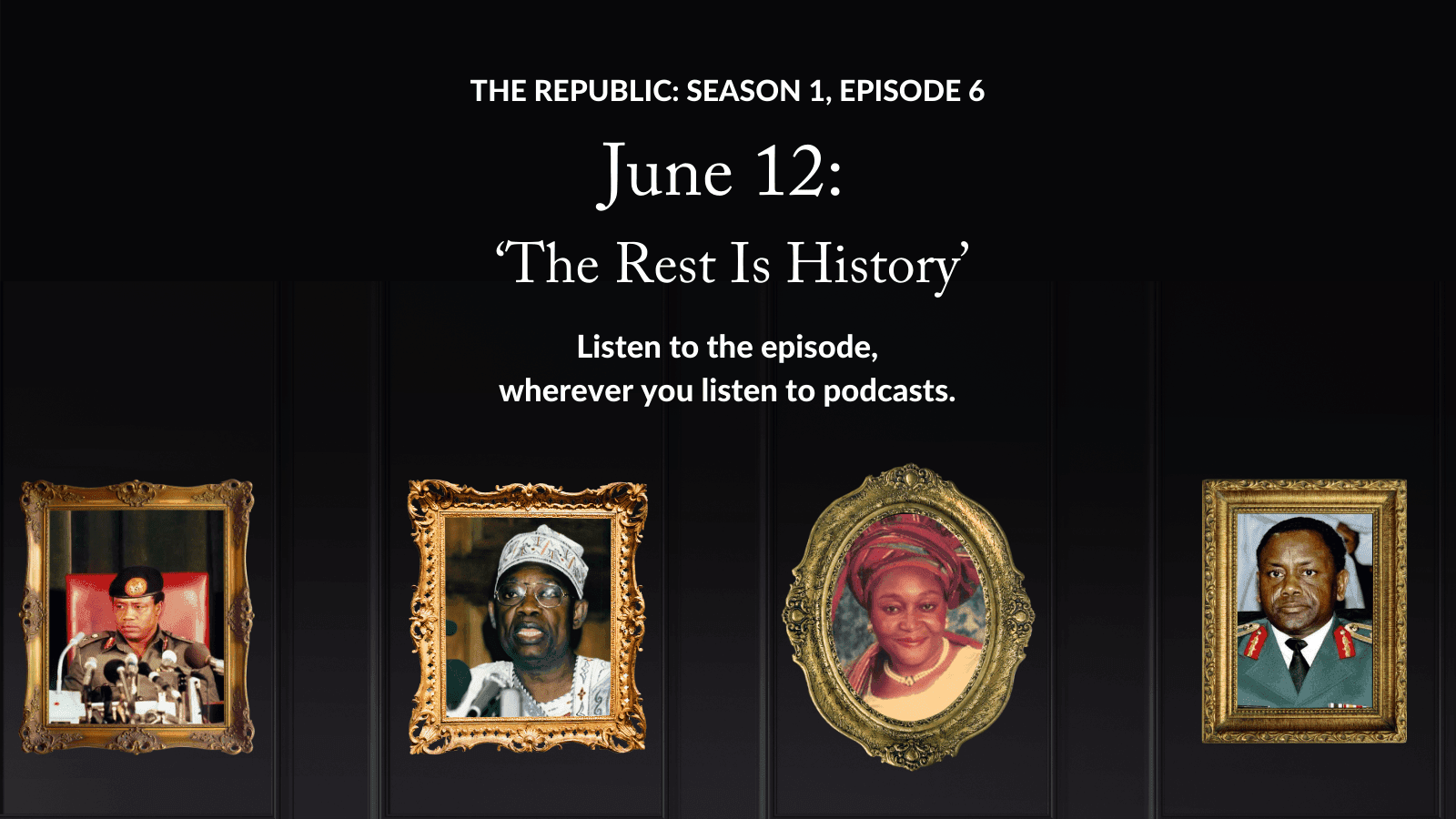
EPISODE 5: THE REST IS HISTORY
Ernest Shonekan: I, Ernest Adekunle Oladeinde Shonekan, do solemnly swear that I will be faithful and bear true allegiance to the Federal Republic of Nigeria. And that I will preserve, protect and defend the constitution of the Federal Republic of Nigeria. So help me God.
The point of an Interim National Government was to serve as a placeholder. You know, organize new elections, handle government responsibilities, all that jazz. But, like many things in Nigeria, that’s not what happened. For one, to many Nigerians it soon seemed like Shonekan was very much out of his depth. It seemed as though the military puppet masters had only allowed the Interim National Government so they would have time to put their ducks in a row while planning their re-takeover. The Interim National Government had to deal with strikes, inflation, criticisms from all angles and a growing concern that this new government was very much illegitimate. It was doomed to fail from the jump and while Shonekan was playing president, the real gs were, as they say, moving in silence.
When IBB stepped down from power, he left behind Abacha who took on the role of secretary of defence and vice chairman of the Interim National Government. Essentially the Vice President. IBB’s reason for this was supposedly to show that the military supported the Interim National Government and democracy as a whole. But here’s the thing, leaving behind a guy who was infamously ‘coup happy’ to make sure nothing unsavoury happens to your unstable government was very much a ‘fox guarding the hen house’ type deal. But you don’t become a self-proclaimed evil genius by not having a contingency plan and IBB had one by the name of Lt Joshua Dogonyaro.
IBB’s master plan was to appoint Dongoyaro as the chief of defense staff giving Abacha more of a background policy-making role while the Dongoyaro would be at the forefront of operations, taking charge. IBB would tell you that this was all for the greater good of the country and stability of the Interim National Government but others would say that this was his flailing attempt at grasping some sort of control. He no longer had the backing of the military and could now only rely on shaky alliances. The announcement for the new appointment was made during IBB’s resignation parade along with the announcement of the retirement of a bunch of senior service chiefs, which IBB seemed to do just out of spite. After all, IBB wasn’t planning on going down with the ship all by himself.
General Sani Abacha: It is on this note that I, on behalf of the Nigerian Armed forces and the police, bid our outgoing Commander in Chief Gen. Ibrahim Badamasi Babangida CFR DSS MNI and his family farewell and wish them a happy life in retirement.
None of these announcements sat well with members of the military. IBB had just forced retirement on a bunch of people, stripping them of their jobs and power. So the director of military intelligence, Brigadier General M.C. Ali, decided to have an aside with Abacha to let him know that IBB’s decision was not going down well and somebody, that person being Abacha, needed to do something about it. Abacha, however, knew how to play the long game. He told Ali to chill. Abacha recognized that before they made any big moves they needed the military united and the ever willey Abacha already had plans on how to do that. He met with the retired service chiefs and told them he empathised with them. He said he was on their side and would help them delay their effective retirements till September 17th. With their support, Abacha backtracked the date of IBB’s resignation to the 26th, effectively rendering all declarations after that day moot, including Dongoyaro’s appointment.

Abacha claimed that he was only doing this because it would be unfair to have the top three military positions made up of only Northerners. So he gave the post to Gen Oladipo Diya, Commandant of the National War College and a Yoruba man from Ogun state, coincidentally MKO’s home state. Now it wasn’t like Abacha was a champion for ethnic equality. In fact he didn’t exactly care for Diya or any Yoruba officers at all. But he knew for his master plan to work, he needed to isolate Dogonyaro and appeal to the Yoruba demographic by pacifying Yoruba leaders.
From the jump the plan had always been to oust Shonekan. For one thing, Shonekan was never sworn in as commander in chief of the armed forces, that may seem like a minor oversight but it meant he had no control over the armed forces but guess who did? Abacha. Abacha’s squad in particular, formally known as the Lagos caucus, was actively plotting Shonekan’s downfall. Nominations were put in and at meetings of the entire caucus and the inner circle, General Sanni Abacha was elected Head of State and Minister of Defense by a self-appointed military electoral college. The remaining top positions were given to Diya who now held the position of Chief of General Staff. Gen. Abdulsalami Abubakar was now Chief of Defense staff. Brigadier General Alli became the Chief of Army staff and Rear Admiral Allison Madueke took on the role of Chief of Naval Staff in order to bring in some sort of ethnic balance. Unfortunately, the election did not favour everyone, as some officials who already had top positions of power were ousted in order to fulfil Abacha’s grand vision. Gen. Ali Gusau who was originally appointed as Chief of Army staff by IBB and Rear Admiral Suleiman Saidu originally the Chief of Naval staff were frozen out of top positions in place of others who better played the parts in Abacha’s grand scheme.
Interviewer: When Chief Shonekan was to tender his resignation in the army were you one of those officers who had an agreement with Gen Abacha?
General Adisa: No I’ve not come into the… As my friend.. Or my officer Mustapha said.. an inner caucus but not inner caucus.
Abacha had now fully consolidated military power. His allies Gen Gusau and Gen Abubakar advised patience. Gusaau didn’t think a full military regime was the best move for the military at that point while Abubakar saw no reason to dispose of Shonekan so soon after he was installed. A few days later, on the 24th of September, our protagonist made his reappearance. MKO was back.
Like the man of the people he was, MKO was welcomed back into the country with crowds of supporters waiting to herald his arrival. But MKO was a man on a mission and he didn’t have time to shake hands, he didn’t even have time to stop home. The first thing he did was head to the defence house in Lagos where he had a secret meeting with Abacha behind closed doors.
Insiders claim that both Diya and Abacha encouraged MKO to come back despite Shonekan’s wishes. Shonekan on the other hand was kind of getting the hang of being president. He was going on the international stage and being recognized as the head of state of Nigeria. He was investigating corruption in parastatals like the NNPC, NEPA, customs and Nigerian Airways. Shonekan also set out to repeal some of the harsher new decrees that IBB had set in motion and released some of the activists who had been imprisoned during the post-June 12 riots.
Unfortunately for Shonekan, this streak wouldn’t last. Shonekan’s decision to remove fuel subsidies in order to manage rising oil prices caused mass protests and riots. Still the worst was yet to come. On the 10th of November 1993, another announcement would shake things up for Nigerians. The results of the lawsuit MKO made in October 1993 against the Interim National Government had finally been released and the Lagos High Courts had come to the conclusion that the Interim National Government was illegal and therefore null and void.
Since IBB had signed away his power on August 26, any decree signed on the 27th was null and void since he didn’t have any political power to make that decision. Meaning decree 61, the constitutional basis for the interim government, did not exist. The dominos were finally falling in place for Abacha. Professor Bolaji Akinyemi, a former Nigeria External Affairs Minister from 1985 to late 1987, and other Nigerians begged Abacha, the most senior government official at this point, to overthrow Shonekan’s government and bring some much-needed stability to the country. But surprisingly Abacha ignored the pleas. He hadn’t meticulously planned his hostile takeover just to swoop in at the very first opening. After all, the Interim National Government was not taking the ruling lying down and was attempting to fight it in court.

There was also General Gussau to think about and Abacha wasn’t trying to underestimate him. But on the 12th of November, realizing all was clear, Abacha was ready to strike. He took Diya, Gussau and a truckload of armed soldiers to the Aso Rock Villa where they accosted Shonekan who was ‘advised’ to step down. His government had been declared unlawful and the people never wanted him anyways. It was best for all parties if he just willingly stepped down and things didn’t get messy. Abacha, in his goodwill, was even willing to let Shonekan give a resignation speech, something completely unheard of in the world of coups. Shonekan knew his only option was to comply. He wasn’t exactly ready to die for Nigeria. So he drafted his resignation speech and handed it to the military for approval and stepped down from office, making history as Nigeria’s shortest head of state at only 82 days–10 days longer than Kim Kardashian’s marriage to Kris Humphries. Giving ultimate power to Abacha.
Abacha: Many have expressed fears about the apparent return of the military. Many have talked about the concern of the international community. However, under the present circumstances the survival of our beloved country is far above any other consideration. Nigeria is the only country we have. We must therefore solve our problems ourselves. We must lay a very solid foundation for the growth of true democracy.
The Abacha takeover was quite popular with many Nigerians. For some reason, people seemed to believe that Abacha was on the side of democracy. They figured he toppled the Interim National Government because it was an unlawful institution that had no intention of passing on power either to MKO, the people’s original choice, or to an elected official. When Abacha retired ‘Babangida’s Boys’, 17 military officers who were close to IBB, David Mark—one of the retired officers gave an interview to Newswatch on April 22nd, 1994. In the interview, Mark not only dismissed rumours that they had been fired because of proximity to IBB, he also put a microscope on Abacha’s new regime. He claimed Abacha’s regime had no plans for a democratic future and planned to stay on till 1999. It wouldn’t be long before Abacha would show his true colours. In fact, he was quick to dissolve democratic institutions and replace democratically elected officials with military officials and the police.
Abacha: Consequently, the following decision come into immediate effect. The Interim National Government is hereby dissolved. The national and state assemblies are also dissolved. The state executive councils are dissolved. The brigade commanders are to take over from the governors in their states until administrators are appointed. Where there are no brigade commanders the commissioners of police in the state are to take over. All local governments are dissolved; the directors of personnel are to take over the administration of local governments until administrators are appointed. The National Electoral Commision is hereby dissolved. All former secretaries to federal ministries are to hand over to their director generals until ministers are appointed. The two political parties are hereby dissolved. All processions, political meetings and associations of any type in any part of the country are hereby banned. Any consultative committee by whatever name called, is hereby proscribed.
Obviously, this speech did not inspire hope for Nigeria’s democratic future but Abacha was just getting started. The next thing Abacha did was go after people, both civilian and military, who he felt were a threat to his power and MKO was one of these people. Weirdly enough, MKO didn’t seem to anticipate how much danger he was in. After all, he also supported Abacha. During the August 28th to 7th September oil strikes of 1993, led by the National Union of Petroleum and Natural Gas Workers (NUPENG), MKO called Frank Kokori, a political activist and the General Secretary of NUPENG, to cooperate with Abacha and suspend the strikes.
Apparently, Abacha had made a deal with MKO to overthrow Shonekan and hand over power to him after six months. With the perspective we have, it’s difficult to understand why MKO would make such a deal. Did he really believe Abacha would be content to govern for a few months and then hand the presidential seat back to the rightful owner? Was it misguided optimism? Hope that justice would prevail? The blind confidence and sense of invincibility that only a wealthy man with powerful friends could possess? Before Abacha became synonymous with cruelty, to a surprising amount of people in the 90s, Abacha really was just some guy. In Kokori’s memoir, Frank Kokori: The Struggle for June 12, he writes that:
I found General Abacha very cordial; almost patronizing. You would think he could not hurt a fly. Nothing revealed that underneath such a gentlemanly façade hid a deadly ambition that would later mow down countless politicians and citizens.
So it’s possible that MKO was just seduced by Abacha’s unassuming personality. What’s more likely though, was that MKO was caught between a rock and a hard place and ended up having to make a deal with the devil. The former governor of Ekiti state, John Kayode Fayemi, who was a writer at the time, believed that was the case. In a cover story he published in Nigeria Now just before the coup, he wrote of the MKO/Abacha alliance that:
The irony of it is great, though, that a man who won the right to power by popular democratic means, should wait on extra-democratic forces to consummate that right. The trouble is, the people may be predictable, electoral orientation and inclinations even more so. But the art has not been discovered to hold a man with a gun to his words. This is the tragedy of Abiola’s strategy.
It truly was a tragedy because Abacha was not planning on upholding his end of the bargain. Nigerians at this point had gotten used to protesting the government and pro-democracy and civil rights groups tried to mobilize against the government. They were quick to realize that they needed a united front against the regime if they were to truly be successful. Little did they know, the catalyst they needed would come in 1994 during President Nelson Mandela’s inauguration. Nigeria had been a major foreign supporter of the abolishment of apartheid, so delegates were invited to the inauguration. Abacha headed to Joburg with his delegation which included former President Shehu Shagari and former Head of State Gen. Yakubu Gowon. Embarrassingly for Abacha, the invite wasn’t exactly for him but for MKO and his own delegates whose entire trip had been sponsored by Mandela’s party, the African National Congress.
In South Africa, Abacha and his squad were treated as an afterthought and even booed by the crowd while MKO and his entourage were given the royal treatment. MKO was recognized by and went on to have multiple meetings with the US VP Al Gore. MKO was even given a more prominent seating position at the inauguration in Pretoria.
To his credit, Abacha didn’t blink at the disrespect. He was obviously fuming though and this would become the turning point in his relationship with MKO. MKO couldn’t even take refuge back home because things had been brewing back home.
Back in Nigeria, MKO’s moves in South Africa had bolstered pro-democracy groups back in Nigeria. One result was the creation of the National Democratic Coalition of Nigeria aka NADECO. NADECO’s members included established politicians like Chief Anthony Enahoro, retired senior officers like Theophilus Danjuma, political and pro-democracy organisations like Afenifere and the Community for Unity and Understanding (CUU), all groups of people who were sick and tired of the military government and the ridiculous political landscape Nigeria had been thrust into. NADECO questioned if a military government, an institution which they pointed out was inherently authoritarian, could usher in democracy. The answer was obvious. No. The military’s track record with both IBB and Abacha showed they were incapable of doing so and to pretend otherwise was in NADECO’s eyes fraudulent. But NADECO wasn’t just going to throw their support behind Abiola, they needed to make sure he was really about that life. So they invited him for a meeting to make sure they were on the same page and he was truly ready to lead the struggle. MKO accepted their philosophy and joined the group.
NADECO member: What we are advocating is a non-violent peaceful dialogue setting. But as long as they continue to make the convocation of the sovereign national congress an unacceptable thing, the chances are this country will go underground.
NADECO’s objectives were simple. They wanted true federalism and a stable government. They demanded that the June 12 election be validated and for MKO to be put in charge of a government with elected officials of diverse ethnicities. They also called for Nigerians to boycott the National Constitutional Conference elections that were being held. Abacha figured he’d heard the last of June 12 drama but the high-profile nature of NADECO’s members made NADECO a formidable resistance force that wasn’t making itself easy to ignore. NADECO’s formation lit a new fire under people and different groups began to echo NADECO’s demands for the military to leave. Religious groups, politicians, traditional leaders, even former Head of State Olusegun Obasanjo joined the call.
Abacha’s patience had run thin at this point. He decided he had let the opposition go unchecked for far too long and made a speech on May 20th denouncing those who would try to disrupt the conference elections and ‘plunge the country into chaos and disruption’. The next day, armed police attempted to disrupt a gathering of Yoruba rulers but failed to stop them from meeting in secret and releasing a statement denouncing the Constitutional Conference and calling for democracy. The people were convinced, and the May 23 elections were largely boycotted in the southwest.
About 15 pro-democracy activists were arrested for allegedly trying to disrupt the elections but they were subsequently released. It seemed NADECO’s influence was bringing everyone out of the woodworks because on May 30, the disbanded senate met in secret to issue a statement calling on Abacha to hand power over to MKO. The regime had had enough of NADECO and their bad influence, so on May 30, they were declared an illegal group and anyone who was in opposition to the regime or a dissenting voice was labelled as NADECO OR ‘Nadecoristic’. This was a big deal because it meant even regular people who disagreed with the government could be bundled up in white vans and declared enemies of the state. The regime began arresting anyone who they felt fit the bill from June 1st. They started with former senate president Ameh Ebute, who was arrested after he openly announced the senate’s decision to reconvene. Many more arrests followed. Former senators, former members of the House of Representatives, former governors and several members and leaders of NADECO including Chief Olusegun Osoba who’s arrest was recorded live on the BBC World Radio Service. Many of the people arrested were not charged with anything, but were still detained for weeks, at least thirteen were charged with treason and were held for at least two months before being granted bail. These events did not dull MKO’s spirit, in fact all this support seemed to invigorate him and on June 11 1994, he would make his iconic stand, the Epetedo Declaration.
Rasheed Aro-Lambo: We are all members of SDP. Dr Dosumu just called me that Aro, I should come o and go to his house at Oshodi street to meet him there. He gave me his phone… I don’t know what you call that big phone then, one big phone like this cellular. He gave the phone to me that I should not tell anybody that Abiola is coming to declare his presidential declaration here. I said Abiola? He said yes.
At Jabita Hotel, Ikeja, the Primrose Group, made up of prominent NADECO members including Chief Adesunbo Onitiri, Senator Shitta-Bey, Dr Wahab Dosumu and Prince Ademola Adeniji Adele convened to agree on a location for Abiola’s declaration. It was agreed they would have it at Epetedo, Dr Wahab’s area on Lagos Island and at Abiola’s suggestion, there would be a judge there to swear him in.
Rasheed Aro-Lambo: Oya comme come Aro. Go and tell people.. Go and tell everybody that Abiola is around.
So a year after the election that started it all, in what must have been a full circle moment for him, MKO arrived at Epetedo in what would be a desperate attempt at forcing the regime’s hand. According to Rasheed Aro-Lambo, an Epetedo indigene and the MC of the event, Abiola arrived early in the morning in a dirty Mercedes Benz. Hashtag-humble. Many people wonder why MKO chose Epetedo instead of somewhere more glamorous to declare himself president but according to Mr Aro-Lambo, the answer was simple. MKO felt safe there. The people there were staunch loyalists and they were willing to put themselves at risk with the regime and police to back MKO.
Abdulwaheed A. Jawando: It’s very very essential that Abiola should swear here in Epetedo. You know the love we have for Abiola… you know this place is safe… they’ll not be able to get or fish him out from this area. We shall protect him to the highest place and we did.
If you’ve ever done a group project, you’ll know Abdulwaheed Jawando, the man you’ve just heard was just yanning. On the actual day, most members of the group failed to show up. They were afraid they would be charged for treason and there was no judge present to swear MKO in. Still, the turnout was decent and as always, the show must go on. So to a crowd of loyalists, press and members of NADECO, MKO denounced Abacha’s government as illegal, reinstated the democratic institutions and declared himself the President and Commander in Chief of the Federal Republic of Nigeria, saying:
As of now, from this moment, a new Government of National Unity is in power throughout the length and breadth of the Federal Republic of Nigeria, led by me, Bashorun M.K.O. Abiola, as President and Commander-in-Chief. The National Assembly is hereby reconvened. All dismissed governors are reinstated. The State Assemblies are reconstituted, as are all local government councils. I urge them to adopt a bi-partisan approach to all the issues that come before them. At the national level, a bi-partisan approach will be our guiding principle. I call upon the usurper, General Sani Abacha, to announce his resignation forthwith, together with the rest of his illegal ruling council.
MKO’s declaration was praised by citizens and activists alike. To them, this was MKO taking a direct stand in face of the military regime. However, for activists like Kokori, it only showed that MKO wasn’t the revolutionary that he was being heralded as. People questioned why he would make the declaration in Nigeria and not London, unaware that the British government had threatened MKO with deportation if he formed a government in exile. To Kokori, it was especially mind-blowing that MKO would defy Abacha so publicly without making contingencies for when Abacha retaliated. And retaliate Abacha did. Arrests began to happen almost immediately after the declaration. Epetedo was flooded with police who arrested anyone they thought might have been part of the rally. NADECO Member Adeniji Adele was immediately picked up and MKO went into hiding. But the damage had been done. MKO was declared wanted and a N50,000 reward was announced for anyone with information on him. His crime: causing disorder and intending to overthrow the government.
Rasheed Aro-Lambo: Immediately after Abiola left, Abiola hold that thing up like this and he declared himself as the president of… everybody shouting oh yes oh yes. By the time he left… just in a few minutes… we saw like ten loads of policemen… like ten load… they are now coming in… where’s the man- you know the way police do- where’s the man… with their gun… where’s the man… the man has left… nobody here… only the people leaving in the area.
Even though at this point MKO was a criminal in the eyes of the government, you wouldn’t have known it by his clumsy attempts to stay hidden. He was moved from place to place, from the island where he stayed in the house of Chief Gbadamosi,to Surulere, where he apparently stayed with Senator Wahab Dosumu. It was there he made a brief public appearance at a rally before heading back to his own house, followed by aides and crowds of supporters. Dele Mommodu, a close ally of Abiola who saw him before his arrest, said in a 2016 interview with Punch Newspaper, that after briefly leaving MKO’s house to freshen up, he returned to find the police surrounding the house with apparent orders not to let anyone in or out. He called MKO to find out what was going on and MKO told him to go back home because he had heard they were coming to arrest him at 1am but he didn’t think Abacha would try it.
This might have been Abiola’s fatal flaw. Like his declaration at Epetedo MKO seemed to expect that everything would work out in the end. At his core he was a businessman and he didn’t seem to realize that Abacha was operating under a different set of rules. On June 23 1994, MKO was arrested by armed forces. The arrest happened while he was having an interview with BBC in front of crowds of supporters singing the national anthem.
Interviewer: Uh, what is happening at your house? Are you being arrested? MKO Abiola: I’m being arrested. I’m just going out now with the police. Interviewer: Hello? MKO Abiola: You see, there’s a loud crowd here and I was being escorted out to detention by singing the national anthem. Interviewer: Why are they arresting you? MKO Abiola: They are arresting me… ha on an allegation of felony… nameless treason or something like that.
His arrest wasn’t unexpected and in fact made him look like a martyr to the people. His supporters stormed the streets demanding his release. NUPENG along with the the Petroleum and Natural Gas Senior Staff Association of Nigeria (PENGASSAN) began a strike on the 4th of July that crippled the country. The Nigeria Labour Congress later joined in the strike in solidarity. Even then, the country’s over-reliance on its oil industry was an exploitable weakness and the strike managed to decrease domestic fuel supplies and incite riots. By August the strikes had eroded international crude oil revenues as well.
The June 12 saga had many strong characters, one of those being Alhaja Kudirat Abiola. Kudirat married MKO at a young age and they had six children. Even though she never attended university, it was clear she was an intelligent, diligent, woman. She was head girl in her secondary school and was destined for great things. Kudirat’s passion for education made her an avid supporter of the Ansa-Ur-Deen movement, an organization with the goal of educational and social development in Muslim communities. After the annulment and while MKO pressed the military government to recognize his electoral victory, Kudirat joined pro-democracy activists to campaign against the military government. Her participation was especially important as her prominence in the movement persuaded other women to have an active role in the protests. She mobilized market women, an incredibly important demographic in Nigeria.
Hafsat Abiola Costello: Women were leaders, not just voting not just participating at that level but really organising demonstrations, writing articles, defying the military, locking down markets, occupying the streets.
Not even Abiola’s incarceration dampened her spirit or weakened her resolve. In 1994, she was a major backer of the oil strikes that crippled Nigeria, and helped to fund the striking workers. Even with threats against her family and herself, Kudirat never faltered. She held interviews with foreign and local press while trying to free her husband. She openly criticised the Abacha regime despite their frequent attacks. The regime tried to charge her with conspiracy for treason and making false statements but none of this stuck. In December 1995, Kudirat joined activists like Anthony Enahoro on a march for freedom in Lagos, bravely facing armed forces the Abacha government had sent to intimidate them. Kudirat was an unexpected thorn in the side of Abacha, who probably thought she would quietly mope in the corner while MKO rotted in prison. Instead, Kudirat only showed tenacity and bravery.
Kudirat Abiola: There cannot be democracy under this atmosphere. An election has been won on June 12 1993. The winner of the election now is being tried for treason. There’s no way they can be… they are now deceiving themselves. Instead of them to tell us that they’ve enjoyed this power so much… They have stolen our money so much they want to keep ruling for as long as they live.
But on 4 June 1996, both Kudirat and her driver were shot in her car by armed men who had been tailing them and they both died in the hospital. Kudirat’s death sent shockwaves throughout Nigeria. In response, Abacha sent his condolences to the Abiola family and condemned the killings as an unfortunate by-product of the increase in crime and terrorism that had been plaguing Nigeria the past month.
But Anyone who had been paying attention knew this was no accident. Kudirat had already spoken up about the threats she had constantly been receiving and she wasn’t the first openly outspoken person against the government who had been assassinated. No matter what Abacha claimed, no matter how sympathetic he tried to look, as the leader of the regime she had openly antagonized, Nigerians felt her blood was on his hands.
When we talk about June 12, Kudirat’s accomplishments are often overshadowed by MKO’s. But it’s incredibly important to remember Kudirat not only as the wife of MKO, fridged by history, but even more so as an outspoken activist, who stood up to arguably Nigeria’s most fearsome military regime.
Hafsat Abiola Costello: I don’t really think about justice just for my mother. I think of justice for the Nigerian woman. I Think of the dynamism of the Nigerian woman, the intelligence, all that they have to give to the nation. I think that justice would be served for Kudirat when Nigeria is a space that allows women to thrive on all their potential.
After Kudirat’s death, things only seemed to get worse. Bombs seemed to be going off every other day, pro-democracy activists were being detained and charged with treason. It was more or less understood that Abacha was looking to hold onto power even after he had dissolved the military government. For one, he forced the five political parties he personally approved to all nominate him for the presidency. Nigerians were not even angry or frustrated anymore; they were just tired. Legal methods were not working, protests were not working, the only other option, at this point seemed to be divine intervention. It’s easy to mock Nigerians for being religious to a fault but when the world around you is so bleak and nothing else works what other options do you have? Nigerians clung to the hope that since the government could not be saved by foreign powers or a local revolutionary, some heavenly intervention would come down and save them from their living hell. And you know what, you could say this intervention happened.
According to Abacha’s Chief Security Officer, Major Hamza Al-Mustapha, Abacha survived eight coup attempts, including one by his second in command, Gen Oladipo Diya in December 1997. So his death on the 8th of June 1998, which is now an urban legend, took everyone by storm. If you ask three different Nigerians how Abacha died you’ll probably get three different answers. He was killed by a mysterious Indian sex worker. He was given a poisoned apple in what was biblical karma. He choked on a piece of chewing gum. The apple theory is probably the most popular because of how poetic it is. The government’s official cause of death isn’t half as fantastical, however. According to official reports, Abacha died of a heart attack. I was five at the time, turning six that year, and I remember how the street I lived on in Mushin lit up following the news of Abacha’s death. There was music, dancing, food. It was a carnival.
Baba Aye: When Abacha died, there was renewed hope. There were even those that felt that at last the mandate would be revalidated and MKO would be… but it would have also opened a fresh Pandora’s box.
After the celebrations and the excitement died down, the reality of the situation truly hit. The question in the air was what next? Yes Abacha was dead but what did that mean for the country? For one, critics like Wole Soyinka and others the Abacha regime had deemed enemies of the state were finally free from Abacha’s wrath. It was also a chance for the government to right some very old wrongs.
Wole Soyinka: My reaction is very simple. It an opportunity for the Nigerian civil society, an opportunity for the Nigerian military, an opportunity also for the international community. Interviewer: To do what?
Wole Soyinka: Right. To put pressure on the military. To say to the military enough of this nonsense. Enough of these spurious transition programmes. Don’t come and start. Don’t have a sort of power struggle among yourselves in order to see who is going to put on the mantle of Abacha. That period is very definitely over. As I’ve been saying just now Abacha never governed the country. Yes he terrorised the country he bullied the country. He was able… he had power, he had no authority. He was able to torture, he was able to kill, he was able to take hostages but he never governed the country because the people werent willing to be governed by a brute. The People were sick of military dictatorship. So it’s up to the military to recognize it, it’s up to the international community to say that we’re sick and tired of the degeneration of a potentially great society.
To many Nigerians, the next step was to get MKO out of prison and finally give him his electoral win. The military, however, preferred to swear in Abdulsalami Abubakar. It goes without saying that the military had become acutely unpopular. However, Nigerians had just spent five years under the rule of a textbook dictator. People wondered rhetroically, and rightly so, could it really get any worse?
Femi Wiwa: Abacha has been the worst in a long line of human rights abuses in Nigeria. The thinking has always been every dictator, every successive dictator is worse than the previous one. So one hopes that we don’t get another dictator because he’d have quite a record to better Abacha’s appalling record.
Even before Abacha’s rise to power not everyone in the military was a fan of being in the government and after years watching on the sidelines, It turned out Abubakar was one of those people. He assured the people that the plans to transfer power to a democratic government would continue as scheduled in October, a promise Nigerians were tired of hearing. He then announced a 30-day mourning period for Abacha.
Abdulsalami Abubakar: For me personally, and for the nation at large, this must be one of the saddest moments of our lives.
Abubakar continued to show he wasn’t going to be Abacha 2.0 and started releasing some of the high-profile detainees. These included Obasanjo, Dasuki, Bola Ige, Beko Ransome Kuti, Chris Anyanwu, Frank Ovie-Kokori along with other journalists and pro-democracy activists. Abubakar seemed determined to unwrite Abacha’s wrongs, until it came to the matter of MKO’s release. Shortly after Abacha’s death, Abubakar’s government granted MKO release from prison but on one condition: he had to relinquish his mandate. Not surprisingly, this condition pissed off MKO’s supporters, especially when UN Secretary General Kofi Annan implied that MKO had accepted the deal and was due to be released. The common belief then was let’s wait till MKO comes out and we can hear it directly from him. But Nigerians never got to confirm whether or not MKO accepted this deal, because on July 7 1998, just before his scheduled release and about a month after Abacha’s death, MKO was declared dead.
Reporter: After four years in detention, Chief Moshood Abiola finally came home on Saturday. But instead of the hero’s welcome his supporters had hoped to give him when this day arrived, Chief Abiola was making this final journey in a coffin.
Official reports claimed that MKO died of a cardiac arrest during an interview with American officials. If Abacha’s death inspired feelings of hope for a greater future, MKO’s death inspired despair. People were stunned. It wasn’t supposed to end like this. MKO should have been coming back home victoriously to a crowd of supporters and to his loving family. All the things the MKO, his family along with Nigerians had gone through couldn’t simply have been for nothing. Just like with Abacha’s death people were not satisfied with the official cause of death. MKO’s family demanded an autopsy from both the family physician and an independent medical expert to which the government complied. The government was cleared when Dr James Young co-signed Abiola’s death as being caused by a long-standing heart disease.
Reporter: The idea of an international post mortem which apparently is under way at the request of the family and the head of state yesterday agreed to a kind of post mortem. It would be very important obviously to clarify this issue which is preoccupying everybody in the country.
Even with evidence though, rumours still circled. MKO’s supporters dismissed the official reports.
Protesters: I can’t believe it… count me out.
Regardless of the conspiracies, one truth remained. Nigerians believed if the election had not been annulled, if MKO had not been arrested and treated like a criminal for demanding justice, he might have lived. But, as with all counterfactuals, we’ll simply never know.
Crowd: We want freedom. We want Freedom. We want freedom.
In the backlash following MKO’s death, Abubakar seemed to be keeping his word. He publicly declared his transition programme with a handover date set for the 29th of May 1999. Then, he dissolved several political institutions Abacha had created including five political parties. He freed all the people who had been detained during the Abacha regime and dropped all charges against exiles who were now free to return to Nigeria.
On 11th August, Abubakar inaugurated a 14-member Independent National Electoral Commission (INEC) headed by Justice Ephraim Akpata. Their job was to make new electoral guidelines and a schedule for party registration and elections within two weeks. True to their word, they announced the schedule for the upcoming elections which included presidential elections for the 27th of February 1999. They ended up registering nine parties, People’s Democratic Party, People’s Consultative Forum, All People Congress, Democratic Advance Party, Movement for Democracy and Justice, National Solidarity Movement, People’s Redemption Party, Social Progressive Party and the United People’s Party.
On the 27th of February 1999, after 28 years of living under military rule, Olusegun Obasanjo, former head of state and retired General was elected president of Nigeria in an ironic turn of events. In May of that year, the new constitution was approved and Obasanjo was sworn in as the second Executive President of Nigeria. Officially beginning the fourth republic.
Chairman INEC Justice Ephraim Akpata: This moment… Is of great significance in the political history of our dear country Nigeria. Olusegun Obasanjo, retired… of the PDP. Having compiled with the requirement of the law and scored majority of votes is hereby declared the winner.
Fast forward to about 20 years later. The June 12 elections had become an iconic moment in our history but the day itself is not celebrated except in some places in the southwest. In 2018, then-president Muhammadu Buhari decided to remedy it by moving democracy day from May 29th to June 12th. The original May 29th date was chosen because that was when Obasanjo was sworn into office, but Buhari argued that June 12 was much more symbolic to the country and the state of democracy as a whole.
Muhammadu Buhari: What we are doing is celebrating and appreciating the positive side of June 12. June 12 which raised democracy and freedom. The June 12th which overcame our various divides and the June 12 that produced unity and a nation in cohesion. This is the June 12 we are celebrating and we will nurture it to our next generation.
May 29 also had a violent history. So Like many Nigerians, Baba Aye felt shifting Democracy Day from May 29 to June 12 was a positive development.
Baba Aye: First, I think that even fixing May 29 for handing over, as Democracy Day was grossly insensitive, taking into consideration the anti-Igbo pogroms of May 29 in the 66 or 67s, leading to the Civil War, I think it’s very, very insensitive. It was insensitive. June 12, yes, it is a significant day, no doubt, in the history of Nigeria. And when we talk of the liberal democracy in the country, probably the most significant day after 1st of October, which marks the day of independence. This in itself does not, in my view, necessarily mean that MKO represented emancipatory politics or would have brought about a qualitative transformation of the fates of the vast majority of Nigerians.
Over the past few months, I’ve grown fond of finding connections between the June 12 era and our political climate today. Some striking similarities are how both followed a Buhari government and how Nigerians experienced two campaigns that revolved around the notion of hope. Hope 93 in MKO’s race and Tinubu’s Renewed Hope of 2023. But unlike the 1993 election which was heralded as free and fair, the 2023 election has been criticized for rigging, electoral malpractice, violence and ethnic bigotry. It has left many asking whether our democratic institutions have weakened. Baba Aye made me wonder if what we have is not a democracy but a mutilated copy, a ‘Frankenstein democracy’.
Baba Aye: You know, there’s something that when I raise it a couple of times, some people feel scandalized. While those without thinking deeply will think it’s a commendation for the Tinubu feel very happy. There is a direct line, in my view, from Awolowo through MKO to Tinubu. I think there was an article I can’t remember by whom in The Republic, who in some ways captured this my line of thinking, but let me get down on it. But to understand my line of thinking, we have to go to the beginning of this discussion, where I said to understand the role a personage/political personality play, you have to first define and understand the time which she or he lived through. And Obafemi Awolowo reflected the era of the post World War II consensus, which allowed the flourishing of the interventionist developmental state in the global south and the Keynesian welfare nation states in North Atlantic countries. MKO was the answer for the period of nascent neoliberalism. Tinubu is the perfect avatar for decadent and obsolete neoliberal capitalism. So I see them as different verses of the same song as it gradually rises to his crescendo. At times, a number of people when they come into power, they actually have good intentions. But good intentions are not enough. How do the objectives seat in with the structural dynamics that they commit to politically, economically and ideologically. So, to answer your question, yes, it is hope reloaded or how did Tinubu put it, but it is hope reloaded within the context of how the neoliberal order that was just emerging at the time of Abiola has now taken full, monstrous shape. So it’s a Frankenstein of that hope which itself, because I mean Victor Frankenstein who made Frankenstein himself was not a saint. So it’s a Frankenstein of the hope, renewed hope. I see there’s a thread from one to the other and even beyond the one to the other way back to Awolowo, but much more closely, there’s a thread between the MKO and BAT agendas.
OUTRO: 30 years after the election, the story of June 12 continues to resonate because, fundamentally, it is the story of Nigeria. At the core of this story is the question of how we choose to govern ourselves years following our independence. When we draw a line between the 1993 and 2023 election it is this question that rings most prominently; in how we can find traces of the hopes, disappointments, anxieties and even anger that we have today in the voters of those days.
To understand this better, let’s go back to Programme 6 of Ali Mazrui’s The Africans, the documentary we started this episode with. In the documentary Mazrui is in Lagos in the 80s, after Shehu Shagari has been overthrown in a military coup by General Buhari. Democracy hangs suspended and the democratic institutions Mazrui visits look like ghost towns. In the clip, Mazrui is sitting in the national assembly, a beautifully designed but ultimately deserted building. I think of how flawed democracies like ours are like this building, conceptually beautiful but too often ominously empty. Mazrui leaves this message for us:
Ali Mazrui: This house in Lagos Nigeria, part of the National Assembly is gone silent. No longer the loud exchanges of policy disagreement. No longer the boisterous laughter of African jokes. No longer votes absentia or votes of confidence. The house is there. You know, you can teach other people how to speak the English language, you can teach them how to practice Christianity but you cannot teach them how to govern themselves. That they must learn themselves.
Thanks to Peace Onafuye, Iniye Spiff and Victoria Audu for the archival audio you heard on this episode and our overall research. My deepest thanks to Ayisha Osori, Mr Gbenro Adebgola, Baba Aye and Professor Toyin Falola whose expertise and insights shaped our research and writing across all episodes in this season.
You’ll find a full list of the books, articles, and documentaries that we relied on in researching this episode at our website,
republic.com.ng forward-slash podcasts.
The Republic is produced by the Voix Collective. Our script writers are Iniye Spiff and, myself, Wale Lawal. I’m also the editorial director.
Thank you for following us on this journey. You can always follow our work at republic dot com dot ng. See you in the future⎈
The views, thoughts, and opinions published in
The Republic belong solely to the author and are not necessarily the views of
The Republic or its editors. We want to hear what you think about this article. Submit a letter to the editors by writing to
editors@republic.com.ng.





Comments
Sign in to comment.