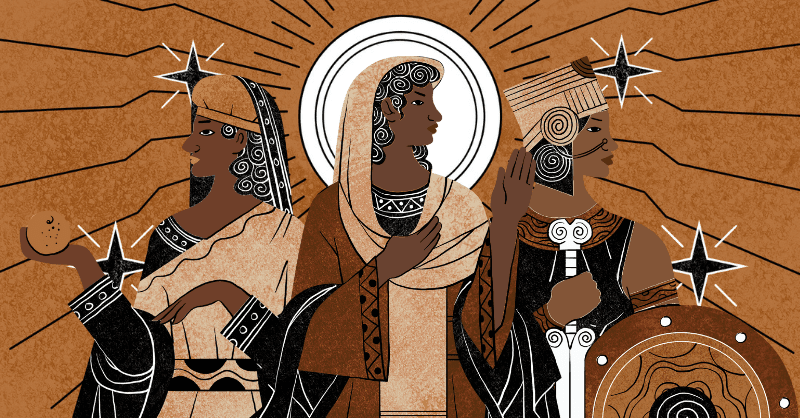

Though Hagar endures on the periphery of Biblical and Judaic tradition, she remains critical throughout Black womanist readings of Abrahamic tradition, most famously among Christian theological scholars like Renita Weems and Delores Williams. Biblical scholar, Nyasha Junior,
writes that Weems’ seminal work,
Just a Sister Away: A Womanist Vision of Women’s Relationships in the Bible (1988), ‘was the first book within biblical studies identified as a womanist work.’ Williams’ work,
Sisters in the Wilderness: The Challenge of Womanist God-Talk (1993), Junior added, ‘has become a standard text in theology,’ as it ‘brought renewed attention to biblical Hagar and to African American appropriation of Hagar.’ These pillars of a Black womanist reading of Abrahamic tradition themselves draw on historiography of other African women who have integrated her into works of narrative and artwork. Toni Morrison’s
Song of Solomon (1977), features Hagar, the rejected lover of the main character Milkman; in 1902 writer Pauline Hopkins published a serial novel,
Hagar’s Daughter, which follows an alleged slave-woman, Hagar, who also becomes rejected and estranged from her lover, eventually jumping seemingly to her death to save herself and her daughter. In 1895, Afro-indigenous artist, Edmonia Lewis, presented her sculpture,
Hagar, in the neoclassical style, pictured without the young Isma’il, with her hands clasped in prayer, facing up towards her Lord, at her feet what assistant professor in Black religious traditions, Oluwatomisin Olayinka Oredein, calls ‘Abraham’s filicidal parting gift, a water skin.’ What these interpretations have in common, Junior cites Dolores Williams, is the congruence ‘with many African American women’s predicament of poverty, sexual and economic exploitation, surrogacy, domestic violence, homelessness, rape, motherhood, single-parenting, ethnicity and meetings with God.’ The story of Hagar offers a spiritual catharsis of sorts, an ‘analogue for African American women’s historic experience.’
Comments
Sign in to comment.