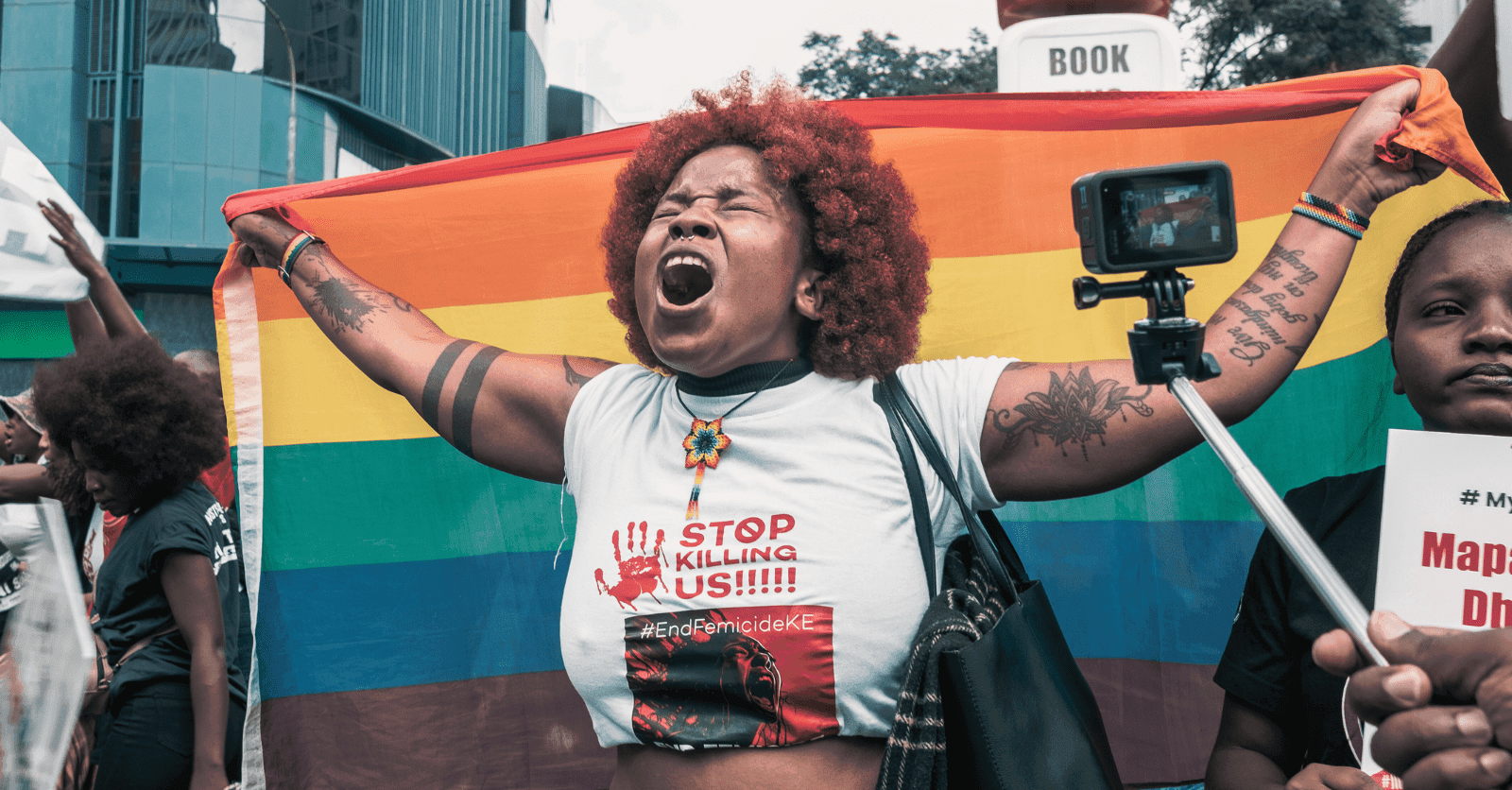
We are tired of being unsafe in our own country,’ Nancy Houston, the co-founder and executive director of Feminists in Kenya, told me on an erratic zoom call a few weeks ago. She was in Nairobi, where Feminists in Kenya is headquartered, and I was in Lagos. Feminists in Kenya is a feminist movement and one of the conveners of the anti-femicide protests that took place across Kenya earlier this year in January. I had followed the protests and had reached out to Houston, wanting to know more about the situation on the ground. We had been trying to have this conversation for some time and had needed to reschedule our call at least once. Finally, we were speaking: it was late March, only a few days since Kenya, Nigeria and several other African countries reported severe internet downtime
following damages to undersea telecoms cables that serve our countries. Incidentally, the internet, specifically the impact of social media on African feminist movements, was among what I planned to discuss with Houston. From Nigeria’s 2018 #MarketMarch protests to Namibia’s #ShutItAllDown of 2020, social media had, in recent years, come across as
a unique boon to feminist protests. Platforms like X (formerly Twitter) and the unique ability to coordinate discussions and thus communities around hashtags, had transformed the internet for activists generally. Such advantages meant that through the internet, Houston explained, ‘we’ve gotten so many opportunities…and we’ve been able to create alliances with multiple feminists.’ But with social media platforms increasingly prioritizing monetization and promoting algorithmic over organic curation, was social media becoming dangerous for activists? ‘I think the internet for us has been a double-edged sword,’ Houston said. Additionally, ‘there is a form of right-wing digital content that is actually spreading so fast. And this content is also radicalizing a lot of men who exist online. So, it’s like the patriarchal violence that exists offline, has moved online as well.’
Together with Kenyan human rights lawyer, Vivian Ouya, Houston founded Feminists in Kenya in 2019 following the protest, #TotalShutdownKenya. That protest was also anti-femicide, which left me with several questions: did #TotalShutdownKenya not achieve its goals? What had happened since then? Did the need for the January 2024 protests suggest that femicide was on the rise or that social media-enabled activism was ineffective? In discussing these questions, I wanted to understand more about feminist organizing in Kenya: the conditions in which feminists organized; how organizations like Feminists in Kenya were staying afloat; what funding and collaborations looked like. The result was a conversation in which Houston not only shared how Kenya’s feminist landscape has evolved since #TotalShutdownKenya, but also highlighted the unique challenges confronting Kenya’s feminist movements: ‘the more we grew,’ she explained, ‘the more we felt like we were being pushed to organize in a certain NGO-ized way.’ Likewise, she outlined the emergent opportunities such feminists are seizing. ‘[T]he resilience of Black feminist activists who are on the front line is highly valuable,’ she said. ‘They are waking up, and they are imagining alternative realities for African women. And they’re saying that this can’t be it for us, what else is there for us as African women?’
Our conversation continues below and has been edited for brevity and clarity.
WALE LAWAL
The first thing I really wanted to get a sense of is the context behind the anti-femicide protests. In news reports I’ve seen, the protests have been represented as a major development. We know that it’s not the first protest of its kind, particularly in Kenya, but I wanted to understand, at least in this iteration of the protests, what really happened? What drove the protests? Is there any context that you can share from your own knowledge of what’s been happening on the ground?
NANCY HOUSTON
On 27 January, earlier this year, Feminists in Kenya in collaboration with Usikimye, and Zamara Foundation called for a nationwide protest against femicide. So, these two organizations, Usikimye and Zamara, are also feminist organizations that we collaborate with. And also, just to give you a brief about the femicides statistics, currently, the Africa Data Hub has reported that from January 2016 to December 2023, over 500 cases of femicide were recorded in Kenya. But then in January 2024, alone when we were marching, over 30 women had been killed in intimate partner violence, femicide cases. So, they were killed by people who actually know them.
So, our premise for this march was that we are tired of being unsafe in our own country. We were basically saying that enough is enough. We are tired of the inaction by the government to centre femicide and gender-based violence as one of the biggest challenges facing Kenyan women currently. And our premise was also the fact that women in Kenya are more than half of this country’s population. We pay taxes in this country, we live in this country, we vote and elect leaders in this country, and our labour is very significant in the growth of our country’s economy. But the message that we are constantly getting as women is that our lives is not a priority. And so, that is really why we were marching.
We were saying that why is it so easy for our lives to be so easily discarded, that we can be killed that women can be killed in Kenya that women can be maimed? And the resulting discourse that we get is that, you know, we are being blamed, so victim blaming narratives and a lot of misogynistic online talking points. So, like I’ve said, we’re simply saying enough is enough. And some of the demands that we were asking the government is that we wanted femicide to be declared a national emergency. That was the first demand. The second demand was that we wanted the Government of Kenya to work in consultation with young Kenyan feminist activists to develop a commission on the elimination of femicide. And finally, we wanted the government to recognize femicide, specifically as a crime in the penal code of Kenya.
WALE LAWAL
You mentioned that there’s data from as far back as 2016. Do feminists in Kenya consider femicide to be a long running issue or a problem that has been increasing in recent years?
NANCY HOUSTON
In all honesty, Wale, I definitely think that femicide has persisted as a longstanding issue in Kenya for the longest time. I mean, this is a challenge that we’ve dealt with for a long time. And also just on the continent, if you look at Zambia, if you look at South Africa, and if you look at Nigeria. I think that African women and African feminists have been on the front line for the longest time talking about femicide and ending gender-based violence (GBV) because it is difficult for us as African women to progress, to move on, to have an economic reality that is sound, if we are dealing with femicide, if we are not safe. So yeah, this is a challenge that a lot of us have been dealing with in Africa. Also, I want to say that the current surge in the media coverage is not some sudden emergence of the problem. Like you know, it’s not new. It’s a result of the relentless efforts of feminist collectives, feminist movements and civil society organizations, who have all worked tirelessly to bring it to the forefront. So, for me, I would say that if we look at history, traditional patriarchal structures; at patriarchy as a system of power, things like economic disparities and culture, for example, female genital mutilation (FGM); these are things that perpetuate gender inequality and have contributed to the persistence of femicide in Kenya.
But like I have mentioned, grassroot movements and women’s rights organizations are really working to advocate for multiple legislative reforms to raise awareness to provide support services for victims of femicide in domestic violence. So, everybody that I know, at least in this space, is really trying as much as possible to raise awareness on femicide. But I also think that—I don’t know was it in 2015, or there abouts?—feminists in Kenya, not our organization, just the movement of feminists in Kenya had initiated a campaign called, ‘My Dress, My Choice’. In this campaign, they were rejecting the patriarchal idea that our bodies as women do not belong to us and they were saying that, in fact, we have autonomy and agency over our own bodies. This was a period in time in Kenya when women would wear short skirts or like tight dresses, or, you know, these dresses that are considered ‘immoral’. They would have motorcycle riders literally removing the clothes off them. So, there was a campaign called ‘My Dress, My Choice’ to reclaim our power in our agency over our own bodies and saying that our bodies are our own, we can wear what we want. ‘My Dress, My Choice’ is the immediate first protest that I remember that was putting these issues on the front line. And then, in 2019, of course, feminists in Kenya did a nationwide march called #TotalShutdownKenya. And here we were raising awareness on GBV and femicide. And we do have challenges, by and large, as feminist organizations. We have challenges, including limited resources. We have a lot of people who are resistant to our cause, a lot of deep-seated misogynistic attitudes and mindsets, but we are steadily pushing. And we hope that by creating a lot of awareness around femicide, we will be able to push for some systemic changes around it.
WALE LAWAL
You mentioned that femicide isn’t just an issue that Kenyan feminists are facing or trying to address. It occurs in multiple African countries. You mentioned South Africa, there’s Nigeria and so on and there’s, of course, you know, what we’re seeing happening in the Gambia, where there’s been this
push to bring back female genital mutilation. So, I wanted to ask, to what extent is the anti-femicide movement, as you’ve seen it, as you’ve experienced it in Kenya, an African movement? Are there exchanges, you know, other connections being formed between organizations in Kenya and those in other African countries? Is Feminists in Kenya, your organization, working in collaboration with any organization outside of Kenya? To what extent are you able to exchange ideas and resources beyond Kenya?
NANCY HOUSTON
I think that’s a very interesting question. Because when we say, ‘to what extent is the feminist movement, pan–Africanist?’ this really gets me because I’ve spoken with a lot of men who are not necessarily feminist, but identify as pan–African. And in their cause, in the pan–African cause, women’s rights are not included. This really gets me because if you are pan–African, and women in Africa, African women born in Africa, are saying that they don’t feel safe in this continent, in their countries, how does your pan–Africanist cause align with women’s rights? To what extent can we as African women say that Africa, this continent, is ours, and that we can identify with this continent, and that we can feel safe in this continent? So, I don’t know. I constantly question that. Because as a pan–African myself, I do want to feel like I am connected to this continent. But sometimes I also sit back and say, is this it for us? Is this it for African women? And I’m sure there’s a woman in Zambia saying, is this it, you know, is this all that the continent has to offer us? But yeah, that’s just a roundabout question. It’s a question that I constantly think about. On feminist alliances across the continent, I have to say yes. Yes, we saw connections, for instance, when we organized the march in 2019. We actually adapted the #TotalShutdownKenya march from the marches that happened in Zambia and South Africa. We saw South African women doing #TotalShutdownSouthAfrica. And because we were going through the same thing in Kenya, we also decided to do #TotalShutdownKenya. So, to that extent, I think that there’s a connection.
WALE LAWAL
One thing that’s also been a long running thread across the different feminist marches that we’ve seen is the role of the hashtag, social media, the internet. And of course, you know, these days, the internet, social media has also gotten a lot of pushback because platforms are no longer as reliable. I wanted to understand your experience of digital-enabled activism. How have you found the internet to be useful, particularly in the recent anti-femicide protest? Have you had challenges with using the internet? Are there ways in which you’re thinking about organizing beyond using social media?
NANCY HOUSTON
I think the internet for us has been a double-edged sword. On one hand, it has absolutely given us this incredible visibility. Our work has reached so many places. We’ve gotten so many opportunities because of our presence on the internet, and we‘ve been able to create alliances with multiple feminists. We’ve been able to have a sense of collectivism and solidarity with other feminists around Africa. That is one side of the internet. But on the other side, the internet has been terrible. It‘s been terrible because an emerging problem is of course technology and safety. For us as Black women who exist online, we feel like when we are visible, we are made to be hyper–visible, so that every tiny thing that we are doing is hyper–visibilized. And when we are hyper-visible, that means that we are opened up to more online violence. And right now, I also think that there is a form of right-wing digital content that is actually spreading so fast. And this content is also radicalizing a lot of men who exist online. So, it’s like the patriarchal violence that exists offline, has moved online as well. And I think that there’s a direct link between femicide and the growth of online manosphere spaces that exploit immense feelings of alienation and anxiety among men and then provides these men with some sort of distorted feelings of power over something or over somebody. So, for example, if a white man exists online, it is easy to radicalize him with content that speaks to having supremacy over everyone. And if a Black man exists online, it is also very easy to radicalize him with content that speaks to the supremacy over women, specifically Black women, and so because of this false—
Nancy’s connection broke at this point, but she successfully reconnected.
WALE LAWAL
I think the last thing we got was you were discussing how the fast spread of right-wing digital content is radicalizing men. You were telling us about how it is easy, for example, with Black men, to radicalize them with information that’s all about Black men dominating women, Black women in particular. We were talking about that kind of framework in which the internet is now amplifying anti-women messaging, or at least, patriarchal messaging towards men.
NANCY HOUSTON
Yes, of course. And I think that men then get this false sense of power. To some extent, I feel like people online or men online, who have been socialized to think in this patriarchal way in this negative way, are looking for some false sense of power; they’re looking for some sort of leadership, or some way to at least provide some sort of leadership for them in using to perpetuate some very vicious, anti-gender rhetoric that that has become very harmful. It is very dangerous to other us, to other marginalized people, to other women to other sexual and gender minorities.
WALE LAWAL
Can you tell us a bit more about the timeline of Feminists in Kenya? Can you tell us more about the organization, about when it was founded? And then I still have some additional questions around initiatives like #TotalShutdownKenya. But to start with, I wanted to understand more around the motivation for founding Feminists in Kenya, the situation on the ground when Feminists in Kenya was first founded, and how the organization has evolved over time.
NANCY HOUSTON
Feminists in Kenya was first founded in 2019 when the #TotalShutdownKenya march happened. So, before Feminists in Kenya was founded, we were multiple feminist activists existing on multiple online platforms. And we would create a lot of feminist political education online. So, we were known for feminist content and feminist education. We were very radical with it. We would speak truth to power, we were very disruptive. And so, at this point when, in 2019, we witnessed a lot of heightened cases of femicide, we came together as a group of feminist activists who have been existing online for a period of time. And because for most of us, our posts were very visible and used to go viral, we called for a feminist march called #TotalShutdownKenya. This was after we had seen the South African feminists and I think Zambian feminists also organizing, total shutdowns in their countries. We collectively came together and organized #TotalShutdownKenya in 2019. That was how Feminists in Kenya was born.






Comments
Sign in to comment.