Like many millennials, I have a little nest egg I have carved out of my earnings as a writer and communications expert and guard jealously. I feather this nest egg infrequently with surpluses I get from side hustles or benefactors instead of channelling these cash infusions into my more hedonistic desires.
It is a big deal for me as a writer in Nigeria to earn enough to have savings. I wasn’t formally trained in media and communications and it is common knowledge that even for professionals, the industry offers very little economic prospects. The basic writer’s salary is less than 100 dollars a month. For a long time, I convinced myself my nest egg was a first step to capitalist prosperity, raw material I could trade for more solid wealth creation tools that finance experts tell us we need, such as stocks and bonds, ETFs, mutual funds, and real estate. Technology made it easier to do this; instant transactions meant I could move this money around at the speed of thought and retrieve it just as easily. I believed I was playing the long game, one where the desired outcome was early retirement, underwritten by multiple streams of passive income.
But then the Coronavirus pandemic happened in 2020, a singularly sobering global event. It started in far-away China, a part of the world so technologically advanced, it might as well be alien to the average Nigerian. The information and images that trickled in at the start of the pandemic focused on markets where zoonotic viruses made the evolutionary leap from exotic animals to people, massive hospitals erected at speeds inconceivable to my Nigerian mind and forced isolation made possible by government surveillance. Then it spread to America, which was as familiar to me as my own backyard, thanks to nearly 30 years of Western media. This time, the news came as a deluge of verifiable reports, gross misinformation, and deaths by the thousands. The world, horrified by how quickly the virus overwhelmed America’s state-of-the-art, for-profit medical complex, shut down its borders and turned away the ‘vital’ commerce it had convinced us was worth bombing sovereign states and killing millions for.
I was on a work trip to South Africa, my first professional international travel opportunity, when the country decided to close its borders. My trip was immediately suspended, and I was rushed through O.R. Tambo Airport and back to Nigeria on an aircraft where flight attendants mandated the wearing of masks. When I returned, a total ban on non-essential activity was ordered, and life in Nigeria as I had left it had ceased. We were ordered to shelter at home for six weeks, enough time for the government to rally whatever skeletal defence it could against a disease that had humbled almighty America.
I was, to my relief, one of the privileged few whose job became even more vital during the pandemic, but far too many livelihoods were instantly vaporized by the first stay-at-home order. Without the great wheel of capitalism to propel us forward, so many people I knew lost hope. Without disposable income and things to do, the lifestyles we had sworn were indispensable were abandoned with almost lightning speed. Essential became the metric by which we sanctioned any kind of social activity, a directive that went against the very soul of Lagos, which was fuelled by chaos and needed outlets for dysfunction. Without churches, clubs and social watering holes, homes became too small, lives became too pedestrian. So, we retreated from our lives and found solace on the internet and its many algorithmic rabbit holes.
MUCH ADO ABOUT MONEY
For all the privileges it bestows, money in the digital age remains as abstract to me as it is to Cuppy Otedola, as the DJ daughter of one of Nigeria’s richest men, Femi Otedola, is known. Sure, it can buy luxuries untold and bestow access to the most exclusive places, but during the pandemic, we saw its limits.
Wealth was powerless in the face of an airborne virus that denied us for two years the simple pleasures of standing in a crowd of strangers and sharing the occasional knowing glance and smile of understanding. All the wealth in the world was useless if it was unsafe to leave our houses. We were forced to wait, billionaire and pauper alike, for the virus to run its course, for enough people to develop viral immunity either through infection or vaccine before life could return to a semblance of normal. Seeing billionaires shelter at home and wholly embrace N95 masks and hourly sterilizations made me question everything I had believed about my nest egg and, more importantly, about wealth.
I realised I didn’t particularly care for stupendous wealth; I never had. I saved because it was expected of me, not particularly because I believed that enough of it would become a ladder out of the crippling pit of poverty. I realised that the pandemic only affirmed what I really believed, a conspiracy many Nigerian millennials I knew secretly harboured: there are hard limits to the functionality of wealth. No amount of wealth can replicate at will the lucid authenticity of a truly spontaneous experience. Money was, at best, a social lubricant, easing certain kinds of interpersonal experiences where power was skewed towards one party.
This is a conspiracy I have come to realise most Nigerian millennials share because we grew up in the age of the internet and were its first guinea pigs. The first decade of my life in Nigeria was spent in a dystopian nightmare of military occupation and a stagnant culture and society, a situation that closely mirrored the generalized uncertainty millennials were born. It was the 1990s, a decade of uncertainty that started with the fall of the USSR in 1991 and ended with the Y2K bubble in 2000. We came of age in the decade of global connectivity, kick-started by the arrival of mobile technology in Nigeria in 2001.
The new century came with several significant technological shifts, each happening at warp speed when compared to previous innovations. The first of these shifts was the invention of the personal computer. It armed every person with a basic education and the tools to easily and accurately document their own lives. The next shift, the internet, allowed us to broadcast these personal accounts to public forums where others could consume them. The third, the smartphone, allowed us to document and share in real-time, and the fourth, social media, allowed us to monetize our experiences down to the most microscopic, pedantic detail as ‘content’. The cumulative result was so impactful that we developed a shared lexicon for what we collectively experienced. We cycled through whole phases of technology in years instead of decades, each cycle of innovation eroding our understanding of ownership and autonomy.
Because of these generational shifts, many of us millennials experienced delayed adolescence as we had to relearn, over and over, how to be adults in a digital world. Because of how meticulously the internet is curated, when something new is discovered, invented or created, there is only a short window of time when we can experience it without any kind of intentional or unintentional priming. In 1999, it would have sounded like science fiction to discover that every person who has contributed in some way to the internet leaves a digital footprint, readily available to everyone else each time they did a web search. But that is our reality today. I have access to 40 years of meticulous documentation from multiple perspectives on almost everything, including my own life, ranging from shallow first-person recollections to scientific explorations to critical analysis. Some of this ‘data’ is hidden behind website paywalls, but most of it is inextricable from my online identity thanks to algorithms, powerful search engines and meta-referencing through memes.
The catastrophic consequences of these innovations became apparent during the pandemic. Confined to my home and experiencing the world almost exclusively through screens, I became convinced that only a handful of experiences were even unique enough to defy this quasi-omniscience of the internet. Everything else had been subjected to the constant documentation, dissection and repurposing that has replaced social discourse. In the pursuit of views and validation, the internet lent itself to performance and flattened nuance in ways that harmed the integrity of my online professional, platonic and romantic relationships.
Without the serendipity of physical interactions, I struggled to recognize intimate experiences in my own life. Watching challenge after challenge, each sillier than the last, weaned me of the desire to perform for my followers, and as the world recovered over the next ten months, the need to experience something unsullied by the internet grew stronger than ever.
ENTER THE RENAISSANCE TOUR
As the pandemic eased, I agitated about how to reintegrate into a world that had shifted axis. During those months of isolation, my primary sources of human interaction outside of my COVID bubbles were the films, books, albums, video games and comedy specials artists had painstakingly made before and during the pandemic. I was also chronically online and saw that I wasn’t the only one who had gained a new appreciation for the devotion that was required to create the kind of work that can approximate the intimacy and serendipity of human interaction. There was a general sense of regret at how dismissive we had all been of the miracle of witnessing the creative genius and an unspoken agreement not to make the same mistakes if we were given another chance to deeply appreciate these artists whose work had shaped our lives.
When the world began to open up, I ventured back outside, burdened with new heights of health-related paranoia and a manic obsession to live as authentically as possible. I had just enough money in my nest egg to chase one elusive experience, and there seemed to be a consensus on what that experience should be.
Exactly two years after the second phase of the Nigerian lockdown was lifted, Beyoncé released ‘Break My Soul’, the first single off her seventh album, Renaissance.
AN ODE TO QUEER JOY
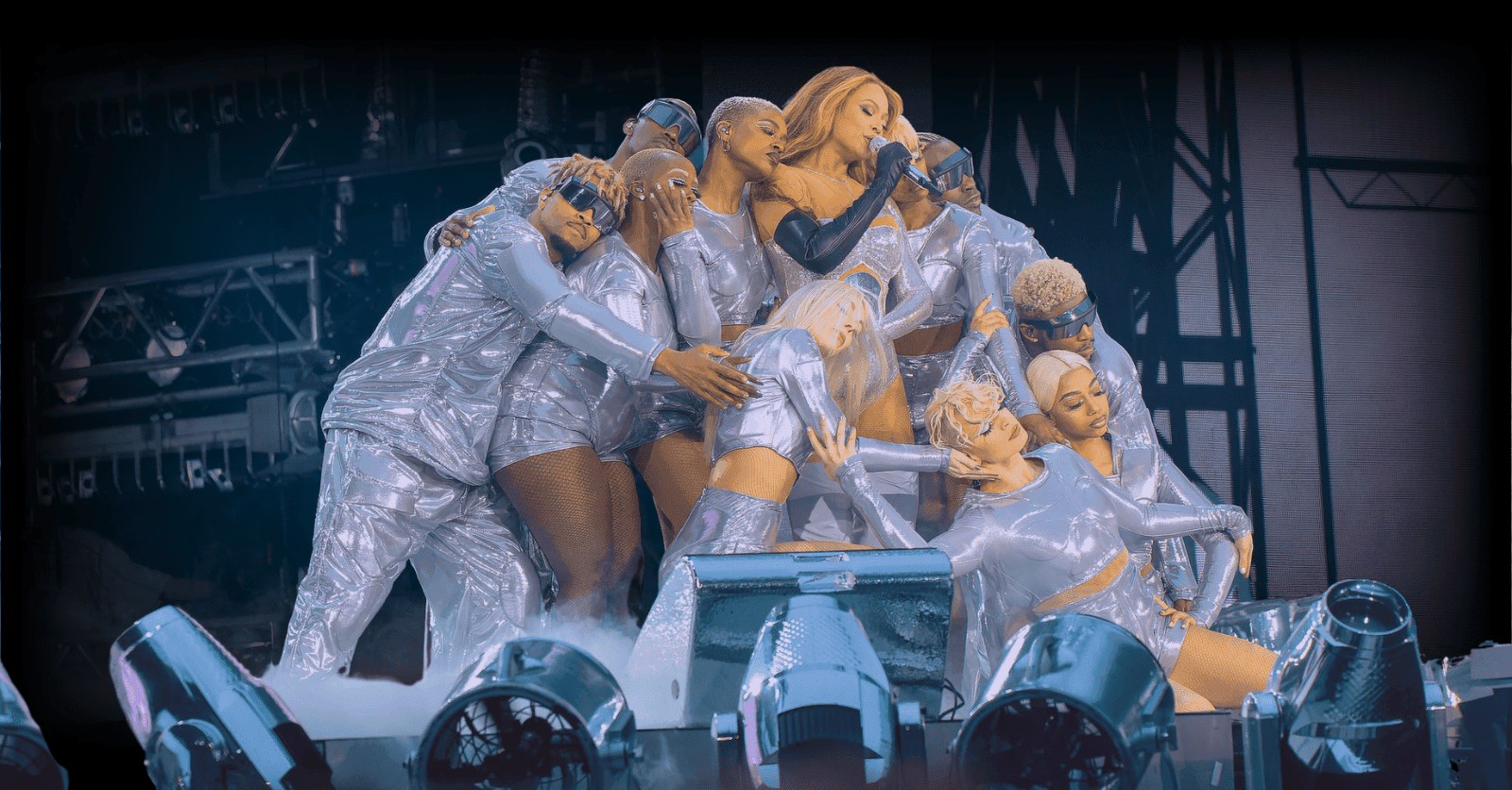
A Beyoncé rollout is a uniquely millennial event, and each one has defined a certain stage in our lives. As an artist, Beyonce straddles the line between pop and semi-autobiographical confessional, the vulnerability of her music lending depth to the fictional eras, complete with faux personas she creates to distinguish between albums. Her first five albums were an exploration of the dichotomy of the artist courting a fandom versus the individual in the public eye, but 2016’s Lemonade marked a tonal shift from first-person confessional to comprehensive social commentary on black womanhood. That was a viral moment, a big enough, novel enough event, that the whole world experienced it in unison with nary an explainer. Renaissance was doing that again, inversely. Her newest album was timely and irreverent, a multi-decade homage to the queer and questioning black ancestors whose influence shaped modern music.
Despite the pandemic, Beyoncé’s NDAs were airtight. There was no visual album or master thesis hinting at what the level of solidarity the world’s most influential living popstar would show with the millennial generation’s most divisive demographic. Beyoncé asked that we all ‘wait and see’. Over the course of 54 shows, she would demonstrate the extent of her conviction. It was a compelling media spectacle, with enough information and background for the world to feverishly anticipate the musical era but nothing to predict how Beyoncé would go about this. It was an event that seemed worth splurging on.
As an alternative black Nigerian, I had a somewhat personal connection to Beyoncé. She was the first black millennial pop star to transcend race in the way Michael Jackson had for my parents. And where Michael was pressured to deemphasize the influence of blackness and queerness in his work to appeal to mass audiences, Beyoncé revelled in hers. I had missed a rare opportunity to see her perform at the start of her solo career when she was invited to Nigeria by a politician in 2006, long before the global superstardom and the massive tours. I didn’t back then because even though it was just a few states over, the trip was too expensive for a younger, less financially independent me.
The internet had barely penetrated Nigeria in 2006, and the obsessive fan pages that track Beyoncé’s every movement today barely existed then. All that survives of her performance is a grainy video of her singing the Nigerian anthem in deference to her hosts. Then, during the pandemic, she collaborated with Nigerian artists on a companion album for The Lion King, a film that was integral to our understanding of Africa, even for Africans. It was a move that forged a deep connection between her artistry and the global south. Even quieter, she donated towards the Nigerian #ENDSARS movement through FEMCO, a Nigerian feminist non-profit, endearing her even more to the Nigerian members of her fandom, the Hive.
Beyonce is an artist who understands the global nature of the internet and leverages it in her artistry. So, it really shouldn’t have come as a surprise to anyone that in 2023, Africans at home and in the diaspora were making it a canon event to see Beyoncé in concert, even if it meant they had to travel out of Africa to do it.
17 years after that performance in 2006, I was one of those Nigerians who had enough money to play the visa lottery and go see Beyoncé somewhere in Europe where tickets were cheaper, and the cost of living was not so cutthroat. It was a lot of money, but for the first time in my adult life, I genuinely considered depleting that nest egg in pursuit of a once-in-a-lifetime experience.





Comments
Sign in to comment.