‘I Want the Chapters of My Life to Be Written by Brilliant Black Women’
Bissau-Guinean writer and author of ‘Resisting Linguistic Genocide: How Colonization Shaped Language in Guinea-Bissau’, Jamila Pereira, believes in striking a delicate balance between storytelling and presenting factual events: ‘While weaving a compelling narrative is essential for engaging readers, it was equally vital to remain faithful to historical truths and realities.’
By Jamila Pereira
May 10, 2024
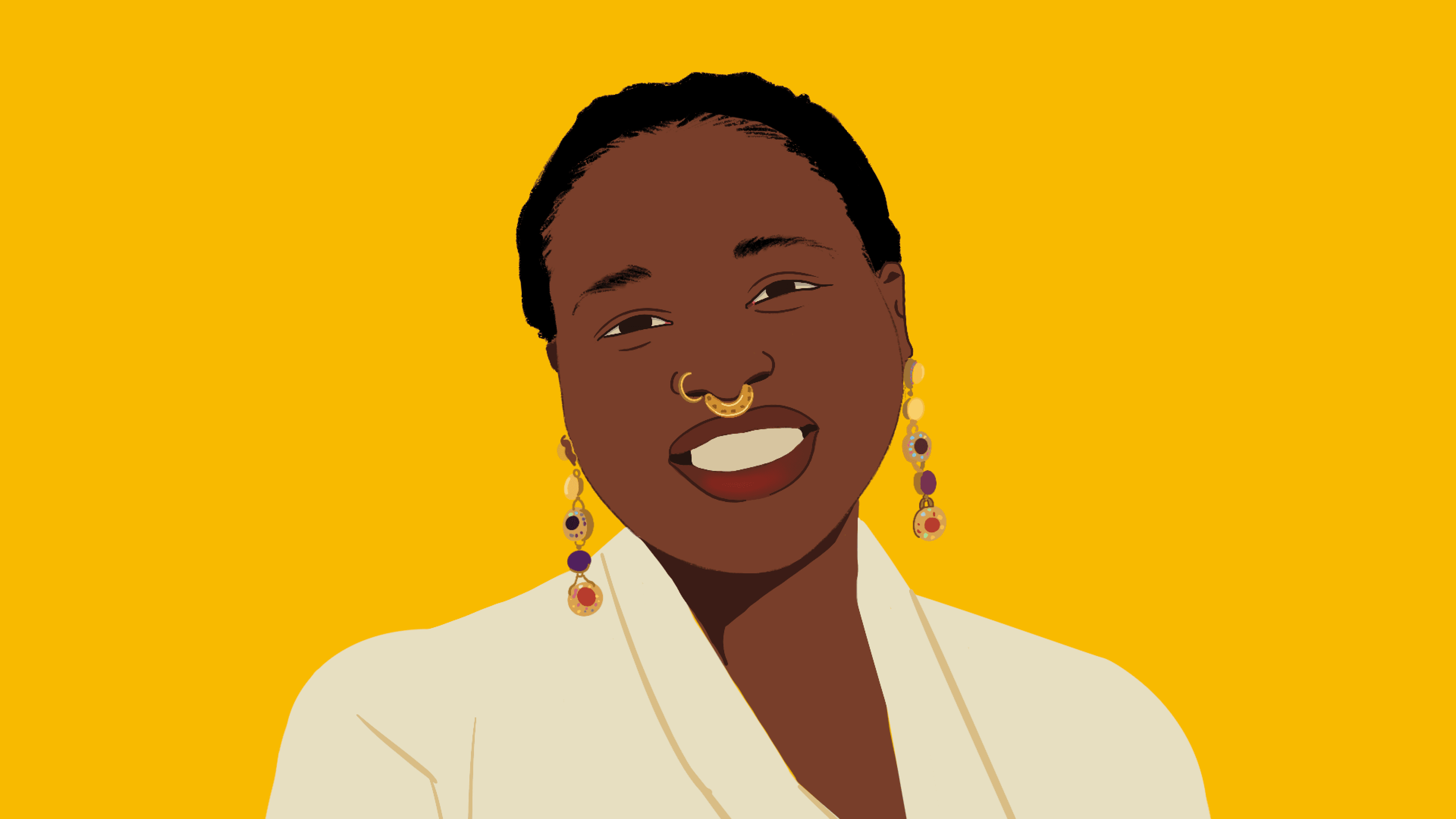
Jamila Pereira. Illustration by Kevwe Ogini.
First Draft is our interview column, featuring authors and other prominent figures on books, reading, and writing.
Our questions are italicized.
What books or kinds of books did you read growing up?
Funny enough, I did not grow up reading many authors or great academics. Growing up as a first daughter in an African household and a dark-skinned Black girl in Europe entailed a life quite different compared to other children around me. Although my parents did give me the freedom to pursue reading, having to be outstanding academically due to social pressure and parental expectations, I instantly created an aversion to reading. It was not until my late teens, when I moved out, that I finally found joy in reading and books. The first book I read was
Joana’s Moon by Maria Teresa Maia Gonzalez, and I couldn’t have chosen a better starting point for this journey.
If your life at this moment was the chapter of a book, which book (fiction or non-fiction) would that be?
I reckon my life would resemble an ensemble of chapters because I feel like I am constantly shifting between different parts of myself, making myself proud along the way and recognizing that every part has evolved quite a lot, too. Consequently, I want the chapters of my life to be written by brilliant Black women, as depicted in Candice Carty-Williams’
Queenie, Jessica George’s
Maame and Yaa Gyasi’s
Homegoing.
What’s the last thing you read and disagreed with?
An infamous sentence I read somewhere: ‘The 25th of April, the day of the carnations and the end of dictatorship in Portugal, marks the beginning of peace and freedom for its former colonies’.
“The potency of a text does not solely rest on its subject matter but heavily depends on how it is crafted and delivered.
What’s the last thing you read that changed your mind about something?
‘Sometimes we have to lose certain people to find ourselves. Sometimes what we lost is what was holding us back,’ Nigerian writer, Toni Tone, said in her book,
I Wish I Knew This Earlier: Lessons on Love. Overall, this book taught me a lot, especially at a time when I felt so disoriented with life, but this quote taught me that it is okay to let go sometimes. Even those you were willing to risk it all for.
What makes a text powerful: the subject or how it’s written?
The potency of a text does not solely rest on its subject matter but heavily depends on how it is crafted and delivered. While the topic provides the foundation, it is the language’s artistry, argument structure, and expressive eloquence that truly engage and sway readers. Even when two writers tackle the same topic, differences in style, tone, and rhetorical devices can significantly impact their effectiveness. Language serves as a potent tool for communication and persuasion, enabling writers to evoke imagery, emotions, and curiosity. The organization and coherence of arguments can enhance the impact of a text, with a well-structured piece more likely to resonate with readers. If you can master words, it is the skilful execution of language and composition that elevates a text beyond information to become a persuasive force, highlighting the paramount importance of how it is written to influence, inspire, and resonate with readers.
What is your writing process: edit as you write or draft first, then edit?
Ironically, my writing process tends to be quite chaotic. I am yet to find exactly what works for me and ensure that it aligns with my level of professionalism, too. Depending on my mood and my train of thought, I am either able to give you 2,000 words in less than five hours or drag myself over 1-2 months. However, this is not only a reflection of procrastination but also a consequence of bilingualism. It influences much of my organization and writing skills. If I am writing in English, I draft and then edit. If I am doing it in Portuguese or Kiriol, I edit as I write, and I will still review it a second and third time because I did not study any of the languages academically.
If I were to describe the process of ‘Resisting Linguistic Genocide,’ I would define it as difficult and simultaneously painful. This essay was undoubtedly one of the most complicated I have written to date due to the history we share. Unveiling tough realities that pertain not only to Bissau-Guineans but also to other native speakers in various parts of the world was certainly challenging. I started by examining my relationship with Kiriol and then decided to dive deeper by examining how my immigrant parents and other families around us dealt with it. When I realized that diaspora children, like me, faced the same issues with the language, I felt like I needed to know beyond a decolonial lens. I wanted to understand the origins of the love-hate relationship between our lingua franca and the younger generations, as well as unravelling why so many parents favoured their children speaking Portuguese instead.
The creation of the essay involved thorough research on linguistic genocide in the Global South and gathering insightful information through minds like Frantz Fanon, Edward Said and Gayatri Chakravorty Spivak. I then examined Guinea-Bissau’s history further, particularly its colonial past under Portuguese rule. This included studying the impact of colonization on the country’s language and cultures, as well as efforts to preserve indigenous languages. Consequently, I discussed how colonization shaped language in Guinea-Bissau, including linguistic assimilation policies and the marginalization of indigenous languages. I highlighted the impact on identity and cultural heritage. Then, I examined efforts by Guineans to resist linguistic genocide and preserve their indigenous languages despite colonial pressures. This involved discussing grassroots initiatives, language activism, and the role of education with locals who engage in daily practices to protect not only native languages but also other cultural practices throughout the nation. Nonetheless, I also reflected on broader implications for language preservation and cultural identity worldwide by speaking to Mamadou Ba, a linguistic scholar in Portugal and founder of SOS Racismo, and Ana Dju, an activist, photography storyteller and the Head of Solutions Mapping at UNDP Accelerator Labs in Guinea-Bissau. Throughout the process, I aimed to maintain a clear and cohesive narrative, supported by evidence and examples, while also engaging the reader with a compelling argument.
Why was it important that you wrote on this issue?
As a daughter of immigrants and an economic migrant myself, I lived with this constant feeling that my roots, language and identity were subaltern to the land I was born in: Portugal. So, today, to be able to eloquently write about this issue and other social problems that affect Guinea-Bissau is a revolutionary act. By recounting our experiences and the impact of colonialism and coloniality within our spaces, writers like me ensure that the stories of their countries are not forgotten and their marks within the literary field are very much present, too.
“If I am writing in English, I draft and then edit. If I am doing it in Portuguese or Kiriol, I edit as I write, and I will still review it a second and third time because I did not study any of the languages academically.
And what’s your favourite book by a writer from Guinea-Bissau?
Mantenhamos Para Quem Luta! It is the first poetry anthology in Guinea-Bissau, issued in 1977 and curated by Hélder Proença.
In writing my review essay, ‘Shadows of a Forgotten Past: Unveiling the Truth of White Nanny, Black Child,’ my approach to writing shifted and this was primarily driven by the sensitivity of the subject. Given the weight of the themes and the potential for emotional resonance, I adopted a more mindful stance throughout the writing process. One crucial adjustment was the adoption of a trauma-informed approach which I have acquired alongside the extensive work I do with migrants and asylum seekers, beyond writing. Recognizing the potential impact of the narrative on readers, I endeavoured to handle the matter with care and empathy. This involved acknowledging the historical trauma and its lingering effects, ensuring that my writing approached the topic with sensitivity, respect and understanding.
Additionally, I faced the challenge of striking a delicate balance between storytelling and presenting factual events. While weaving a compelling narrative is essential for engaging readers, it was equally vital to remain faithful to historical truths and realities depicted throughout the essay. Thus, I meticulously researched, spoke to survivors, and cross-referenced sources to ensure the accuracy of the information presented, while also infusing the narrative with the necessary depth and nuance to captivate the audience. My approach to writing this review essay was guided by a commitment to honouring the complexity of the topic, navigating its intricacies with respect and integrity, and fostering a deeper understanding.
And what’s an interesting piece of information you discovered while working on this essay that didn’t make it to the published version?
While crafting the essay, I had the opportunity of keeping most of my findings within the essay. However, there was an intriguing discovery that did not make it to the published piece and that would be an additional interview besides Ade Anifowose. I discovered that someone I work closely with, on a professional level, is also a survivor of the practice. What surprised me the most is that she is my age (31). Although I decided to explore other options, this individual’s story shed light on a unique aspect of the topic, offering a fresh perspective that could have enhanced the reader’s understanding and engagement. And despite not making the final cut, the editorial team’s support and encouragement was instrumental for a wider perspective. Their guidance nudged me to delve deeper, prompting a more comprehensive exploration of the subject matter. As a result, the essay evolved into a more expansive piece, enriched by additional layers of insight and information.
“I wanted to understand the origins of the love-hate relationship between our lingua franca and the younger generations, as well as unravelling why so many parents favoured their children speaking Portuguese instead.







Comments
Sign in to comment.