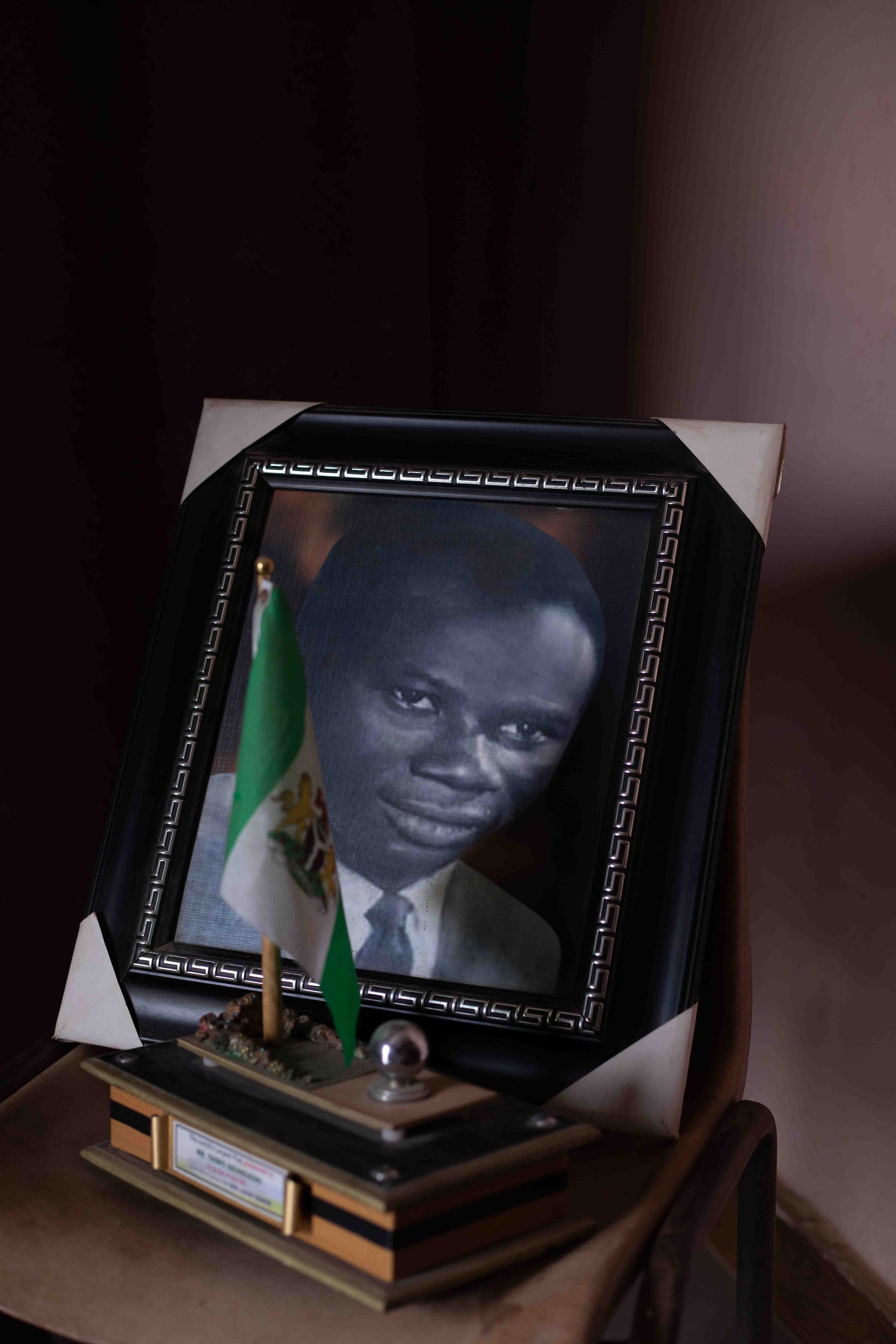
This is where my grandfather is buried,’ Akinwunmi Akinkunmi said, pointing to a grave. It was earlier this year, in March, we were on Oketedo Street in Ibadan, and I peered at the grave through the afternoon sun. I could make out the name, John Makinde Akinkunmi, inscribed on the grey headstone. The headstone also indicated that he died in 1952—six years before his son and Akinwunmi’s father, Taiwo Akinkunmi, designed the Nigerian flag.
‘Beside my grandfather are the graves of my great-grandfather and great-grandmother,’ Akinwunmi said. The inscriptions on their headstones had faded so I could barely make out their names; but I saw they had died in 1926 and 1924 respectively. The patriarch lay in the middle, on a higher platform, his headstone slightly taller than his son’s. Unlike the graves belonging to the two men, which had a fancy web-edged cross, on top of each headstone, the matriarch’s grave only had a short slab for a headstone.
‘And your father?’ I asked, though I done some research already and anticipated his response. ‘His body is still in a morgue. We have not buried him yet.’ Mr. Taiwo had designed Nigeria’s flag in 1958, two years before Nigeria gained independence. Until 1960, as a British colony, Nigeria had used the British Union Jack. After Mr. Taiwo returned to Ibadan in 1963, he joined the agricultural department of the regional civil service. He lived and worked quietly, unnoticed and uncelebrated, until 2010, when he was recognized as one of 50 distinguished Nigerians during Nigeria’s golden jubilee celebrations. When Mr. Taiwo died in August 2023, the government promised the Akinkunmi family a state burial to be held by December 2023; but as of March 2024, after I had reached out to Akinwunmi to confirm the status of the burial, the burial seemed to be on hold. I discussed with Akinwunmi over several weeks, but our conversations left me with even more questions about his father, his family, the flag and the burial. To find answers, I decided to take a train from Lagos to Ibadan; and that afternoon on Oketedo Street, the atmosphere was solemn, though the front yard bustled, alive with business. For a moment, Akinwunmi and I stared at the three graves in silence.
‘HE HAD CONTRIBUTED TO NIGERIA’S HISTORY’
In 1958, Mr. Taiwo, a fresh-faced Nigerian student in London at Norwood Technical College, (later renamed Lambeth College) stumbled upon a competition in a newspaper calling for submission for Nigeria’s flag ahead of the country’s planned independence. The young Taiwo was interested and set to work immediately after he got to his room. He was not an artist, but he was convinced he had an edge. Born a twin in Ibadan in 1936 to a civil servant father and a trader mother (his twin brother died at birth), he grew up accompanying his mother on her numerous business travels to different parts of the country, especially the North. According to Akinwunmi, ‘this gave my father first-hand experience of Nigeria, as he travelled the nation with my grandmother in his teenage years’. On these trips, he took photographs of the places he visited. Akinwunmi showed me some of these photographs. In one, a woman from northern Nigeria was on a mat working. Behind the photograph, Mr. Taiwo had written: ‘Typical Hausa wife in Northern Nigeria engaged in one of the main occupations in that part of the country.’
For his entry into the flag design competition, Mr. Taiwo opted for a simple rectangular design, divided into equal strips of green, white and green. On the white strip, he drew a red sun. The green represented agriculture and the white symbolized peace, while the red sun represented energy. In 1958, Nigeria was largely an agrarian country, and this informed Mr. Taiwo’s representation of agriculture in the flag. Also, before he left Nigeria for the UK, he had worked as an agriculturist at the Western Region Secretariat in Ibadan as a civil servant. ‘My father also chose white to represent peace because he had visited many parts of the country and he knew we cannot progress without unity,’ Akinwunmi explained. ‘He told me he added the red firmament because we need energy, we need power, to drive agriculture.’
When Mr. Taiwo was done designing the flag, he mailed his entry through the Nigerian High Commission. About a year later, he received a letter from the London office of the Commissioner for Nigeria in the UK, informing him that out of more than 3,000 entries, his submission had been selected as the winner. When the flag was unveiled on Independence Day on 1 October 1960, however, it had been modified—the red sun at the centre was removed from the final design. ‘My father told me that he did not know why the firmament was removed as the meaning was symbolic,’ Akinwunmi said. ‘Nonetheless, he was happy that his entry had won and that he had contributed to Nigeria’s history.’
At midnight of 1 October 1960, Salaudeen Akano who was then a naval officer lowered the flag of the protectorate of Nigeria for the last time. The pre-independence flag was first adopted in 1914 following the amalgamation of the northern and southern protectorates. The flag was a modification of the Union Jack that featured a blue extension, a red disc, and on the disc, a green six-point star, and the word ‘NIGERIA’, inscribed in white below a gold crown. Akano’s brief exercise happened in Lagos, then the capital of Nigeria, during an event held by a platoon led by Onwura Zonyeuno Chiazor. There was silence as the floodlights were dimmed and the protectorate flag descended. When the clock struck midnight, a new flag, Mr. Taiwo’s flag, was hoisted. As the flag reached the top, fireworks erupted, the floodlights were turned on and the crowd at Race Course—which was later renamed Tafawa Balewa Square—went wild with jubilation as a new nation was born.
The prime minister, Tafawa Balewa, who stood on the grounds that would later be renamed after him, gave a speech to usher in the new nation. He spoke about how many Nigerians had anticipated the day of independence and how, upon Nigeria’s independence, Nigeria’s relationship with Britain had transformed from that of colonizer and colony to one of partners. He recognized the efforts of many Nigerians in achieving independence, saying:
Time will not permit the individual mention of all those friends, many of them Nigerians, whose selfless labours have contributed to our Independence. Some have not lived to see the fulfilment of their hopes on them be peace, but nevertheless, they are remembered here, and the names of buildings and streets and roads and bridges throughout the country recall to our minds their achievements, some of them on a national scale. Others confined, perhaps, to a small area in one Division, are more humble but of equal value in the sum-total.
True to Balewa’s words, the names of many of those who contributed significantly to Nigeria’s independence were immortalized as roads, government buildings, bridges, institutions were renamed after them. But one name remained unknown: Taiwo Akinkunmi. His name was not acknowledged during the Independence Day celebration nor were any public amenities named after him. When he returned to Nigeria in 1963, there was no celebration to welcome him back to the country. He was, instead, welcomed by a handful of family members who were just glad to have him back. Such minimal recognition of his contribution to Nigeria’s history would define Mr. Taiwo’s life for a very long time. ‘We waited for more than 50 years for our father to get recognized,’ Akinwunmi said. ‘Now we are waiting again after he has died.’
‘NOBODY KNEW HE HAD DESIGNED THE NIGERIAN FLAG’
It was a Friday in March 2024, and as the train from Lagos left the Babatunde Raji Fashola station in Agege where I had joined it, I opened my laptop and placed it on my lap. I couldn’t see my screen, though, because the seat in front prevented me from pushing my screen to a comfortable angle. I was already looking forward to meeting Akinwunmi, whose first name I had noted differed, from his surname by one letter.
I went through my notes. Mr. Taiwo had died aged 87, ‘after a brief illness’, as the press had reported it; though I would soon find out that contrary to such reports, he was not ill before his death. The story of Mr. Taiwo’s death, I would learn, was full of misconceptions, half-truths and conjectures. First, however, I needed to get to Ibadan.
The train ride from Lagos to Ibadan takes about two hours. This was my third trip to Ibadan in a year and, my sixth in two years. On all my visits, I had used the train service, which itself was rather new, having only launched in 2021. Until then, I travelled by road, a journey that could take up to four hours especially when the Lagos-Ibadan expressway was undergoing one of its frequent repairs. The air was festive the two times I was in Ibadan in 2023: the first was for my wedding and the second was with a couple of my friends to spend the weekend. This time, my visit was work-related, and I was going alone. I had booked my trip online (a first, as I had always paid cash at the station in the past) and selected my seat. Online, SEAT 1 was marked as the first seat in the coach and supposedly had more legroom. On the train, however, it was the last seat as the numbering started from the back and did not have the expected legroom. Soon, the train sped to Ibadan and houses turned into trees in the other direction.
It was my editor-in-chief, Wale Lawal, who encouraged me to go to Ibadan, to visit Akinwunmi, talk to him, see and experience the house his father had lived in before he died. I started working on the story in September 2023, after I saw a Punch Newspapers story announcing Mr. Taiwo’s death. My initial plan was to call Akinwunmi, conduct a phone interview and produce a newsy report. This plan changed in January 2024, when I received a five-paragraph Facebook message from Akinwunmi claiming that his father had not yet been buried. According to Akinwunmi, ‘the initial date scheduled by the family for the burial ceremony was December 7th and 8th 2023 but was annulled by the State Government on the ground that none of the State Government official was present when the date was picked.’ Still, the government insisted that Mr. Taiwo deserved a state burial, leading the family to postpone the date of his burial to February 2024.
Akinwunmi had reached out to me because he felt the conversations between the Akinkunmi family and the government had reached a dead end, and he needed an outlet. We spoke at length, and when I brought up the situation in an editorial meeting at The Republic, one question seemed to remain unanswered: Why has the body of the man who designed Nigeria’s flag remained in a morgue in Ibadan seven months after his death? More importantly, why is no one talking about this?
‘We are approaching the Professor Wole Soyinka Train Station, Abeokuta…,’ the announcer said over the speaker, adding that the train would be stopping for three minutes to allow passengers to embark and disembark. Mr. Taiwo’s grandfather was born in Abeokuta and had grown up there before moving in the 1900s to Ibadan, where he spent the rest of his life. Three generations of Akinkunmis have since lived in Ibadan and consider the city their hometown.
As the train left Abeokuta for Ibadan, I went over my notes on Mr. Taiwo’s return to Nigeria. I had read that on returning to Nigeria, Mr. Taiwo took a job at the Ministry of Agriculture, beginning as an agriculturist and worked his way up to the assistant superintendent of agriculture. He spent 31 years working in the ministry before retiring in 1994 to what his family considered a life of obscurity. Akinwunmi said his colleagues barely knew who he was because he kept a low profile. He recalled that:
My father worked in the agriculture ministry all his life, and nobody knew he had designed the Nigerian flag because he did not brag to anyone about it till he retired. It was we his children that took it upon ourselves to start sending letters to Olusegun Obasanjo when he was president in early 2000. We felt as an Egba man, Obasanjo would come to the aid of my father and give his due recognition, but we did not get any response. Maybe the quality of the letters we sent did not meet the standard of Aso Rock.
It wasn’t until 2006, 12 years into his retirement and while living on an irregular pension, that Mr. Taiwo got some public recognition. Researcher, Sunday Olawale Olaniran, was compiling a pamphlet on Nigeria’s history and decided to track him down to his family house in Dugbe. There, Olaniran found the man many
thought had died. According to
Al-Jazeera, together with an unnamed journalist, Olaniran wrote a story about Akinkunmi, which was published in a newspaper on Independence Day. On his
blog, Olaniran wrote the story, ‘Taiwo Akinkunmi, Hero Without Honour’ noting that:
Nigeria as a giant of Africa is greatly blessed with both human and natural resources. In the process of this book, I decided to appreciate the effort and contribution of some people who did one remarkable thing or the other in our Country by putting their biography in the this book. That was what brought about the inclusion of ‘section 4’ of this book which I tagged –Nigerian Heroes/Heroine- where I revealed the biographies of some foreigners like Lord Lugard who did the amalgamations, Flora Shaw who coined Nigeria, Mary Slessor who stopped the killing of twins in the country and Mungo Park who discovered the river Niger.
As the research progresses, I just developed a thought in my heart that there is somebody left behind which I have to include. A man whose commands honour and respect among the over 20 million young ones everyday. Students (when singing national anthem) stands attentively to honour the flag of Nigeria which the man used his initiatives to design 48 years ago. Visit any School in the Country, you find it there, it’s hanged in many offices even in the Presidential villa in Abuja, it’s there and other Nigerian Embassies abroad.
Recently, I and my crew decided on a trip to give honour to whom honour is due. We paid a visit to Pa Michael Taiwo Akinkunmi, the man who designed Nigeria National Flag in the year 1958.
We were ushered in by his son named Akinwumi Akinkunmi and we had a brief interaction with Baba who just clocked 70 years on earth.
This story gained some media interest and led to Nigerians going to Mr. Taiwo’s house to donate food and clothing.
Two years later, a special edition of the TV gameshow, Who Wants To Be A Millionaire, titled ‘Who Deserves To Be A Millionaire’, reached out to Mr. Taiwo to participate. The special edition focused on rewarding Nigerians known to have contributed to the country. On the gameshow, participants were paired with celebrities who answered quiz questions on their behalf. The more questions they answered correctly, the higher their winnings. On the show, Mr. Taiwo won N2 million, which he used in building his own house in the Aiyepe area of Ibadan. He painted the house in the colour of the Nigerian flag.





Comments
Sign in to comment.