

Our new print issue, Africa’s Hustle Republics, is here! Subscribe for less than ₦1K/$1 a week for full access.
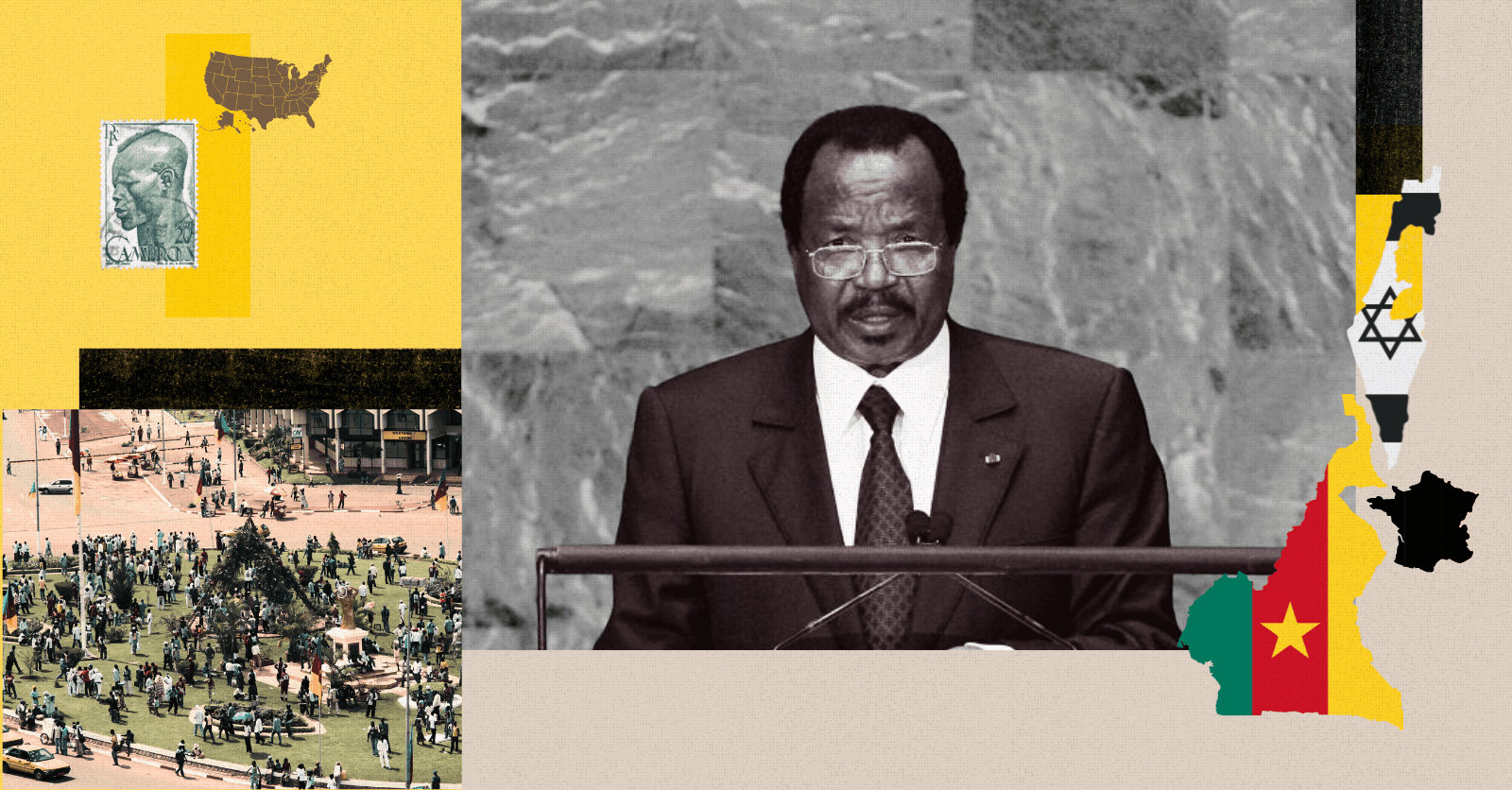
How Israel, France, and the US shape the Anglophone Crisis.
Oct 27, 2024
Collage by THE REPUBLIC. Ref Photo 1: Yaoundé, Cameroun. DANIEL PANEV / FLICKR. Photo 2: Paul Biya. MARCO CASTRO / UN PHOTO.
In February 2024, I returned to Cameroon with my father. For the first time in years, I saw the country that he once called home—its villages, towns, and cities now visibly marked by an ongoing war. My family, a blend of Anglophone and Francophone heritage, hails from M’mouck-Fosimondi, a village that sits at the intersection of two worlds: the French-speaking West and the English-speaking Southwest. Originally part of the Francophone side like many Bamileke people (one of Cameroon’s largest ethnic groups), M’mouck-Fosimondi became a refuge during the tumultuous years of the Bamileke Wars, also known as the Union of the Peoples of Cameroon Rebellion, when the Bamileke people, fighting for independence from French colonial rule, fled the violence that erupted in their homeland. The village resettled in the Southwest, on the frontier of the conflict, creating a microcosm of Cameroon’s broader tensions—a place where French and English are spoken, where neighbours embody the divided loyalties of a nation, and where the vestiges of colonial rule still reverberate.
Over the last seven years, the Anglophone Crisis has spiralled out of control, affecting dozens of people from our community, especially those near the border. Members of my own family and community have been caught in this exodus, forced to leave behind their homes as conflict encroaches further. The village that once symbolized resilience in the face of one conflict now finds itself at the frontier of another.
The roots of this conflict, however, reach far beyond the country’s borders. As Cameroon’s Anglophone crisis deepens, it is increasingly shaped by a matrix of international alliances that obscure the deeper political and economic grievances at its heart. The interplay of Israel’s military support, France’s enduring post-colonial influence, and the US’s counterterrorism agenda sustains President Paul Biya’s regime and enables it to suppress dissent with impunity. These geopolitical relationships create an axis of power that helps sustain the conflict, while simultaneously entrenching the marginalization of Cameroon’s Anglophone population. While the term ‘Anglophone crisis’ has been widely adopted, it’s important to note that Francophones are also affected by the actions of a wealthy, largely Francophone elite. The conflict is messier than its name implies, and Anglophone leaders have not always upheld their promises. Still, the Anglophone population has historically borne the brunt of marginalization, and this label reflects that reality.
The Republic is a Nigerian media-tech company dedicated to explaining our time—through deeply reported journalism on power, culture and society.
Focused consumption without interruptions.
Years of reporting at your fingertips.
Long-form journalism that matters.
Create a free account to continue reading this month and access more of our work.
About the Author
is a Cameroonian-American writer, cultural strategist, artist, grant-maker, and nomad who has called Nairobi, Paris, Dublin, and now Brooklyn home. His writing has been featured in Africa is A Country, BBC, Okay Africa and Rolling Stone.




Comments
Sign in to comment.