Many Nigerians and international observers pushed for the Abacha regime to recall its sentence but on November 10 1995, they woke up to devastating news.
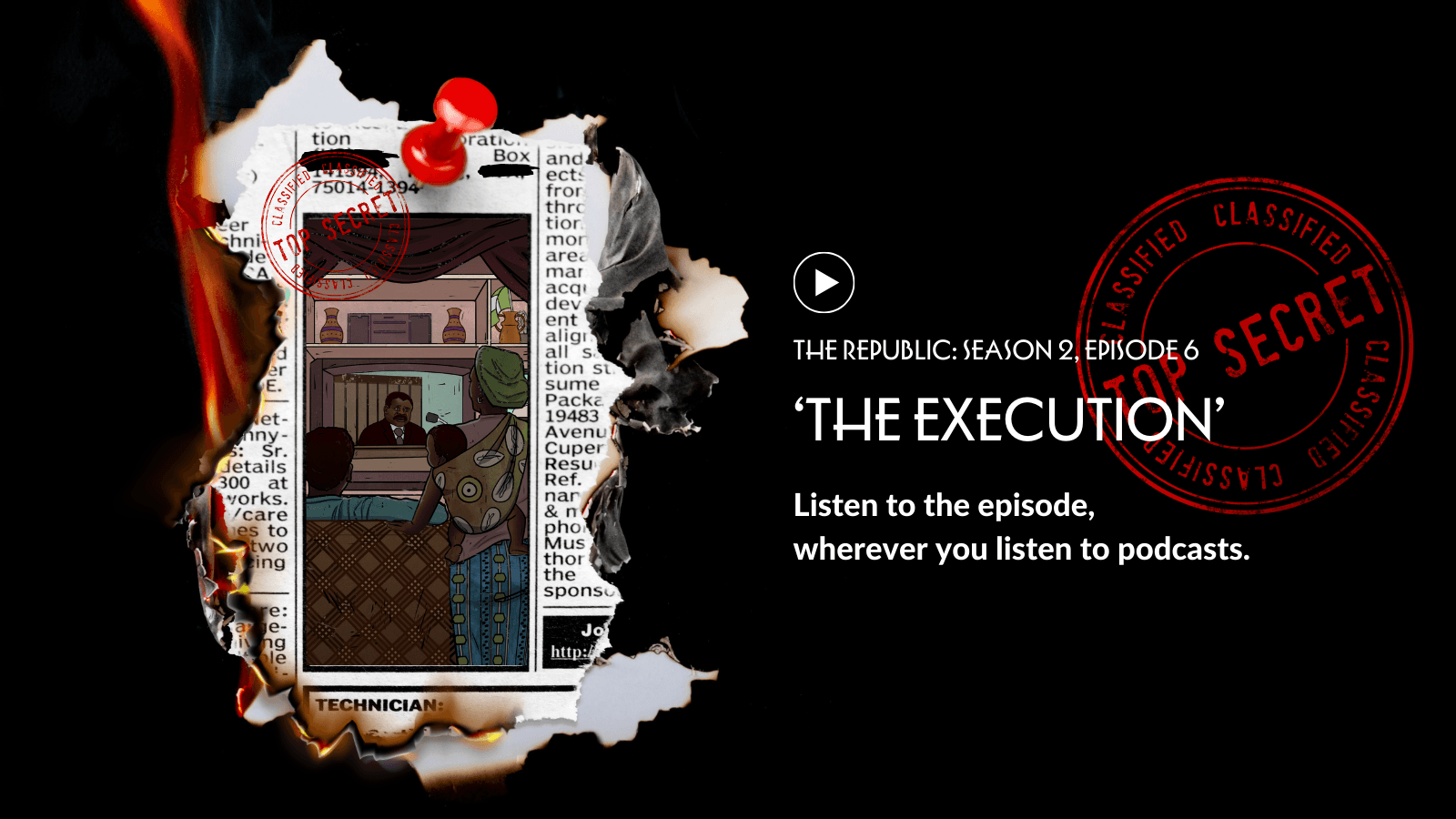
Illustration by Sarah Kanu with design by Dami Moji for THE REPUBLIC.
SANI ABACHA
This regime will be found humane and decisive. We will not condone nor tolerate any act of indiscipline. Any attempt to test our will, will be decisively dealt with.
JOHN MAJOR
‘Prime Minister, could you give us your response to the events in Nigeria?’ ‘I said yesterday that I thought this was a fraudulent trial, a bad verdict, an unjust sentence, and it is now being followed by judicial murder.’
WALE LAWAL
One could say that between late 1993 to 1994, Nigeria’s head of state, General Sani Abacha had been consolidating power and legitimizing his regime. By 1995, Abacha entered full dictator mode. In February 1995, he began his plans to install himself as Nigeria’s President for life.
PROF TOYIN FALOLA
It was rumored, when he sent a delegation to North Korea, that he went there to study the model of creating a permanent self-rule.
On 8 February 1995, Abacha dissolved his Federal Executive Council. The Federal Executive Council consisted of ministers who were in charge of key ministries of the government under Abacha’s military regime. Abacha set up a new 36-man Executive Council to prepare Nigeria for a transition into a democratic regime with a single political party system in which he would emerge as the only candidate. Later that month, after the Abacha regime arrested the Nigerian writer Mohammed Sule, the Constitutional Rights Project, a Nigerian Human Rights organization, published a report declaring 1994 as the worst year in Nigerian history for human rights. Little did they know that Abacha was just getting started. Professor Toyin Falola and the novelist Chimeka Garricks explained what this moment felt like at the time.
When he unmasked himself, between 1993 and 1998, he engaged in political repression and human rights violation. I was in the US then. People were afraid of him. Even when you’re speaking on the phone, your family members will be warning you; don’t talk about Abacha. All opposition he killed them. Very, very, very draconian, media censorship, closing newspaper offices, arresting editors, and many fled.
CHIMEKA GARRICKS
Abacha as a person was a kind of guy who was a dictator’s dictator. He took being a dictator seriously.
And in 1995 Abacha set out to show Nigerians, and the world, just how seriously he took his plans for sustained rule over Nigeria. In March 1995, Abacha arrested over 150 members of the military, including General Olusegun Obasanjo, and General Shehu Musa Yar’Adua, on suspicions of plotting a coup to remove him from power. Three days later, football federation, FIFA, announced that the Youth World Cup which was to be hosted in Nigeria later that year, would be hosted in Qatar. FIFA cited the Abacha regime’s record of human rights violations as the primary reason for their relocation, as well as the poor handling of a meningitis outbreak in Nigeria.
Abacha didn’t flinch. Just some months later, in May 1995, Abacha had lawyer Femi Falana arrested. Interestingly, the Ogoni Nine trial was about to begin and Falana was a key member of the Ogoni 9’s defense team. When Gani Fawehinmi, another lawyer and member of the defence team, was also arrested, the entire team of Ogoni Nine defense lawyers resigned, citing irregularities in the trial.
In July 1995, the Abacha regime found General Obasanjo and General Yar’Adua guilty of treason, and sentenced them to death.
OLUSEGUN OBASANJO
When they gave my own judgment or verdict, and took me to Kirikiri, they put me in the same hospital, they put both of us there and we were there for three nights or four nights. So he was then taken to Port-Harcourt and I was taken to Jos.
In response to the Abacha regime’s human rights violations, in August 1995, the Nelson Mandela-led government of South Africa imposed an arms embargo on Nigeria. A few days later, Mandela, President Robert Mugabe of Zimbabwe and President Yovweri Museveni of Uganda visited Abacha to appeal the fates of Obasanjo and the other 39 soldiers Abacha had sentenced to death. By this time, Abacha had begun to frequently appear in public, not dressed in military uniform, but in flowingbabarigasof different colours. This change in his public clothing attire indicated that Abacha was trying to reinvent himself in the minds of Nigerians projecting the image of a civilian president, and not a military head of state.
1 October 1995, Independence Day, was the day Abacha chose to show his true colours. In his Independence Day speech, Abacha announced there would be a transition from the military regime to a civilian government in 1998. Among Nigerians at the time, it was an open secret that Abacha intended to be installed as the first civilian president of the Third Republic. The stage was now set for Abacha to ramp things up and show Nigeria, and the world, that he was not going anywhere, anytime soon.
INTRODUCTION
Hello and welcome toThe Republic,a podcast about pivotal African figures and historical events. I’m your host, Wale Lawal. In seven episodes, I’m going to walk you through one of the biggest miscarriages of justice in Nigeria’s history: the Abacha regime’s execution of the Ogoni 9 in 1995. To experience what happened, we’ll explore the life and legacy ofKen Saro-Wiwa, and the significance of the Ogoni struggle against oil companies and their environmental degradation of the Niger Delta.
In this episode, we cover Abacha’s decision to execute the Ogoni Nine. We discuss the possibility that Abacha consulted with several Ogoni elites before going ahead with the executions; we also revisit the final meeting of Abacha’s Provisional Ruling Council on 8 November 1995 to uphold the verdict. We shed light on the efforts of the Saro-Wiwa family and members of the international community to overturn the verdict. Then, we’ll revisit the final moments of Saro-Wiwa and the controversies surrounding the burial and the remains of the Ogoni 9.
EPISODE 6: THE EXECUTION
ABACHA CONSULTATION WITH OGONI ELITE BEFORE FINAL DECISION ON OGONI NINE
On 22 May 1995, the final phase of the Ogoni Nine trial began. The Ogoni Nine had been in detention since May 1994. Saro-Wiwa’s health was declining, and had taken a turn for the worse. Still, the Special Military Tribunal resumed trial. With their lawyers, Falana and Fawehinmi having retired, the Ogoni Nine were more or less left without legal representation. If they were found guilty of murder, they would get the capital sentence of death. This was all anyone in Nigeria at the time could think of. After the courts pronounced the Ogoni Nine guilty, public attention turned to whether the Abacha regime would truly go ahead to execute them.
The tribunal finds them guilty. Now what I didn’t think was gonna happen was that they were going to be executed.
Many people had the same sentiments as Chimeka Garricks, the novelist and lawyer you’ve just heard. So why did Abacha, despite appeals from all over the world, stick to his decision to sentence Saro-Wiwa and the other eight Ogonis to death?
PROF BEN NAANEN
You know, the Abacha regime wanted to destroy MOSOP, and maybe if you were in the position, I don't know whether you would have done otherwise. But somehow, there could have been a better way of approaching the issue. So the regime was determined to destroy MOSOP. That’s the Abacha regime… They were determined to destroy MOSOP so that the Ogoni effect will not have a contagious effect in other oil producing areas and destroy the national economy.
A question I’ve still not been able to answer is whether Abacha consulted with any Ogoni traditional elites before deciding to execute the Ogoni Nine. And what the views of these elites were. These are important questions because the four Ogoni chiefs that were killed on 21 May 1994 were pro government and had met with the Civilian and Military Governors of Rivers State, Rufus Ada-George and Lieutenant Colonel Musa Dauda Komo, to denounce Saro-Wiwa and MOSOP.
Also, even before the four chiefs were murdered, there were already Ogoni elites and leaders within MOSOP who opposed Saro-Wiwa. Saro-Wiwa’s opponents included Garrick Leton, the first President of MOSOP and Edward Kobani, the first vice president of MOSOP. Professor Ben Naanen, who served as MOSOP executive secretary in the 90s, recalled that some of the anti-Saro-Wiwa leaders within MOSOP had in fact been former members of the Ibrahim Babangida government.
Some of the leaders were high up in the hierarchy. Dr. Leton, for example, was an advisor, one of the key figures of the Social Democratic Party in this part of the country. He was an adviser to Chief Abiola of the SDP. And Chief Kobani ‘the bulldozer’, the vice president, was also a well known politician, a mobilizer.
On 12 June 1993, Election Day, a protest by the National Youth Committee of the Ogoni People (NYCOP), against the anti-MOSOP Ogoni elders escalated and turned violent. Dr. Owens Wiwa recalled events of that day in the Timothy Hunt book,The Politics of Bones.The protest was tied to Saro-Wiwa’s instructions to the Ogoni people to boycott the 12 June elections. However, some anti-MOSOP Ogoni leaders like Bennett Birabi who was the Senate Minority Leader in Babangida’s government, went around Ogoni reprimanding the people and demanding that they ignore MOSOP’s boycott. This caused arguments between both sides and eventually escalated into violence.
After this incident,The Guardianpublished an article which mentioned that radical members of MOSOP who supported Saro-Wiwa, had accused the anti-MOSOP Ogoni elders of being state agents and attacked them. Baridan Lekara, the author of the article, wrote that it was misleading to regard the struggle by ‘a few selfish leaders’ as an Ogoni struggle: He said, and I’m quoting this, ‘The truth is that one person, Ken Saro-Wiwa, out to gain...cheap popularity, has brainwashed our people promising each adult Ogoni 3 million Naira reparation if the struggle succeeds’.
Also, a journal calledWest Africa, reported that there was strong opposition to Saro-Wiwa’s leadership by those who accused him of having done nothing for the Ogonis when he held top posts in the governments of Yakubu Gowon, and Babangida. These critics of Saro-Wiwa saw his efforts and those of the other MOSOP leaders as a way to negotiate better deals for themselves with the power holding elites, such as Shell and the Federal Government.
So one could say that Saro-Wiwa was a common enemy not just to Abacha and Shell but also to key members of the Ogoni ethnic community. This could explain why the calls not to execute the Ogoni 9 fell on deaf ears.
THE PROVISIONAL RULING COUNCIL’s DECISION TO UPHOLD THE EXECUTION
Fellow Nigerians, this administration has demonstrated a will to make the hard decisions. Only those detractors who deliberately persist in a blinkered view of us, and our efforts, fail to take account of all that we have achieved in a short time. I sincerely appeal to the international community to support our endeavors.
On 8 November one week after the military court sentenced the Ogoni Nine to death by hanging, Abacha had a meeting with his Provisional Ruling Council. Set up on 17 November 1993, the Provisional Ruling Council served as Abacha’s de facto government of Nigeria, with him making the final decisions. Composed of mostly military officials, the Provisional Ruling Council governed Nigeria with an iron fist, and acted out Abacha’s draconian decrees. The meeting on 8 November 1995, was the final meeting where the Abacha regime would decide the fate of the Ogoni Nine.
The Ruling Council had eleven members spanning service chiefs and top military commanders, such as General Oladipo Diya and General Abdulsalami Abubakar, who would later succeed Abacha as head of state. The purpose of this meeting was not known until seventeen years later in 2012, when a memo leaked. The memo revealed that Abacha met with his Ruling Council in the wake of mounting pressure from the international community to suspend the death sentence of the Ogoni Nine. But at the meeting the Provisional Ruling Council agreed to go ahead with the execution.
In the leaked memo, Abacha was quoted as saying that ‘no sympathy should be shown to the convicts so that the sentence will be a lesson to everybody.’End of quote. According to the memo, Abacha also believed that the Ogoni issue had lingered for a very long time and needed to be addressed once and for all. As far as Abacha was concerned, if the Ogoni Nine were executed, it would send a clear message to Nigeria, and the rest of the world, that his authoritarian regime was not weak. Reportedly, Abacha also accused Saro-Wiwa of being a foreign agent and a separatist who was being used to create destabilization by agents trying to split Nigeria into different regions. As a result of these, and in light of an intensified global campaign to free the Ogoni 9, Abacha decided to fast-track the execution.
On the outside, however, people still doubted that the Abacha regime would go through with the executions. MOSOP leader Fegalo Nsuke confirmed this.
FEGALO NSUKE
There was a lot of lobbying internationally, and with the pressure that was coming from home and the extent of international lobbying that was going on, nobody really expected that General Abacha would kill Ken Saro-Wiwa.
While a global campaign pushed for the Abacha regime to revise the death sentence, the leaked memo from 2012 shows that the 11-member Ruling Council never considered backing down. Still the families of the Ogoni Nine, the international media, and various NGOs fought to save the lives of the Ogoni 9.
THE EFFORTS OF SARO-WIWA’S FAMILY AND INTERNATIONAL MEDIA AND NGOS TO GET THE EXECUTION VERDICT OVERTURNED
For months leading up to the execution of the Ogoni Nine, international organizations, such as Amnesty International and the Commonwealth of Nations, were actively involved in calling for the overturning of the execution. The Saro-Wiwa family, led by Saro-Wiwa’s son Ken Junior and Saro-Wiwa’s brother Owens Wiwa, also made several efforts to save the lives of the Nine. In the lead up to his conviction by the military tribunal, Saro-Wiwa was going through a financial crisis. He knew that Abacha planned to bankrupt him financially before destroying him judicially. According to Dr. Owens Wiwa’s account inThe Politics of Bones, as a last resort,Saro-Wiwa had made plans to sell his property on Aggrey Road in order to afford feeding for himself and his Ogoni inmates in prison.
Then, as if by divine intervention, Saro-Wiwa’s money problems were solved. In October, just a few days before the Ogoni 9 were sentenced to death, Saro-Wiwa and MOSOP were awarded the 1994 Right Livelihood Award. The Right Livelihood Award is an international prize first awarded in 1980 to honour activists involved in human rights, environmental protection, education, and advocating for peace. Also known as, the alternative Nobel Peace Prize,the Right Livelihood Award came with a prize money of $120,000.
In 1994, the award committee presented the award to four laureates. Saro-Wiwa and MOSOP were co-winners. The award committee singled out Saro-Wiwa for his courage in fighting nonviolently for the rights of the Ogoni people, and for being a source of inspiration to minority rights all over the world. The prize’s effect was immediate. As soon as the award was announced, the Ogoni 9 and their inhumane detention received even more international attention. The prize also drew attention to Shell’s dismal record in the Niger Delta. With the Ogoni 9 in jail and MOSOP sympathizers being targeted by the government, MOSOP representatives were not able to receive the award in person. Instead, Nobel laureate Wole Soyinka volunteered to represent MOSOP at the award ceremony. Soyinka attended the ceremony with the President of the US MOSOP chapter Vincent Idemyor.
At the same time, Dr. Owens Wiwa and MOSOP’s executive secretary Ben Naanen were going through diplomatic channels, speaking to ambassadors and High Commissioners in the hopes that these officials could influence Abacha to overturn the death sentence. Professor Naanen told me more about this.
You know, in fact, at some point, I was the only person, link person between MOSOP and the rest of the world. Because Saro-Wiwa had been arrested. Ledun Mitee, the deputy president, had been arrested, and Ogoni was under repression. These were days of fax messages. Those things were sent to me by fax. And I was now coordinating the international campaign from my base in the Netherlands, operating between Geneva, the Netherlands, Brussels, the headquarters of the EU and so on.
wale lawal
InThe Politics of Bones,Dr. Owens Wiwa claimed that the Dutch diplomats rebuffed the advances of Saro-Wiwa and MOSOP to intercede on behalf of the Ogoni 9. As far as the Dutch were concerned,MOSOPwas a violent organization and the Ogoni Nine deserved the death sentence for organizing and supporting violence. Owens Wiwa further suggested that it was perhaps not surprising that the Dutch held this view, considering the fact that Shell is a Dutch company. But Dr. Owens and Ken Junior had better luck with other embassies. For instance, the Canadian High Commissioner to Nigeria, Gerard Olsen, assured Dr. Owens that he would get through to Shell. The Swedish ambassador to Nigeria, Arne Ekfeldt, also promised to speak to Shell.
The campaigns did not stop there. At well-publicized international events, Ken Junior met officials like the US Vice-President, Al Gore, Ethel Kennedy, a relative of the former US president, John Kennedy, Nelson Mandela, as well as the US ambassador to Nigeria, Walter Carrington. In the Timothy Hunt book,The Politics of Bones,Owens Wiwa recalled that the Managing Director of Shell Nigeria, Brian Anderson, was reportedly an acquaintance of Abacha. To get to Anderson, Carrington reportedly introduced Dr. Owens to John Thorold Masefield, the British High Commissioner to Nigeria. Masefield in turn introduced Dr. Owens to Anderson. At a meeting with Anderson in Anderson’s home off Awolowo road in Ikoyi, Dr. Owens pointed out that it was in the best interests of Shell that Saro-Wiwa and MOSOP vice-president Ledum Mitee were released. He explained that the Ogoni people, and MOSOP trusted Saro-Wiwa, and if Shell helped to secure the release of the Ogoni 9, the Ogonis would be open to allowing Shell return to Ogoniland and resume its operations.
Anderson then told Owens Wiwa that he would speak to Abacha on one condition: that MOSOP release a press statement saying that there was no environmental degradation in Ogoniland caused by Shell, and stop its anti-Shell campaigns in the media. Owens Wiwa replied to Anderson that this was an impossible condition for MOSOP to meet as it required the organization to lie to the Ogoni people, and to the public. That ended the meeting with Brian Anderson, and Owens Wiwa went on to say that after this meeting, Shell became unreachable.
MOSOP leader Nsuke told me a bit more about this period:
I think the Ogonis could do very little at the time, especially the members of MOSOP, because there was heavy state repression. And it wasn't like they just picked Ken Saro-Wiwa and stopped there. Those who were putting themselves together to protest against the detention of Ken and the arrest of these people who were in detention, some of them were killed. And by the end of the day, with our last count as at 1999, we lost about 4000 Ogonis in that state repression. So they killed a lot of people, and it became so difficult for people to really come out in protest. They were courageous to still come out. But it waslike the armythat was in charge of the military task force that was stationed in Ogoni, Major Paul Okuntimo, was just out to kill anybody that was MOSOP or that was sympathetic to MOSOP. So by the end of the day, we had lost 4000 persons. It was difficult in that kind of situation to really put up a strong local resistance against that repression and so much of what happened, happened internationally.
Efforts to put pressure on the Abacha regime to overturn the death sentence continued. Amnesty International declared Saro-Wiwa a prisoner of conscience. In April 1995, Saro-Wiwa also won the prestigious Goldman Environmental Prize, the world’s biggest award for environmental activism. As the winner of the Goldman Prize, Saro-Wiwa received a cash prize of $75,000 and featured in aTimeMagazine article that described him as ‘a hero who dares to raise a voice against the partnership between the government and an oil company.’ Saro-Wiwa’s daughter, Noo, also told me that:
NOO SARO-WIWA
My brother, Ken Jr., went to New Zealand where the Commonwealth Summit was being held, and he was talking to.. he was meeting with all sorts of people. He met with Nelson Mandela. He met with different Nigerian government ministers. And you just think, we’ll, surely things are going to be okay. You can’t imagine that..I just felt like ultimately, the Nigerian government would you know defer to that sort of global authority. Especially when you had people like Nelson Mandela, even though he wasn’t as vocal as I wanted him to be. And I’ve since found out that there was a reason for that. He had been discouraged, apparently by Thabo Mbeki, you know, not to criticize the Nigerian government too much. But still, he was there at the summit. And I felt no, it’s going to be okay. I really believed that, and that the death sentence was just, again, saber-rattling. You looked at people like Nelson Mandela and you saw what he went through. You saw what South Africa went through, and you felt, no, there’s light at the end of the tunnel. And I felt that right up until the day my father was executed.
On 10 October Saro-Wiwa was nominated for the Nobel Peace Prize. One could argue that this was the highest point of global recognition that the Ogoni Nine had received. A month later, on 10 November another big opportunity to put pressure on the Nigerian government emerged. Heads of Government of all Commonwealth Nations were scheduled to meet at the Commonwealth Summit in Auckland, New Zealand. Ken Junior attended the summit to lobby in person for the release of Ogoni 9. But time was not on his side.
The Hastiness to Execute the Ogoni 9 and on the Eve of the Commonwealth Meeting in Auckland
JIM LEHRER
Now the execution of a human rights activist in Nigeria that has been denounced in the United States and around the world. Charlene Hunter-Gault has the story.
CHARLENE HUNTER-GAULT
Nigeria, among the largest and potentially wealthiest nations in Africa has been under military rule for much of its history. Today the current military announced it has executed Ken Saro-Wiwa and eight of his associates.
JAMES MATES
Ken Saro-Wiwa, writer, human rights activist, campaigner on behalf of his fellow tribesmen, hanged this morning in a Nigerian prison.
DUM SYL
I can vividly recall. Boma Erekosima who was a broadcaster, like a spokesman for the government, said, ‘that small fly wey, dey disturb government, he don die.’
I said yesterday that I thought this was a fraudulent trial, a bad verdict, an unjust sentence, and it is now being followed by judicial murder.
What you’ve just heard are some of the international reactions that emerged on 10 November 1995. In the early hours of the morning, the Ogoni 9 were executed by hanging at the Port-Harcourt prison, less than five minutes from Aggrey Road.
It wasn’t really, it wasn’t really easy, when the news broke that Ken Saro-Wiwa and the other 8 had been executed. I think even the weather mourned those nine. All of Port Harcourt had a weather that was like sunset. It was such a very sad event.
Well, by then, I was in my second year at university. I was at University of London, so I was living in London, and I didn’t receive the news until that evening, because I’d been walking around that day. And we didn’t have mobile phones or anything in those days. So my mother called my flatmate, and my flatmate left me a message to call my mother. And so my mother was the one who gave me the news. So I went back down to our family home just outside London. I mean, it’s just very strange because I wasn’t really aware of how big a story this would be. I saw a newspaper on my way down, it was the Evening Standard, and my father's face was on it. And it’s hard...the whole thing was just very surreal.
DR. NABI
In fact, precisely that day when he was executed at the prison yard , the Port Harcourt Prison Yard, I was at CPS, Barracks, Aggrey Road, and I was in the midst of the Ogonis. In fact, we were still in doubt when CNN broke the news. The execution has taken place. He has been executed. The prison yard is a little away from Aggrey Road. Just get to the end of Aggrey Road and you turn left and you get there.
SHEHU SANI
I was in Port-Harcourt prison when Ken Saro-Wiwa was brought in and hanged. I can see them from the window.
The news of the hanging of the Ogoni 9 sent shockwaves not just through the city of Port-Harcourt, but also around the world, and especially in New Zealand where the Commonwealth Nations were holding their conference, and preparing to make further appeals for clemency to the Nigerian government on behalf of the Ogoni Nine. Here’s Mandela reacting to the news:
NELSON MANDELA
In view of this latest development, the South African delegation at the Commonwealth conference will recommend the expulsion of Nigeria, from the commonwealth. Pending the installation of a democratic government.
According to Professor Naanen:
BEN NAANEN
Mandela, was outraged that Saro-Wiwa and his colleagues were executed. And that is why the Commonwealth, very promptly there and then, it was unprecedented in the history of the Commonwealth, suspended Nigeria there and then. There wasn't even any debate. Okay, there wasn't even any debate.
SARO-WIWA’s FINAL MOMENTS
I’ve often wondered what Saro-Wiwa’s thoughts were in the final moments of his life at the Port-Harcourt prison.
Saro-Wiwa was the first to be led to the execution room. According to Ken Junior, on the morning of the execution, as Saro-Wiwa was being led to the execution room, a prison guard tried to manhandle him, which caused a brief argument. With black cloth around his head and covering his eyes, and with the noose around his neck, Saro-Wiwa spoke his final words; ‘Lord take my soul, but the struggle continues.’
Hey, there was an international condemnation, serious international condemnation, United Nations, world organizations, different countries. They condemned it. And they condemned it in terms of legality. They condemned it in terms of how the tribunal was set up.
The condemnation and outrage all over the world at the execution of the Ogoni 9 was like an avalanche. And far from mere statements of condemnation, some countries and bodies like the European Union, South Africa, Belgium, Germany, the UK, and the U.S., took active steps to punish the Abacha regime for executing the Ogoni Nine. For example, U.S. president Bill Clinton, who Saro-Wiwa had written letters to, instructed his administration to hit Nigeria with sanctions. This included a naval-backed oil embargo against Nigeria. Clinton also moved for Nigeria to be suspended from the United Nations at the next meeting of the Security Council.
BENNO ANTONIUS EITEL
The German government has worked for the worldwide abolition of the death penalty. We shall continue to do so. If the shocking news I have just mentioned should prove to be correct, my delegation cannot but join those delegations that have before me expressed their utter dismay over these executions.
JOHN WESTON
The British Government has stated, in London, that the British government is appalled at this callous act. The British prime minister is in close contact with his colleagues at Auckland about further steps.
There was a boycott of Shell gas stations all over the world. Greenpeace was very active. Amnesty International - active, Human Rights Watch very active and the global media indeed, just like the Gaza protest some campuses here and there, small and big crowds gathered to condemn it and his death gave voice to human rights issues, exposed the activities of multinational companies and put. The environment is on the agenda, and this was the age before global warming that is now so active, so that united the world in condemnation.
Having held its ground, and rebuffed all attempts to overturn the death sentence handed to the Ogoni 9, the Abacha regime damned the consequences and urged the international community to stay out of Nigeria’s internal affairs. Here’s Isaac Ayewah, Nigeria’s delegate at the UN Security Council meeting that held a day after the execution:
ISAAC AYEWAH
The Nigerian delegation seeks to remind those delegations which have ascribed to themselves the role of the world’s policemen to kindly note that what has reportedly taken place in Nigeria today, in relation to the subject of their comment, bears no relevance to the item under consideration in the Council. The Nigerian delegation therefore finds it unacceptable for these members to want to meddle in the domestic affairs of Nigeria. We regard it as gross interference in our internal affairs. I thank you.
Abacha was signaling to the international community that he was going to be opposed to external resistance. And remember he changed a street name, formerly of an American ambassador and the streets leading to the US Embassy, he renamed it Louis Farrakhan Road, taking a figure that they hate intensely in the US, and they took it as much of a sovereignty issue. Who are you to tell me what I should do? Do I tell your government what they should do?
Abacha was sending a clear message to the world that the chapter of the Ogoni 9 had closed. But had it?
On some weird level, I feel grateful that there was this attention we had, there was this outrage. You know, when people are outraged for you, that helps a lot. But it still makes the whole thing very, very surreal. Because we weren't able to bury him for a long time, for several years afterwards.
SARO-WIWA’S REMAINSWALE LAWAL
The Abacha regime was not content with executing the Ogoni 9. They also had to control what happened to their remains and their burial. No sooner had the Ogoni Nine been executed than rumors began to go around that Abacha had had their bodies buried in a mass grave and dissolved in acid. People also said that Abacha had filmed the execution of the Ogoni 9 for his viewing pleasure. But despite these rumors I was not able to find evidence that this was the case.
What we do know is that the Ogoni 9 were buried in unmarked graves in the Port Harcourt cemetery, also a short distance from Saro-Wiwa’s old office along Aggrey Road. They were buried at night, and heavy military presence prevented the public from going close to the cemetery. For many years, the exact location where the Ogoni 9 were buried was unknown to their immediate family and the general public.
Dr. Owens Wiwa recalled inThe Politics of Bones,that a ceremonial burial took place and that instead of his corpse Saro-Wiwa’s coffin held two of his books,On A Darkling Plain,and Pita’sPrison, andthe pipe he smoked until the day he was executed.
CONCLUSION
With the Ogoni 9 executed, and buried in secret graves, what was next for the Abacha regime, the families of the Ogoni 9, and the Ogoni people as a whole? Join us next week for the next and final episode of this season, where we will tackle several questions. Including what was the fallout of the execution in Nigeria and abroad? Who were the dissenting voices that protested the execution of the Ogoni 9? Who supported the execution? How did the aftermath of the Ogoni 9 execution inform how the Ogoni and Niger Delta struggles manifest today?
Thanks to Aderemi Ojo, Ibrahim Odugbemi and Peace Onafuye for the archival audio you heard on this episode and our overall research.
You’ll find a full list of the books, articles, and documentaries that we relied on in researching this episode at our website, republic.com.ng/podcasts.
The Republic Podcast is produced by The Republic, a digital media startup based in Lagos, Nigeria; with technical sound engineering by the Voix Collective. The artwork for the show is by Sarah Kanu with graphic design by Dami Mojid and Wale Lawal. Our script writers are Funbi Akinsanya, Tony Malik and myself, Wale Lawal⎈




Comments
Sign in to comment.