

Our new print issue, Africa’s Hustle Republics, is here! Subscribe for less than ₦1K/$1 a week for full access.
In the wake of tumultuous geopolitical policies and an increasingly multipolar world, pan-Africanism today struggles to evoke the spirit of comradeship that it used to.
Jun 8, 2025
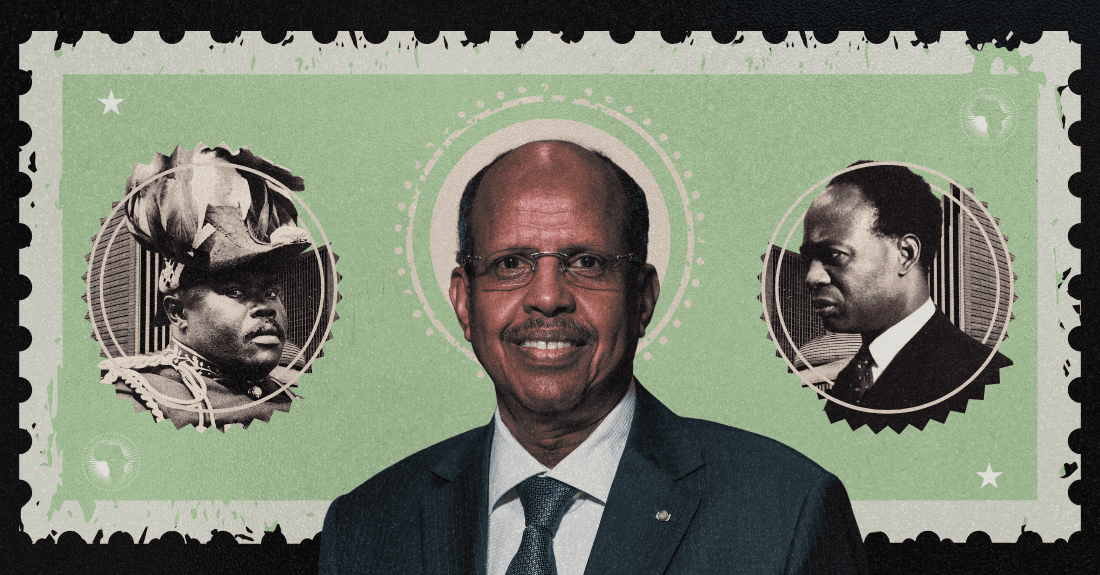
Photo illustration by Dami Mojid / THE REPUBLIC. Marcus Garvey / BETTMANN ARCHIVE, Mahamoud Ali Youssouf / AU, Kwame Nkrumah / UN PHOTO.
Diplomatic success isn’t about who shouts the loudest. It’s about who whispers to the right ears.
—Mwangi Maina
On the eve of the African Union’s (AU) February 2025 summit, a post on X by journalist Mwangi Maina captured a prevailing fear among Kenyan analysts on social media. Former Kenyan prime minister, Raila Odinga’s campaign for the chair of the African Union Commission had turned from a personal mission to a national cause driven by President William Ruto. It also evoked memories of the last time a Kenyan stood for this post, Amina C. Mohammed, who was also heavily fancied and the ‘frontrunner’ heading into the contest in 2017. Like Mohamed, Odinga’s campaign team was confident they had gotten the assurances of a substantial majority. Like Mohamed, Odinga’s campaign was driven by the passion and determination of his president. Like Mohamed, they would both fall short at the final hurdle.
On Saturday, 15 February 2025, Djiboutian foreign minister, Mahamoud Ali Youssouf, was elected chair of the commission on the seventh ballot. In the run-up to the contest, he had to fend off a misinformation campaign that he had withdrawn from the race and a late key endorsement from the Southern African Development Community (SADC) for Madagascar’s Richard Randriamandrato. The candidate’s strength was evident in the first ballot, where Odinga polled 20 votes, with Youssouf just behind on 18 and Randriamandrato on 10. By the third ballot, Youssouf pulled ahead and held firm with 25 and then 26 countries, falling short of the 33 needed for a two-thirds majority. Randriamandrato was eliminated after the third round, and Odinga’s blocking minority was tested on the seventh, when, standing alone, Youssouf was able to emerge elected.
The Republic is a Nigerian media-tech company dedicated to explaining our time—through deeply reported journalism on power, culture and society.
Focused consumption without interruptions.
Years of reporting at your fingertips.
Long-form journalism that matters.
Create a free account to continue reading this month and access more of our work.
About the Author
is a research analyst and a writer on the politics of policy, institutions, and governance.


Comments
Sign in to comment.