

Our new print issue, Africa’s Hustle Republics, is here! Subscribe for less than ₦1K/$1 a week for full access.
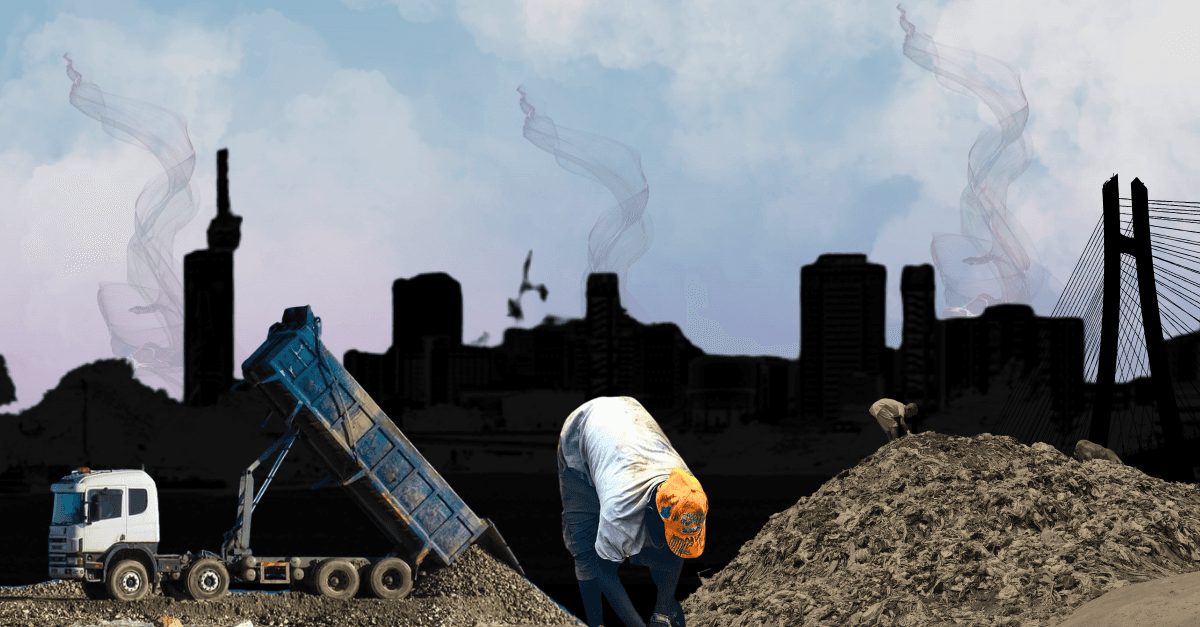
The smell of Lagos is far more than a sensory inconvenience; it is a symptom of deeper urban management gaps, waste management inefficiencies, inconsistent policies and citizen irresponsibility.
Jun 29, 2025
Photo Illustration by Ezinne Osueke / THE REPUBLIC. Source Ref: Lagos, Nigeria / WIKIMEDIA; Dumptruck / PICRYL; Agbara industrial dumping ground / WIKIMEDIA.
In a recent viral TikTok video, Nigerian corps member Ushie Rita Uguamaye, widely known as ‘Raye’, commented on the persistent foul odour that plagues Lagos State. Her critique sparked a wave of reactions from Lagosians across social media, resulting in a heated discussion about the city’s troubling environmental conditions. In this article, we take a look at the Lagos waste-management ecosystem, exploring how it has impacted public sanitation, socio-economic development and the reputation of the city. We offer a few suggestions for mitigating identified gaps.
With over 20 million residents, Lagos generates an estimated 13,000 metric tonnes of solid waste daily. The city government, however, struggles to manage this effectively as only 4,000 tonnes, which is about 33 per cent of the daily waste generated, i s collected. Heaps of refuse on Lagos streets present an unpleasant visual of the city, and the unpleasant sight is worsened when the resultant odour from poor sanitation practices comes into the mix.
Poor waste management has significant physical, social and economic costs. The inefficient waste management system also contributes to climate change impacts as the waste sector accounts for 25.3 per cent of Lagos State’s total greenhouse gas emissions. There are significant infrastructure and policy gaps in the Lagos waste value chain, as well as economic and social development potentials, if well harnessed.

The Republic is a Nigerian media-tech company dedicated to explaining our time—through deeply reported journalism on power, culture and society.
Focused consumption without interruptions.
Years of reporting at your fingertips.
Long-form journalism that matters.
Create a free account to continue reading this month and access more of our work.
About the Author
is Leverhulme Professor of Planning and Heritage at the University of Liverpool. She is a Professor of Urban Management and Governance at the University of Lagos (on leave of absence). With over twenty-five years professional experience, Professor Lawanson is an urban planning and development specialist and is well known for her inter-sectoral work which engages students, policy makers, local communities and civil society actors. Her research focuses on the interface of social complexities, urban realities and the quest for spatial justice in Africa. At the University of Liverpool where she leads the Urbanism and Coastal Heritage Lab, her work explores how the twin threats of globalisation and climate change impact the built environment, sustainable livelihoods and cultural heritage of West African cities.


Comments
Sign in to comment.