

Our new print issue, Africa’s Hustle Republics, is here! Subscribe for less than ₦1K/$1 a week for full access.
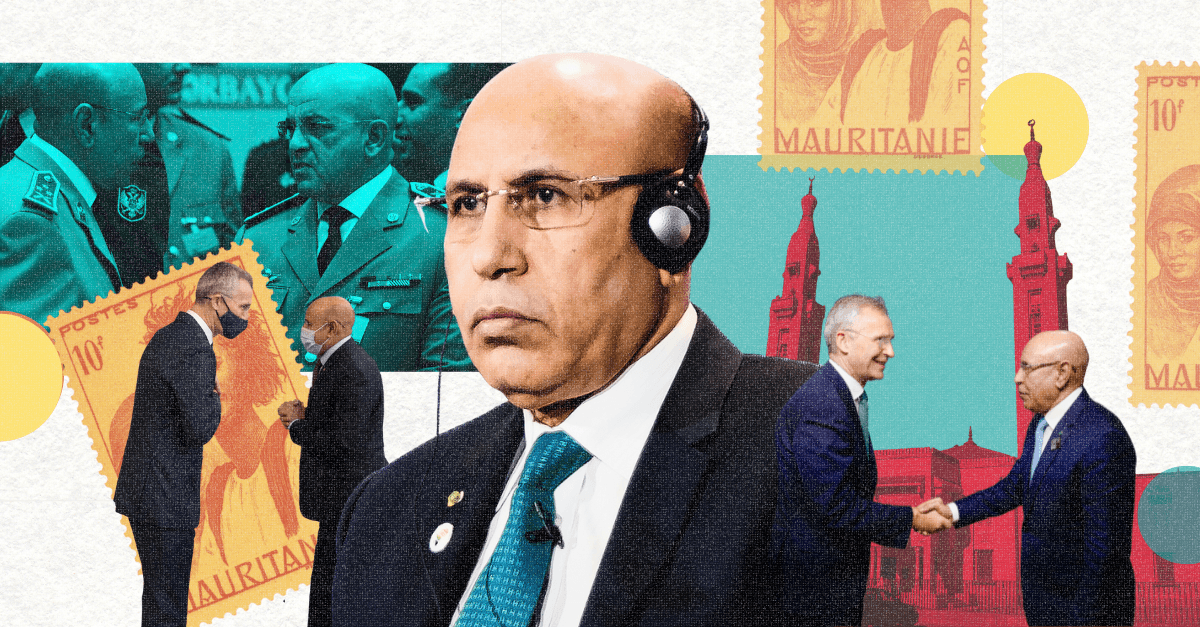
While domestic challenges to Mohamed Ould Ghazouani’s legitimacy dimmed soon after he was re-elected as Mauritanian president last year, his attempt to balance competing external pressures risks reigniting the social tensions that underpinned the original mobilizations against his re-election.
Jun 29, 2025
Photo Illustration by Ezinne Osueke / THE REPUBLIC. Source Ref: Mohamed Ould Ghazouani / WIKIMEDIA; NATO North Atlantic Treaty Organization / FLICKR; jbdodane / FLICKR; 10-franc Mauri Couple single / SMITHSONIAN NATIONAL POSTAL MUSEUM.
Photo Illustration by Ezinne Osueke / THE REPUBLIC. Source Ref: Mohamed Ould Ghazouani / WIKIMEDIA; NATO North Atlantic Treaty Organization / FLICKR; jbdodane / FLICKR; 10-franc Mauri Couple single / SMITHSONIAN NATIONAL POSTAL MUSEUM.
It has been one year since Mauritanian President Mohamed Ould Ghazouani was re-elected for a second five-year term on 29 June 2024. This outcome was widely anticipated, but it came within a national context that is historically no stranger to military coups, and a regional one in which such coups increasingly appear the norm rather than the exception. The result was contested by lead opposition candidate and anti-slavery campaigner Biram Dah Abeid in the aftermath, which saw widespread protests and a police crackdown resulting in the deaths of at least three people. But these challenges to Ghazouani’s legitimacy tapered off as the election faded from view. In the interim, Ghazouani has domestically consolidated his political position while striving to balance various countervailing external pressures. The act of doing so, however, has undermined Mauritania’s regional and continental diplomatic efforts and risks reigniting the social tensions that underpinned the original mobilizations against Ghazouani’s re-election.
In terms of domestic politics, Ghazouani has, since his re-election, enfolded the opposition, while concurrently ensuring that his erstwhile ally, former President Mohamed Ould Abdel Aziz, remains neutralized as a political threat. Ghazouani achieved the former through a national dialogue open to all registered political parties, with those of the five candidates who contested the June 2024 election given priority. This process mirrors a previous dialogue process which saw the historical opposition in Mauritania declare loyalty to the ruling party as part of a ‘republican pact’, which has, however, remained dormant. If that process is anything to go by, the recent dialogue framework is likely to be a similar means of stultifying and demobilizing the opposition.
The Republic is a Nigerian media-tech company dedicated to explaining our time—through deeply reported journalism on power, culture and society.
Focused consumption without interruptions.
Years of reporting at your fingertips.
Long-form journalism that matters.
Create a free account to continue reading this month and access more of our work.
About the Author
is a lecturer in the Department of Anthropology and Sociology at SOAS University of London. His book After Border Externalization: Migration, Race and Labour in Mauritania is available open access with Bloomsbury Publishers.




Comments
Sign in to comment.