

Our new print issue, Africa’s Hustle Republics, is here! Subscribe for less than ₦1K/$1 a week for full access.
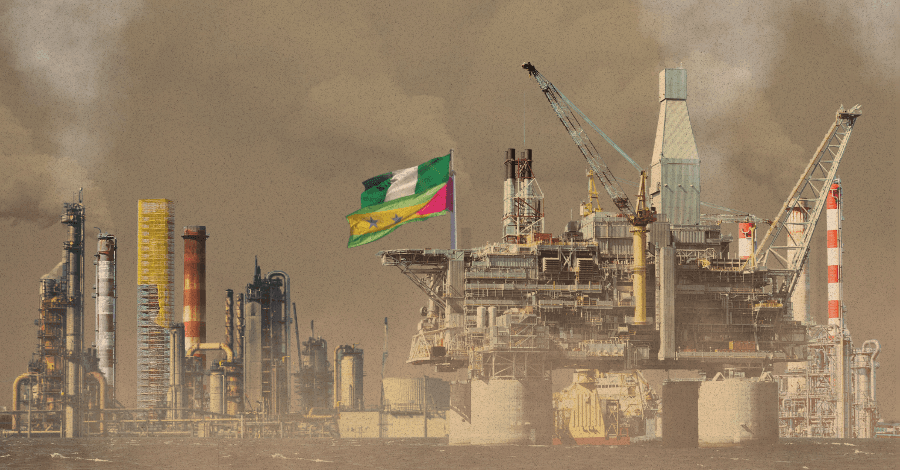
When the Nigeria–São Tomé and Príncipe Joint Development Zone (JDZ) was established in 2001, it was expected to become a profitable offshore oil-producing area. But nearly 25 years later, the project has proven to largely be a white elephant.
On 12 July 2025 the small twin-island state of São Tomé and Príncipe—comprising just 210,000 inhabitants as of 2024—celebrates its 50th independence anniversary since Portuguese rule. The hitherto uninhabited islands in the Gulf of Guinea were colonized by the Portuguese starting from 1493 by white settlers and enslaved Africans from the Kingdom of Benin, followed subsequently by enslaved people from the Kingdom of Kongo and Angola. The resulting genetic and cultural mixing among the different groups brought forth the archipelago’s distinct African Creole society with its own culture and language.
In his speech on Independence Day in 1975, the country’s first president, Manuel Pinto da Costa (1975–1990), declared that the São Toméans had achieved this historic and decisive stage because five centuries of colonial domination and oppression had not succeeded in breaking either their will nor determination to live freely and independently. The liberation struggle, he said, would be meaningless if São Toméans did not use the independence to definitively eliminate poverty, misery, unemployment, disease and ignorance, as well as an end to the evils inherited from the fascist colonial system. The independent state inherited from the Portuguese was characterized by a plantation economy based on cocoa monoculture. In fact, in the 16th century, São Tomé emerged as the first tropical plantation economy based on African slave labour and sugar monoculture. The plantation economy disappeared gradually in the 17th century when São Tomé was displaced by Brazil’s emerging plantation economy where the sugar produced was of much better quality. In São Tomé and Príncipe, the plantation economy was only re-established in the 19th century when the Portuguese introduced new cash crops from Brazil, coffee and cocoa. Initially coffee was the major cash crop but by the end of the 19th century, cocoa was by far the main export product.

The Republic is a Nigerian media-tech company dedicated to explaining our time—through deeply reported journalism on power, culture and society.
Focused consumption without interruptions.
Years of reporting at your fingertips.
Long-form journalism that matters.
Create a free account to continue reading this month and access more of our work.
About the Author
is a research associate at the Centre for International Studies CEI-Iscte, Lisbon, Portugal.


Comments
Sign in to comment.