

Our new print issue, Africa’s Hustle Republics, is here! Subscribe for less than ₦1K/$1 a week for full access.
‘Jikwe, why did you not marry?’ Okenwa asks, his gaze holding Mgbeojikwe’s. ‘What were you thinking?’ … ‘I could have married you,’ he says, adjusting in his seat, ‘In a different world.
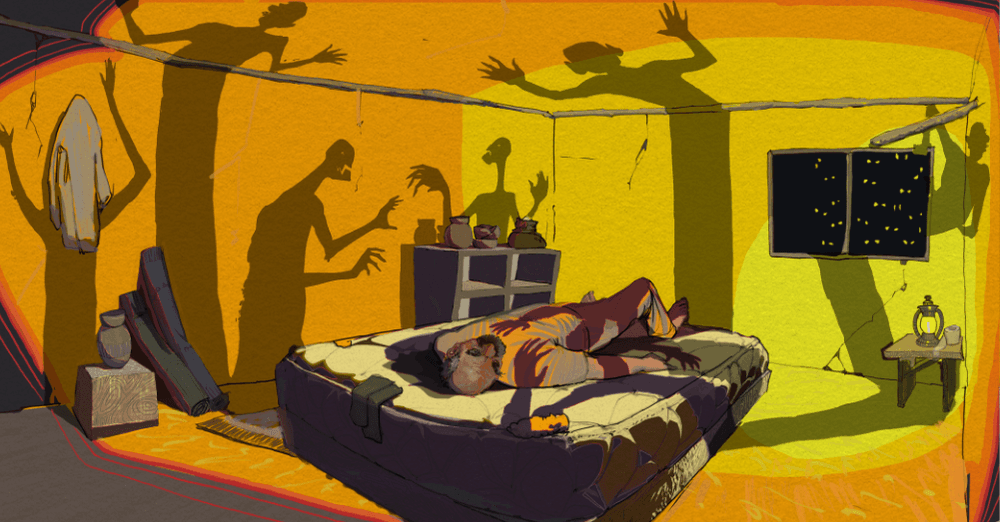
Mgbeojikwe’s room is a dark funeral of musty decline. Even at the height of noon when the sun is at its peak, his room remains shrouded in shadows. Stretched out on his squeaky bed, the threads of his mattress so bare he can almost count each spot where the springs press into his back, he thinks back on his life, winded by how fast, how strangely, it had zoomed by.
The shadows in his room are all the company he has on most days. He tries to remember them by stature and gait, if not by name. The flash of a name across his memory leaves a bitter aftertaste. Silence so loud he sometimes calls out the name, to see if shadows remember who they used to be. He is not always sure if a particular shadow is familiar or not. The forms bleed into each other, and into the cracked patches on his wall.
Mgbeojikwe’s room used to be bright and young, long ago. The mud wall, crumbling near the roof and foundation, used to gleam with a fresh redness. Most men of his age grade who helped build it were long dead, and sometimes Mgbeojikwe catches a glimpse of their shadow in his passageway, perhaps lost, unable to find their own huts where they last remember it.

The Republic is a Nigerian media-tech company dedicated to explaining our time—through deeply reported journalism on power, culture and society.
Focused consumption without interruptions.
Years of reporting at your fingertips.
Long-form journalism that matters.
This story features in our print issue, 'An African Manual For Debugging Empire'.
Create a free account to continue reading this month and access more of our work.
About the Author
is an award-winning writer and queer liberation activist from Enugu, Nigeria.




Comments
Sign in to comment.