

Our new print issue, Africa’s Hustle Republics, is here! Subscribe for less than ₦1K/$1 a week for full access.
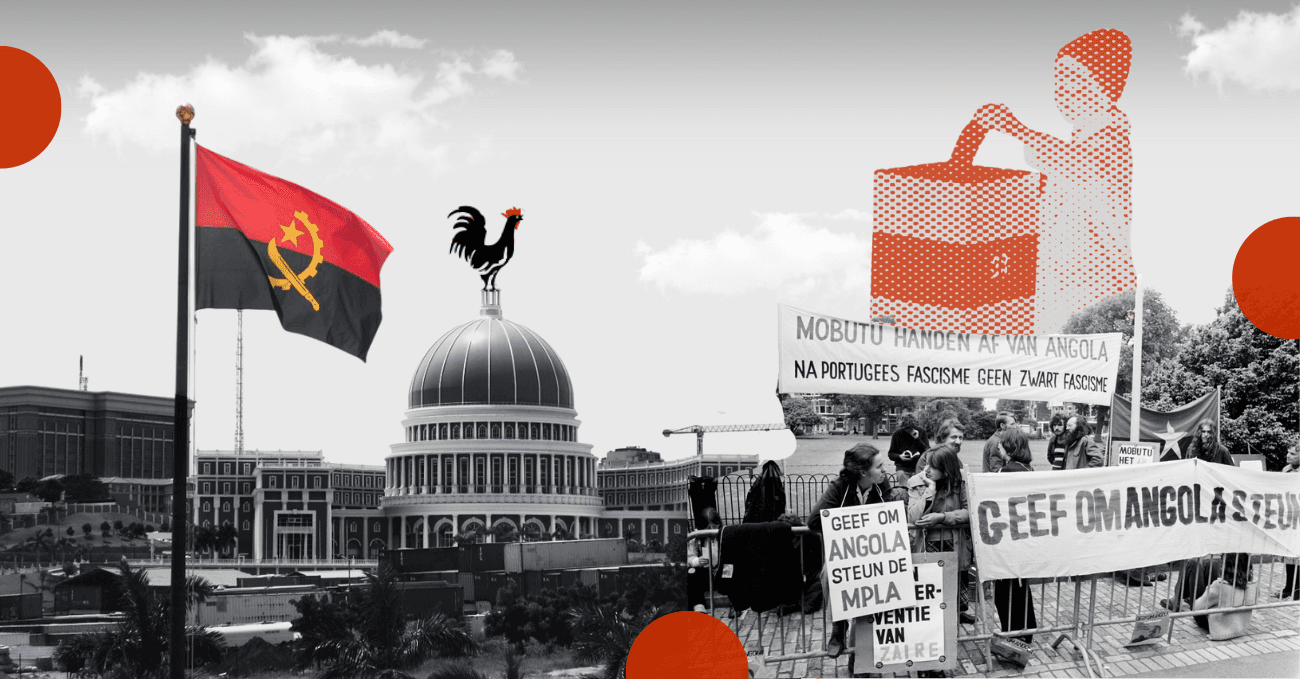
In Angola, the intersection of technology and governance is forging an unconventional democratic landscape—one that emerges spontaneously and outside traditional political structures.
Aug 24, 2025
Photo illustration by Ezinne Osueke / THE REPUBLIC. Source Ref: USAID / FLICKR.
In 2027, general elections are scheduled to be held in Angola. The forthcoming elections are set to pose a considerable challenge to the political party that has been in power since 1975, the Movimento Popular de Libertação de Angola (MPLA). The primary reasons for this are the decline in oil-related revenues and the fact that 66 per cent of the population are under the age of 25. This generation did not experience the Angolan Civil War (1975–2002), and their expectations are not driven by animosity, but rather by a desire for a better life and development. It is noteworthy that since 2008, which marked first elections following the civil war, the MPLA has exhibited a consistent decline, with a decrease of approximately 10 per cent in each subsequent election. The party’s electoral performance is demonstrated by the following percentage of votes received in successive general elections: 81 per cent in 2008, 71 per cent in 2012, 61 per cent in 2017 and 51 per cent in 2022. Should this trend continue, it is forecast that the ruling party will be unsuccessful in the next elections, with a predicted voting share of only 41 per cent.
In this context, the Luanda government is proposing a change to the electoral law, which, it claimed, is intended to make the electoral process more transparent and simpler. However, from the perspective of the main opposition party, União Nacional para a Independência Total de Angola (UNITA), the proposed changes are a means of accentuating the possibilities of electoral fraud, since they make the monitoring of the process by extra-official or independent bodies more difficult than it already was.

The Republic is a Nigerian media-tech company dedicated to explaining our time—through deeply reported journalism on power, culture and society.
Focused consumption without interruptions.
Years of reporting at your fingertips.
Long-form journalism that matters.
This story features in our print issue, 'An African Manual For Debugging Empire'.
Create a free account to continue reading this month and access more of our work.
About the Author
writes about Angola and South West Africa. Verde is a legal analyst of MakaAngola and a research associate at the African Studies Centre, University of Oxford and CEPED, Université Paris-Cité.


Comments
Sign in to comment.