This story appears in our print issue, ‘
100 Years of Ladi Kwali: Stories from Another Nigeria’
. Buy here. In 1977, from 15 January to 12 February, Nigeria held its biggest cultural festival of all time. The Festival of Black Arts and Culture (FESTAC) was a gathering of writers, dancers, musicians and visual artists from across Africa and the African diaspora, with a budget of ₦400 million (roughly $625 million at the time) estimated to be about ₦20 trillion ($14 billion) today.
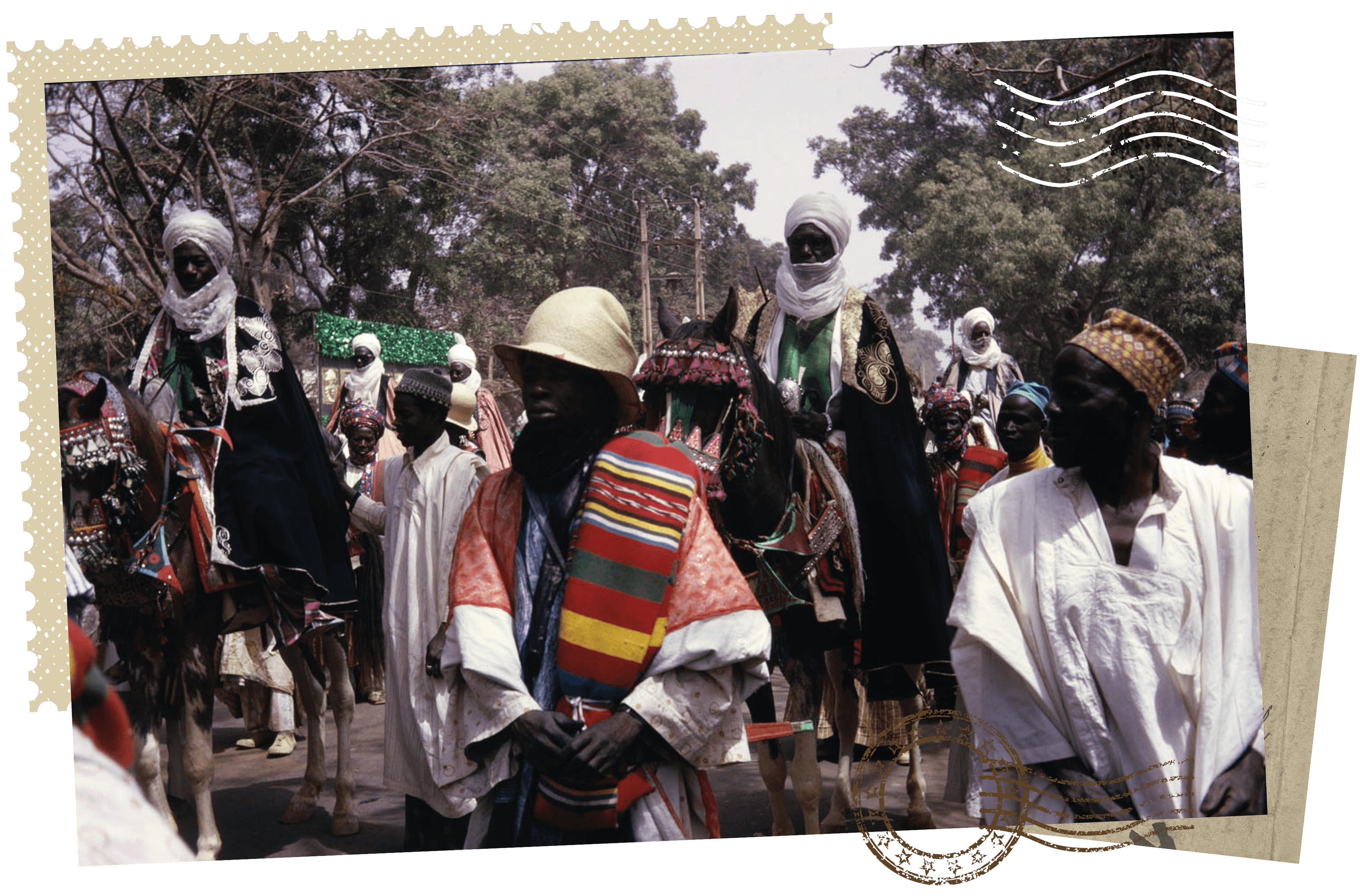
While the festival was primarily held in Lagos, there were other regional events to celebrate. Thus, on a clear-skied sunny Saturday, 05 February 1977, in Murtala Mohammed Square, Kaduna State, about 3,000 horses, 20,000 men and 500 camels assembled along with cultural troupes for a grand durbar displaying culture from Gongola (present-day Gombe and Adamawa states), Plateau, Sokoto, Kwara, Kaduna, Bauchi and Niger states. The horses and camels marched from Kawo, the city’s entrance, to the heart of the town on Ahmadu Bello Way, a distance of about ten kilometres. The durbar had spectators from all around the world, and it remains, to date, the largest durbar ever organized in northern Nigeria.
The durbar was a salute to northern Nigeria’s ancient cultural heritage and its contributions to Black arts and culture. In a speech published in a 1977 article of the Daily Times (recovered in December 2025 from the National Archives in Kaduna), General Olusegun Obasanjo, then head of state, described the durbar at its grand finale as ‘unique, because to a very large extent it represents many features of our traditional power structures, especially in this part of the country—the Emirate system—as it was even before the advent of the British. Our cultures remained unruffled.’
And yet a concerning detail about the grand durbar of FESTAC ‘77 is how inaccessible information about the durbar is today. When FESTAC is discussed, its grand finale is often left out of the conversation; an event so extensive that performers were kept in a public housing project outside Lagos with 15,000-bedroom units, which became FESTAC town, and a 10,000-unit settlement in Kaduna, currently known as Malali Low Cost Housing Estate. Yet, unlike Lagos, Kaduna’s role is often overlooked.
When searching for facts and memorabilia from the durbar, the natural place to start would be at the museums and archives of Kaduna. However, no artefacts from the event are exhibited at the national museum in Kaduna. According to Ismail Zakari, the public relations officer of the National Museum, Kaduna, many artefacts from FESTAC and the grand durbar, such as the Benin bronzes and Nok sculptures, are not even in Nigeria. He said:
[They are some] of the most guarded artefacts, and what we have are replicas in Lagos at the Centre for Black Arts and Culture, and we also have some in Akwa Ibom. Some of the artefacts from the durbar are still in Nigeria, but they’re scattered across different museums. But the Benin Bronze or the FESTAC head are not in Nigeria again. In the museum here, we have the original Nok heads that were exhibited at the FESTAC.
Zakari believes that the Nigerian cultural scene has both gained and lost certain things since the FESTAC era. He states that the political and economic elite started to view Nigerian culture as one of the most advanced in the world at that time, and FESTAC ‘77 ignited a growth in cultural acceptance and awareness in Nigeria. However, we haven’t benefited as much because priceless items like ‘the FESTAC head’ (the ivory pendant representing the Benin Kingdom’s Queen Idia) have been at the British Museum for 50 years, and very few Nigerians have ever seen them. He reiterated that there is a drought of knowledge about FESTAC 1977, and that the available information now does not point to the technology used to assemble important exhibits. He also linked the drought of knowledge to a lack of interest from Nigerian youths today in museums and archives, especially in northern Nigeria. According to Zakari:
In the north, they believe that the museum is a place where we keep idols. Because of that, we find it hard to convince them that these things are not just idols but a form of history. We need to have more investment in technology and structures to be able to engage the youth now. We are also finding it hard to convince people that these artefacts are theirs to own. With every visitor to the museum, there should be 3D imaging, language bots and so on.
Zakari hinted that in present-day Nigeria, there are policies that impede collaboration, research and other activities that could boost the development of Nigeria’s cultural scene:
The issue of TSA [Treasury Single Account] is one aspect that makes it difficult to get funding from foreign donors. Companies should be adding donations to the museum as part of their corporate social responsibility. The government is doing much, but the government needs to do more, and we, the people, have to also play our part and see the museum as our own.
According to Zakari, Kaduna’s creative scene has been evolving over the years and is up to speed with the rest of the country. ‘We are very much in interesting times,’ he added. ‘For up to 15 years, so many young people have been able to come up with wonderful creative ideas, and we at the National Museum Kaduna are partnering with a lot of them.’
Even though young people seem uninterested in antiques, the high attendance at arts festivals indicates that there is some interest in culture and contemporary art.
Forty-nine years later, the stands of Murtala Mohammed Square that held thousands of spectators of the grand durbar remain standing. The stands, along with many monumental and archival spaces in Kaduna like Arewa House, Space 2000 and the National Museum, are witnessing a new generation of cultural archivists and curators who present Kaduna’s talent to a local and international audience.







Comments
Sign in to comment.