The True Source of Ladi Kwali's Genius | The Republic
The True Source of Ladi Kwali's Genius
For decades, the potter on Nigeria’s twenty-naira note was considered the product of British colonial art instruction, but this viewpoint denied a crucial truth: that Ladi Kwali’s art came from a Gbagyi worldview in which clay, labour and the female body were sacred, inseparable and hers alone.
This story appears in our print issue, ‘100 Years of Ladi Kwali: Stories from Another Nigeria’. Buy here.
Once upon a time in a rotund house in Suleja, Niger State, a slim woman in a headgear prepared and kneaded a lump of damp ochre clay. She scooped a long strip of clay and placed it on her side-positioned other hand, coiling it around to the end, before slapping on another similar strip of clay, pinching it into position following a circular pattern, then another and another. And as she kept up this routine, her hand rising with each layering, a roundish shape began to emerge. It was still rough, like an ancient stone-hewn wood, not much of any smoothness except at its tapering near the top. She paused to look upon it—or we can suppose she did, because of the practice where she came from—and when she examined it with the hindsight of experience, throwing her head back, she saw that what she had made was good and, nodding, continued her work.
That was Ladi Dosei Kwali, and what we can suppose was her typical workday. For many Nigerians, Kwali’s story is limited to a now almost forgotten vestigial aspect of our legal tender, the twenty naira. Long captivated by the image of the woman on the back of the note since its introduction in 1977, Nigerians, by many accounts, however, know nothing about her beyond the fact that she was a supposedly famous potter, a condition that explains Kwali’s unique place in Nigerian heritage conversations: that of obscure renown.
While many may argue that an engraving on the national currency is immortalization enough, there is often some feeling, especially within the art world, that she had neither been properly explicated nor her art properly understood—until recent times, that is. Yet the recent reappraisals of her work in international exhibitions temper its wholesome ethnic origins with colonial affectations.
It is doubly important then to put anyone under no illusions as to the originality of Kwali’s art; more so as Nigeria’s first internationally renowned and recognized potter and ceramist. That art had emerged from the oft-dissimulated Gbagyi (or Gwari) culture that gave her identity. And what that background reveals about the nature of Kwali’s art is endlessly interesting.
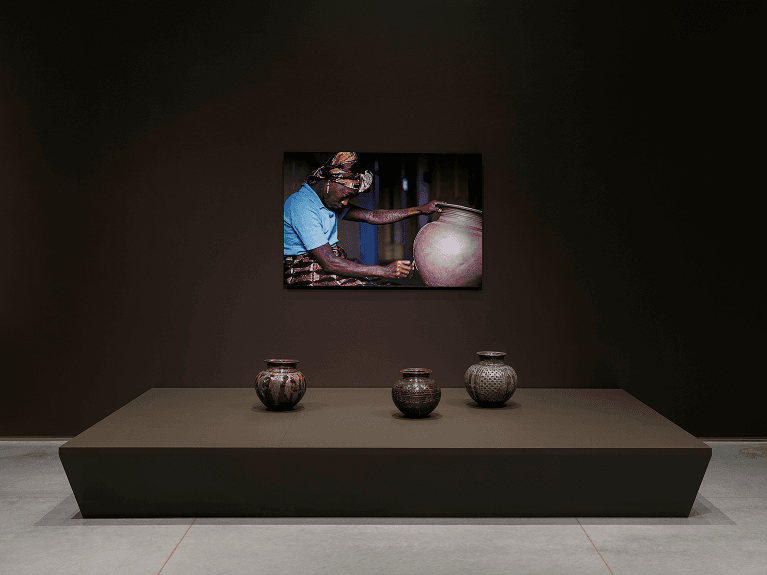
Installation views Body Vessel Clay: Black Women, Ceramics & Contemporary Art, Found Foundation Gallery, New York (). Courtesy Ford Foundation Gallery. PHOTO SEBASTIAN BACH.
WHAT GBAGYI COSMOLOGY SAYS ABOUT ART AND AGRICULTURE
Few Nigerians can deny witnessing, at least once, the magnificent image of Gbagyi women, often in blue wrappers, carrying pots and calabashes loaded high and lengthwise with firewood and goods. The one remarkable feature of such images (usually televised) is that those women are habitually shown to be carrying those calabashes and pots on their shoulders. Once seen, these images are promptly forgotten or subsumed by the dominant narratives of this country’s major ethnicities. But this general attitude to minorities in Nigeria belies the fact that the Gbagyi have a strong, irrepressible identity. To boot, a Gbagyi saying goes that ‘a ta gyin Gbagyiza ya na ynizhe n kwa zhin won: you cannot separate the Gbagyi from the world that produces them.’ In Knunu, the Gbagyi worldview, the negotiation of life—from birth, through marriage, to death—is linked by an ancient system of beliefs and spiritual worship (A’shnagba) that privileges veneration of the land and the things in it, which are believed to have been divinely bestowed on the Gbagyi by Shekwoyi, the supreme being. According to academic Yusuf Ayuba, the importance placed on land is manifested in the awe with which the Gbagyi hold the land formations in the inselberg hill country of Niger, Kaduna, Kogi and Abuja, where they mostly reside.
The rocky hills, or ‘Pe, become abodes of deities and, by that virtue, a natural protection for the people. Several Gbagyi myths speak of the hills as an ancestral cradle where their mostly hunter forebears took shelter and subsequently became sedentary, and from where they began to encounter the world. Often, in Africa and elsewhere in the world, according to Cameroonian scholar, Lang Michael Kpunghe, communities that draw immanence from the environment, practices such as farming or any other form of earth-tending become highly sacred arts (which, in the case of the Gbagyi, is seen not merely as labour but service). Therefore, the importance placed on farming (yams, eponymously called Gwari, are especially important), wood-fetching, carving and pottery by the Gbagyi is not merely economic but existential and religious.
Thus, secular and religious objectification translates into artistry. Everything about the Gbagyi shows that their philosophy and culture is intensely artistic. A legend that illustrates the people’s intellectual temperament tells of an ancient competition (the nature of which is rather obscure) among Nupoid-speaking peoples—the Nupe, the Gbagyi and the Ebira—about who had superior artistry and intellect. The story went that after a decade of evaluation by independent judges, the Gbagyi were adjudged to be the most advanced in those engagements. However apocryphal this story may be, it underscores the Gbagyi propensity towards creation or dominance in the creative and intellectual arts.
Archaeological evidence of terracotta sculptures in the settled Gbagyi lands may be the earliest instance of Gbagyi traditional pottery, which, were it incontrovertibly true, appears to link them to the nearby ancient Nok civilization and Neolithic era earthenware skills. But the evidence misaligns with Gbagyi legends and histories, which point to migrations from Wukari and Kwararafa empires (mostly present-day Taraba, Benue and parts of the Middle Belt) before the 19th century—and those were interestingly civilizations, which flourished in the rich alluvial plains of the Benue River basin.
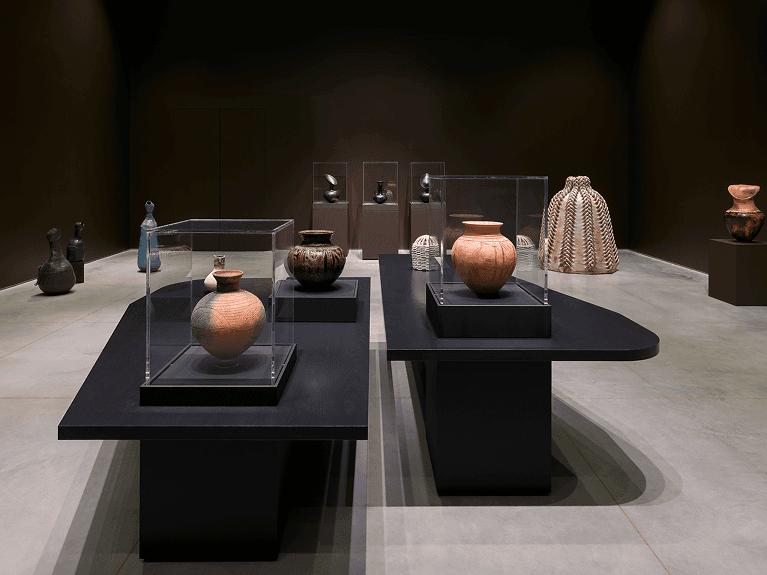
Installation views Body Vessel Clay: Black Women, Ceramics & Contemporary Art, Found Foundation Gallery, New York. Courtesy Ford Foundation Gallery. Photo by SEBASTIAN BACH.
WOMEN, BODY AND THE CALABASH
Kwali was a typical Gbagyi woman. The culture and laws that Gbagyi women adhere to emanate solely from notions of labour and handiwork within Knunu. The shouldering of loads has interesting affinities within the tableau of Gbagyi cultural values. The body is regarded as a sacred entity, a realm in which the very life force that keeps humans alive circulates from head to foot. Each part of the body is said to have a role to play in carrying life. The legs are the motors of the body, the shoulders carry all external weights, while the head is the ‘king of the body’, where commands, thoughts and rules reside.In a 2013 Trip Down Memory Lane blogpost, a Gbagyi traditional ruler from Kuta offers a plausibly obvious reason for this: ‘The reason why we don't carry loads on our heads is because we don't want to burden our heads. The brain is found in the head, and it is with it that the affairs of the world are being goaded; if we burden it, it is a belief among us that we will be mentally retarded.’
By and large, this choice was partly why pottery was regarded as a female vocation in Gbagyi culture, for it is somehow linked to notions of beauty and bodily preservation. Detailed studies, such as one conducted by researchers Emeafor Obinna and Pamela Eze-Uzomaka in 2018, reveal that the processes of creating pottery in the Gbagyi community of Ushafa—from clay mining and processing, to making the pots and firing them with firewood and dry grass—are all traditionally done by women.
This reveals something about where women stand in relation to Gbagyi culture. A 2023 study by Jake O. Otonko and Eucharia Ugochi Opara observes that ‘[w]ithin the Gbagyi culture, there is a customary expectation for women to demonstrate characteristics such as submissiveness, obedience, respect, subservience, docility, cooperation and support towards men. This is particularly observed within the realms of agricultural activities and household responsibilities.’
In such scenarios where the Gbagyi female body has been made a vehicle for such responsibilities, something is made clear: that the artisanal exertions of Gbagyi women are, au fond, existential endeavours; that their pottery are not merely beautiful objects but necessities for their livelihoods. The female body and clay have both become vessels in which the artistic and the traditionally regulated functions are merged.
When we view Kwali’s work, we must acknowledge the memory that her particular use of clay holds, which is signified by its attachment to labour and function. Where true art is concerned, as prominent nineteenth-century English artist and socialist William Morris argued, labour must come from pleasure and even leisure, not consumerist production and reproduction. For art is an expression whose first impetus is to fashion beauty from the known (of course, conversations on the art or artifice in utility objects, rising from Marcel Duchamp’s disruptive urinal, is nothing new). The superimposition of labour and art, in the case of Gbagyi women, whose primary reason for making pots is for sustenance, presents a rather peculiar situation in which the arts mean more than cultural beauty. Thereupon, Kwali’s work is evidence of a culture that demands that those pots never go empty.
THE POETRY OF POTTERY: LADI KWALI’S STYLIZED POTS
We are in Chicago in 1972, during Kwali’s demonstration tour of the United States. The venue is the courtyard of the Field Museum, where the Contemporary African Arts Festival is being held. Kwali is at work on a pot. She is layering coils of clay. Her fascinated audience has clearly never seen pottery done like this. But Kwali's hand continues to move round and round in a pattern. She is quick but also calmly deliberate, and in those moments when her hands and the clay had become one, she has become a ferrywoman of the mysteries of her culture, freighting creative idioms across generations like a griot or a travelling poet.
We are in Chicago in 1972, during Kwali’s demonstration tour of the United States. The venue is the courtyard of the Field Museum, where the Contemporary African Arts Festival is being held. Kwali is at work on a pot. She is layering coils of clay. Her fascinated audience has clearly never seen pottery done like this. But Kwali's hand continues to move round and round in a pattern. She is quick but also calmly deliberate, and in those moments when her hands and the clay had become one, she has become a ferrywoman of the mysteries of her culture, freighting creative idioms across generations like a griot or a travelling poet.
The international renown Kwali gained in the latter years of her career came in the form of these showmanship exercises in front of audiences in international venues that stretched from Europe to the United States, which she toured with British studio potter, Michael Cardew, who was the chief instructor at Abuja Pottery, the institution to which she was affiliated. In her 2000 book, Women and Ceramics: Gendered Vessels, British scholar Moira Vincentelli noted that such pottery demonstrations ‘have long been used as spectacle and sales incentive at fairs and festivals,’ and continuing that line of thought, she writes: ‘but there is a particular relationship created when the demonstrator is not merely demonstrating a craft technique but also a craft technique which signifies cultural difference.’ Vincentelli’s telling observation is that Kwali was not merely demonstrating the making of a cultural artefact—of course that was also a point of interest for those riveted European crowds—but was herself seen as the cultural artefact (an excerpt she quotes from a pesky newspaper report of a demonstration by Gbagyi potters Asibi Iddo and Asabe Magaji stamps this: ‘Two Nigerian women left their mud-homes in the remote jungle for the first time to bring Aberystwyth a demonstration of their skills as potters last week … for the potters it was their first glimpse of the modern world…’—with the racialized lexicon of a statement such as this, it is hard to shake off the feeling that Kwali and her colleagues’ performances in those European towns were viewed by their audiences as some kind of vaudeville curiosity).
Kwali’s performer incarnation created a paradox: in one sense, audiences viewed the sinuous poetry of Gbagyi pottery from scratch, witnessing firsthand the way in which Kwali’s mastery of her own indigenous hand-building pottery resolved into the creation of magnificent pots and vessels. It is an affirmation of the truth that pottery is an art whose appreciation is as much in the finished pot as it is in the process. Many have talked about a near-spiritual experience in either watching a potter at work or being directly involved as the potter themselves. This is the rapturous vein in which Tanya Harrod, Cardew’s biographer, described Kwali’s performances:
She starts by punching into a solid cylinder of clay, pulling up the sides, adding rough coils of clay, walking round and round the pot, scraping and thinning the pot’s wall while the whole thing sways outrageously. The shape is then bellied out and an elegant rim created by manipulating a piece of cloth or leather. The end result has perfect symmetry and classical rightness. Ladi Kwali was a past mistress of this and she was also peculiarly imaginative about decorating, always ready to try new ideas. To awed outsiders, she appeared to go into a trance-like state as she incised outlines and cross-hatching with a knife-like tool, working her way round the pot without any preliminary setting out.
In another sense, these performances somehow drew her apart from other significant artists being discussed in venerable art rooms, though any conflation of ceramics and traditional art, such as painting and sculpture, is problematic. To refer to Janet Koplos’ essay, ‘Ceramics and Art Criticism’, published in The Ceramics Reader (2020), anxieties about the place of pottery as an art form have always been a thing of contention, even among ceramists and potters. While Kwali’s work did get exhibited in places like Berkeley Galleries in London as her name became more known, what we see are the subtleties of period reports, such as the one quoted from Vincentell, which show how she (and others like her) were treated as an exotic novelty. Admittedly, of course, her origins are heavily contingent on her art.
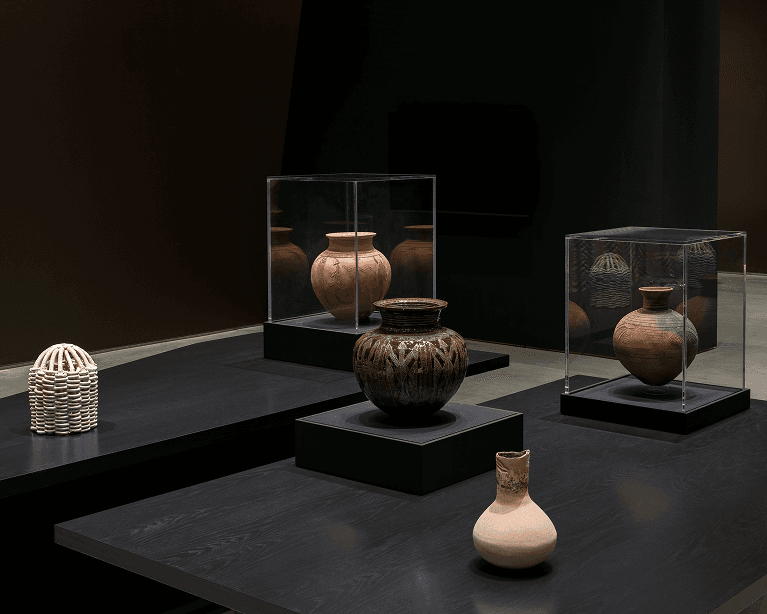
Installation views Body Vessel Clay: Black Women, Ceramics & Contemporary Art, Found Foundation Gallery, New York (). Courtesy Ford Foundation Gallery. Photo by SEBASTIAN BACH.
In Kwali, the town in central Nigeria, where the artist, Kwali, was born in 1925, artistry was a necessary and even moral expectation. Acquainted with pottery from a very young age, she learnt the skill quickly in the same way women in her family have learnt it for generations. The young girl’s talent was obvious almost immediately, and her pots were selling out without being taken to the market.
Her pots followed traditional style and were fired using piles of mostly dry grass. Of the different kinds of pots she produced, the Giri—a slim-necked gourd-like pot which the Gbagyi used for grain-storing—was common in the earliest years of her career. Other clay pots of cultural significance include the Randa, which has a wide mouth, a short neck, a rather narrow rim and was used traditionally to store beer or water. The Kasko, another of such pots, has either a round or funnel-like shape and a varying number of uses, from cooking to incense burning. The pots Ladi became famous for were of the randa type.
These early pots spotted concentric lines from neck to rim and were engraved with figurative etchings of fish, lizards, chameleons, snakes, crocodiles, birds, scorpions and other symbolic animals—the kind of fauna found in the hilly and mostly forested savannah region where the Gbagyi have made home. Some drawings were totemic symbols referencing the venerated figures in the Gbagyi A’shnagba spirituality. Fish, for instance, is associated with the Gbagyi deity, Sauri. Kwali’s signature artistic move was to fashion an aesthetic that expands upon the Gbagyi spiritual cosmos, taking its visual language directly from Knunu.
Kwali’s mastery of the pottery was complexified by her acquaintance with Cardew (then colonial pottery officer in Nigeria) who convinced her to join the newly founded Abuja Pottery in 1954 (he had come across her pots at the Abuja Emir’s palace four years earlier). By the time Kwali joined Abuja Pottery as its first female potter, she was already a known name regularly patronized by potentates and merchants in the central Nigeria region. But this collaboration exposed her to a different kind of pottery technique, marking her transition from earthenware to stoneware. Learning the skills of Western pottery, such as glazing, kiln firing and wheel throwing, Kwali found herself increasingly exploring ways in which these new skills could improve what she already knew from her Gbagyi style.
Kwali’s mastery of the pottery was complexified by her acquaintance with Cardew (then colonial pottery officer in Nigeria) who convinced her to join the newly founded Abuja Pottery in 1954 (he had come across her pots at the Abuja Emir’s palace four years earlier). By the time Kwali joined Abuja Pottery as its first female potter, she was already a known name regularly patronized by potentates and merchants in the central Nigeria region. But this collaboration exposed her to a different kind of pottery technique, marking her transition from earthenware to stoneware. Learning the skills of Western pottery, such as glazing, kiln firing and wheel throwing, Kwali found herself increasingly exploring ways in which these new skills could improve what she already knew from her Gbagyi style.
But Kwali’s conscious merging of two pottery processes, the Gbagyi and the Western, exposes further complexity in the definition of the identity of any given pottery, for modern English pottery today has arrived at its present state through heavy influences from traditional Japanese ceramics (particularly the early twentieth-century Mingei movement). In short, the modern studio pottery movement in Britain began in 1920 when its pioneering figure, Bernard Leach, returned from sojourning in Japan. The complexes of influences that go from the Far East to the West and to Abuja Pottery do not privilege any simple narrative of ‘Cardew’s influence’ (for the narrative of ‘modern pottery’, as any artistic revival, is replete with influences and cross-influences). In any case, Kwali mostly stuck to her Gbagyi style, only incorporating those international links in the finishing processes of stoneware-making. She never used the Japanese-style decorations that are now characteristic of English studio pottery and parts of the American tradition.
For precisely this reason, recent events in art have begun to position her as a modernist and innovator who pioneered a new ceramic style that came from merging her traditional Gbagyi style and some of the international processes. This is partly the pitch of art critic and curator, Dr Jareh Das, whose impressive curatorial project, ‘Body Vessel Clay: Black Women, Ceramics, and Contemporary Art’, was most recently exhibited at the Ford Foundation Gallery between September and December 2025. The exhibition contextualizes Kwali’s work as an undeniable influence on contemporary ceramics and on pottery by Black women artists. Das explains in her email to me that Kwali is not so much a breaker of convention ‘as a bearer of one.’ She wrote:
While her dialogue with the British studio pottery movement, particularly through Michael Cardew, is undeniable and did lead to international recognition and a lasting legacy, that narrative has too often eclipsed centuries-old, women-led pottery traditions in Nigeria and across the African continent. What I am especially interested in is how this legacy of Gbari (Gbagyi) handbuilding, alongside wider African women’s handbuilding and coiling practices, has been taken up, reactivated and celebrated globally, particularly among Black women artists in the diaspora. In these contexts, the method becomes a site of continuity rather than rupture, forging connections across generations and geographies. Contemporary Black and African ceramicists (and artists who work with clay) are not simply influenced by Kwali as an individual figure, but are engaging with a much longer lineage of women’s knowledge, embodied skill and material intelligence that her work brings into view.
Professor of art and archaeology and advisor at The Republic, Chika Okeke-Agulu, agrees that ‘Ladi Kwali was a transformative figure within the history of modern pottery in Nigeria,’ who ‘created modern Gbagyi pottery—with new media, techniques and decorative program—and for a Nigerian and international clientele.’ However, Okeke-Agulu, who is also the author of Postcolonial Modernism: Art and Decolonization in Twentieth-Century Nigeria, sees no intellectual basis for any modernist discourse in her work, which he feels exists sufficiently on its own independent basis:
I would not consider her a postcolonial modernist, alongside the likes of Uche Okeke, Demas Nwoko, Afi Ekong, Erhabor Emokpae, Colette Omogbai, etc. For me, postcolonial modernism was a Modernist movement, defined by the same three characteristics that underlie all 20th-century modernisms: focus on formal invention, clearly articulated negotiation of their relationship with imagined tradition; and identification with a (national or international) cultural vanguard. The fact that she was not part of this network of artists does not make her contribution to the history of Nigerian pottery any less significant.
Yes, Kwali made inventive expressions in her pottery, but they were creations that spoke from the position of place and culture rather than to any galvanizing ideological zeitgeist. Her aspiration was the nobility of all people in craft: to strive silently to make a most natural and inspiring article of beauty. The appearance of that in her ceramic work often evoked great symmetry of form and meticulous detailing. They project culturally mediated idioms in their designs. Through their coruscating glaze, the figures Kwali etched on them give them the crystalline appearance of a precious found object.
This is what we see in some of her classic pots currently on display at the Nigerian Modernism exhibition at the Tate Modern in London. A randa pot in one of the vitrine plinths has a round fullness of shape, surfaced with a shiny ebony glaze and concentric pale green or silver lines around the neck. There is another ornate strip circling the shoulder area close to the pot’s neck. Cross-striated geometric lines descend from the neck strip in double vertical lengths across the pot, creating blank columns upon which Kwali had engraved reptilian figures, by turns lizard-like and scorpion-like. Another figure has an elongated human-like form, similar to the almost flighty spirits of Enwonwu’s Anyanwu era.
Kwali’s pots were not created in a vacuum. Their appearance and craftsmanship echo cultural memory. The contestation of memory here goes from the necessities of ordinary living, the rituals of hunting, farming, religion, life and death to the technical hybrids that emerged from colonial dialogue. Kwali’s use of clay tells not just a story of Gbagyi culture and Gbagyi women but also a story of Nigeria and, to the extent that clay-making and history goes, the story of Africa.
TO DEFINE A HERITAGE
The recent attempts (in 2025, the centennial of her birth) to situate Kwali in a proper artistic discourse—particularly Das’s recent exhibition at the Ford Foundation Gallery and Tate Modern’s Nigerian Modernism exhibition, where full rooms were devoted to Kwali—emerged from a need to reclaim her reputation as an independent artist whose influence on subsequent ceramics is undeniable. Reporting on the ‘Body Vessel Clay’ exhibition in The New York Times, Times’ West Africa bureau chief Ruth McClean noted that Kwali’s:
… work, and her words, did not reach her international audiences directly. She was taken to Europe and the United States for demonstration tours by the English potter Michael Cardew, whom scholars have criticized; one, Lisa Bagley, described him as ‘a gatekeeper between African ceramists and Western audiences.’ As a senior potter officer of the Nigerian colonial government, Cardew employed her, worked alongside her and learned from her, and introduced her to glazing, wheel throwing and kiln firing. Internationally, Kwali (1925-1984) and her work was mediated through him, and much of what we know of her comes through his papers and his biographer...
To say that it is criminal that, for many years, Kwali’s work was examined through the prism of Cardew’s work is to understate the insidious issues at play here. The one linkage often implied was that Cardew taught her most of what she knew about pottery, a claim that casually erases the culture that gave roots to her and the ancient traditional pottery methods which she pointedly stuck to throughout her career. Das frames it better in the context of her curation, pointing to how Kwali’s ‘Gbari [Gbagyi] handbuilding practice, passed down generationally within families, has been consistently overshadowed in how she is remembered and historicized.’ But as I have previously pointed out, the so-called ‘influence’ is rather ambiguous when closely examined.
Cardew himself has been portrayed as not being overtly interested in forcing Western pottery techniques on his students at Abuja Pottery and had no qualms about indigenous pottery methods (having begun his own career making traditional English slipware). In many instances, he sought to acquire the aesthetics of ‘authentic’ African pottery, or so we learn from Harrod’s biography of Cardew, The Last Sane Man: Michael Cardew, Modern Pots, Colonialism, and Counterculture (2012). If indeed this were the case, then it does appear that a misrepresented narrative had emerged somewhere in the interstices of the period between the 1960s and the 1980s, the latter being the decade that saw the demise of both potters.
When asked if she sees any narrative of art or culture-based exploitation therein, Das insists that she does not see Kwali as someone who was exploited. ‘She exercised agency before, during and after she engaged with the Pottery Training Centre in Abuja (now Suleja) …,’ Das said. ‘While the institutional and colonial frameworks within which her work circulated cannot be ignored, it is important to recognize that Kwali was celebrated in her lifetime and actively shaped her own professional trajectory.’
The testament of Kwali’s influence continues to generate artistic and socio-political discourse around how art by African and Black women world-over is appreciated. While exhibitions such as ‘Body Vessel Clay’ extend such discourse into contemporary ceramics, women and art in general, other recent exhibitions indirectly approbate other dimensions of that influence.
To researcher and curator Tony Agbapuonwu, ‘Ladi Kwali is a testament to the role women in various fields played in nation-building, and the colonial liberation struggles of Nigeria.’ In an email to me he said:
In my recent collaboration with potter and artist Mobolaji Otuyelu in the exhibition Anyanwu: The New Light, at the National Museum Lagos, she, like Kwali, presented a clay pot in the exhibition alluding to the ancestral connotations of land as Mother Earth and Ala in Igbo cosmology, which positions women as nourishers of life. Today, the ceramics conversation in Africa raises the urgent need to critically engage our indigenous knowledge systems.
The indigenous knowledge system from which Kwali viewed and spoke to the world is demonstrable in the pots she produced, for as the philosophy of her kin expresses, she cannot be separated from her heritage. They hark back to a world and time when clay was both an existential engagement and a symbolic vessel that carried the hopes and aspirations of a people. If no attempt is made to know that world, then we do a great disservice to Kwali’s art, which shows a consummate understanding of her people’s provenance and worldview⎈
is a writer of fiction and nonfiction. A runner-up for the J. F. Powers Prize for Fiction (2024), Chika was a 2021 Fellow of the Ebedi International Writers’ residency in Iseyin, Nigeria. He currently resides in Nigeria.











Comments
Sign in to comment.