This story features in our latest print issue, ‘Africa’s Hustle Republics’
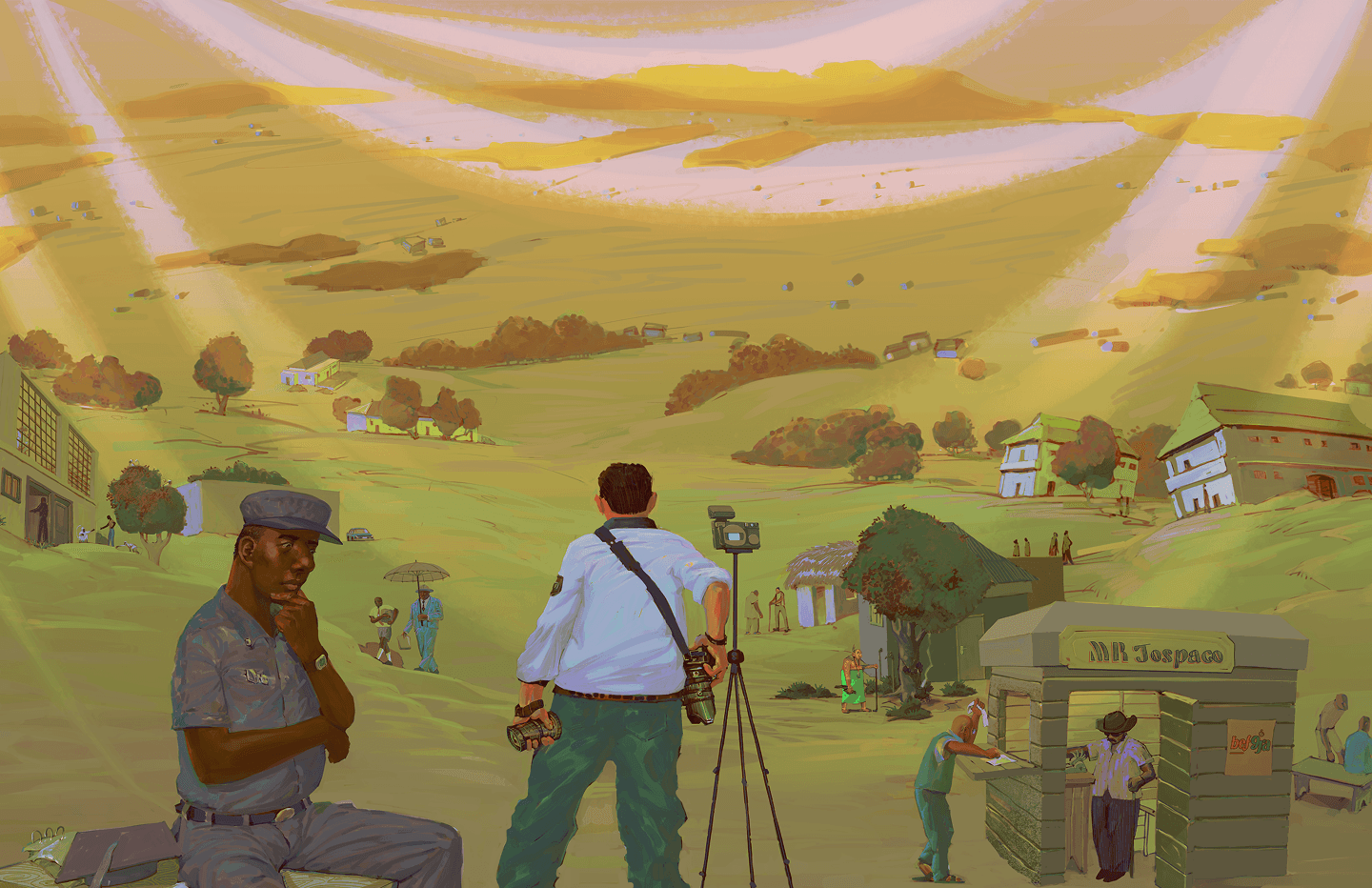
. Buy here. The colour of Robert Wood’s eyes reminded me of metal in its first stage of rust. Robert, a seasoned photographer, was unusually chatty with workers of my class at the National Geographic headquarters. By class, I mean cleaners, storekeepers and security guards: those of us who gathered in the basement kitchen to warm our African food whose condiment smell often sent our American co-workers scampering away.
Robert’s work had taken him to various parts of Africa. He spoke a smattering of Swahili and a few other Southern African languages, enough to perform familiarity when the mood took him. When he was not out in the field, he loved having lengthy, sometimes awkward conversations with me. We weren’t short of issues to debate, especially since he knew I had a law degree from back home. So, you could say he was accustomed to Black immigrants from the continent. He had travelled through East, Southern and Central Africa many times, but West Africa had never pulled him close.
One ordinary spring day, while we talked on the steps of the 17th Street entrance to our office building in downtown Washington DC, the middle-aged white photographer told me there was nothing to photograph in West Africa. The ignorance of a man who had travelled so far and so often caught me off guard.
‘Which part are you from again?’ he asked.
I wanted to ask him if that was all he knew about the most populous nation on the continent: the Niger Delta’s oil and the raging militancy that had lately flooded the American media.
‘No, I am from the midwestern part, though some parts are considered Niger Delta as well.’
‘I see—Nigeria has never come under my radar, you know, plus there’s too much stuff going on down there, man,’ he said.
Robert exhaled smoke from the left side of his mouth, one of his brownish eyes closed to avoid the drifting cloud. I allowed his words to sink in as if they were ash sprinkled on a bucket of water.
‘Mr Robert, I must tell you—’
‘You can call me Bob,’ he said through his southern drawl.
Robert was a likeable man; one could say he was an easy pill to swallow. Other white staff in the building just looked at us immigrants like flies in a mug of fresh beer. If I wanted any white man photographing anything in my village, I preferred him. Knowing how skilful he was, he would do a great job and I could see my home again, even if only in still images.
‘Okay, Bob, you are missing a lot. There is so much interesting stuff to photograph in my village alone, especially the ancient shrines with wall drawings and sculptures that date back centuries. Never before seen by the outside world.’
Having worked at National Geographic and watched the kinds of things they exhibited that made white audiences queue up and go bananas, I knew what might interest Robert. I had been harbouring the idea of nudging him toward my country, hoping the magazine might one day publish photographs I could recognize and not just animal skeletons and exhumed Egyptian mummies in coffins that gave me nightmares. I still could not understand what fascinated white people about the dead. Let the dead rest in peace, I would mutter sometimes.
‘Our forests are bustling with wildlife. You can’t even imagine the sorts of nature’s rare species you will encounter: lions, leopards, birds and what have you,’ I said.
I was now padding things because I had never seen lions or leopards while growing up. I had not travelled home or seen my Charity since I left Nigeria seven years ago. My green card process had hung in some bureaucratic tangle like a kite flown too close to a tree. So, I did not know whether the birds and monkeys in our forests even still existed. But since white people wanted lions and leopards and not people, let me dish wild animals to this one standing before me. As my people would say, if a goat likes elephant grass, you feed it elephant grass to eat.
‘How dangerous is that part of your country?’
I did not expect Robert to offer the same lame excuses as others who spent their time reading state department travel advisories about diseases, wars, coups, political instability and every other kind of ridiculousness. One of my friends said the warnings were a scheme to help NGOs make more money from Africa. Moreover, I had seen Robert’s photographs and knew he had been to countless dangerous zones around the world, work for which he had won awards, including the prestigious Pulitzer Prize. If anything, Nigeria was not dangerous enough for him. He had published widely acclaimed photo books, including Giants of Africa, which I had thought was about Nigeria, the country others commonly called the giant of Africa, only to discover the book was about elephants in Kenyan nature parks.
‘My village is not dangerous. It is much safer than southeast Washington DC. Nobody owns guns, except old ones for hunting small game.’
There was a certain edge in the way I answered him, reminding him that Washington DC, where we worked, was more dangerous than my entire country. Robert didn’t speak for a moment...





Comments
Sign in to comment.