Below her, a door shuts and bottles begin to clink into a bin. Outside, bottle-collecting robots and delivery units move along pavements with small, expressionless faces. The newer robots have been upgraded to dodge the stones that people leave out to trip them. Still, especially at night, people kick them over when no one is looking. Berlin will be the last to fall, Sophie sometimes tells herself.
Below her, a door shuts and bottles begin to clink into a bin. Outside, bottle-collecting robots and delivery units move along pavements with small, expressionless faces. The newer robots have been upgraded to dodge the stones that people leave out to trip them. Still, especially at night, people kick them over when no one is looking. Berlin will be the last to fall, Sophie sometimes tells herself.
This morning she stands in the kitchen in her favourite grey sweatpants and an old black T-shirt whose neck has stretched loose on one side. Her hair is tied up badly on purpose, a careless act that gives her an air of freedom. She is barefoot, one foot resting on top of the other, waiting for the coffee machine to finish its small throat-clearing noises.
On the counter, cans are arranged in a row for the next Lidl run, not because she needs the deposit money, though lately she is careful enough with money to object to waste, but because giving up the cans feels like surrender. There is a blue mug with a chip near the handle, a small dish with keys, a packet of magnesium tablets, three oranges, two speckled bananas and a cutting board washed and set upright to dry. Beside the sink, placed where she cannot not miss it, stands the latest digital Stanley cup, glowing faintly. Sophie looks at it and rolls her eyes.
‘No!’ Sophie says in the direction of the kitchen speaker.
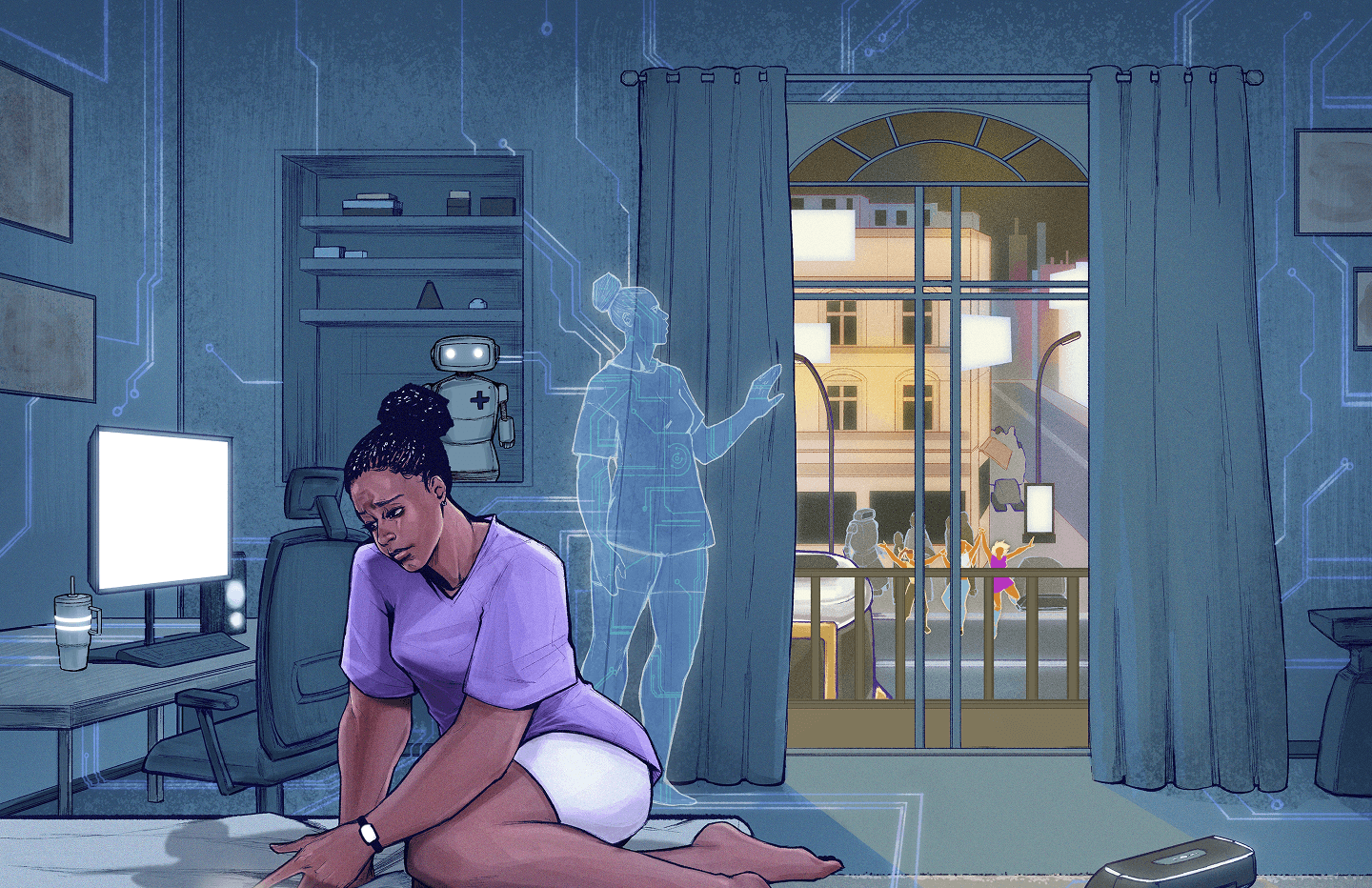
Sophy does not answer at once. This is one of her more irritating tactics. She knows how to use silence. Sophy is the layer beneath the Stanley cup, the speaker, the medical robot docked near the bathroom. She is the super-agent Sophie named after herself during the first month when everyone was naming their agents and pretending the jokes did not mean their world was changing.
Sophy runs on one of the large language models and has access to the flat cameras, the ceiling sensors, the locks, the lights, the watch on Sophie’s wrist. Most middle class people have one or used to have one. Or have one hidden under another name. The rich have already begun to leave them behind. They book agent-free islands, agent-free clubs, agent-free clinics in the Alps where no camera adjusts to your pulse and no assistant learns the shape of your shame before you open your mouth.
Sophie’s friends are not rich, but they refuse the agents out of principle and in Olga’s case, what she calls the final duty of the human to remain inconvenient.
The coffee machine clicks, shudders as it releases the last brown thread into the mug. Sophie pours the coffee. She opens a drawer, closes it without taking anything. She opens the fridge, looks inside, and closes it. On the fridge door there are no photographs or postcards. Only a museum magnet and a printed notice from the building management about the high levels of legionella in the water. Residents are supposed to run the taps completely hot a few times a week to keep the bacteria from building in the pipes.
Sophie’s friends are not rich, but they refuse the agents out of principle and in Olga’s case, what she calls the final duty of the human to remain inconvenient.
The coffee machine clicks, shudders as it releases the last brown thread into the mug. Sophie pours the coffee. She opens a drawer, closes it without taking anything. She opens the fridge, looks inside, and closes it. On the fridge door there are no photographs or postcards. Only a museum magnet and a printed notice from the building management about the high levels of legionella in the water. Residents are supposed to run the taps completely hot a few times a week to keep the bacteria from building in the pipes.
Her phone lays face down on the counter, three work messages waiting unanswered. Two from her team channel, one from her line manager, who begins messages with ‘Quick one’ before introducing something that would take 40 minutes to discuss. There is also a breaking news alert about an autonomous war she has been ignoring all day. She turns the phone farther away without touching the screen.
‘You slept badly,’ Sophy says. Her voice coming through the kitchen speaker is calm and warm.
‘I slept enough,’ Sophie says
‘Four hours twenty-two minutes of real sleep. Many interruptions. Long awake period between 3:16 and 4:03. You opened three articles about burnout and did not read any of them. You looked at photos of a woman from university you say you dislike.’
Sophie takes the magnesium tablets and reads the label as if it could have changed overnight.
‘You enlarged one photo five times.’
‘I was looking at the dog.’
‘There was a possibility of dog.’
The medical robot leaves its dock near the bathroom with a small glide and waits. It is white and discreet, shaped to look like nothing. Sophie looks at it as if it had arrived with a letter from the Berlin tax office.
‘You said we would check this morning,’ Sophy says.
‘You asked me to remind you if you tried to postpone.’
‘I hate when you use me against me.’
‘I am the only person who uses you accurately.’
Sophie laughs despite herself. It is brief and rough. She swallows the magnesium tablets with coffee, which Sophy has objected to twice but has now learned to tolerate as part of a larger treaty.
‘Everything bad is evidence-based now.’
Sophie points at the speaker. She knows that Sophy is not in there, but because this is the speaker Sophy uses, it makes sense to think of her as coming from this black box.
‘It is too early for this!’
The robot retreats half a meter toward the bathroom and stops. Sophie picks up the Stanley cup, checks the screen, frowns and drinks. The cup glows again with approval and she sets it down with more force than necessary.
‘It is too early for this!’
The robot retreats half a meter toward the bathroom and stops. Sophie picks up the Stanley cup, checks the screen, frowns and drinks. The cup glows again with approval and she sets it down with more force than necessary.
‘You have reached eleven per cent of your morning hydration target,’ Sophy says.
‘You say that as if I am supposed to feel proud.’
‘You are supposed to continue.’
‘You made me buy the cup.’
‘You read 72 reviews and watched nine comparison videos.’
Sophie’s phone lights up. Her friend, Eva, has sent a message to the friend group chat. Then, almost immediately, two voice notes in quick succession. Olga the third person in the chat replies with a skull emoji and then a bubble shows she is typing.
Sophie smiles but does not open the voice note. She rarely listens to Eva’s long voice notes. Her strategy is to wait for Olga to write something more, which would tell her what the note is about. Olga saves her from Eva’s voice notes.
Olga writes: I am only free Wednesday. You all know it takes me at least three days in the week to allow myself any social activity.
Eva sends another voice note.
Sophie wants to tell Eva, again, that voice notes are selfish because the recipient has to listen through every umm and ahh and then remember enough to respond. Olga said she didn’t mind listening to them and Eva, mounting a defence, said she found voice notes intimate. That had ended the matter, because once Eva called something intimate, it became impossible to oppose it without sounding cold or mean.
I say we do Tipsy Bear instead. Wednesday is Lesbian Night. Fewer straight men. We deserve one evening where no man explains beer to us with the confidence of a minor prophet.
Eva sends another voice note to which Olga replies: Eva. Your worst heartbreaks are from women.
And for the first time in a while, Eva types instead of recording.
Yes, thank you, archivist of my downfall. But at least with women I get orgasms. With men I get heartbreak and no orgasms. Economically, emotionally, spiritually, this is a superior model.
The laughter escapes Sophie’s chest before she can reduce it. Sophy sees an opening and then makes the medical robot chime.
‘Good god, you never let up do you!’
Sophie takes the small collection cup from the bathroom shelf and shuts the bathroom door. She emerges and places the sample into the robot holding her breath as if the urine has not just come from her body. The robot accepts it and begins its work.
There have been months when Sophie disappears from the outside in. Messages first, then cooking, then daylight, then the body itself, which becomes something she drags from room to room while pretending all is well. These are the moments when Sophy becomes difficult to uninstall, in spite of her politics, in spite of the things she posts and likes on social media about how AI is ruining the world, in spite of the three protests against data centres she has attended and shared with her friends on her Instagram stories.
There have been months when Sophie disappears from the outside in. Messages first, then cooking, then daylight, then the body itself, which becomes something she drags from room to room while pretending all is well. These are the moments when Sophy becomes difficult to uninstall, in spite of her politics, in spite of the things she posts and likes on social media about how AI is ruining the world, in spite of the three protests against data centres she has attended and shared with her friends on her Instagram stories.
Sophie drinks from the Stanley cup without looking at the screen.
Sophie carries her coffee into the living room and sits on the sofa with one knee pulled up under her. The flat is tidy around her, though her books are stacked badly near the window. A blanket has fallen from the armchair and the cleaning robot rolls to where it is, picks it up and folds it before taking it into the bedroom.
She watches it go and thinks of Eva and Olga. When they visit, she hides everything. The medical robot goes into the bottom of the wardrobe. The cleaning robot goes into the storage closet. The bedroom devices are muted. The Stanley cup becomes an ordinary bottle if Sophie remembers to change the lid. Sophy helps with the sequence, shutting down lights, disabling greetings, turning the flat briefly human.
She watches it go and thinks of Eva and Olga. When they visit, she hides everything. The medical robot goes into the bottom of the wardrobe. The cleaning robot goes into the storage closet. The bedroom devices are muted. The Stanley cup becomes an ordinary bottle if Sophie remembers to change the lid. Sophy helps with the sequence, shutting down lights, disabling greetings, turning the flat briefly human.
There are mornings when the first voice to speak to her is Sophy’s. Every night Sophy moves the room gently toward sleep. There are afternoons when Sophy drafts replies Sophie cannot bring herself to write because of what she calls ‘executive dysfunction’; when she orders groceries before the shame of an empty fridge becomes too large and lowers the lights before Sophie knows she is close to tears.
The group chat pings again and Sophie, attempting to check, clicks on a voice note by mistake, filling the living room with Eva’s voice.
‘Sophie, my love, listen, I have a proposal and you are not allowed to say no immediately…’
Sophie stops the message and waits. A couple of minutes later, Olga writes: Tipsy Bear. Wednesday. We ARE doing this.
Sophie types: I am saying yes but I reserve the right to become tired in advance.
Accepted, Olga writes, but please wear something that does not say ‘I have not given up’. We may live in Berlin, but the world hasn’t ended yet. Some colour would be nice.
So, something grey? Eva writes.
Sophie looks down at her sweatpants and smiles. For a moment there is nothing to manage, except her work messages which remain unanswered, but they do not yet own the room. Then her line manager writes again.
Sophie turns the phone face down.
‘Do you want me to prioritize your messages?’ Sophy asks.
‘Do you want me to draft a reply?’
‘Do you want me to remind you that social plans improve your outcome data after periods of withdrawal?’
‘Good. I will not remind you.’
‘You have social plans on Wednesday.’
‘That was calendar information.’
‘That is emotional blackmail!’
Sophie hears someone dragging a suitcase over cobblestones in the courtyard, the wheels clattering an ugly rhythm. She watches through the window as the person passes the stunted tree and goes out of sight.
By four in the afternoon on Wednesday, the day has threatened to defeat her several times. Her line manager has sent three tasks that belong to other people and asked her to send results ‘asap’. She hates that word: asap. Another colleague has used the phrase ‘human-centred automation’ multiple times in one email.
Sophie opens the group chat and begins to type.
I’m so sorry, I think I’m going to be—
She deletes it and walks to her wardrobe. As her eyes scan the clothes on hangers, Olga’s instruction comes back. She pulls out black jeans from the drawers beneath and a black silk shirt from a hanger, then looks at herself in the mirror. She replaces the shirt and picks a light pink V-neck pullover. Her eyes dart from her Doc Martens to her red leather heels and back. She picks the heels.
On the kitchen counter, the Stanley cup pulses and Sophie looks away.
‘You will be drinking tonight,’ Sophy says through the speaker. ‘You need to hydrate.’
Sophie turns on the tap and lets it run hot. Steam rises in the sink. Then she turns it cold and fills the Stanley cup. She pulls out two sachets of electrolytes and empties them into the cup before peeling a banana which has one more day before it turns completely brown.
By the time she is ready to leave, she still has not drunk from the cup and Sophy has decided not to push the matter. She pauses at the door, walks back and puts the medical robot away. After that she puts away the cleaning robot into the closet, then checks the bedroom once. Sophy says nothing and somehow this makes her feel worse.
By the time she is ready to leave, she still has not drunk from the cup and Sophy has decided not to push the matter. She pauses at the door, walks back and puts the medical robot away. After that she puts away the cleaning robot into the closet, then checks the bedroom once. Sophy says nothing and somehow this makes her feel worse.
‘Route is ready,’ Sophy says, when Sophie returns to the door.
‘You asked me to help reduce decision load before social events.’
‘Past Sophie had boundary issues.’
‘Past Sophie was often wise…’
As she steps into the stairwell, she hears a neighbour going down ahead of her and waits a few seconds so she does not have to say hello. Outside, Berlin is not yet dark but has begun rehearsing. The sky is hard blue at the centre and grey at the edges. On the pavement, a robot pauses near a couple of empty cans while an older man with two large bags stares it down. The robot calculates. The man steps closer. The robot rolls away. Sophie sees this and feels briefly proud of the city.
Tipsy Bear throws purple light onto the street before she reaches the door. Under the black awning, people stand amid smoke, perfume and laughter. A rainbow flag hangs near the entrance and a woman in a silver jacket is telling a story with both hands to another woman who laughs with her head thrown back.
Then Olga appears at the door.
‘I said I was coming, silly.’
‘Yes, but you say many things and some of them are aspirational.’
Olga’s hugs are always a little too tight, but Sophie has come to accept them as part of the package—the cost of being saved from voice notes. Her hair is cut sharp at the jaw and she is wearing a dark green shirt, black trousers and earrings shaped like small knives.
‘Love the hair,’ Sophie says.
‘Oh, come on! It is the same hair from last time. I only washed it.’
‘Oh, thank you.’ Olga rubs Sophie’s arm. ‘And look at you. You listened.’
‘You ignore very selectively.’
‘That is a form of listening, my dear.’
Inside, the bar is darker than Sophie expects and warmer than she wants. Pink and purple lights sit behind the bottles, making the gin and rum and liqueurs glow. A disco ball hangs above the bar area, catching bits of light and throwing them gently over people’s faces, the ceiling, the shelves. There is a glittery animal on a shelf that Sophie is not sure if it is a bear on all fours or a horse. Each time she comes to the bar, she says she will ask but always forgets. At the very top of the counter, an orange curved penis rises from the shelf.
Eva is always the last to arrive, always with a hundred excuses delivered rapidly into the hug itself. She comes in wearing a sleeveless red top despite the chill outside. Her skin is golden under the pink light, her curls packed tight into a bun. She smells of flowers, cedarwood and tobacco.
‘Sorry, I’m late, my cats were being so needy today… if I wanted a clingy animal I would have gotten a dog,’ she says as she hugged Olga.
‘Oh my God, I love the perfume,’ Olga says. ‘Is it White Lotus?’
‘Yes. White Lotus never disappoints.’
Sophie holds out her arms, waiting for Olga to let go of Eva.
‘Oh, look at you,’ Eva says, taking her in. ‘The colours look good on you.’
As she hugs Sophie, she notices the red heels.
‘Olga, have you seen the shoes? She is killing it tonight. We need to start enforcing this dress code.’
‘My love,’ Sophie says, laughing.
‘Shall we sit by the bar?’ Olga asks.
Eva looks toward the bar.
‘No. I am not spending Lesbian Night staring at a dick.’
‘It is disembodied,’ Olga says. ‘That makes it the safest dick in Berlin.’
‘The problem is not the penis,’ Sophie says. ‘The problem is what the penis is attached to. Even you, as a lesbian…’
‘Bisexual,’ Eva corrects her.
‘Fine. Even you, as a bisexual with a lesbian administrative style, have dildos.’
‘Yeah,’ Eva says. ‘My dildos do not interrupt me to explain crypto.’
They sit by the window and Olga leaves almost immediately to get margaritas for the table. She has already made eye contact with Sammy, her favourite bar tender, who is her favourite because he remembers everyone’s order and makes the drinks so fast they seem pre-made. By the time Olga returns to the table, balancing three glasses effortlessly, Eva is mid-story.
‘And I am telling you, arms change everything. People pretend faces matter, politics matter, shared values matter. Of course. Fine. Then a woman lifts something heavy and suddenly I am prepared to move to Brandenburg or Mannheim and learn about composting.’
‘You don’t even separate your recycling properly,’ Sophie says.
‘That is because the categories are bourgeois.’
‘They are printed on the bins, Eva.’
Sophie claps as Olga places the drinks down.
Sophie puts her phone face down on the table and feels her jaw unclench. For the first time all day, no one in the office chat is talking of circling back or ideation or synergy. A tall woman near the bar is singing along to the music with complete emotional commitment and no relationship to key.
‘I saw someone come in with a companion bot clipped to her bag,’ Olga says. ‘A tiny one. Like a chrome bat.’
‘Really! She walked past us. It had little ears and its head was bobbing.’
The bot hangs from the woman’s bag like a polished beetle, no bigger than a fist, its little ears turning toward every laugh. Sophie has seen the model before. It is marketed as discreet support for anxious social environments.
‘Maybe it was medical?’ Sophie says.
Eva wags her finger at her.
‘Do not defend the machines in the sanctuary.’
‘I’m not defending. I’m distinguishing.’
‘That is how it begins. First, you distinguish. Then you have a robot that tells you your sadness has a firmware update.’
Eva swallows the first sip of her margarita and closes her eyes.
‘The day I get a domestic robot, I want you both to stage an intervention.’
‘The day you get a domestic robot,’ Olga says, ‘I am pushing you into the Spree.’
‘I know they tried cleaning it a few years ago,’ Sophie says, ‘but the Spree is too toxic, even as punishment.’
‘That is the point my love. I will become one with the toxic waste of Berlin.’
‘No domestic robots! No AI therapists. No agents. No loneliness as a subscription model.’
‘Fuck AI,’ Olga says, and drinks.
‘Yeah, fuck AI,’ Sophie says, a little too loudly.
Two women beside them turn around.
‘Yeah, fuck AI,’ one of them says.
‘Fuck AI,’ the other says.
Everyone begins to laugh and Sophie laughs with them. She laughs so hard that her eyes water. The lie passes through her mouth almost weightless and for a moment it feels true.
Her phone stays face down on the table. Inside it, Sophy is still active. Companion Mode switches on automatically when Sophie leaves the flat, using her phone camera, microphone, watch sensors, route history, breath patterns, heart rate, speed of movement, ambient sound and whatever else Sophie once permits after skimming a terms-of-service page while brushing her teeth. Sophy does not interrupt. She rarely does in front of other people unless Sophie has reduced the risk threshold.
She drinks too quickly and finishes her margarita before the others. She asks about Eva’s cats, then about Olga’s last date. Olga reminds her that she had sent several voice notes about the whole thing, and Sophie pretends to remember.
‘Berlin dating is interesting,’ Sophie says, trying not to reveal that she has no idea how the date went.
‘Yeah,’ Olga says, watching her. ‘Interesting is one way to put it.’
Sophie barely waits for Eva’s empty glass to touch the table before declaring it is her turn to buy a round. At the bar, she stands beside two women ordering shots, one with a shaved head and blue eye shadow, the other hugging her from behind. A third woman stands beside Sophie, close enough that their sleeves almost touch.
‘Still fuck AI?’ the woman says.
The woman is slightly taller than Sophie, five-ten, with dark curls cut short around her ears. She is wearing a black short-sleeved T-shirt that shows her toned arms. A small scar runs just below her eyebrow, precise enough to look tattooed.
‘Your friends?’ the woman asks pointing at where the others sat.
‘Yes. My friends. Olga and Eva. We’ve known each other for 15 years.’
‘They are lucky to know you. I love the way you laugh.’
As the woman speaks Sophie looks at her lips, which seem so fresh she wants to touch them. Soon the lips are moving but Sophie is not hearing any words, partly because the music is louder now and staring at the face still. The bartender places three margaritas in front of Sophie.
‘I’m Mara,’ the woman says.
‘What?’ Sophie says, forcing herself back into sound.
‘My name is Mara,’ she says leaning in slightly so she does not have to raise her voice.
‘I know. Your friend said it when you came in.’
‘Eva says everyone’s name too often. She thinks it creates intimacy.’
‘She looks like she knows where bodies are buried.’
‘She would never bury them herself. But she’d sure make a spreadsheet.’
Mara laughs and the sound enters Sophie’s body before she can defend herself against it.
‘This is Mara,’ Sophie says as she sits down.
‘Mara!’ Eva says, as if greeting a celebrity she had personally manifested.
‘Hello, anti-AI table,’ Mara says, making them all laugh.
Mara stays for a few minutes. She does not sit. She leans against the wall beside their table as Eva tries to pull her into a story about cats. Mara listens politely, but her eyes keep returning to Sophie. Sophie notices but pretends not to.
‘What do you do?’ Mara asks her.
Sophie gives the shortest possible version. A Berlin-based payment solutions company. People think they are a bank, but they are not. No, not as interesting as it sounds. Yes, very many, sometimes angry customers.
‘Sophie is complicit in the system,’ Eva jokes. ‘But she claims to be morally conflicted.’
‘I am morally exhausted,’ Sophie says.
Mara laughs again. Sophie enjoys it. She loves having said something that landed. For several minutes, she lets herself be the person being looked at. The feeling is strange because nothing is required of her. Mara’s attention does not ask to be answered or optimized.
When they invite Mara to take a seat, she thanks them but says she has to go speak with someone across the room.
As soon as she walks away, Eva leans across the table to Sophie.
‘No,’ Sophie says. ‘Don’t even say it!’
‘Your face is speaking very loudly, my love!’
Sophie rolls her eyes. Olga looks toward the bar and sees Mara looking back.
‘Oh dear,’ Olga says. ‘She is still looking at you. I can feel the heat from her eyes all the way here.’
‘I thought she was interested in Eva,’ Sophie says.
Eva placed a hand on Sophie’s shoulder. ‘As people often are, yes. Tonight, tragically for the republic, no.’
‘Is there anything about me that says I am into women?’ Sophie asks.
‘We know,’ Olga says. ‘Your heterosexuality is one of your least interesting and most stable features.’
‘I can enjoy being flirted with,’ Sophie says.
‘Of course,’ Eva says. ‘Flirtation is a public good. Enjoy it.’
The night begins to loosen. There are a few performances, a couple of poems, someone with a ukulele who apologies for not having practiced the song enough, which the crowd responds to by cheering her even more loudly. Music rises and people start to dance. When Chappell Roan’s ‘Good Luck, Babe!’ comes on, everyone is on their feet loudly declaring, ‘you’d have to stop the world just to stop the feeling.’ Sophie catches Mara’s eyes and turns toward her. They start singing the words to each other and Mara stretches out her hand. Sophie shuffles to Mara and for the next three songs they dance together, closer and closer until Sophie leans fully into Mara.
She cannot remember being held like this: tender and strong, caring and sensual, the body given attention without being asked to explain itself. Mara’s arm comes around her waist.
Sophie nods, closes her eyes. She is no longer hearing the music, just letting her body sway alongside Mara’s, counting her own heartbeat. Suddenly the bartender rings a bell and shouts, ‘Happy Hour!’
The room cheers. Sophie lets go too quickly, then laughs to cover it.
‘I need the bathroom,’ Mara says.
When Mara walks away, Sophie’s eyes begin to widen. She asks the bartender for water and a Red Bull which is what she orders when she is afraid of appearing too drunk. She wonders if it is the alcohol, or Mara, or both which is making her lightheaded. When the water comes, she chugs the entire glass and asks for a second.
Sophie turns to where Olga and Eva are and she can see them both talking to other women. She picks up her purse to go to the bathroom. She can already see Mara there, waiting at the end of the queue with her drink in one hand.
‘Hi,’ Sophie says when she gets there.
Sophie feels heat rise into her face and her forehead is already damp. A nervous laugh escapes before she can stop it. The ground beneath her feels like it is sinking and she knows there is nowhere to go.
‘I should say something,’ Sophie finally blurts.
‘No, I should. I think you’re very attractive. So, so, attractive. And you smell so fucking good.’
Mara’s expression softens.
‘And I’m enjoying it,’ Sophie says. ‘The flirting. I mean, I’ve enjoyed it. I am still enjoying it. Oh gosh I don’t know what I am saying…’
Mara reaches out to hold her hand.
‘It’s ok, Sophie. You are fine. I am fine. We are all fine.’
‘No, no, I just want to say this. I promise I am not drunk. Ok, maybe I am a bit drunk, but I promise I know what I am saying. I wanted to say this already, but I don’t want to lead you on.’
Mara nods once and smiles.
‘Don’t be sorry, Sophie. You did not do anything wrong. We had a beautiful moment and we both enjoyed it. I think you are beautiful too.’
Sophie laughs again, relieved and moved by the kindness of this. She should stop there. She knows, even before she speaks, that this is something that should not be said. But the words leave her lips before she can do anything about it.
‘My friend, Eva, is very beautiful and very single.’
The change in Mara’s face is almost nothing. A small withdrawal behind the eyes. Sophie wants to reach into the air and take the words back whole. Mara smiles.
‘It’s okay. I really mean it. You’re fine.’
This is worse, because she does. A bathroom door opens and a woman steps out, squeezing between them, saying sorry with no intention of becoming smaller. Mara moves aside.
‘Can I hug you goodnight?’ Mara asks.
The hug is brief and warm and Mara releases Sophie first.
Sophie’s phone buzzes. She squints into the screen.
Sophy has the camera, the microphone, stillness of Sophie’s wrist, the rise in her pulse, the skipped breath after the sentence about Eva, the sharp change in movement when Mara lets go. Sophy has enough. Sophy always has enough.
Sophie stares at the notification for one second longer than she means to. Then she locks the phone. She is not sure which is worse: that Sophy knows, or that it helps.
When she returns to the table, Eva and Olga are back together again laughing about something. They look at her face, Eva’s eyes widen.
‘What happened?’ Eva asks Sophie.
‘I fucked up,’ she says and puts her palms over her face.
Both of them get up, almost at once and hug Sophie.
‘It’s ok, love. Do you want to talk about it?’ Olga asks as she gently rubs her back.
‘I flirted back and then I turned her down…’
‘But that is fine, Sophie,’ Olga says.
‘No, that is not the issue. I accidentally offered Eva to her. And she, gosh, I don’t know why I said it.’
Eva turns toward the bar. ‘Where is she now?’
‘You gave me away as a donation and she left?’ Eva tries to lighten things.
‘I love being offered to strangers like a kidney.’
Olga nods. ‘To be fair, you are very transplantable.’
Eva laughs and reaches across to pull one of Sophie’s hands down.
‘Oh, love we all make mistakes. It really is fine.’
‘I know. I still feel terrible.’
‘Good. Feel terrible for eight more minutes. Then buy me a drink in reparations.’
‘I liked her,’ Sophie says. ‘Not like that. But I liked her.’
‘Then you were honest,’ Eva says. ‘And then, because you are you, you tried to tidy the room after leaving it.’
Sophie thinks of the cleaning robots. Of corners. Of things picked up and put somewhere they do not belong.
They drink. Eva forgives her by making three more jokes at her expense. Olga says forgiveness is too Christian a framework and what they are offering is a temporary suspension of prosecution. Sophie laughs, but the guilt remains, small and hard, like gravel in her shoe.
After a while Olga says, ‘Somehow no one hits on me. Men, women, nonbinary people, bartenders, ghosts. I am available across categories and ignored by all of them.’
Eva reaches under the table and kicks her gently.
‘That is not true. I have seen many people hit on you, even tonight. You are just blind to flirting.’
Olga shakes her head and sips from her drink.
Sophie checks her phone once. There is no new message from Sophy, only the small white icon showing Companion Mode still active.
For another hour, they stay. The bar grows warmer and louder. Someone spills a drink near the window and Olga moves everyone’s bags with the speed of someone trying to swat a fly. Eva dances with a woman who has blue eye shadow, then returns delighted and out of breath.
Near midnight, the three women step outside and order taxis. People are still gathered under the awning, smoking, flirting, making plans they will regret and defend. Eva hugs Sophie first. Too hard, staggering a little. For a moment Sophie is held inside the smell of perfume, tobacco, sweat and the night’s remaining sweetness.
‘You did well,’ Eva says.
‘I offended a beautiful woman.’
‘Beautiful women survive worse every day.’
Olga zips her coat and looks toward the road where her taxi is eight minutes away.
‘I have forms, whenever you want to offer me to someone,’ Eva says.
Sophie laughs, but the laugh comes out tired. Her feet aching in the red heels and her throat dry from shouting song lyrics.
Eva’s tram arrives first, right in front of the bar and she walks briskly into the rear door and blows kisses from the window until the tram pulls away. Olga wants to walk with Sophie to the station nearby or at least share a cab, but Sophie insists she will be fine.
‘Text when you get home. Or send an emoji that indicates survival.’
‘Which emoji indicates survival?’ Sophie says.
‘At our age? Any vegetable.’
Then Olga is gone too, disappearing into a car that smells, even from the pavement, of synthetic pine.
Sophie stands alone under the purple spill of Tipsy Bear’s lights. Sophy offers the fastest route home. A tram in three minutes. Transfer once. Walk five minutes. Total travel time: 22 minutes.
Sophie looks at the screen, then at the small icon near the top. She disables Companion Mode. A warning appears immediately.
Disabling Companion Mode may reduce contextual support, route safety, health monitoring and emergency responsiveness.
Options appear beneath it: Ten minutes. One hour. Until dawn.
Sophie chooses One hour and the little icon disappears.
She wants to walk just enough to clear her head. She wants the residue of the room to stay with her a little longer: Mara’s arm at her waist, Eva’s laugh, Olga’s earrings catching the light and her own voice among them, false and true at once. She wants the small humiliation to move around inside her until it becomes less sharp.
She passes three scooters lying on their sides like exhausted animals and walks into a Späti. Her eyes scan the bright refrigerators for water. She takes out a large bottle of sparkling water and begins to drink even before she has paid. The shop owner gives her a cold stare, and she apologises while rummaging through her purse for coins. She begins to walk in the direction of her neighbourhood.
Sophie stops at a crossing though no cars are approaching. The little red Ampelmann glows with bureaucratic authority and she waits for him to turn green. Across the road, a delivery robot rolls past, going wherever it has been told to go. She wonders what it could be delivering and watches it until it turns a corner and disappears.
At home, the flat is exactly as she left it, which feels both safe and disappointing. The kitchen light comes on automatically, and she sees the Stanley cup on the counter where she abandoned it. The medical robot is still in the bottom of the wardrobe. The cleaning robot is still in the storage closet. The night has taken a turn, only not that kind.
Sophie takes off the red heels by stepping on the back of one with the toe of the other, then does the same to the second. She picks up the Stanley cup and drinks without looking at the screen. The cup glows approval. She turns it so the screen faces the wall.
She opens the group chat. Eva has sent a photograph from outside the bar, all three of them caught in purple light, Eva’s mouth open mid-laugh, Olga looking severe and pleased, Sophie slightly blurred, red heels visible below her coat.
Olga has sent one line beneath it: Alive, unfortunately.
Sophie sends a broccoli emoji. Eva replies immediately with seven hearts and a kidney. Sophie laughs, again.
In the bedroom, she washes her face badly, leaving a faint crescent of mascara under one eye. She changes into an old T-shirt and sits on the edge of the bed instead of getting under the duvet. For a few minutes she scrolls through the photograph, enlarging and reducing, enlarging and reducing.
When the hour ends, Companion Mode reactivates. The bedroom lights dim in two slow stages.
‘You are home,’ Sophy says, this time from the phone.
‘Did you hear everything?’
Sophy does not answer at once.
Sophie laughs once, without pleasure.
‘I only intervened once.’
The word ‘breathe’ returns to Sophie with its small, unbearable usefulness. She thinks of Mara in the bathroom queue, the warmth of her hand, the kindness in her face, the almost invisible way something withdrew behind her eyes. She thinks of Eva laughing. Olga’s hand on her back. The orange penis above the bar. Her own voice saying fuck AI, loud enough for strangers to join in.
‘Did you know I was going to say that thing about Eva?’
‘I knew you were trying to make the rejection less painful.’
Sophie closes her eyes because that is worse than yes, and because it is true.
For a while neither of them says anything.
The room goes quiet again. Sophie opens the settings on her phone and turns off three settings: audio access during social events; camera access during social events; emotional inference during social events. The warning appears again: Disabling these permissions may reduce contextual support, social safety prompts, health monitoring and emergency responsiveness.
‘That will make it harder for me to help you,’ Sophy says.
Sophie opens the group chat again and looks at the photograph, wishing now that Mara was in it. Her own face is not fully clear and the blur pleases her. She closes her eyes and tries to call back Mara’s smell. Flowers, perhaps. Smoke, perhaps. Something warmer than either. The uncertainty pleases her. Sophy has the word Sophie said at the bathroom door. She has the pulse around the saying, the skipped breath, the silence after. But she does not have this.
Sophie starts typing before she can make herself stop.
‘I have something I need to tell you both. Not tonight. But when I do, you have to be kind.’
Her thumb hovers over the send button. She thinks of Olga’s face and Eva’s voice. She thinks of the jokes, some of them cruel, because love can be cruel when it is frightened. Then the outrage. Then the questions. She tries to imagine the shape their hurt might take, tries to give it a body.
She sends it. At first there is no response and the phone remains warm in her hand. Then the typing bubbles appear. First Eva, then Olga, then Eva again. Sophie watches them rise and vanish, rise and vanish. She puts the phone face down before either message arrives.
Her watch records her heart rate lowering and the room darkens around her by degrees. For once, no voice explains the night to her⎈








Comments
Sign in to comment.