

Our new print issue, Africa’s Hustle Republics, is here! Subscribe for less than ₦1K/$1 a week for full access.
Feb 23, 2017
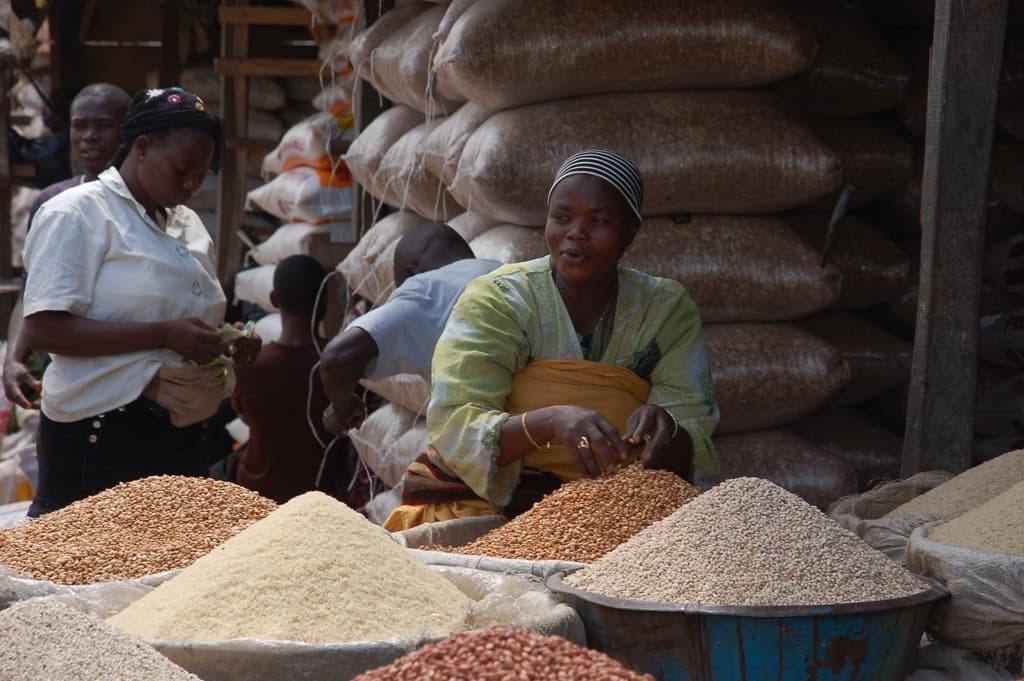
Women buying and selling cowpeas at Bodija Market, Ibadan.ADEBAYO O./IITA
A growing body of evidence points to the recognition that empowering women economically is essential not only for women to realise the full range of their rights and freedoms, but also for economic growth and poverty reduction in society as a whole. Indeed, as the argument goes, empowering women is smart business—or to be specific it is ‘smart economics’. It spurs economic growth, leading to an increase in a country’s GDP. This rhetoric has led to the rise of women’s economic empowerment programmes and policies the world over that aim to promote women’s participation in the labour market as well as their ability to make and act on decisions and control resources such as income.
Women’s economic empowerment is so high on the global socio-economic agenda that in 2016, the UN Secretary-General announced the first ever High-Level Panel (HLP) on women’s economic empowerment in order to “provide thought leadership and mobilise concrete actions aimed at closing economic gender gaps that persist around the world.” In September of 2016, the UN HLP launched its first report on women’s economic empowerment outlining key drivers—seven to be exact—needed to advance gender equality.
The African continent has not been left behind in these discussions around the economic sense behind empowering women. The incidence of gender gaps in the labour market is estimated to have cost Niger’s economy 23 per cent of its GDP, Burkina Faso 13 per cent of its GDP and Côte d’Ivoire, Mali and Senegal nearly 10 per cent of their respective national incomes. Many African women—like their counterparts in other parts of the world—also experience gender discrimination in a number of areas, thereby limiting their opportunities to be economically empowered. This includes a lack of access to land, educational opportunities, credit coupled with restrictive formal and informal laws that hinder female labour force participation, highly segmented labour markers and gender wage gaps, and women’s disproportionate responsibility for unpaid work and care in their homes and communities.
Recognising the need to address gender gaps in women’s access to economic opportunities, markets, goods and services, the African Union (AU) launched, in 2010, the African Women’s Decade (2010-2020) and the Fund for African Women to accelerate the implementation of all commitments on gender equality and women’s empowerment on the continent. This was followed with the AU’s declaration in 2015 that it was the “Year of Women’s Empowerment and Development towards Africa’s Agenda 2063.” 2015 also saw the development of the African Development Bank’s (AfDB) first-ever Gender Equality Index for Africa. The index, ‘Empowering African Women: An Agenda for Action’, covers 52 of Africa’s 54 countries and discusses three dimensions of gender equality: economic empowerment, human development, and laws and institutions.
With the growing interest in women’s economic empowerment, there has also been increasing support for women’s entrepreneurship—particularly in developing countries—as a way to ensure women are economically empowered. Yet, there are obstacles that both women-owned enterprises (WOEs) and women entrepreneurs face. Recognising, reducing and redistributing women’s unpaid work and care are but some of the areas that can play a transformative role in addressing these barriers.
The Republic is a Nigerian media-tech company dedicated to explaining our time—through deeply reported journalism on power, culture and society.
Focused consumption without interruptions.
Years of reporting at your fingertips.
Long-form journalism that matters.
Create a free account to continue reading this month and access more of our work.
About the Author
is an independent consultant and researcher with extensive experience in gender and social inclusion. She is currently an Africa Fellow at the World Bank Group; the founder and editor of the African literary blog, bookshy; the curator of ABC—a visual showcase of African Book Covers; and one-third of the literary podcast, Not Another Book Podcast.




Comments
Sign in to comment.