

Our new print issue, Africa’s Hustle Republics, is here! Subscribe for less than ₦1K/$1 a week for full access.
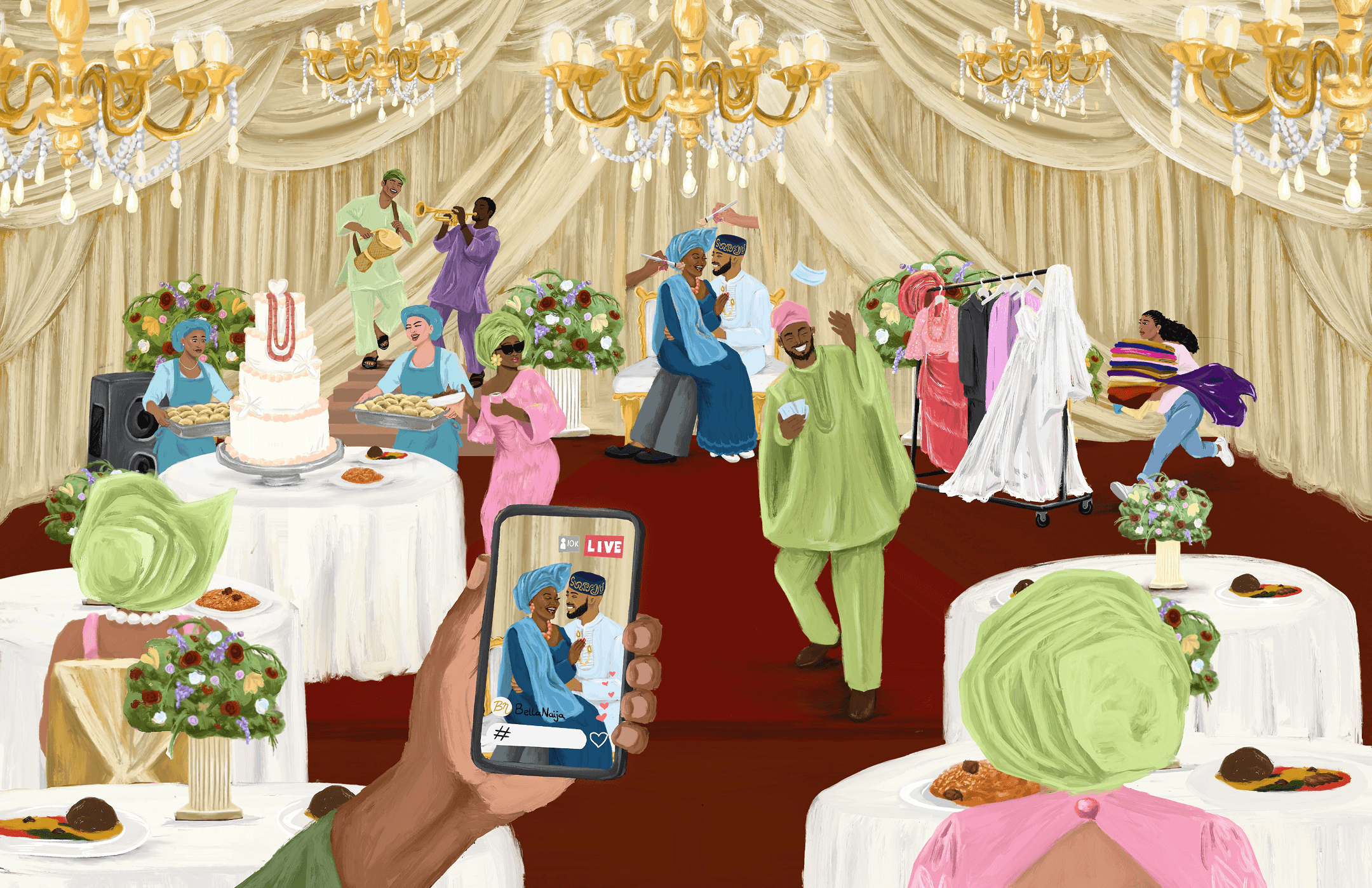
In recent years, Lagos weddings have become spectacles, in scope, in scale, in animation and in sheer grandeur. Despite Nigeria’s economic instability, the wedding industry, especially in the country’s economic hub, continues to flourish, revealing a complex ecosystem driven by social expectations, cultural pride and rising consumerism.
LISTEN TO THIS ARTICLE

Take professional gele stylists for example; people who make a living solely off tying our traditional headgear into the most beautifully complicated of structures. Content creators, separate from the main videography team, are now staples too, documenting moments specifically for Instagram and TikTok. Additionally, a typical Yoruba wedding engagement has two compères: an Alágà Ìdúró to represent the groom’s family and an Alágà Ìjòkó to represent the bride’s.

Take professional gele stylists for example; people who make a living solely off tying our traditional headgear into the most beautifully complicated of structures. Content creators, separate from the main videography team, are now staples too, documenting moments specifically for Instagram and TikTok. Additionally, a typical Yoruba wedding engagement has two compères: an Alágà Ìdúró to represent the groom’s family and an Alágà Ìjòkó to represent the bride’s.

With over 300 ethnic groups in the country, it is hard to define a single Nigerian wedding culture; however, Nigerian weddings generally follow the same pattern. Our weddings commemorate the union of two families, rather than just two individuals, and such a monumental union can hardly be fulfilled in one day. The process typically starts with the introduction ceremony, during which the groom, along with his family, visits the bride’s family to express his intentions of marriage. What follows is the traditional wedding where various traditional rites that officially mark the joining are performed. The groom and his family also present a bounty of gifts to his bride’s family in appreciation of them giving away their daughter’s hand in marriage. Gifts, often symbolic, range from jewellery, fabrics, food items and livestock to palm wine.
With over 300 ethnic groups in the country, it is hard to define a single Nigerian wedding culture; however, Nigerian weddings generally follow the same pattern. Our weddings commemorate the union of two families, rather than just two individuals, and such a monumental union can hardly be fulfilled in one day. The process typically starts with the introduction ceremony, during which the groom, along with his family, visits the bride’s family to express his intentions of marriage. What follows is the traditional wedding where various traditional rites that officially mark the joining are performed. The groom and his family also present a bounty of gifts to his bride’s family in appreciation of them giving away their daughter’s hand in marriage. Gifts, often symbolic, range from jewellery, fabrics, food items and livestock to palm wine.

Nigerian weddings have historically been colourful occasions to flaunt cultural wealth. However, some would argue that they did not become avenues to brandish material wealth until the 2010s—at least for middle-class Lagosians. Before then, such flamboyance was reserved for the true crème de la crème of society. As far back as 1989, an article excerpt from Newbreed magazine read, ‘Wedding ceremonies for the rich and famous have always been occasions for a show of glitter.’

Nigerian weddings have historically been colourful occasions to flaunt cultural wealth. However, some would argue that they did not become avenues to brandish material wealth until the 2010s—at least for middle-class Lagosians. Before then, such flamboyance was reserved for the true crème de la crème of society. As far back as 1989, an article excerpt from Newbreed magazine read, ‘Wedding ceremonies for the rich and famous have always been occasions for a show of glitter.’

Tosan Jemide, a veteran luxury baker now based in Australia, was one of the vendors who heralded this boom. When Jemide returned from the United Kingdom to launch Cakes by Tosan in 2000, there wasn’t much buzz around wedding cakes. By the 2010s, however, the tides had turned and Jemide could easily charge millions to craft a multi-tier luxury wedding cake. ‘I would say very authoritatively that my entrance into the cake industry added some prestige to baking as a career path,’ Jemide proudly told me in a Zoom interview.

Tosan Jemide, a veteran luxury baker now based in Australia, was one of the vendors who heralded this boom. When Jemide returned from the United Kingdom to launch Cakes by Tosan in 2000, there wasn’t much buzz around wedding cakes. By the 2010s, however, the tides had turned and Jemide could easily charge millions to craft a multi-tier luxury wedding cake. ‘I would say very authoritatively that my entrance into the cake industry added some prestige to baking as a career path,’ Jemide proudly told me in a Zoom interview.

It has also spurred the creation of whole new careers, like bridal styling and gele styling, and the flourishing of existing ones like photography and bridal design. Temitope Kayode-Ojo, founder of LAVISH, was among Nigeria’s first bridal stylists. She moved to Lagos in 2017, leaving behind a thriving finance career at Morgan Stanley in the United States, to launch a business that was largely unheard of. ‘When we started, we had to do a lot of education because people just did not understand why they needed to pay for something they thought their aunty or sister could do. Then people would offer to pay ₦50,000 because they didn’t attach that much value to the service,’ Kayode-Ojo narrated. Now, in 2026, bridal stylists in Nigeria can charge up to millions of naira, although Kayode-Ojo believes this does not necessarily translate to much international value, considering the devaluation of the naira.

It has also spurred the creation of whole new careers, like bridal styling and gele styling, and the flourishing of existing ones like photography and bridal design. Temitope Kayode-Ojo, founder of LAVISH, was among Nigeria’s first bridal stylists. She moved to Lagos in 2017, leaving behind a thriving finance career at Morgan Stanley in the United States, to launch a business that was largely unheard of. ‘When we started, we had to do a lot of education because people just did not understand why they needed to pay for something they thought their aunty or sister could do. Then people would offer to pay ₦50,000 because they didn’t attach that much value to the service,’ Kayode-Ojo narrated. Now, in 2026, bridal stylists in Nigeria can charge up to millions of naira, although Kayode-Ojo believes this does not necessarily translate to much international value, considering the devaluation of the naira.
We have four types of vendors in the Nigerian industry. We have the high-end vendors that you could liken to designer brands like Versace and Chanel. Then we have the mid-level vendors, which I would liken to Zara and River Island. Then we have the China-grade. Don’t forget that even the high-end and mid-level are still produced in China, but we have the low-quality China that they dump here in Nigeria. With them, it’s always a trial and error. Then at the very bottom, we have the Aba-made. For the very obvious things like the decor, the photography and your looks, the likes of Zara and Versace can suffice. Then for the elements that are less obvious, I can call on the China-grade vendors.
You may want to prioritize feeding over photography, maybe because you know the kind of criticism that comes with insufficient food. However, the only thing you’ll be left with after your wedding is the pictures and the memories. So, invest in your photography and videography, your makeup, your decoration and your outfit. Every other thing is secondary.

One striking thing about the Lagos wedding industry is how women dominate it at nearly every price point. Deola Ade-Ojo, more popularly known by her design name Deola Sagoe, has built a decades-long career, commanding premium rates for bridal couture. Representing the newer generation is Victoria James, known professionally as ‘VeeKee James’, whose signature bridal designs, costing millions of naira, have become aspirational for many Nigerian brides today. Additionally, event planners like Funke Bucknor-Obruthe of Zapphaire Events operate at the highest tiers, managing budgets that exceed ₦100 million—a fact she disclosed during a 2022 interview on TV show Off Air with Gbemi and Toolz. In this industry, unlike many others in Nigeria, women’s expertise is not only respected but also handsomely rewarded.

One striking thing about the Lagos wedding industry is how women dominate it at nearly every price point. Deola Ade-Ojo, more popularly known by her design name Deola Sagoe, has built a decades-long career, commanding premium rates for bridal couture. Representing the newer generation is Victoria James, known professionally as ‘VeeKee James’, whose signature bridal designs, costing millions of naira, have become aspirational for many Nigerian brides today. Additionally, event planners like Funke Bucknor-Obruthe of Zapphaire Events operate at the highest tiers, managing budgets that exceed ₦100 million—a fact she disclosed during a 2022 interview on TV show Off Air with Gbemi and Toolz. In this industry, unlike many others in Nigeria, women’s expertise is not only respected but also handsomely rewarded.

The wedding industry has continued to bloom, and BellaNaija, a premier entertainment and lifestyle blog founded in 2006, has been there to capture it all. Before the blog launched its wedding outfit BellaNaija Weddings circa 2013, there had been several popular wedding magazines like Ovation in the 1990s and WED magazine in the early 2010s. However, with the advent of social media, what people were really seeking was the convenience of swiping their phone screens for information, an offering BellaNaija Weddings was primed to give. It was a symbiotic relationship of sorts; as the wedding industry grew, BellaNaija Weddings focused its lens to capture this growth, and the blog became a household name that gave wedding vendors more visibility. According to Osas Okonyon, head of weddings at BellaNaija, vendors (especially those in their vendor programme) often ‘trace key inflexion points in their careers to being featured on the platform’. With over five million followers on Instagram, BellaNaija Weddings has become a one-stop directory for all things weddings for Nigerians at home and across the globe. As Okonyon told me:

The wedding industry has continued to bloom, and BellaNaija, a premier entertainment and lifestyle blog founded in 2006, has been there to capture it all. Before the blog launched its wedding outfit BellaNaija Weddings circa 2013, there had been several popular wedding magazines like Ovation in the 1990s and WED magazine in the early 2010s. However, with the advent of social media, what people were really seeking was the convenience of swiping their phone screens for information, an offering BellaNaija Weddings was primed to give. It was a symbiotic relationship of sorts; as the wedding industry grew, BellaNaija Weddings focused its lens to capture this growth, and the blog became a household name that gave wedding vendors more visibility. According to Osas Okonyon, head of weddings at BellaNaija, vendors (especially those in their vendor programme) often ‘trace key inflexion points in their careers to being featured on the platform’. With over five million followers on Instagram, BellaNaija Weddings has become a one-stop directory for all things weddings for Nigerians at home and across the globe. As Okonyon told me:
Couples use BellaNaija Weddings to imagine what their weddings could look like, and vendors use it to define standards for craft, storytelling, and service. In that sense, our role goes beyond documenting culture; we’re actively participating in the construction of contemporary Nigerian wedding culture, especially for a generation navigating tradition, modernity, diaspora influences, and digital identity.
When I made the song, I had a very strong feeling that it would be a wedding staple, but it didn’t get the traction for a while. Then in 2023, makeup artists started using the song for their content and it started being used in weddings. Later that year, bookings started coming and they haven’t stopped. Now, I’m one of the most sought-after wedding performers in Nigeria.
When we started [in 2017], there was heavy presence of platforms like BellaNaija; brides were hooked on that as they used it for inspiration. But I don’t think anybody anticipated how much social media has now taken over weddings in Nigeria. It has now become a case of how your wedding shows up online is how it was in person. If it looks amazing online, then it must have been amazing in person. And if your wedding didn’t look great online, then, maybe in person it was like that too.

As Nigerians, we pride ourselves in being a communal people and while this can be a great thing because it means we care for people beyond our immediate circles, it also means we are often prisoners of their opinions. The Nigerian eye of judgement is far-reaching, and social media only scales that. Our culture of showmanship, of the continued pressure to display wealth and importance, is further precipitated by viral Instagram reels in a way that print magazines could not achieve back in the day. Okonyon, however, pushed back against the narrative that the dynamic between weddings and social media is inherently negative. ‘The pressure some couples feel is very real,’ she acknowledged. ‘Weddings have always carried significant social expectations, shaped in no small part by our cultural and family structures. Some would say that social media has amplified this.’ Nonetheless, she emphasized that BellaNaija’s editorial philosophy has always centred authenticity over performance. ‘We celebrate beautiful weddings, but we are equally drawn to the stories, cultures, personalities and emotions behind them,’ Okonyon said. ‘We feature weddings across different styles, traditions, budgets and locations because there is no single blueprint for what a meaningful wedding looks like.’ Okonyon also noted that social media has given modern couples ‘greater access to ideas and more freedom to personalize their celebrations.’

As Nigerians, we pride ourselves in being a communal people and while this can be a great thing because it means we care for people beyond our immediate circles, it also means we are often prisoners of their opinions. The Nigerian eye of judgement is far-reaching, and social media only scales that. Our culture of showmanship, of the continued pressure to display wealth and importance, is further precipitated by viral Instagram reels in a way that print magazines could not achieve back in the day. Okonyon, however, pushed back against the narrative that the dynamic between weddings and social media is inherently negative. ‘The pressure some couples feel is very real,’ she acknowledged. ‘Weddings have always carried significant social expectations, shaped in no small part by our cultural and family structures. Some would say that social media has amplified this.’ Nonetheless, she emphasized that BellaNaija’s editorial philosophy has always centred authenticity over performance. ‘We celebrate beautiful weddings, but we are equally drawn to the stories, cultures, personalities and emotions behind them,’ Okonyon said. ‘We feature weddings across different styles, traditions, budgets and locations because there is no single blueprint for what a meaningful wedding looks like.’ Okonyon also noted that social media has given modern couples ‘greater access to ideas and more freedom to personalize their celebrations.’
I’m a very simplistic person, but in Nigeria, it was very easy to get dragged into a certain kind of ostentatiousness. There are demands of being in a society where so much importance is attached to what you have, as opposed to what value you can offer. It was the same with wedding cakes. People would come to me and say, ‘How can you make my better or bigger than the one you did for that person?’
For the industry, this need for extravagance is beneficial as it brings in more money. But many of these fixtures are not necessary. At the back end, we see a lot of wastages. Yes, I want you to have a nice time at my party, so I’ve given a lot of options, but it is left for the client and guests to have some catering etiquette. Guests should learn to ask for smaller portions so we can reduce wastage to a barest minimum.

Yet amidst the pomp, there is a growing demographic of Nigerians that are beginning to question the sheer toll of a typical Lagos wedding. Enter the rise of intimate weddings. Of course, while an intimate wedding in foreign lingo might comprise less than 30 guests, a Lagos wedding is considered intimate when it has a guestlist of less than 300. The push for intimate weddings is largely driven by the disinterest in performing for and catering to strangers at your own wedding. However, Toria believes the shift is also sustained by the struggling economy. ‘For the couple, it’s about having personalized experiences where they can actually enjoy themselves. But for the parents, they agree to it just because they don’t have a choice… It’s not easy to feed one or two thousand people right now.’ A compromise is often reached such that couples leave their traditional weddings in their parents’ hands but take the reins for an intimate white wedding. This is largely the rationale behind destination weddings too.

Yet amidst the pomp, there is a growing demographic of Nigerians that are beginning to question the sheer toll of a typical Lagos wedding. Enter the rise of intimate weddings. Of course, while an intimate wedding in foreign lingo might comprise less than 30 guests, a Lagos wedding is considered intimate when it has a guestlist of less than 300. The push for intimate weddings is largely driven by the disinterest in performing for and catering to strangers at your own wedding. However, Toria believes the shift is also sustained by the struggling economy. ‘For the couple, it’s about having personalized experiences where they can actually enjoy themselves. But for the parents, they agree to it just because they don’t have a choice… It’s not easy to feed one or two thousand people right now.’ A compromise is often reached such that couples leave their traditional weddings in their parents’ hands but take the reins for an intimate white wedding. This is largely the rationale behind destination weddings too.

However, there are also Nigerians home and abroad who dare to have their intimate weddings on home soil, the kind of people Favour Chukwubuikem hoped to serve when she established ‘Intimate Weddings by Fave’ in 2023. Intimate weddings have the added benefit of shaving off millions from catering and venue costs. However, they are not necessarily less expensive as couples may decide to beef up their spending on vendors who can deliver a luxury wedding experience. Still, Chukwubuikem admits that within two years of operation, the spend, even for a luxury intimate wedding, has not surpassed ₦30 million—a figure which was earlier emphasized would not be enough to plan an elaborate Lagos wedding. For Chukwubuikem, the process of curating an intimate wedding involves truly getting to know the couple and tailoring the event to their personalities and love story. Couples who are radical enough to have intimate weddings are also often immune to the pressures of social media.

However, there are also Nigerians home and abroad who dare to have their intimate weddings on home soil, the kind of people Favour Chukwubuikem hoped to serve when she established ‘Intimate Weddings by Fave’ in 2023. Intimate weddings have the added benefit of shaving off millions from catering and venue costs. However, they are not necessarily less expensive as couples may decide to beef up their spending on vendors who can deliver a luxury wedding experience. Still, Chukwubuikem admits that within two years of operation, the spend, even for a luxury intimate wedding, has not surpassed ₦30 million—a figure which was earlier emphasized would not be enough to plan an elaborate Lagos wedding. For Chukwubuikem, the process of curating an intimate wedding involves truly getting to know the couple and tailoring the event to their personalities and love story. Couples who are radical enough to have intimate weddings are also often immune to the pressures of social media.
About the Author
is a writer and self-proclaimed polymath, who’s passionate about telling authentic African stories and making complex concepts plain. Her writing portfolio spans everything from news articles to prize-winning short stories, and two fiction books which have sold hundreds of copies combined.



Comments
Sign in to comment.