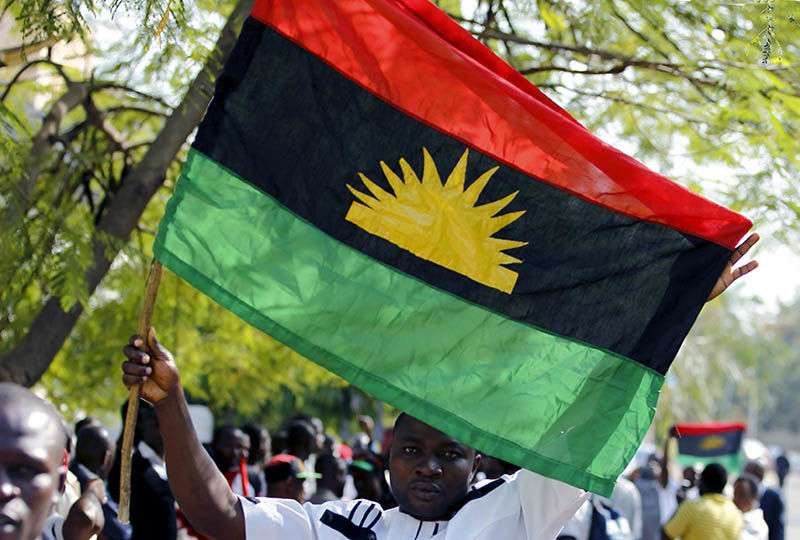
In recent years, there has been an upsurge in campaigns advocating for the recognition and reinstitution of a Biafran State. The demands have come from individuals and groups alike, stirring renewed interest in the Nigeria-Biafra Civil War. Such interest, while unprecedented, should be expected. After all, the conflict was significantly swayed by ethnic bigotry, regional loyalty, greed and abuse of power, and, ultimately, culminated in an estimated two million deaths, most of which were of innocent children, men and women. Representing diverse social and professional backgrounds, these victims have a right to be recognized, mourned and celebrated, even as others must be held responsible for their vicious pre-war, war and post-war crimes.
While I don’t belong to any of the pro-Biafra movements that have emerged in recent times, from ages 6 to 9 I was a Biafran citizen. Meaning, I can hazard a guess as to what the modern pro-Biafran concerns—which remain unresolved and largely unrecognized—might be. These concerns are rooted in historical antecedents steeped in frustration from feeling sidelined and defrauded, and have evolved from protest (a yearning to be heard) to action, both peaceful and confrontational. The cry of today’s pro-Biafra agitators for renewed autonomy is not a declaration of war neither does it necessarily signify enmity between ethnicities, even if elements among the agitators may occasionally display such ideals. It is, also, not predicated on a desire for egotistical disintegration as their detractors would charge, but is a consequence of feeling excluded.
Notwithstanding, current exponents of a revived Biafran nation are championing a cause that, though not always explicitly, digresses from the principles espoused by those who fought for Biafra from 1967 to 1970. Both groups of “Biafranists” may share feelings of betrayal, insecurity, fear and ostracism, but the earlier Biafrans, like the archetypal cornered rat, had been mauled in Western and Northern Nigeria and, arguably, had no option but self-defense when once more confronted by their assailants on their home turf.
Today’s pro-Biafran agitators can claim a series of economic, political and, more recently, military onslaughts on its members, and that, consequentially, they reserve the right to make demands for autonomy. However, these activists must recognize that they exist out of and are perpetuating a Biafra model that departs significantly from the original Biafran ideology. Their overriding clamour for a Biafra comprising only current Igbo States, for instance, excludes the peoples of current Rivers, Bayelsa, Akwa Ibom and Cross Rivers States, who were ‘within scope’ during the ideation of the original Biafran State. Granted, indigenes of these states would likely demonstrate erratic confidence in a renewed Biafran dream, but it remains that recent crusaders for a revived Biafra display a characteristic disregard for non-Igbos, who, incidentally, played fundamental administrative, military and leadership roles in the Biafra of the 1960s.
Such deviation from the original Biafran vision not only raises important questions about the credibility of those that flaunt themselves as noble defenders of the Biafran cause. It also challenges those on both sides of the fence, whose views on the Civil War typically deteriorate to obsessions with ethnic allegiances rather than an objective quest for, and the preservation of, truth. At the heart of this deficiency is tribalism, a key factor in the nurturing of the various socioeconomic, military and personality clashes that eventually culminated in the vicious war.
I experienced this narrow-mindedness first-hand at a recent conference on Biafra where I was scheduled to speak. Not surprisingly, some members of pro-Biafra organizations arrived at the conference with erroneous thoughts on the event’s purpose. They expected the conference to celebrate them, enlarge their recognition and provide a platform for their views to be aired. One of them, whom I believe holds a leadership role of sorts, having seen my name as a participant and speaker, asked one of the organizers why a “Calabar man” was speaking at this conference.
I should point out that the general reference to the indigenes of Akwa Ibom and Cross Rivers as “Calabar people” is derogatory and condescending in its homogenisation of these people, and in the history of its being a way to delineate these people as inferior. When some participants heard of this remark, they immediately pointed out that the gentleman was clearly unaware of the role my father played during the war. And while I appreciate their indignation on my behalf, I believe the more pressing issue was the swift and blatant prejudice meted out by an individual supposedly pushing for the creation of an exemplary, sovereign nation.
I certainly do not want to be a citizen of this man’s “Biafra” and, furthermore, I do not believe that his ignorance, bias and narrow-mindedness are isolated traits. If such a person is in a position of leadership, then, presumably, his followers and fellow leaders share his philosophies. The fact is, regardless of whose ‘son’ or ‘daughter’ participates at such conferences, and despite their racial, ethnic or national backgrounds, they should be welcomed to contribute their thoughts on a vital experience that needs to be analysed extensively to understand its cause and consequences, the lessons to be learned and potential preventative measures against similar tragedies.
The problem with those who view the Biafran experience as an opportunity to reaffirm their ethnic commitments and biases, such as this gentleman, is that they restrict the narrative to their parochial perspectives and, ultimately, ignore or distort salient truths and topics.







Comments
Sign in to comment.