

Our new print issue, Africa’s Hustle Republics, is here! Subscribe for less than ₦1K/$1 a week for full access.
Gender is a complex system that has more to do with society, culture and time periods than it has to do with biology. Read more.
Nov 25, 2020
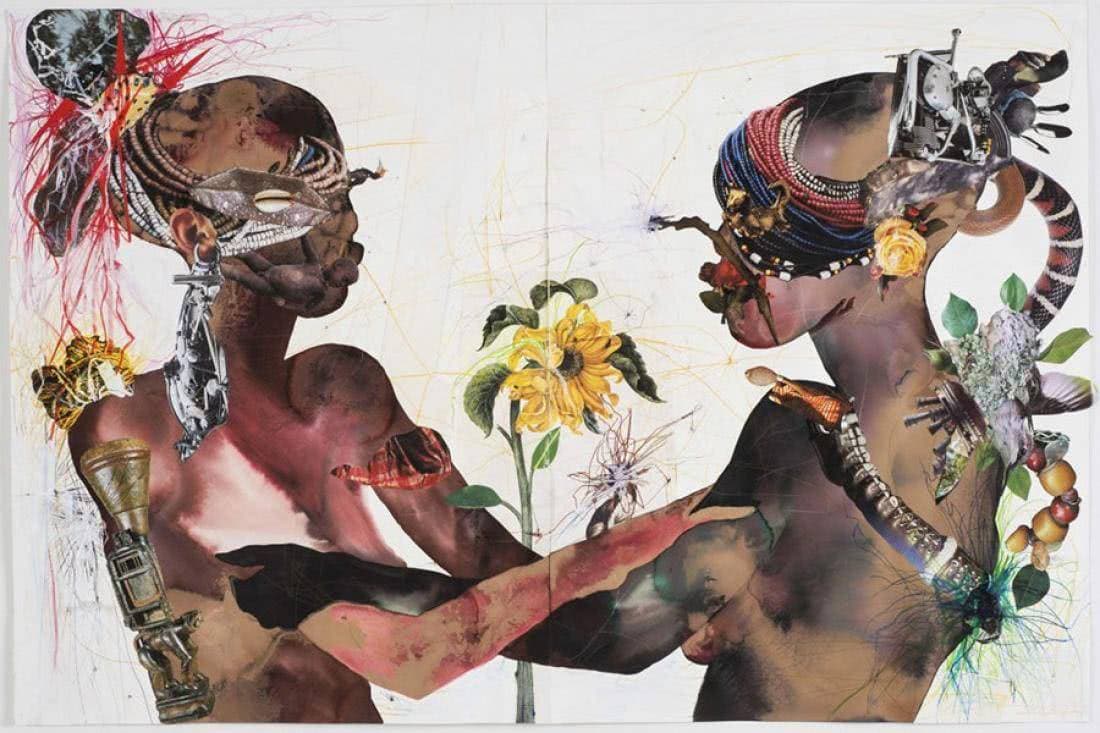
'You are my sunshine,' collage painting on paper. 2015. Wangechi Mutu
october, 2019: Aké Festival, Mike Adenuga Centre, Lagos. There I was sitting in the audience in that elegant air-conditioned hall. The lights were dim. Behind me, the crowd seemed to stretch into infinite darkness. Four people sat on the stage, bright and pretty, with rays of light glistening softly off their skins and clothes. They were talking about gender for a panel titled, ‘The Gender Binary and Everything in Between.’
It was midday. Before the hour was over, I would be out as a non-binary person in this gathering of about a hundred people.
Coming out was not a difficult decision to make. In the months leading up to that moment, I had begun to map an identity outside of the binary—outside of the limitations of man and woman—determined to represent myself more honestly. That was why I had been excited to attend this discussion about gender, thinking that, finally, I was being seen.
But I was disappointed. I admit, too, that I was slightly annoyed. A well-meaning panel, without quite meaning to, had failed to include me.
The aim of the panel was to explore less mainstream gender identities. Two intersex persons, one trans man, and one cis woman who served as moderator sat on the stage to speak on this—quite a diverse group but not one sufficiently inclusive, for it failed to include a non-binary person. Through the entire length of the conversation, the non-binary gender was conspicuously absent, not explored, not cited or even vaguely alluded to. I thought, how can you talk about ‘gender binary and everything in-between’ and not have a non-binary person present in the conversation?
The only explanation I could gather for the blatant omission led me to blame the contraptions of the English language, which fails to adequately capture people like me. English practises a general othering (at best) and erasure (at worst) of the non-binary gender. I knew this, being a student of language, and it occurred to me that perhaps language may have a part to play in this erasure, since it largely determines how we think and talk about gender.
And so, at Aké, when it was time to take questions, I deployed my own language to assert my presence. I, seated in the audience, raised my hand and said, inserting a tiny tinge of hurt into my throat, that I was non-binary.
The Republic is a Nigerian media-tech company dedicated to explaining our time—through deeply reported journalism on power, culture and society.
Focused consumption without interruptions.
Years of reporting at your fingertips.
Long-form journalism that matters.
Create a free account to continue reading this month and access more of our work.
About the Author
is a writer and a student of English at the University of Ibadan, Ibadan. Their writing has appeared online on The Lagos Review and in print in Thursday's Children.


Comments
Sign in to comment.