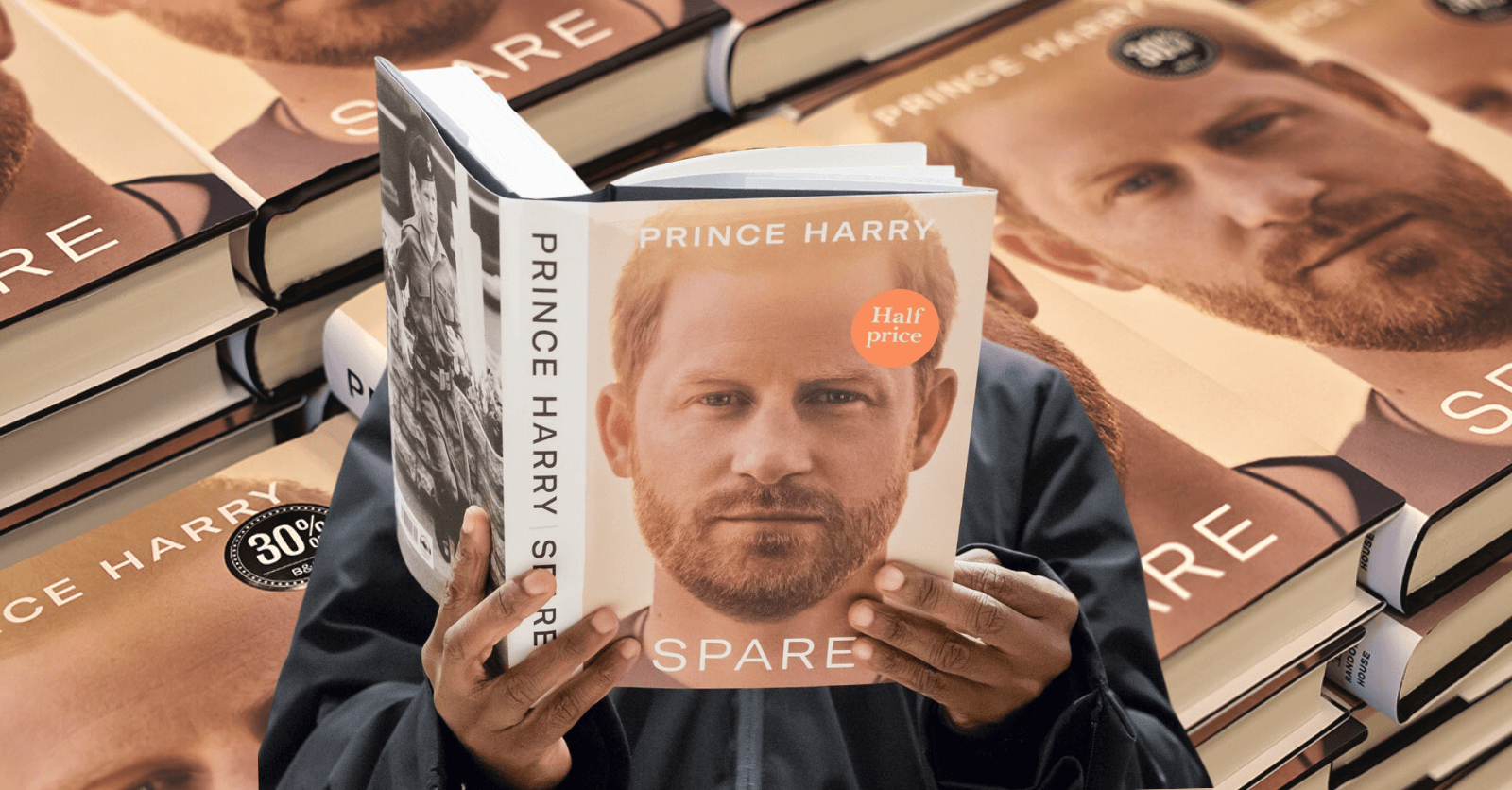
Spare, the new, widely discussed memoir by Prince Harry, Duke of Sussex, is the Prince’s attempt at telling his story in his own words (or more accurately, the words of ghost writer, J. R. Moehringer). Given who Harry is, the commercial success of the memoir was completely inevitable. Revelatory excerpts (quick takeaways) from the book such as Harry’s battles with anxiety and panic attacks, Harry’s body count while serving in Afghanistan and deplorable actions of members of the British royal family have been circulating online for the last few weeks simultaneously giving the book a certain gravitas and the whiff of ‘scandal’. All of the promotion (Harry and his wife, Meghan Markle, Duchess of Sussex released a six-part Netflix documentary before the book’s release) and coverage of the memoir seems to be almost besides the point for what essentially is a memoir about the contours of unresolved grief—how it warps your mind and memories, shapes your past and your future.
The memoir is bookended by the death of Harry’s grandfather, Prince Phillip, Duke of Edinburgh, and the birth of Harry’s second child, Lilibet Mountbatten-Windsor. The memoir follows a tidy path in this way as Harry takes the reader through his somewhat turbulent time at Ludgrove School and Eton College (‘Heaven for brilliant boys’)—furtive weed smoking, post-lights-out violations, academic struggles etc. There’s a horrifying bit meant to highlight Harry’s youthful mischievousness where the reader is regaled with a tale of Harry taunting a disabled matron at Ludgrove—to his gap year at a farm owned by his mother, Princess Diana’s friends in Australia and then Lesotho before his stint at the Royal Military Academy at Sandhurst. The through line in these various points in Harry’s life, and where this book mostly succeeds as an autobiography, is the insidious ways avoiding the grief of his mother, Diana’s death moulded his personhood without really giving him much of a choice.
Harry and by extension his brother, Prince William, are tethered to bureaucracy and responsibility to the monarchy from birth and so they’re forced to endure things children shouldn’t when their parent dies: maintaining a facade of stoicism and politeness while also having to console and mollify a crowd of wailing adults, most of whom had parasocial relationships with their mother. Public stoicism in the throes of difficulty is the ‘ethos’ of the British royal family and it’s a shame how well Harry understands that burden at the tender age of 12. As it turns out the damaging qualities society extols in boys and men are a perfect fit for public royal life.
Also striking is Harry’s determination to position himself as an unreliable narrator: ‘Whatever is the cause, my memory is my memory, it does what it does, gathers and curates as it sees fit…’ His truth—what he remembers and how he remembers it—is his singular focus. The cause of the slippery nature of his childhood memories is beside the point. Harry does not recall details like conversations (unless you count the painfully awkward moment his father breaks the news of his mother’s death to him like he’s a doctor trying to deliver bad news to a patient: ‘They tried, darling boy. I’m afraid she didn’t make it’, very matter-of-factly with measured detachment and little care). Nor does he recall dates of events and suchlike but he never forgets the intricacies of a physical setting—architecture, landscape.
At the point of Diana’s death and years after, Harry believes she isn’t really dead and her ‘death’ is just an elaborate ruse she devised to live an idyllic life in Paris away from the harassment and torment of the British press. It’s easier to feed your delusions than come to terms with the fact someone you love is gone forever. If you don’t have to grieve, you don’t have to feel. ‘My memory had been spotty since Mummy disappeared, by design, and I didn’t want to fix it, because memory equals grief,’ Harry states.
And so, Harry continues to operate on this axis of emotional avoidance by constantly putting himself in physical danger in order to feel something: rugby, drugs, brawls, war. While serving as a Forward Air Controller (FAC) in Afghanistan, Harry pleads with his commanding officer to be moved to the deadlier war zone, Garmsir; while learning to tactically fly helicopters, a no-nonsense flight instructor named Nige says to him, ‘You’re not terribly concerned, if I may say, Lieutenant Wales, with dying.’
Equally frightening is the cavalier manner Harry discloses his body count during his service in Afghanistan, comparing the 25 ‘enemy combatants’ he killed (who apparently may not have been Taliban members but
innocent civilians) to ‘chess pieces removed from the board’; ‘bads’ killed before they could harm ‘goods’, invoking the atrocity of 9/11 as justification for his actions. Murder for the greater good. Harry understands that dehumanizing people he has been trained to see as the enemy is a necessary step in killing them and alleviating any guilt about it. Unfortunately, he also thinks he deserves a cookie for acknowledging the depravity of this cycle of detachment when it comes to taking human lives.







Comments
Sign in to comment.