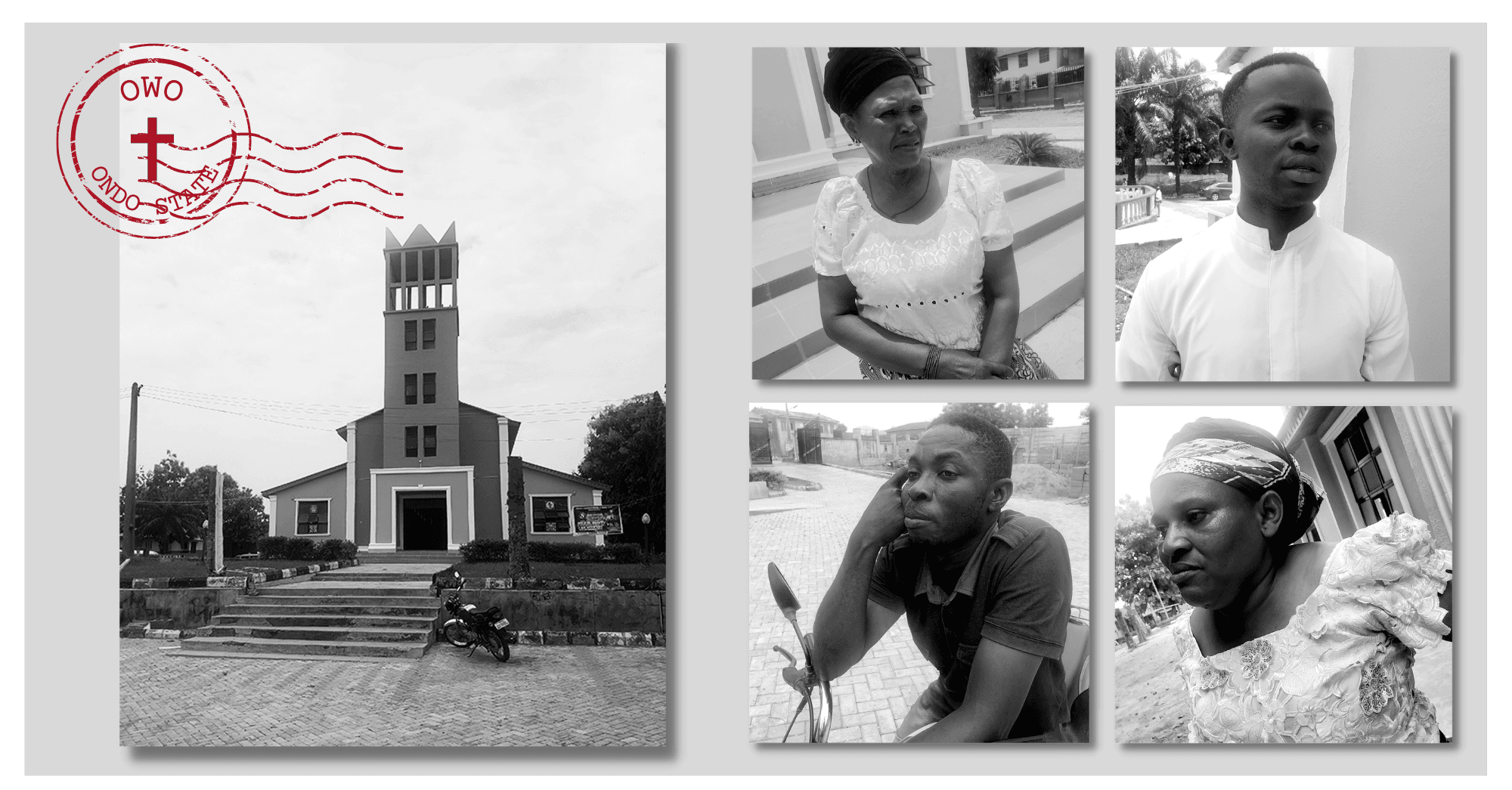
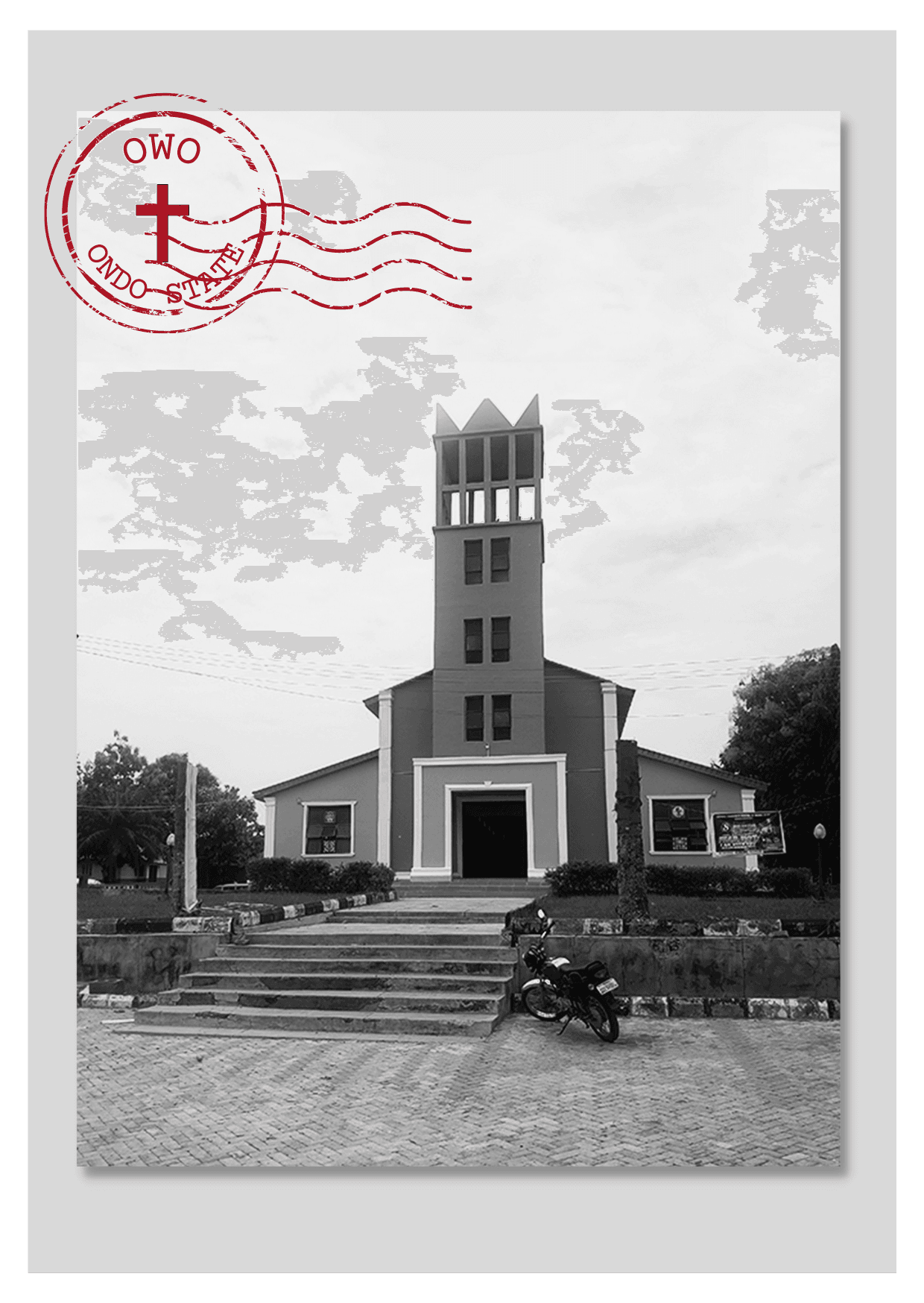
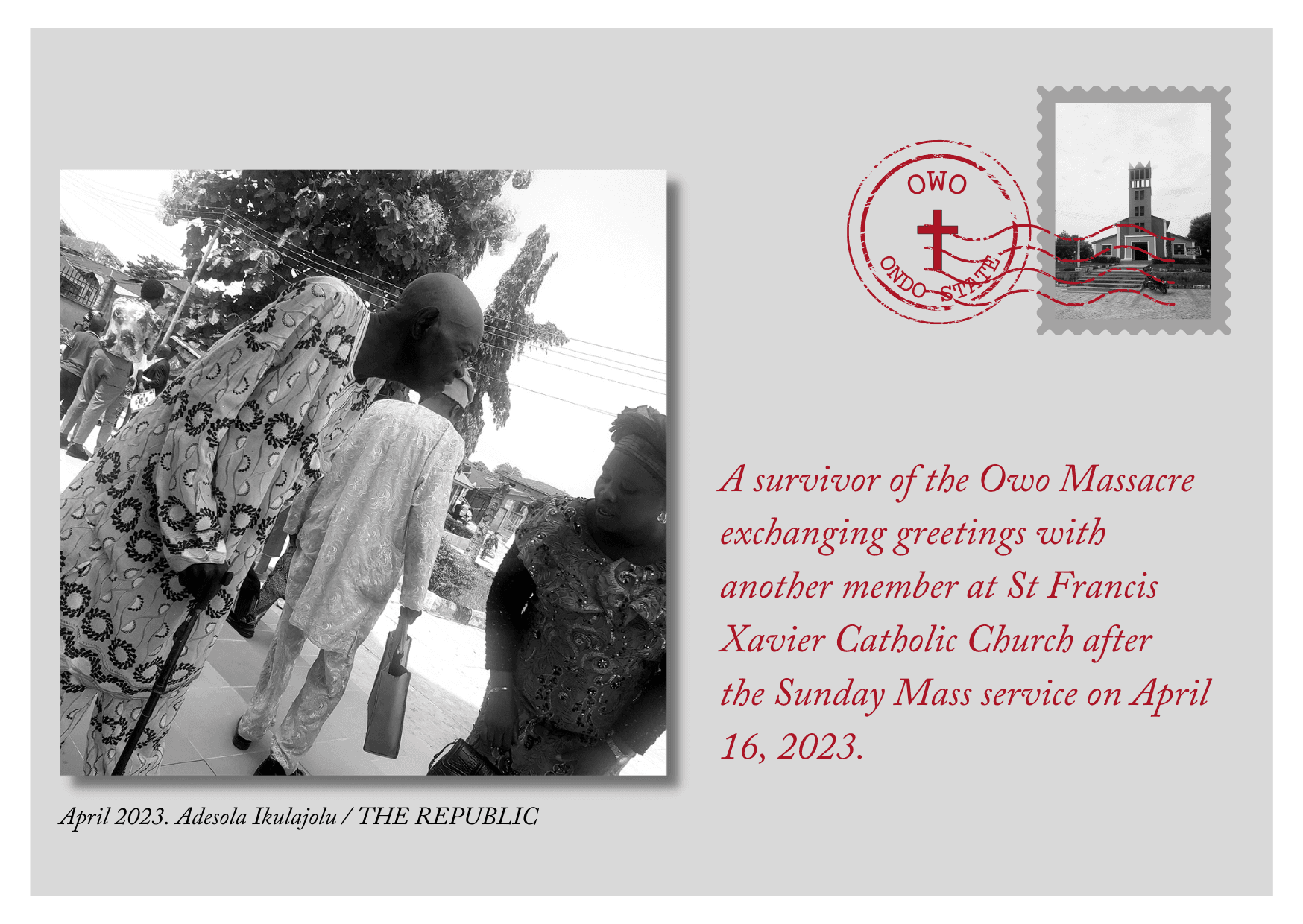
Nearly a year after a shooting took place at St Francis Xavier Catholic Church in Owo, Ondo State, we visited the church, where despite the trauma of surviving a massacre, church members have returned, and service has resumed.
Editor’s note: This essay is available in our print issue, A Nation Divided. Buy the issue here.
‘And God shall wipe away all tears from their eyes; and there shall be no more death, neither sorrow, nor crying, neither shall there be any more pain: for the former things are passed away.’
— Revelation 21:4, King James Bible
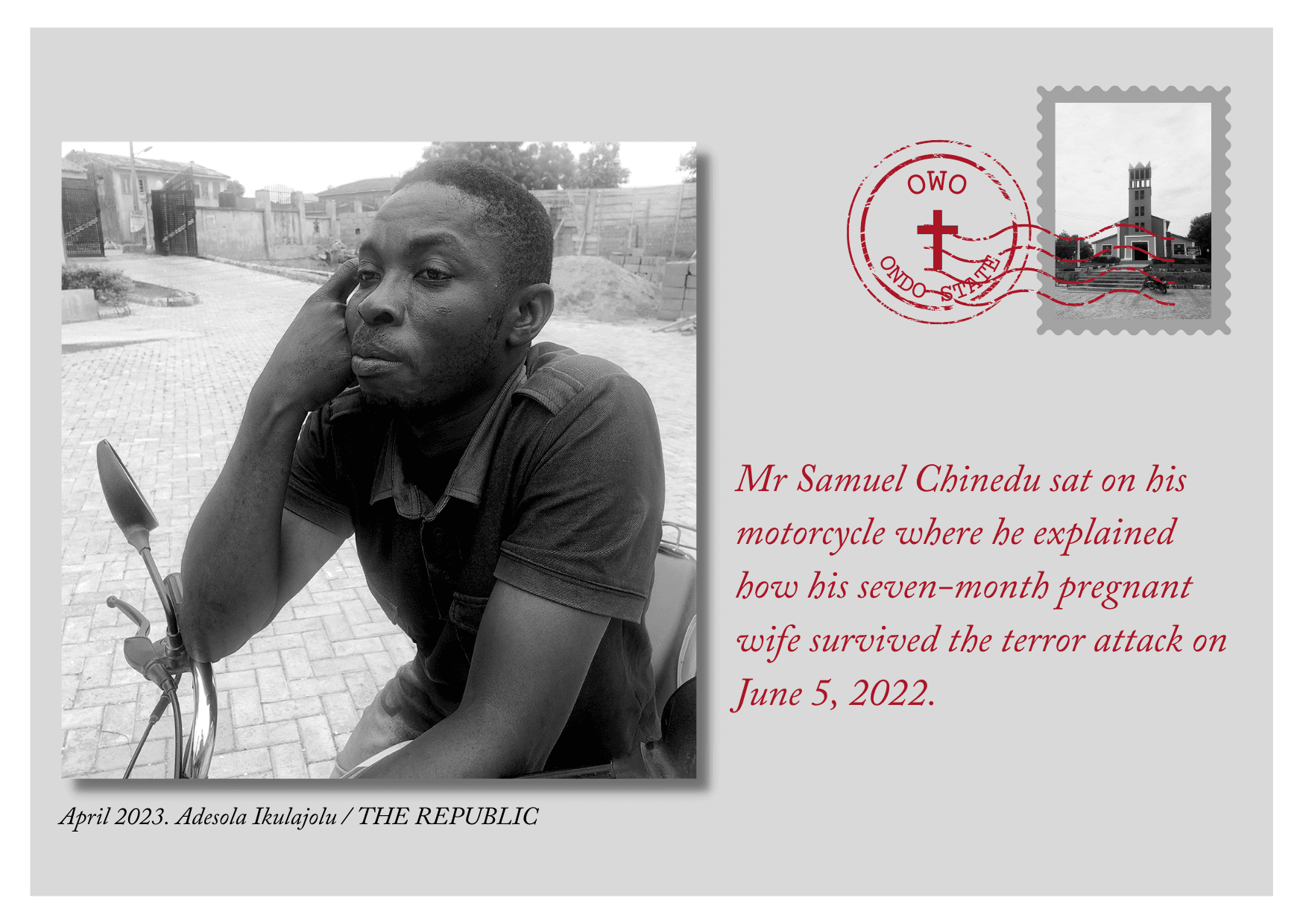
In the early hours of Sunday 05 June 2022, Gladys Chinedu began her church-day routine. She was seven months pregnant, and, despite the usual strains of pregnancy, she carried on preparing for the early morning mass that she regularly attended at St Francis Xavier Catholic Church in Owo. The town was about 48 kilometres away from the Ondo State capital, Akure. At about 8 a.m., Gladys was ready and full of excitement, a feeling she had every time she went to church. Church was her refuge, where she communicated with God quietly, often praying for safe childbirth.
Named after a Spanish missionary, St Francis Xavier Catholic Church is in the heart of Owo. Owo itself is a serene town, known for being home to one of the largest palaces in Africa. The Palace of Owo as it is called has about 100 courtyards for different functions. The town is mostly populated by Yoruba people, and the town’s residents are typically employed in farming and trading.
Gladys and her husband, Samuel Chinedu, arrived at church that morning, joining other worshippers as they exchanged familiar greetings, hugging here and shaking hands there. Beyond being a place of worship, St Francis Xavier Catholic Church was a part of its members’ life stories: it was where many of them had gotten married and/or baptized their children.
As the organist played a slow hymn, Gladys who had planned to sit with her husband decided to join a friend in one of the pews closer to the altar. Sitting away from her husband, Gladys did not know that the day would take a tragic turn.
At about 11:30 a.m., when Pentecost Sunday was coming to an end, unidentified gunmen burst into the church. ‘We thought it was the street guys playing and making sounds outside the church, but when we started hearing the heavy gunshots inside the church, we scattered into different directions,’ Samuel said. The men shot sporadically at worshippers after throwing dynamites that blew up in different directions inside the church. It was a day that perfectly fit the ominous Yoruba saying, ‘ojó burúkúèṣù gbomi mu’, ‘a day so bad, the devil drank water.’
The thought of him leaving his pregnant wife behind stopped Samuel from bolting instinctively in the direction of the door of the church. ‘My mind asked me to run,’ he said, ‘But I didn’t.’ There was pandemonium inside the church spurred by the gunshots; smoke made visibility difficult; and people ran in different directions for safety. ‘When I heard the first gunshot, I was thinking it was child’s play, not until reality came. Then, it was like being in the middle of a war,’ Samuel recalled. He attempted to find his wife through the smoke and noise, but the next dynamite that exploded was so close to him and so loud that he went flat on his chest, before crawling under a pew in fright. On hearing the initial gunshots, Gladys didn’t run; she also just lay down on the floor.
Neither adults nor children were spared in the mass shooting that occurred that day at St Francis Xavier Catholic Church. According to official reports, over 40 worshippers were killed while more than 80 were injured. The carnage lasted about 20 minutes. By the time the last of the masked men walked out of the church, the shooters had left behind bodies punctured with bullets and victims who barely clung to life. Those who managed to survive did not feel any sense of luck or relief. The gory sight of the scene left scars in the minds of the people, tears in their eyes and anger in their hearts.
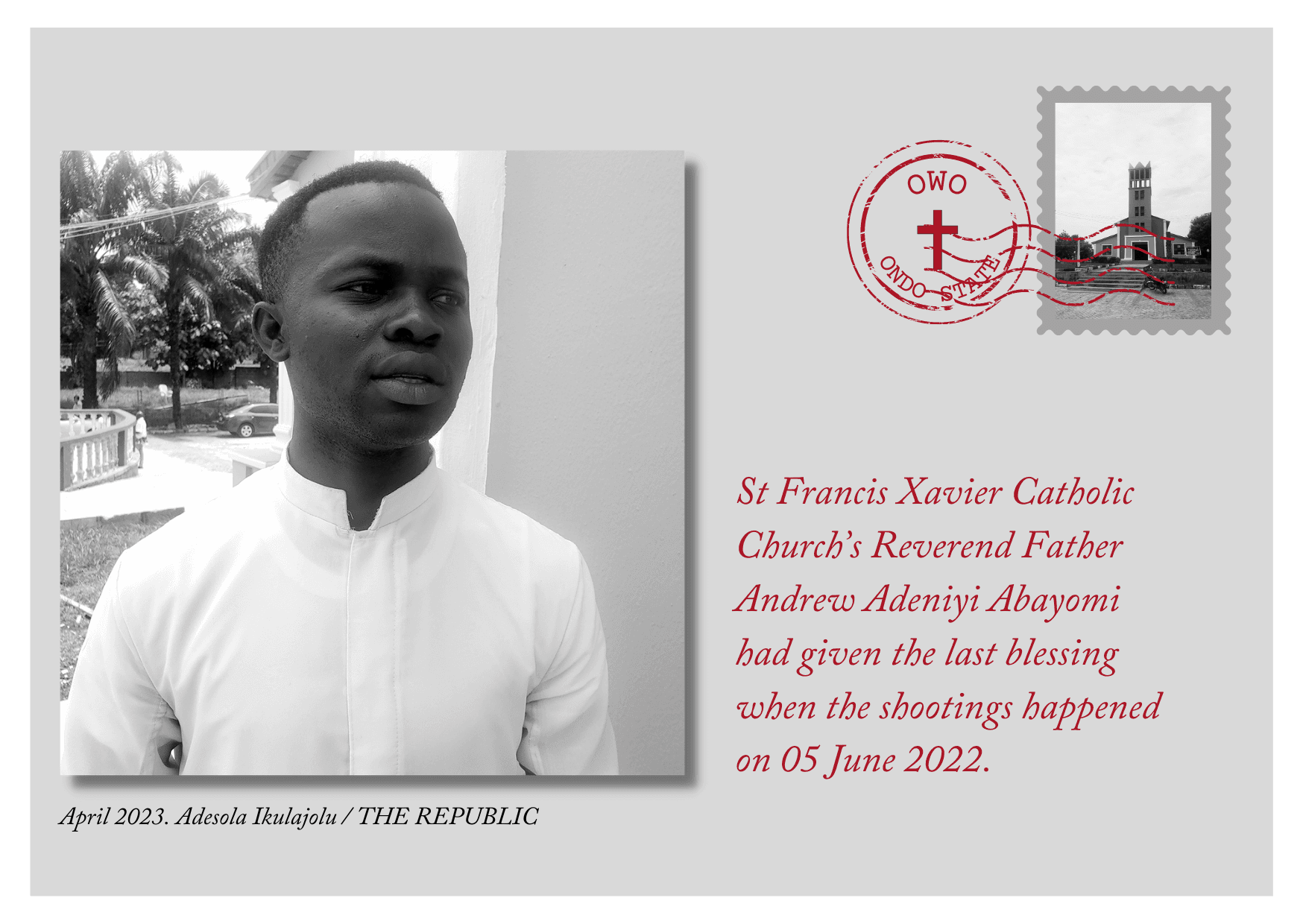
Until the gunshots became heavy, the associate priest of St Francis Xavier Catholic Church, Reverend Father Andrew Adeniyi Abayomi, had no idea why there was so much chaos in the church. ‘I could only see the people,’ he said, ‘I didn’t see the gunmen. It was after hearing the gunshots I realized we were under attack.’
Father Abayomi had given the last blessing on that Sunday when the shootings began. He recalled that he was about to notify the congregation of the closing of the service when he saw members running for safety from the back; a scenario he thought felt like a movie scene at first. ‘Immediately it was happening, I told myself it was not a movie, it was a reality,’ he explained. ‘It was just like the childhood story of what will you do if a lion is chasing you. It felt like I was dreaming, and I told myself you have to wake up and face the reality.’
A statement released by the Defence Headquarters in August 2022 highlighted that the Islamic State West Africa Province (ISWAP) had claimed responsibility for the shooting. Chief of Defence Staff, General Lucky Irabor, also later revealed that four suspects were arrested in connection to the shooting.
Since 2002, Nigeria has been combatting terrorist groups such as Boko Haram and ISWAP. According to the Global Center for the Responsibility to Protect, terrorist groups have killed more than 35,000 people in northern Nigeria since 2009, displacing many more. As of 2020, the Global Terrorism Index ranked Nigeria as the third most insecure country in the world; in 2022, the Global Peace Index ranked Nigeria 143 out of 163 countries and 37 out of 44 sub-Saharan African countries.
‘IT IS AN INCIDENT I DON’T LIKE TO REMEMBER’
On the Sunday of the Owo Massacre, 61-year-old Christianah Oladele, attended the church service with her daughter, Juliet, who was visiting from Lagos. The two were long-time members of the church and were familiar to the congregation, some of whom were their neighbours.
When the attack happened, Christianah froze, too afraid and too frail to run. A bullet pierced her left hand. Juliet also suffered gunshot wounds and both women had to be treated at the Federal Medical Center in Owo.
‘This hand was affected,’ Christianah said, showing me her left hand, which she can no longer lift or use. She told me that a few years before the attack she lost her husband to sickness. ‘But I am still managing it. My daughter who came from Lagos was affected, too. She is back in Lagos with the injury.’
is a freelance investigative journalist telling stories of marginalized communities and underreported issues in Nigeria. His reports have featured in The Nation,Ripples Nigeria,Premium Times, and more.







Comments
Sign in to comment.